
The romantic story that “a good clinical idea and an app” is enough to build a valuable digital health company is wrong. The data show that value flows to products that are clinically validated, operationally embedded, and financially provable—usually in that order.
You are a post‑residency physician or early‑career clinician in the job market, looking at digital tools and medical startups. The noise is extreme. Every deck claims “70% reduction,” “5x ROI,” “AI‑powered.” Most of it collapses on contact with a CFO.
Let’s strip this down to numbers. What actually moves clinical validation and valuation for digital tools today?
1. Where Digital Tools Actually Create Measurable Value
Ignore the buzzwords for a moment. Look at where CFOs and CMOs are actually cutting checks and renewing contracts. The pattern is remarkably consistent.
The money concentrates in four buckets:
- Avoided acute care events (ED visits, admissions, readmissions)
- Clinician productivity (RVUs, panel size, throughput)
- Documented quality gains tied to payment (HEDIS, STAR, MIPS, CJR, etc.)
- Billable services created or up‑coded (RPM/CCM codes, telehealth, e‑consults)
If a digital tool cannot be mapped cleanly to one or more of those, its “valuation” is basically sentiment-driven. You see this clearly in deals where the “clinical win” is soft—e.g., “better engagement,” “patient satisfaction”—with no quantitative link to utilization or revenue.
To ground this, look at typical ROI levers being modeled for hospital and payer buyers:
| Lever Type | Metric Example | Typical Dollar Value Per Event |
|---|---|---|
| Avoided readmissions | 30-day HF readmit | \$10,000–\$20,000 |
| Avoided ED visits | Low-acuity ED diversion | \$400–\$1,200 |
| Extra billable visits | Telehealth or e-visit | \$60–\$150 per encounter |
| RPM/CCM codes | 99453–99458, 99490 | \$40–\$150 per patient/month |
| Clinician time saved | Extra RVUs per month | \$500–\$5,000 per clinician |
The tools that have actual valuation leverage do two things:
- They show statistically credible movement on a metric in that table.
- They convert that movement into dollars using payer‑specific or provider‑specific rates.
So when you evaluate or build a digital tool, treat clinical endpoints and financial endpoints as a single pipeline. If the chain breaks at any link, your valuation premium disappears.
2. What “Clinical Validation” Means Now (Not in 2015)
A decade ago, a pilot with N=50 and a p‑value <0.05 was enough to get conference posters and maybe a Series A. That era is dead. The bar has moved up, and the expectations differ by buyer type.
For a post‑residency clinician stepping into startups or consulting roles, you need to translate your clinical literacy into evidence literacy that investors respect.
2.1 Levels of Evidence Buyers Recognize
Here is how health systems, payers, and sophisticated investors mentally grade digital evidence now:
| Tier | Typical Study Design | Investor/Burden of Proof Impact |
|---|---|---|
| Anecdote / Case series | N<50, uncontrolled | Essentially ignored |
| Pre–post pilot | Single site, no control | “Interesting, not decisive” |
| Controlled cohort | Matched controls, multi-site | Baseline requirement for big buyers |
| Pragmatic RCT | Randomized, real-world practice | Gold standard, drives higher valuation |
| External validation | Independent site / registry data | Significant trust multiplier |
The brutal part: many “RCTs” in digital health are underpowered, with short follow‑up, soft endpoints, and heavy selection bias. Sophisticated payers and hospital analytics teams are not fooled; they look for:
- Event counts, not just percentages (e.g., 30 vs 40 readmissions, not “25% relative reduction”)
- Clear definition of denominators (per enrolled, per eligible, per outreach?)
- Pre‑specified primary outcomes, not data‑mined secondary endpoints
- Intention-to-treat analyses, not “engaged user” cherry‑picking
When a tool claims “50% reduction in readmissions,” the first question I ask is simple: “50% of what, over how many patients, and what was the baseline?” About 80% of the time, the effect disappears once you normalize for baseline risk and regression to the mean.
3. The Data Pipeline from Clinical Effect to Dollars
If you want to connect clinical validation to valuation, you need a clean causal chain. Here is the practical pipeline that matters for digital tools:

| Step | Description |
|---|---|
| Step 1 | Digital Tool Deployed |
| Step 2 | Process Change |
| Step 3 | Intermediate Clinical Metric |
| Step 4 | Hard Clinical Outcome |
| Step 5 | Utilization or Revenue Change |
| Step 6 | ROI and Valuation Uplift |
Most startups stop around C—“we improved adherence,” “we improved screening rates.” That is not enough. The leverage is at D and E.
Example: remote monitoring for heart failure.
- Tool: RPM app + connected scale + nurse dashboard
- Process change: Daily weight check, nurse triage calls for threshold breaches
- Intermediate clinical metric: Earlier detection of fluid overload
- Hard outcome: Fewer HF admissions and readmissions
- Utilization change: 0.4 fewer admissions per patient per year
- Financial: At $12,000 per HF admission avoided and 1,000 patients, that is $4.8M gross savings annually
If your digital tool cannot produce a table somewhat like this, you will struggle to justify non‑trivial enterprise contracts:
| Metric | Value |
|---|---|
| Baseline HF admissions per pt/yr | 0.8 |
| Post‑tool admissions per pt/yr | 0.4 |
| Reduction per pt/yr | 0.4 |
| HF program population | 1,000 patients |
| Admissions avoided per year | 400 |
| Cost per HF admission | \$12,000 |
| Gross annual savings | \$4.8M |
You then subtract program costs (devices, staff, licensing). If your net is still strongly positive with conservative assumptions, you have the beginnings of a valuation‑relevant case.
4. Statistical Rigor: What Actually Gets Scrutinized
Let me be very clear: p‑values and pretty charts are not enough. The data show consistent failure modes in digital health evaluations that instantly reduce credibility.
4.1 Sample Size and Power
Investors and clinical leaders will not always compute power, but they do look for:
- N>500 for common chronic diseases to trust utilization impacts
- N>1,000–5,000 when mortality or hospitalization is the main endpoint
- Multi‑site data to show generalizability across patient mixes
To visualize the problem, think about this distribution: for a small N, your apparent “effect” swings wildly with random noise.
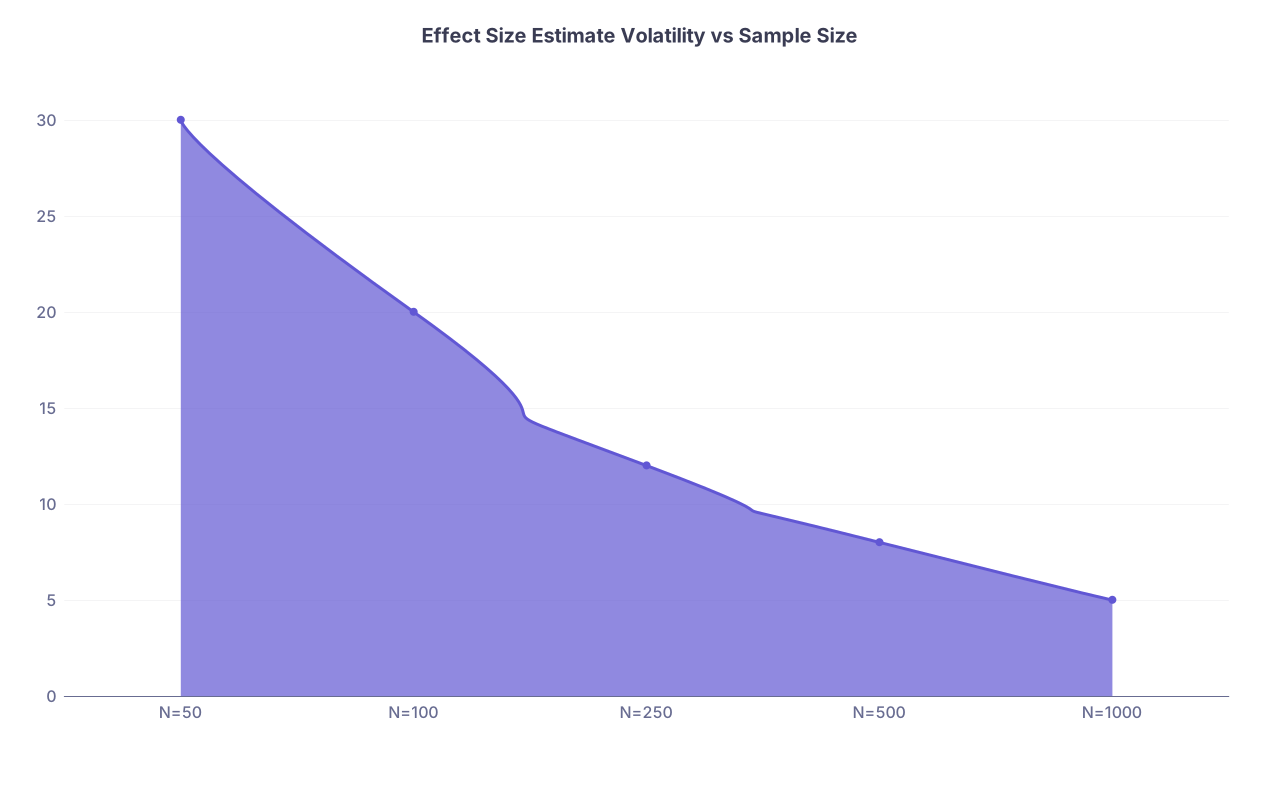
| Category | Value |
|---|---|
| N=50 | 30 |
| N=100 | 20 |
| N=250 | 12 |
| N=500 | 8 |
| N=1000 | 5 |
That “30% reduction” at N=50 often shrinks to 5–10% at scale. You see this every time a flashy pilot gets rolled out across an integrated delivery network.
4.2 Control Groups and Confounding
The data show that uncontrolled pre–post comparisons routinely overestimate effect sizes by 2–3x. Why?
- Natural regression to the mean (high utilizers trend down anyway)
- Concurrent quality initiatives (care management expansion, new pathways)
- Coding changes and documentation improvements
- Benefit design or network changes at the payer level
That is why more sophisticated clients insist on:
- Propensity‑matched control cohorts
- Difference‑in‑differences analyses across intervention vs control sites
- Sensitivity analyses that test robustness to reasonable alternative assumptions
If you are a clinician joining a startup, learn to ask for:
- Baseline trend lines for both groups
- Confounders used in matching (age, comorbidity scores, prior utilization)
- Whether sites self‑selected into early adoption (they usually did)
These issues directly affect valuation. A startup that can show rigor here—especially with independent or payer‑run evaluations—commands higher revenue multiples because their “impact” looks less like marketing and more like a repeatable mechanism.
5. What the Market Pays For: Revenue Multiples and Evidence
Valuation is not magic. For most revenue‑stage digital health companies, investors are effectively asking: “How many dollars of ARR do you have, and how durable and high‑margin are those dollars?”
Evidence directly affects both the level and quality of ARR.
Common bands (these are directional, not gospel):
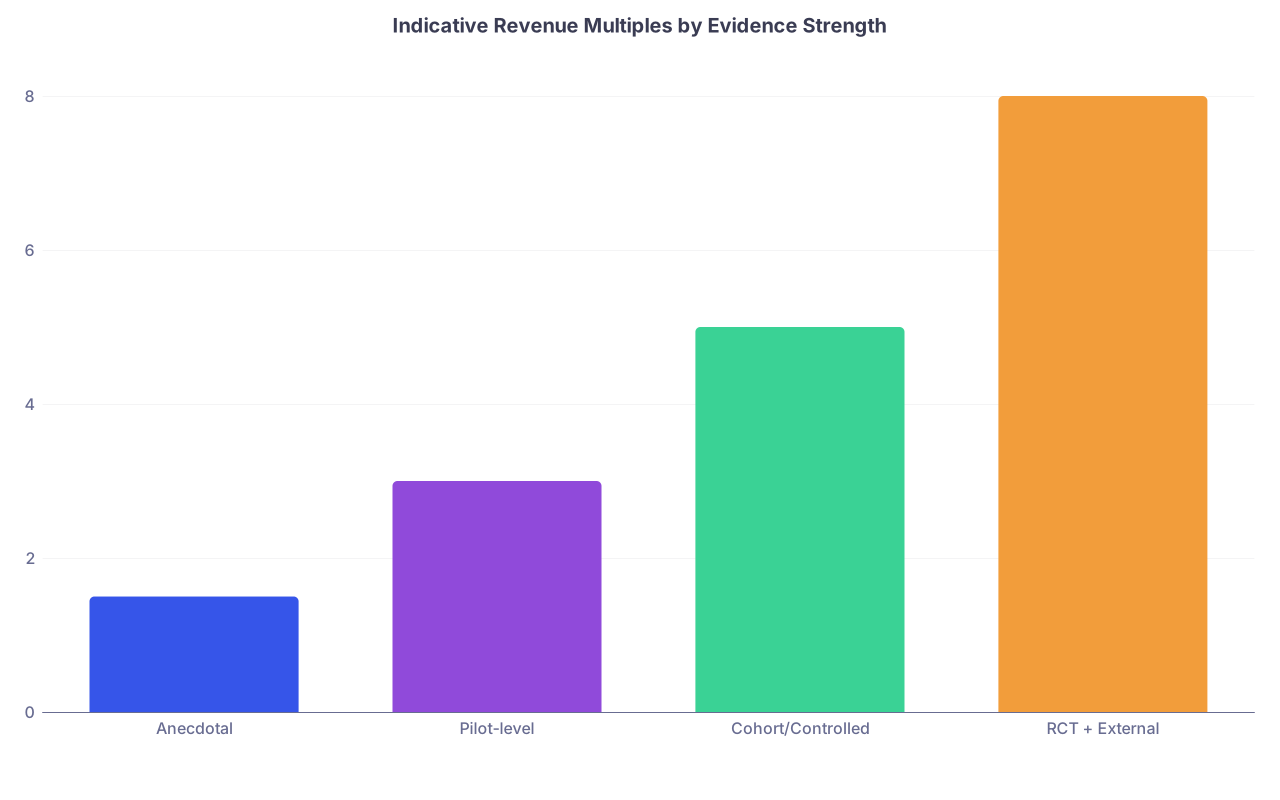
| Category | Value |
|---|---|
| Anecdotal | 1.5 |
| Pilot-level | 3 |
| Cohort/Controlled | 5 |
| RCT + External | 8 |
What I have seen across deals:
Anecdotal / weak evidence
- 1–2x ARR on acquisition, often distressed or acqui‑hire scenarios
- Heavy churn, pilot‑to‑pilot business, uncertain renewals
Pilot‑level evidence with some signals
- 2–4x ARR
- Still testing pricing power, often reliant on a few lighthouse customers
Controlled cohort, multi‑site, with financial modeling
- 4–6x ARR
- Larger contracts, some multi‑year deals, growing NRR (net revenue retention)
RCTs + external validation at scale, integrated into workflows
- 6–9x ARR, sometimes higher in hot categories
- Strong renewal rates, up‑sell potential, defensible differentiation
Investors do not care about “RCT” as a buzzword. They care that evidence quality increases:
- Contract size (more confident ROI → bigger deployments)
- Contract length (multi‑year vs annual)
- Stickiness (embedded in clinician workflows and clinical pathways)
As a post‑residency clinician evaluating a job at a startup, ask directly:
“How many customers have run independent evaluations of your tool, and what did those show?”
If eyes shift to the floor, recalibrate your equity expectations.
6. Categories: Where the Evidence and Money Are Concentrated
Digital tools are not equal. The data show much stronger evidence—and better valuations—in some categories than others.
6.1 Stronger Evidence / Clear Value Translation
These areas tend to have measurable endpoints and strong financial mapping:
- Remote monitoring for well‑defined chronic conditions
- HF, COPD, HTN, diabetes
- Outcomes: admissions, ED visits, HbA1c, BP control, adherence
- AI‑assisted imaging / diagnostics with FDA clearances
- Radiology (e.g., triage algorithms), ophthalmology (diabetic retinopathy), dermatology
- Outcomes: sensitivity/specificity, time to diagnosis, throughput
- Digital therapeutics with RCTs and payer coverage
- Specific behavior health and chronic disease programs
- Outcomes: clinical scales, utilization changes, medication reductions
Strong companies in these spaces almost always hold:
- Published peer‑reviewed trials
- Health economic models (cost‑effectiveness, budget impact analysis)
- Subgroup analyses (high‑risk vs low‑risk, adherence tiers)
6.2 Weaker Evidence / Soft Outcomes
High promise, but often hand‑wavy:
- Generic wellness apps
- Broad “engagement” platforms without clear line to utilization
- General “care coordination” tools without clear accountability for outcomes
- Point solutions that rely purely on patient self‑report without objective endpoints
These tools may still be valuable; they just struggle to convert stories into valuations without hard data. If your career path points toward one of these, you may be the person who has to drag it into the world of quantifiable outcomes.
7. Designing Validation That Actually Convinces a CFO
Most clinical people think in terms of “Is this tool helpful for my patients?” The market thinks in “Is this tool predictably accretive to margin?” Those are related but not the same.
Here is the basic sequence for validation design that actually influences valuation:
Define the primary financial lever.
- Reduced admissions? Increased billable encounters? Quality bonus capture?
Lock a primary clinical proxy that tightly links to that lever.
- For readmissions: 30‑day event rate.
- For quality bonuses: measure(s) used in the program (e.g., HbA1c control <9%).
Choose your unit of analysis before you start.
- Patient‑month, patient‑year, clinician‑month, practice‑year.
Build in a control strategy.
- Matched controls or stepped‑wedge site rollouts for quasi‑experimental designs.
Pre‑register major outcomes where possible.
- This is rare in digital health but it signals seriousness.
Collect cost data alongside outcomes.
- Program operating costs, incremental staffing, hardware, integration fees.
Then you present results the way a CFO actually reads:
| Metric | Control | Intervention | Difference |
|---|---|---|---|
| Patients (12-month period) | 1,500 | 1,600 | — |
| Admissions per 100 patients per year | 30 | 22 | -8 |
| Admissions avoided (absolute) | — | — | 128 |
| Cost per admission | — | — | \$10,000 |
| Gross savings | — | — | \$1.28M |
| Program cost (annual all-in) | — | — | \$400,000 |
| Net savings | — | — | \$880,000 |
| ROI (net / program cost) | — | — | 2.2x |
The language changes from “patients love it” to “we produced a 2.2x ROI with conservative base rates.” That is what moves valuations.
8. Your Role as a Post‑Residency Clinician in This Space
You are not just another “clinical advisor” to sprinkle MD credibility on a pitch deck. If you want leverage—equity, leadership roles, strategic influence—you must become the person who sits at the intersection of:
- Clinical realism
- Data rigor
- Economic framing
Concretely, here is where clinicians add disproportionate value to digital validation:
- Defining inclusion/exclusion criteria that mirror real practice
- Catching nonsense composite endpoints that look good statistically but mean nothing clinically
- Flagging operational friction that will kill adoption (extra clicks, duplicated work)
- Ensuring outcome definitions align with guidelines, not marketing needs
And bluntly: the people who can say “This 40% reduction is fake; here is why” or “We can actually push this from an N=300 pilot to an N=5,000 multi‑site design” are the ones investors invite to the table early.
To visualize the crossover skills:

If you are post‑residency and sick of RVUs, this intersection is where a lot of interesting careers are being built.
9. Common Data Traps That Destroy Credibility (and Valuation)
I have seen otherwise promising tools lose millions in potential value over basic statistical sins. Learn to spot and avoid these:
Engagement‑only analyses
- Reporting outcomes only for “highly engaged users.”
- Reality: low‑engagement patients often drive the majority of utilization and cost.
Short follow‑up periods
- Claiming big reductions over 30–90 days in chronic conditions.
- Many effects decay; health systems want 12–24 month data.
Ignoring site‑level variation
- Averaging results across wildly different sites.
- Smart buyers ask: “What does the worst quartile site look like?”
Mixing intention-to-treat with per‑protocol without clarity
- Elevates effect size; investors will discount it when they realize.
Overstating AI contribution
- Tools that are 90% workflow change and 10% model, but marketed as “AI‑driven.”
- The more your value is tied to generalized change management, the less defensible the valuation multiple.
Every one of these issues, once uncovered, leads to either a lower price, a delayed round, or a smaller deployment.
10. What the Numbers Show, Condensed
Strip away the hype and the data are blunt:
- Digital tools with strong, independently validated clinical impact tied directly to utilization or revenue command materially higher revenue multiples and more durable contracts.
- Evidence quality—sample size, control strategy, and financial translation—has become the single biggest differentiator between “interesting pilot vendor” and “platform company” in investor minds.
- Clinicians who can move beyond anecdotes to design, interpret, and defend real‑world impact data sit at a leverage point in the post‑residency job market that most of their peers never touch.
If you remember nothing else: build or join products where you can point to a real number on a real P&L and say, with a straight face, “Our tool moved that.” Everything else in digital health valuation is noise.