
Most physicians over-save before starting a company and still feel underprepared. The number isn’t the problem—the clarity is.
You’re not really asking, “How much money do I need?”
You’re asking, “Can I afford to walk away from a stable attending paycheck and not wreck my life if this startup fails?”
Let’s answer that directly.
The Short Answer: Your “Quit Number” in One Line
Here’s the simple rule I use with post‑residency physicians thinking of going all‑in on a startup:
Savings target = 12–18 months of lean, realistic living expenses + 6 months of true emergency buffer + 6–12 months of runway to get back into paid clinical work.
For most new attendings in the US, that usually shakes out to something like:
Bare minimum to even consider it:
$60k–$90k savings (single, low fixed costs, no kids, willing to be very lean)More comfortable range (what I actually recommend):
$120k–$250k savings (depends on family, location, loans, and how fast you can go back to clinical)If you’ve got dependents / big mortgage / private school / high COL city:
Often closer to $200k–$400k is realistic if you’re going to fully stop clinical work.
If those numbers make you panic, don’t bail yet. Let’s break down how to actually calculate your number instead of blindly copying someone else’s.
Step 1: Get Brutally Honest About Your Real Monthly Burn
Don’t start with “how much do I make as an attending?” Start with:
“What’s the minimum livable lifestyle I’m actually willing to tolerate for 18–24 months?”
You need three numbers:
Non‑negotiable fixed costs (monthly):
- Rent/mortgage
- Minimum student loan payments (or IDR/PAYE/RePAYE amounts)
- Insurance: health, disability, basic life, malpractice if needed
- Utilities, phone, internet
- Basic car payment/transportation
- Child support / alimony if applicable
Realistic variable costs (monthly): not fantasy numbers
- Groceries
- Gas/transport
- Childcare / aftercare
- Essential medical expenses
- Modest eating out / social (yes, you’ll still do this, don’t pretend you won’t)
- Basic clothing / household stuff
Startup‑related personal costs (monthly):
- Coworking or small office (if needed)
- Extra software subscriptions you personally pay
- Travel to conferences/investor meetings you can’t push on the company yet
Add those up. That’s your true monthly burn as a founder.
Most physician‑founders I talk to land somewhere between $4k–$12k/month depending on family, city, and ego.
Now multiply:
- Lean full‑time startup plan: 12–18 months of burn
- More conservative: 18–24 months
If your lean burn is $7k/month and you want 18 months:
$7k × 18 = $126k
This is your personal runway number. Not for the company. For you.
Step 2: Add a Real Emergency Buffer (Not “Startup Expenses”)
Next layer: what if things go sideways? Not the startup. Your life.
You want 6 months of essential expenses as a separate emergency buffer.
Key point:
This is not for “oh we need another dev” or “conference in Vegas” or “we’re a bit behind on product.”
This is for job loss, health crisis, family emergency, divorce-level chaos.
Use just your absolute minimum survival expenses (no travel, no nice‑to‑haves). For many physicians, that’s maybe 60–70% of your lean monthly burn.
If your lean burn was $7k/month, bare‑bones survival might be $4.5k–$5k.
Call it $5k × 6 = $30k emergency buffer.
Now you’re at:
- Personal runway: $126k
- Emergency buffer: $30k
- Total so far: $156k
That’s starting to look like a real “I can do this and not implode my life” number.
Step 3: Account for Your Re‑Entry Time to Clinical Work
Here’s what many founders totally ignore:
If your startup fails or you decide to quit, you won’t be drawing an attending paycheck a week later.
You need recovery runway:
Money to live on while you ramp clinical work back up.
For most post‑residency physicians:
- If you keep your license active and maintain some recent clinical work (moonlighting, PRN, 0.2–0.3 FTE), you can usually ramp back up in 3–6 months.
- If you go totally cold (no clinical for 1–2 years), some hospital systems will pause. It may take 6–12+ months to land the job you actually want.
Plan for at least 3–6 months of your lean burn as “re‑entry runway.”
Using our $7k/month example: $7k × 6 = $42k
Add that:
- $126k personal runway
- $30k emergency buffer
- $42k re‑entry runway
- Total target: $198k
That’s a solid, rational number for a single or partnered physician with moderate expenses going all‑in.
Step 4: Adjust for Your Reality – Loans, Kids, and Geography
Now we fine‑tune. A few big levers move this number up or down.
Student Loans
You’re post‑residency. Loans didn’t vanish.
Most common patterns I see:
Going for PSLF/IDR:
Your payment is income‑linked. If your startup income is low, your payment may actually drop. That helps your runway.Aggressive payoff plan:
If you were throwing $4k–$6k/month at loans, you probably can’t do that while founding.
Switch to a lower voluntary payment temporarily, or refinance with flexibility.
If your required minimum payments are already reasonably low (IDR/PSLF), you don’t need a huge extra cushion beyond your monthly burn estimate.
Family and Kids
If you’ve got dependents, you can’t hand‑wave this. The key costs that blow up:
- Childcare / nanny / aftercare
- Health insurance for the family
- School tuition if private
- Non‑negotiable activities (therapies, special needs, etc.)
These aren’t “oh I’ll just cut back on eating out” items. Don’t be cute here.
I’ve seen plenty of physician founders with 2–3 kids in big cities that realistically need $12k–$18k/month even after cutting fluff. That pushes their 18‑month runway north of $250k quickly.
Geography
San Francisco, NYC, Boston, LA = you need more.
If your rent alone is $4k–$6k/month, you either:
- Need a bigger savings target, or
- Need to consider relocating or radically downsizing if you’re serious about going all‑in.
Step 5: Separate Your Savings From Company Runway
Crucial distinction: your personal runway is not your company’s seed round.
Do not do this:
- Dump your entire $200k savings into the startup, go zero clinical, and then hope fundraising works.
Better pattern I recommend:
- Decide your personal runway number (say $180k).
- Cap how much of that you’re actually willing to invest in the company early (for example, $25k–$50k).
- Treat that like any external pre‑seed: documented, tracked, and ideally matched by non‑you capital at some point.
Your company’s financial needs are a different question (dev, regulatory, R&D, pilots, legal). If you’re in medtech, device, or regulated digital health, you’ll often need outside money anyway.
Your personal capital is there to buy time so you can build enough of the business to:
- Prove traction
- Raise external funds
- Or reach some revenue to support at least a modest founder salary
Step 6: Decide How “All‑In” You Actually Need to Be
Everyone says “all‑in,” but there are levels.
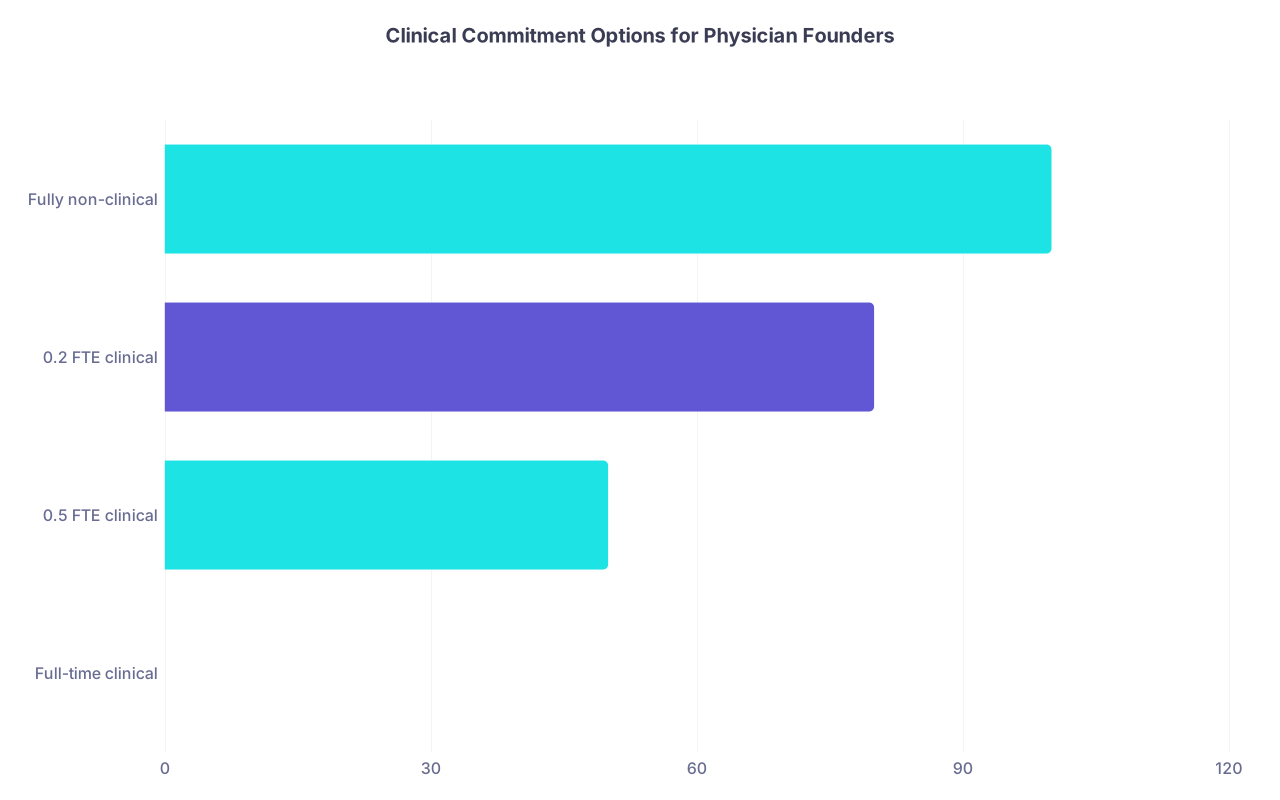
| Category | Value |
|---|---|
| Full-time clinical | 0 |
| 0.5 FTE clinical | 50 |
| 0.2 FTE clinical | 80 |
| Fully non-clinical | 100 |
Here’s the trade‑off:
Full‑time clinical:
Startup is a nights/weekends hobby. You’re not really building a scalable company. Fine for a side hustle; not fine for a real startup.0.5 FTE clinical:
Nice balance. You still have meaningful income, maintain clinical credibility, and protect downside. Growth will be slower, but you may not need 18–24 months of cash.0.2–0.3 FTE clinical:
This is the sweet spot I see for many serious physician founders.
You still bring in some cash, stay current, and keep your hire‑ability high. But you get 3–4 days/week mentally available for the startup.Fully non‑clinical:
Maximum focus, maximum risk. You absolutely need that 18–24 months of well‑planned runway.
Your savings target will drop dramatically if you keep even 0.2 FTE clinical income. Run the math:
Say your lean burn is $8k/month. If 0.2 FTE brings in $5k/month post‑tax, now your net burn is $3k/month.
For 18 months: $3k × 18 = $54k, plus emergency + re‑entry.
You might be in business with $100k–$130k, not $200k+.
Step 7: Use a Hard Stop Rule So You Don’t Drift
One thing no one tells you: founders destroy more wealth by staying in a dead startup too long than by starting too early.
Before you quit your job, write down:
Your red lines:
- Date by which you must be drawing at least $X/month from startup or consulting
- Minimum bank balance below which you will start scaling up clinical shifts
- Maximum amount you’re willing to personally invest in the company
Your checkpoint dates:
At 6, 12, 18 months—what milestones should you see? Revenue? Users? Pilots? Term sheet?
Then tell someone else—spouse, mentor, cofounder—so it’s not just in your head.
Example Scenarios: What the Numbers Actually Look Like
Let’s run a couple of realistic quick scenarios.
| Scenario | Monthly Burn | Runway Months | Total Target |
|---|---|---|---|
| Single, low cost city, 0.2 FTE clinical | $5k | 18 | ~$100k |
| Married with 2 kids, moderate COL, no clinical | $11k | 18 | ~$250k |
| High COL city, 1 child, 0.3 FTE clinical | $8k (net) | 18 | ~$150k |
These are not universal. They’re starting points.
How This Changes for Different Types of Medical Startups
Not all “medical startups” behave the same.

| Step | Description |
|---|---|
| Step 1 | Idea Stage |
| Step 2 | Digital Health SaaS |
| Step 3 | Clinical Services Model |
| Step 4 | Medical Device |
| Step 5 | Biotech |
| Step 6 | Lower capital need |
| Step 7 | Moderate capital need |
| Step 8 | High capital need |
| Step 9 | Very high capital need |
| Step 10 | Type |
Very roughly:
Digital health SaaS / B2B tool for clinics:
Often can soft‑launch while working 0.5 FTE. Can validate quickly and cheaply. Personal runway matters more than giant seed round at first.Clinical services startup (virtual clinic, niche telemed, staffing model):
Regulatory, malpractice, operations heavy. You can often revenue‑generate faster, but you’ll also need more ops support earlier. Staying 0.2–0.3 FTE clinical is usually fine.Medical device / diagnostics / biotech:
This is a different animal. You’ll need serious external capital. Your personal savings is about life support, not company funding. Here I’m more insistent on the 18–24 month personal runway plus early fundraising.
FAQ: Physician Founders & Savings Before Going All‑In
1. I have only $80k saved but a high‑paying attending job. Is that enough to jump?
Maybe—but only if you design it right.
$80k can be enough if:
- You keep 0.2–0.3 FTE clinical
- You cut your lifestyle down to a sane level
- You view the first 12 months as “validation phase,” not “I must replace my attending income”
If you want to go fully non‑clinical in a big city with $80k? No. That’s reckless.
2. Should I pay off my student loans aggressively before I start a company?
Not usually.
Once you’re post‑residency, your biggest asset is optionality, not being debt‑free on paper. I’d rather see you:
- Move to a manageable, flexible payment structure (IDR, refinance with no pre‑pay penalties)
- Keep a larger cash buffer
- Buy yourself time to build something meaningful
Slamming $150k into extra principal before founding just kills your runway.
3. How much of my personal savings should I invest directly into the startup?
Cap it. Hard.
A common pattern that works:
- No more than 10–25% of your total net worth (including retirement) into the startup directly
- From your liquid cash savings, think in the $25k–$75k range for early MVP, legal, and initial ops
- Treat every dollar you put in as if you’ll never see it again
If you’re talking about putting your entire $200k nest egg into the company, stop. That’s gambler energy, not founder discipline.
4. What about my spouse/partner—how does their income change the math?
If your partner has stable income that covers a big chunk of the fixed costs, your required savings can drop significantly. But don’t get lazy because “they’ve got it.” You still want:
- At least 9–12 months of joint lean expenses in cash or very liquid investments
- Clarity on what happens if they lose their job or step back for any reason
And for the love of all things sane, have an explicit conversation about risk tolerance and timeline before you quit.
5. Do I really need 18–24 months? Can’t I just grind and make it faster?
Some do. Most don’t.
Medical startups move slower than generic SaaS. You’ve got:
- Regulatory delays
- Long sales cycles with health systems
- Credentialing and contracting issues
- Pilot programs that take 6–12 months to mean anything
If you only have 6–9 months of runway, you’ll panic‑optimize for short‑term revenue instead of building something defensible. That’s how you end up with a random locums agency with a website, not a real startup.
6. Should I keep moonlighting once I go “all‑in”?
Usually yes, at least at the start. A few reasons:
- It keeps your clinical skills and CV fresh
- It gives you psychological cushion so every startup decision isn’t life‑or‑death
- It extends your runway dramatically
The trap: if moonlighting creeps back up to 0.5–0.8 FTE because “the money is nice,” you’re not actually all‑in on your company. Set a hard cap (e.g., 2–4 shifts/month) and stick to it.
7. What’s the one financial move I should make before I quit my attending job?
Lock in your downside.
That means:
- Get individual own‑occupation disability insurance in place
- Make sure your medical license, DEA, and board certs will stay active
- Get your malpractice trailing coverage or future plan clear if needed
- Build your emergency + re‑entry buffer before you walk away
Once your downside is protected, the specific savings number stops feeling mystical and becomes just math.
Key takeaways:
- Stop chasing a magical savings number—calculate your actual 18–24 month burn, then add emergency + re‑entry buffers.
- Use part‑time clinical work as a lever: even 0.2 FTE can cut your needed savings by six figures.
- Cap how much of your net worth you pour into the company, and set hard stop rules so you don’t drift into financial ruin “for just one more quarter.”