
The wrong business model will kill a good medical startup faster than a bad logo, a mediocre deck, or a slow developer.
You’re not asking “B2B vs B2C vs B2B2C.” You’re really asking: Who pays me, who uses me, and who can block me? Get those three wrong and it does not matter how clinically brilliant your idea is.
Let’s walk through this like a physician, not like a generic tech blogger.
Step 1: Understand What B2B, B2C, and B2B2C Actually Mean in Healthcare
Forget the generic business-school definitions. In healthcare, each model comes with specific gatekeepers, regulatory landmines, and sales realities.
Here’s how it really breaks down:
B2B (Business to Business)
You sell to organizations: hospitals, health systems, payers, employers, digital health companies, pharma, device companies.
Users might be clinicians, nurses, care coordinators, HR teams. But the customer is a budget holder with a cost center.B2C (Business to Consumer / Patient)
You sell directly to patients or sometimes directly to clinicians as individuals.
Think: subscription apps, direct-pay telehealth, training tools for physicians, performance coaching, patient-facing tools that people actually swipe a card for.B2B2C (Business to Business to Consumer)
You sell to an organization, which then distributes your solution to patients (or clinicians).
Common: insurer pays, employer pays, or health system “white labels” and deploys to their population. The org is your buyer; the patient is your end user.
To make it concrete:
| Model | Typical Customer | Example Concept |
|---|---|---|
| B2B | Health system | AI sepsis early warning in EHR |
| B2C | Patient | Migraine self-management app (DTC) |
| B2B2C | Employer or payer | Weight loss program for covered members |
| B2C | Individual clinicians | Board review question bank |
If you remember only one thing:
B2B = long sales, big contracts. B2C = fast feedback, brutal churn. B2B2C = political, but scalable if you get in.
Step 2: Start With Your “Unit of Value,” Not Your Technology
You probably started from a clinical problem: prior auth chaos, readmissions, burnout, inefficient clinic workflows, chronic disease mismanagement.
Good. Now ask three questions:
Who gets the financial benefit first if this works?
- Hospital margin?
- Payer medical loss ratio?
- Employer productivity?
- Patient out-of-pocket savings or improved quality of life?
- Physician revenue / fewer no-shows / more RVUs?
Who feels the pain the most, on a daily basis?
- Frontline clinicians?
- Patients?
- Operations / admin?
- CFO / payer medical director?
Who can pay realistically, given how healthcare money flows?
- Patients rarely pay $200/month consistently.
- Hospitals can pay 6–7 figures… after 9–18 months of committee hell.
- Employers and payers will pay if you show clear, believable ROI on claims and absenteeism.
Once you answer those, the business model often picks itself.
Step 3: Pros and Cons of Each Model for Physician Founders
B2B: Selling to Health Systems, Payers, Employers, and Industry
B2B is where the big checks live. But you’ll earn every dollar.
Best when:
- You’re solving a problem tied tightly to cost, compliance, throughput, or risk.
- Value shows up in metrics CFOs care about: LOS, readmissions, ED revisits, denials, staffing ratios, risk score accuracy, STAR/HEDIS, etc.
- The workflow is inherently institutional (in the EHR, in the revenue cycle, in pop health dashboards).
What you’re actually signing up for:
- 6–18 month sales cycles (no, that is not an exaggeration).
- Legal, InfoSec, compliance, and “we need another committee review.”
- Pilots that start small and “might” scale if you survive the politics.
Why it’s attractive:
- Large contract sizes (5–7 figures/year per customer).
- High switching costs once embedded (integrations, training).
- Clear enterprise value story – investors like that.
Why it burns founders out:
- You spend more time in procurement calls than talking to patients.
- Your product roadmap gets yanked around by your biggest client’s whims.
- Progress looks like “90 days to get a security review scheduled.”
Common B2B physician startup fits:
- Clinical decision support inside Epic/Cerner.
- Workforce optimization tools for nurse staffing.
- Care management platforms for value-based care groups.
- Risk adjustment and coding optimization for payers.
B2C: Selling Directly to Patients or Individual Clinicians
B2C looks sexy on Twitter. “We’ll just get 100,000 users paying $10/month.” Sure.
Best when:
- Your product solves a problem patients feel every day: pain, anxiety, fertility, weight, sleep, appearance.
- The benefit is obvious without a CPT code or prior auth.
- You can explain the value in one sentence to a non-medical friend.
Two very different B2C segments:
Patient DTC
- Weight loss, mental health, fertility, chronic pain, dermatology.
- Often cash-pay / subscription.
- Needs marketing, brand, and relentless user experience optimization.
Clinician DTC
- Board prep, CME, note templates, billing tools, AI scribes for individuals.
- These users can expense or write off the cost.
- Word-of-mouth and reputation matter more than TikTok campaigns.
Why B2C is tempting:
- Fast feedback: you can ship, test, iterate weekly.
- No procurement committee.
- Global reach from day one.
Why B2C in healthcare is brutal:
- Acquisition costs (Facebook/Google ads) can kill your margins.
- Patients churn once symptoms improve or life gets busy.
- Regulatory risk if you drift into “practicing medicine” without proper structure.
- For patient DTC, trust is hard to build and easy to lose.
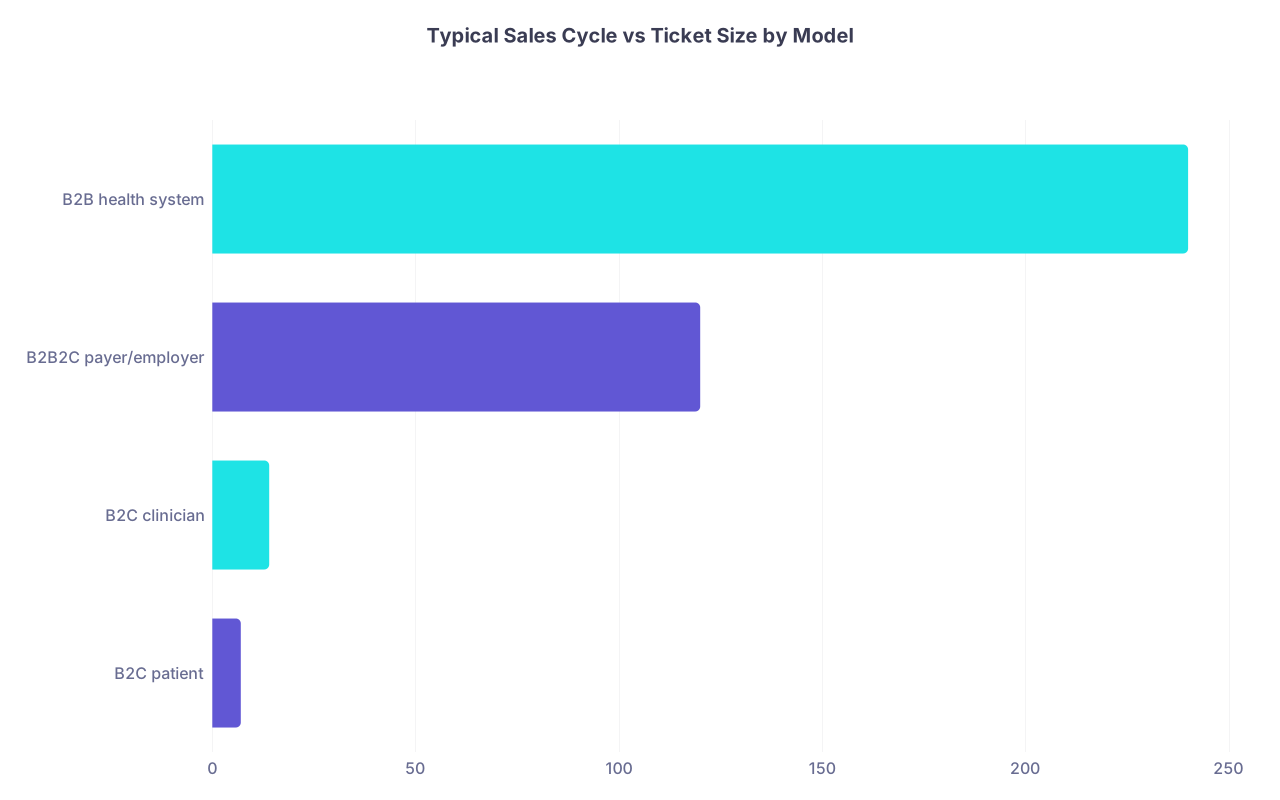
| Category | Value |
|---|---|
| B2C patient | 7 |
| B2C clinician | 14 |
| B2B2C payer/employer | 120 |
| B2B health system | 240 |
(Think of those numbers as rough days to first deal: B2C days vs B2B months.)
B2B2C: The “We Sell to Payers/Employers, They Give It to Patients” Model
This is the darling of many digital health plays because it promises scale: get one contract, reach 50,000 covered lives.
Best when:
- Your solution changes patient behavior over time: diabetes, hypertension, obesity, MSK, mental health.
- You can prove ROI with claims and utilization data.
- Employers or payers see retention, productivity, or reduced medical costs.
Reality of B2B2C:
- You have two funnels: selling to the organization + getting patients to actually enroll and use it.
- Customers will demand:
- Engagement metrics (enrollment %, retention).
- Clinical outcomes (A1c drops, PHQ-9 change, weight loss).
- Economic outcomes (ED visits, admissions, specialty referrals).
Why it works when it works:
- Very scalable if you nail employer or payer distribution.
- Recurring revenue with multi-year contracts.
- Strong “mission” narrative around population health.
Why it fails quietly:
- Low engagement → “We’re not renewing next year.”
- You overpromise ROI timelines; actuaries do not like fairy tales.
- You underestimate how hard it is to get employees to sign up for anything.
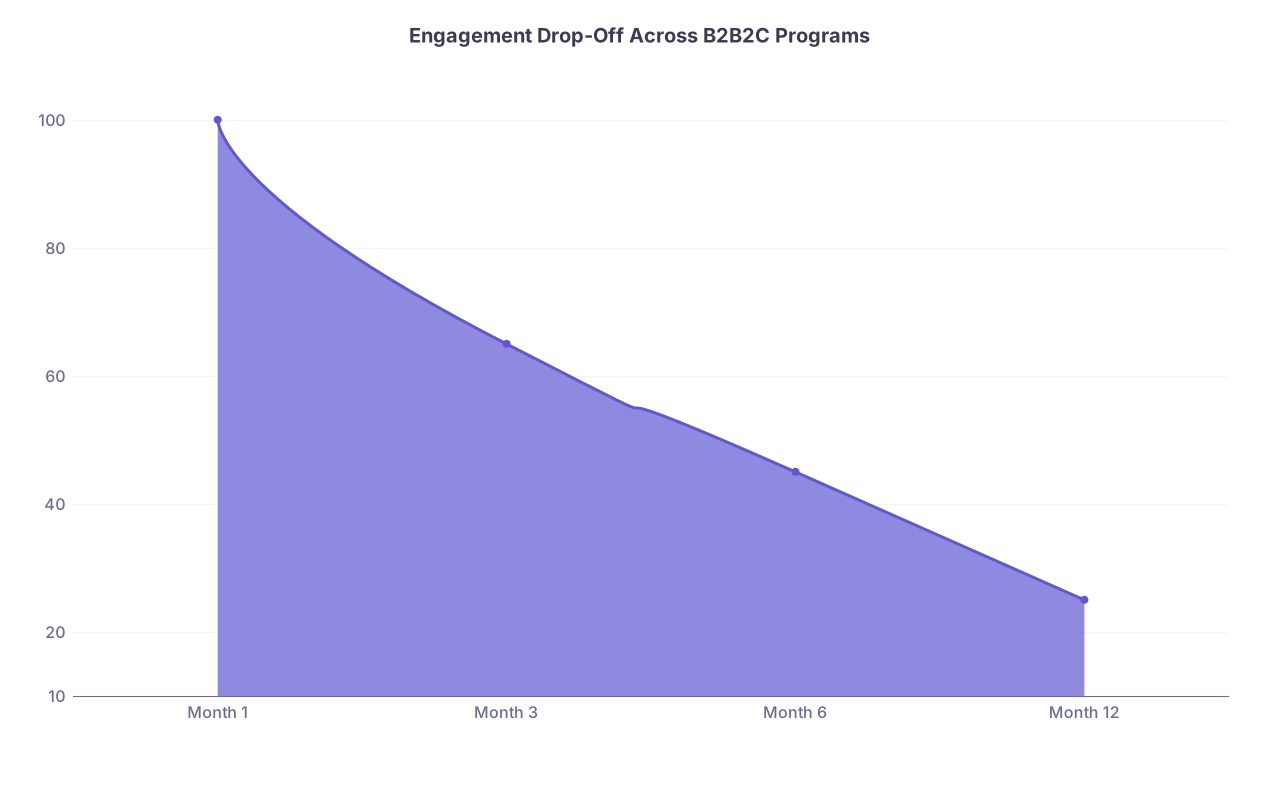
| Category | Value |
|---|---|
| Month 1 | 100 |
| Month 3 | 65 |
| Month 6 | 45 |
| Month 12 | 25 |
That’s the curve you’re fighting in almost every behavior-change product.
Step 4: A Simple Decision Framework for Your Medical Startup
Stop thinking “What model do investors like?” and ask:
1. Who controls the money that moves when my solution works?
- Hospital margin → likely B2B with health systems.
- Claims spend → B2B or B2B2C with payers.
- Employer productivity / benefits → B2B2C with employers.
- Out-of-pocket, convenience, appearance → B2C patient.
- Clinician revenue, board scores, career → B2C clinician or B2B with groups.
2. Can my end user realistically pay out-of-pocket at scale?
- If yes → B2C is on the table.
- If no → B2B or B2B2C, because you’ll need institutional budgets.
3. How “clinical” is this?
- If it feels like medical care (diagnosis, treatment decisions, prescribing)
- Expect higher regulation, need for medical director, liability risk.
- Pure B2C can be risky unless you structure it as a proper telehealth practice.
- If it’s guidance, education, enabling tools
- B2C and B2B2C are easier to launch, though still regulated if you wander into medical claims.
4. How long can you survive without significant revenue?
- Short runway, no fundraise yet → Lean toward:
- B2C clinician tools
- Small-practice B2B (e.g., selling to independent clinics with short sales cycles)
- Longer runway / institutional backing → You can consider:
- B2B with health systems
- B2B2C with payers/employers
Step 5: Match to Your Personality and Skills (This Part People Ignore)
This is where most physicians screw up: they choose a model that fights their own strengths.
Be blunt with yourself:
If you like negotiations, complex stakeholders, and long games
You might actually enjoy B2B and B2B2C. Those meetings with CFOs, CMIOs, and HR benefits leaders will not drain you as much.If you like building, experimenting, and seeing rapid user feedback
B2C or small-practice B2B. You’ll get to ship faster, talk to users more, and avoid never-ending procurement hell.If you hate selling but love teaching and content
B2C clinician-focused education, courses, and tools might align nicely.
You’re not just picking a model. You’re deciding what your day-to-day life will look like for the next 3–7 years.
Step 6: Common Hybrid Paths That Actually Work
You do not have to get the model perfect on day one. The trick is to start where friction is lowest, prove value, then move “upmarket.”
Some real patterns that work:
Start B2C, Prove Engagement → Shift to B2B2C
Example: You build a migraine self-management app.- Year 1: Direct to patients, $10–20/month, get 5,000–10,000 users.
- You collect outcomes data: reduced ED visits, fewer missed workdays.
- Year 2–3: Approach employers/payers with your data; now you have leverage.
Start with Clinician B2C → Expand to Health System B2B
Example: AI scribe app for individual physicians.- Sell month-to-month to doctors sick of charting at 10 p.m.
- Once you’ve got 200 doctors in a region, approach their health system:
“Your docs already love this. Let’s do an enterprise deal and integrate with Epic.”
Start Small-Clinic B2B → Move to Payer B2B2C
Example: Remote monitoring for hypertension.- Prove it in independent cardiology and primary care groups.
- Show lowered BP, fewer hospitalizations.
- Then sell to payers as a preferred solution for their network.
Step 7: Quick Model Fit Cheatsheet for Common Physician Startup Ideas
Here’s the blunt version:
AI scribe / note assistant
- Start: B2C to individual clinicians or small B2B to practices.
- Long-term: B2B with health systems.
Chronic disease digital program (diabetes, obesity, MSK)
- Better: B2B2C with payers/employers.
- Possible on day 1: small B2C, but do not assume huge DTC scale.
Medical education content / question bank / OSCE prep
- Pure B2C (students, residents, attendings).
- Option: B2B to residency programs/universities later.
Workflow tool for inpatient teams (handoffs, rounding lists)
- Likely B2B with hospitals.
- You might get some organic B2C clinician adoption first, but to really matter, you’ll need enterprise deals.
Cosmetic / dermatology / fertility / men’s health
- B2C or B2C + B2B2C (employers for fertility benefits).
- Patients will pay out of pocket if you package it correctly.
How to Decide This Week (Not in Six Months)
Do this today:
Write a one-sentence value statement:
“We help [who] achieve [measurable outcome] by [how you do it].”Underline the [who]. That’s your starting point.
- If the “who” is a patient segment → strongly consider B2C or B2B2C.
- If the “who” is an org outcome (LOS, readmissions, spend) → lean B2B/B2B2C.
Call 5 people who match that “who”:
- If it’s a hospital problem, talk to a CMO, CMIO, or service line lead.
- If it’s an employer problem, talk to a benefits manager at a 1,000+ person company.
- If it’s a patient problem, talk directly to patients, not just about them.
Ask one non-fluffy question:
“If this worked exactly as promised, whose budget would this come from?”
Their answer is your business model roadmap.
FAQ: B2B vs B2C vs B2B2C for Medical Startups
1. Which model do investors prefer right now?
They care a lot less about the label and a lot more about actual traction and believable unit economics. That said:
- Enterprise B2B with clear ROI and renewals is always appealing.
- B2B2C with strong engagement and outcomes is hot if you have hard data.
- B2C is viewed skeptically unless you show efficient acquisition and good retention.
Translation: pick the model that gets you fastest to real, measurable traction, not what you think is trendy.
2. Can I start as B2C and later become B2B or B2B2C?
Yes, and many successful companies do exactly that. Start where you control access to users (usually B2C or bottom-up B2B), prove people care and outcomes move, then move up to institutional buyers with your data. Just be honest with yourself: some products will never appeal to enterprises, and some will never scale as pure DTC.
3. Is B2C in healthcare basically impossible without huge marketing budgets?
Not impossible, but unforgiving. If you go B2C:
- Pick a niche with intense, ongoing pain (e.g., fertility, chronic pain, acne, ADHD) or a career-critical segment (board exams).
- Use content, communities, and partnerships to lower acquisition costs.
- Be ruthless with retention: design onboarding and nudges so people actually use what they pay for.
If you think “we’ll grow virally” without a concrete growth engine, you’re lying to yourself.
4. I’m a practicing physician with limited time. Which model is the least insane to start with?
For most practicing docs:
- B2C clinician tools (notes, billing, learning) are most manageable: you understand the user deeply and can reach your peers directly.
- Small-practice B2B is next: you can sell to local groups you already know. Going straight to a multi-year health system B2B or payer B2B2C play while working full-time is possible, but you’ll feel like you have two full-time jobs and a third one called “legal review.”
5. Can one startup realistically run B2B, B2C, and B2B2C at the same time?
Early on, no. It dilutes your focus and confuses your messaging. You can:
- Start with one primary model.
- Experiment lightly with another channel only after you have clear product–market fit with the first. Mature companies can support multiple channels, but they have separate teams, pricing, and go-to-market strategies. As a new founder, pick your battle.
Open your notebook (or Notes app) right now and write down the exact person or organization that saves or makes money if your idea works. That name—patient, clinician, hospital, payer, employer—is your first hard clue: B2B, B2C, or B2B2C. Don’t move to your logo or website until you’ve circled one.