
The default advice to “always keep one foot in clinical practice” is wrong for many physician-founders.
If you’re scaling a serious medical startup after residency, you need an actual strategy for clinical work—not a guilt-driven side hustle that slowly kills both your company and your sanity.
Here’s how to decide, in clear terms, whether you should keep practicing clinically while you scale your startup, and if yes, exactly how to do it without blowing yourself up.
Step 1: Get Clear On What You’re Optimizing For
You’re not really asking “clinical or not?” You’re asking:
- Am I optimizing for runway and risk reduction?
- Am I optimizing for speed and growth?
- Am I optimizing for identity and credibility?
Those are three different games. Stop trying to win all three at once.
Here’s the core trade-off:
- More clinical work → more money, more safety, slower startup.
- Less clinical work → more focus, faster startup, higher financial and career risk.
If your startup is:
- Pre-revenue, pre-funding, or early prototype → default bias toward keeping some clinical.
- Seed/Series A, growing fast, real team counting on you → default bias toward significantly reducing or pausing clinical.
- Essentially a lifestyle/consulting/hybrid company that depends on you as an expert → probably keep a narrow, curated clinical footprint.
You’re post-residency. The big decision is whether you’re going to be:
- A physician who runs a side business, or
- A founder who still has a medical license.
There’s no moral high ground either way. There’s only alignment or misalignment with your goals.
Step 2: Know the 4 Realistic Models (And Their Consequences)
Most people waffle somewhere in the middle. That’s where burnout lives. Pick a lane.
| Model | Typical Clinical Load | Best For |
|---|---|---|
| Full Clinical + Startup | 0.8–1.0 FTE | Early idea, no traction |
| Hybrid (1–4 shifts/mo) | 0.1–0.4 FTE | MVP to early scale |
| License-Only/Nonclinical | 0 FTE | Funded growth phase |
| Short-Term Clinical Sprints | 1–2 months per year | Extending runway |
Model 1: Full Clinical + Startup (0.8–1.0 FTE)
This is the “I’ll just do it on nights and weekends” fantasy.
Reality: your startup will move at a crawl and you will resent both jobs.
When this model makes sense (for a short window):
- You’re still validating whether your idea is even real.
- You’re not committed to being a founder long-term.
- You’re experimenting, building basic prototypes, talking to users.
If your company is already incorporated, you have a product in development, and a couple of people depending on you? Full clinical is almost always the wrong choice.
Model 2: Hybrid Founder (1–4 shifts per month)
This is the most functional setup for a serious early-stage founder.
What it looks like in practice:
- Hospitalist picking up 2 weekend shifts per month.
- EM doc doing 3–4 night shifts a month.
- Telemedicine sessions 1–2 evenings a week, highly scheduled.
The goal is not “keep practicing.” The goal is:
- Maintain income floor: cover personal burn + minimal extra.
- Maintain license and board eligibility.
- Maintain clinical relevance for your market credibility.
The key is to set a hard cap (e.g., “No more than 3 shifts/month”) and design your startup life around that. Don’t let “sure, I can cover that” become your default answer.
Model 3: License-Only / Fully Nonclinical
This is the founder who has fully stepped out of day-to-day clinical.
You keep:
- Active license
- CME
- Malpractice tail coverage, if needed for advisory work
- Maybe very rare locums or shift work in emergencies
You give up:
- Regular patient care
- Day-to-day “current practice” credibility
When this is the correct move:
- You’ve raised real capital (not a friends-and-family $50k).
- You have a team that needs your full attention.
- Growth is constrained by your time, not your idea.
- You’re repeatedly skipping important founder work to cover shifts.
If you’re post-residency, seed-funded, and scaling, staying clinically active out of guilt—not strategy—is one of the most common unforced errors I see.
Model 4: Short-Term Clinical Sprints
I’ve seen a few founders use this very effectively.
Pattern:
- 9–10 months: almost fully on startup.
- 2–3 months: intense locums/hospitalist blocks to refill cash runway personally (or bridge a funding gap).
Who this actually works for:
- Hospitalist, EM, anesthesia, PM&R, psych—specialties with flexible locums work.
- People with disciplined boundaries who can truly “switch modes.”
This is not a long-term lifestyle. It’s a runway-extending tactic while your startup moves from “promising” to “real business.”
Step 3: Use This Simple Decision Framework
Let’s get concrete. Answer these five questions honestly:
How many months of personal runway do you have right now if you stopped all clinical tomorrow?
- 0–6 months → You probably need hybrid or sprints.
- 6–18 months → You have optionality; consider going lighter clinical.
- 18+ months → You can seriously consider pausing clinical if the startup justifies it.
Is your startup’s biggest bottleneck currently YOUR time?
- If yes, that’s a strong argument for reducing clinical.
- If no (e.g., product blocked by engineering, regulatory waits), you can potentially keep more clinical.
Does your product require current clinical practice for credibility or insight?
- Building an AI scribe? Being clinically current helps but isn’t mandatory.
- Selling workflow software to hospitalists or EDs? Recent practice is a bigger deal.
- Direct-to-patient digital health clinic? Active practice is often a selling point—at least early.
Are you still enjoying clinical work, or is it pure obligation?
- “It drains me, I dread every shift” → your startup will suffer.
- “It grounds me, I like my patients, but it tires me” → limit, do not eliminate, at least initially.
Are you actually performing well clinically right now?
- If you’re late charting, snappy with staff, missing details because you’re thinking about product roadmap, that’s a red flag.
- Standing in front of a septic patient and mentally editing your pitch deck is a sign it’s time to step away.
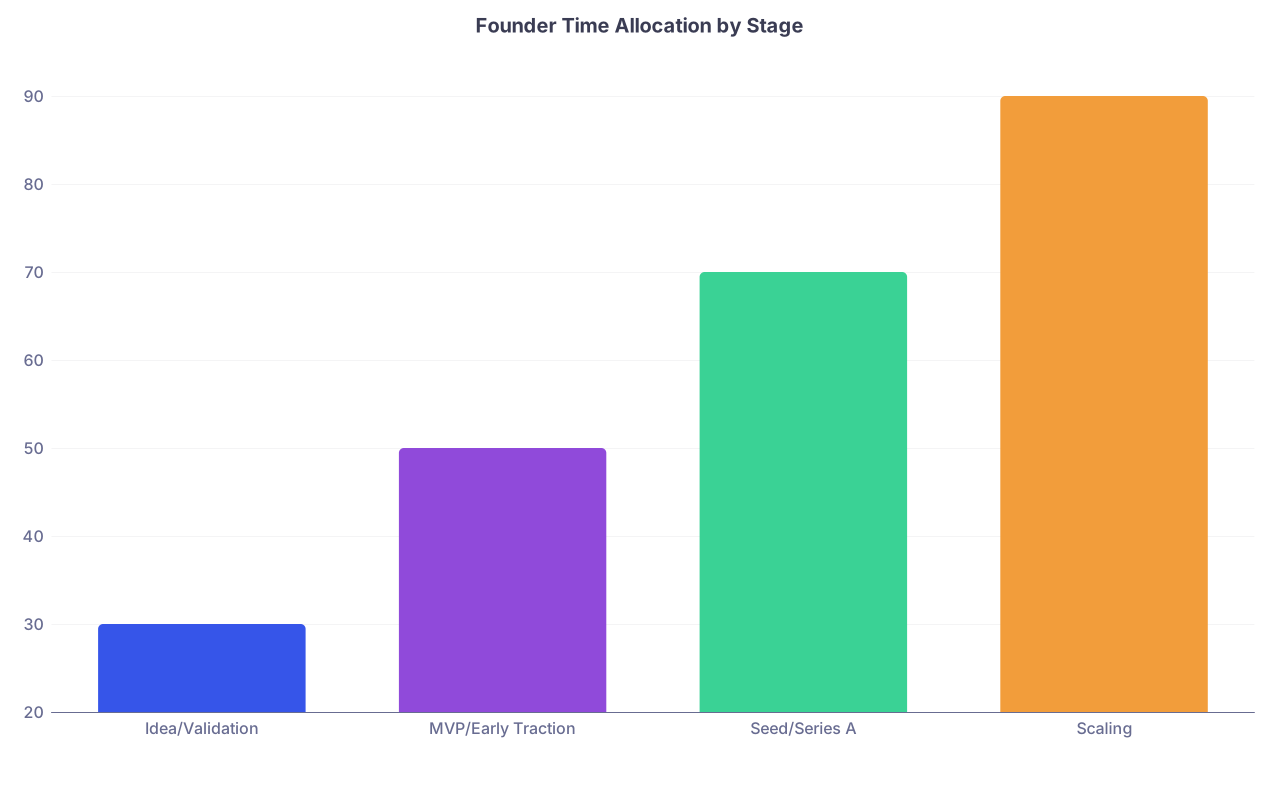
| Category | Value |
|---|---|
| Idea/Validation | 30 |
| MVP/Early Traction | 50 |
| Seed/Series A | 70 |
| Scaling | 90 |
Above numbers are approximate % of total work time that usually needs to go into the startup if you want it to be truly competitive. If you’re at 70% clinical and 30% startup at Series A stage, you’re kidding yourself.
Step 4: Clinical Work as Strategic Asset (Not Security Blanket)
If you choose to keep practicing, you have to turn clinical work into strategy, not comfort. That means:
Align setting with your startup.
Building a B2B solution for health systems? Choose a hospital-based role, not a boutique aesthetics clinic.
Building a telehealth platform? Do telehealth. Stay close to the workflows.Use clinical as R&D and UX research.
Keep a running list of:- Broken workflows
- Workarounds your colleagues use
- Phrases patients actually say (gold for marketing copy)
- EMR templates and clicks that make people insane
Be ruthless with schedule design.
Batch your shifts:- Example: 3 twelve-hour shifts over one long weekend per month, and that’s it.
Don’t sprinkle them across weeks—that kills momentum.
- Example: 3 twelve-hour shifts over one long weekend per month, and that’s it.
Know your non-negotiables.
For instance:- No post-call investor meetings.
- No taking investor calls from the call room.
- No “I’ll just code for 2 hours after this 14-hour trauma shift.”

| Step | Description |
|---|---|
| Step 1 | Post residency physician founder |
| Step 2 | Maintain hybrid clinical work |
| Step 3 | Consider pausing clinical |
| Step 4 | Keep minimal strategic shifts |
| Step 5 | Runway over 12 months |
| Step 6 | Startup bottleneck is founder time |
Step 5: Don’t Ignore the Credentials and Licensing Reality
You trained for a decade. You probably do not want to burn your license accidentally.
At minimum, you need to plan for:
License maintenance
Many states: 25–50 CME hours/year. Some require recent clinical activity to keep certain privileges. Track this.Board certification
Different boards, different rules. Some require active practice; some allow “nonclinical” tracks or practice verification via other means. You need to read the fine print now, not in five years when you want to go back.Malpractice tail
If you’re leaving a group to go mostly nonclinical, you may need tail coverage. That bill can be ugly. Budget for it.

If there’s even a 30% chance you’ll want to return full-time to clinical in the next 5–7 years, protect that option. It’s far easier to maintain than to rebuild.
Step 6: The Emotional Side No One Talks About
A lot of doctors keep practicing for reasons they will not say out loud:
- Fear of being “just a business person.”
- Guilt about leaving patients and colleagues.
- Family members who only respect “real doctors.”
- Identity collapse at the idea of not rounding every morning.
I’ve watched excellent founders sabotage their companies by clinging to the white coat for identity reasons while insisting it’s “for the money” or “for credibility.”
If this sounds like you, be honest:
- Are you clinging to clinical work because your startup is weak?
If yes, fix the startup, don’t drown it slowly. - Are you clinging because you cannot imagine introducing yourself without “I’m a hospitalist”?
That transitions over time. It’s uncomfortable. It doesn’t mean you made a mistake.
There’s also the opposite problem: founders who quit clinical work the second their SAFE round closes, then panic 18 months later when the market shifts or they get pushed out of their own company. Balance courage with optionality.
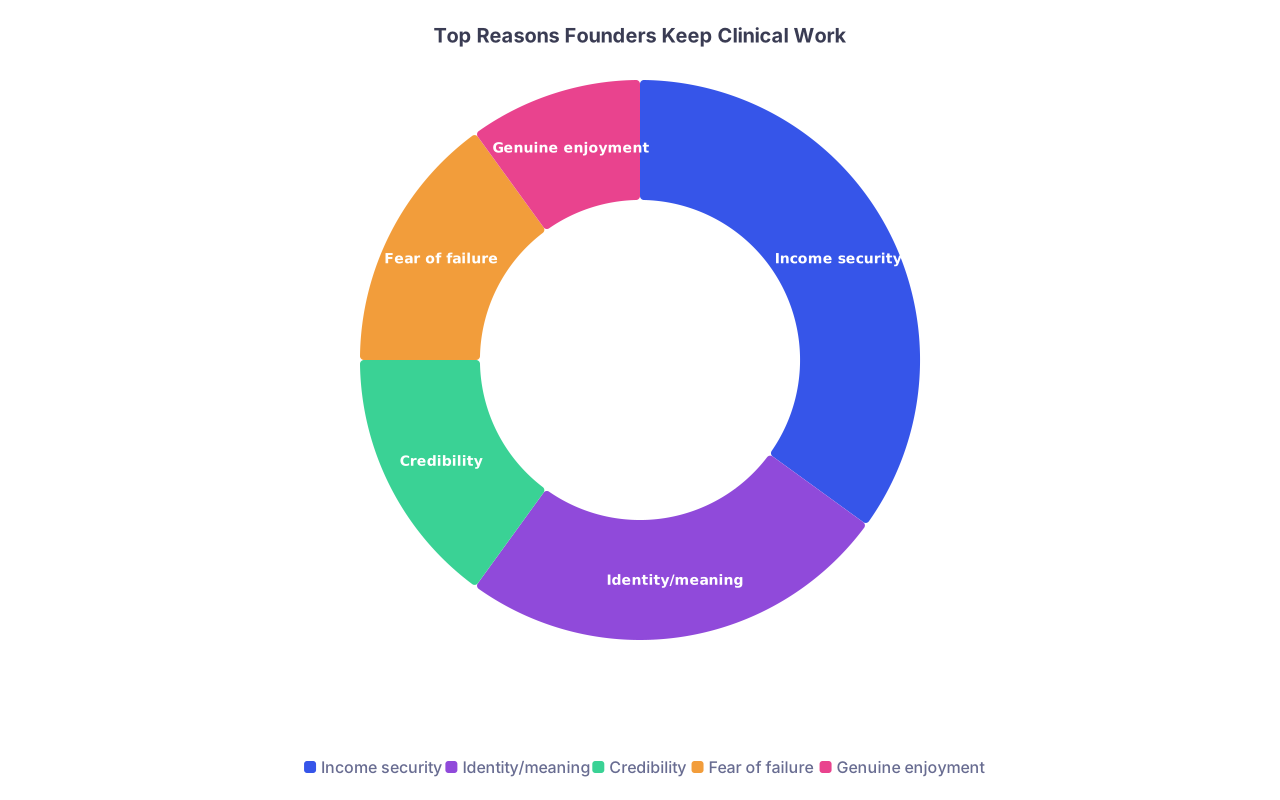
| Category | Value |
|---|---|
| Income security | 35 |
| Identity/meaning | 25 |
| Credibility | 15 |
| Fear of failure | 15 |
| Genuine enjoyment | 10 |
Step 7: Practical Playbooks By Scenario
Let me give you three real-world scenarios and what I usually recommend.
Scenario A: Just Finished Residency, Bootstrapping a SaaS Tool
- No funding yet, building with a part-time developer.
- You have $40–60k in savings, maybe.
Recommended:
- 0.5–0.6 FTE clinical for 12–18 months.
- Aggressive saving to build 6–12 months of personal runway.
- Move to 1–2 shifts/month once you have paying customers.
Scenario B: Post-Residency, Seed-Funded, First 5 Hires
- Raised $1–3M seed.
- Product in pilot with early customers.
- You’re the only physician founder.
Recommended:
- 0–2 shifts/month, maximum.
- Keep license current and do targeted shifts aligned with your user base (e.g., the same type of hospital that’s your buyer).
- Plan an explicit 6-month reevaluation: either cut to 0 or deliberately keep 1 shift/month for grounding.
Scenario C: Attending 3 Years, Big Mortgage, Pre-Seed, Family of 4
- Idea and early wireframes, but no revenue.
- Golden handcuffs from lifestyle inflation.
Recommended:
- Accept that you are not yet a full-time founder. For now, that’s fine.
- Shift to 0.6–0.7 FTE clinical, aggressively downsize expenses, build runway.
- Treat startup as serious, scheduled second job: 15–20 hours/week, no more.
- When you have either funding or real revenue, then consider dropping to hybrid.

Step 8: How to Exit Clinical Cleanly (If You Decide To)
If you do choose to pause or stop clinical work for a while, do it like a professional, not an escape artist.
Talk to your department/group early.
Three to six months’ notice if possible. You may want these people as customers or references later.Create a re-entry plan on paper:
- How you’ll keep CME up.
- Conferences you’ll attend.
- When you’ll reevaluate full-time vs. part-time vs. return.
Document everything:
- Pay stubs
- Credentialing letters
- Proof of practice for boards/state boards
Make your startup role explicit:
- On LinkedIn, site, and introductions: “Physician and founder of X” or “Nonpracticing physician founder of X.”
- Don’t lie or fuzz it. People respect clarity more than half-truths.

| Step | Description |
|---|---|
| Step 1 | Decide to pause clinical |
| Step 2 | Notify group and schedule end date |
| Step 3 | Confirm license and board rules |
| Step 4 | Set CME and conference plan |
| Step 5 | Reevaluate at 12 24 months |
The Bottom Line
You should keep practicing clinically while scaling your medical startup only if it clearly supports one of three things:
- Extending your financial runway without destroying your energy.
- Directly improving your product and credibility in your specific market.
- Maintaining future optionality in a rational, time-bounded way.
If it does none of those, you’re probably hanging on out of fear or habit. That’s not strategy. That’s drift.
Your next move today is simple:
Open your calendar and your last three pay stubs. Decide, in writing, what your clinical FTE will be for the next 6 months only—with a specific date when you’ll reassess based on actual startup traction, not vague feelings.
FAQ (5 Questions)
1. Will stepping away from clinical hurt my credibility with customers and investors?
Sometimes, but less than you think—if you’re transparent. Many healthtech investors and customers care more that you were a serious clinician and actually understand workflows than whether you took a shift last week. If your product is tightly tied to active practice (e.g., procedure-heavy tools, cutting-edge clinical protocols), then staying at least minimally active helps. For everything else, your insight and execution matter more than your current call schedule.
2. How little clinical work can I do and still keep my license and boards?
This is specialty and state specific. Some boards only require proof of training and CME, others mandate minimum practice hours. Some hospital privileges require a certain number of cases per year. You need to pull your specific board and state rules and, if needed, email them directly. Many founders get by with as little as 1–2 shifts/month or short locums blocks, but that only works if it meets your board’s definitions.
3. What about malpractice coverage if I cut back a lot?
If you’re leaving a group or practice, you may need tail coverage to protect against past claims. That can be expensive—sometimes 1–2x your annual premium. If you’re doing minimal shifts, make sure:
- You’re covered under an employer’s policy for those shifts, and
- You clearly understand if any “gap” is created when you switch arrangements.
Talk to your risk management department or a malpractice broker before making big changes.
4. Is telemedicine an easier way to keep up clinical while founding?
Usually yes—but only if it’s structured. Telemed can be an efficient way to:
- Maintain some patient contact
- Keep clinical instincts reasonably sharp
- Generate modest income with more flexible hours
The trap is letting it expand into whatever hours you “kind of have free.” You still need hard caps and scheduled blocks, otherwise it fragments your founder time just like in-person shifts.
5. If my startup fails, will leaving clinical hurt my chances of getting another attending job?
There might be friction, but it’s rarely fatal if you plan. Gaps of 1–3 years are usually manageable if you:
- Maintained license and CME
- Stayed loosely engaged with your specialty (conferences, reading, maybe minimal shifts)
- Can explain the story clearly: “I built a company, here’s what we did, here’s why I’m coming back.”
Beyond ~5 years fully out of practice, reentry gets significantly harder. That’s why I push founders to decide: either maintain a thin but real clinical presence, or accept that you’re likely pivoting permanently toward a founder/operator career.