
What do you do when your startup’s Slack is pinging nonstop, your clinical inbox is overflowing, and you realize you’re doing two full-time jobs… badly?
Let’s answer the question you’re really asking: When is it actually safe and smart to leave my employed physician job for my startup—and when is it reckless?
You’re not just changing jobs. You’re stepping off a very stable, very well‑paid escalator (salary, benefits, 401k, maybe PSLF) into a world where nobody cares that you’re an attending, and your revenue might be $0 for a while.
So you need a decision framework. Not vibes. Not “follow your passion.” A real, practical checklist that says:
- “Yes, you’re ready to jump,”
or - “No, you’re still in the fantasy phase—fix these gaps first.”
Let’s walk through it.
The Core Rule: Don’t Leave for an Idea. Leave for a Business.
If your “startup” is still:
- A deck in Notion
- A prototype only your friends have seen
- A vague “I want to fix primary care” energy
…you’re not ready to quit.
You leave your employed position when you have traction plus runway plus clarity. Not before.
Here’s the simple filter I use with physicians:
You’re likely ready to seriously consider leaving when you can say “yes” to most of these:
- I’ve validated that real customers will pay for this.
- I’ve got at least 9–18 months of personal runway.
- I know exactly what I’ll do with 40–60 free hours a week if I quit.
- I understand my legal/contractual risks (non-compete, IP, moonlighting policy).
- I’m not relying on “I’ll just raise a big round” as my only lifeline.
We’ll unpack all of this. But keep that list in your head.
Step 1: Prove It’s More Than a Hobby (Traction Thresholds)
You don’t quit to “focus on building.” You build until the lack of time is clearly the main bottleneck.
Traction for a medical startup can look like different things depending on what you’re building:
- Direct care clinic or telehealth: paying patients, recurring visits
- B2B software for practices/hospitals: signed pilots, LOIs, or small contracts
- Device or diagnostics: letters of intent, pilot sites, maybe early grants
- Consumer health app: real engagement metrics, not just downloads
Let me be more concrete.
What does “real traction” look like?
You don’t need millions in ARR. But you do need more than vibes.
| Startup Type | Minimum Traction Before Quitting |
|---|---|
| Cash-pay clinic | 20–40 recurring patients/month |
| Telehealth niche | $5k–$15k monthly revenue |
| B2B SaaS for clinics | 3–5 paying customers or pilots |
| Services/consulting | $8k–$15k predictable monthly |
| Health tech app | 1–2 strong pilots + engaged users |
These are not sacred numbers, but they’re directionally right.
If your startup is:
- Pre-revenue AND
- Pre-pilot AND
- No one outside your circle has committed money or time
…quitting your job is usually premature.
Step 2: Runway – How Long Can You Survive If Revenue Is Zero?
This is where a lot of physicians are quietly delusional.
You’re used to checks hitting your account every two weeks. The moment that stops, your burn rate starts to matter in a way it never has.
You need runway: how long you can live and build without a salary.
The minimums I recommend
- Bare minimum: 9 months of personal runway
- Safer: 12–18 months, especially if you have kids, a mortgage, or loans
- Ideal if you’re pre-revenue: 18–24 months or a meaningful seed round already in the bank
Runway = cash savings + spouse/partner income (if stable) + any part‑time or locums income you know you can generate.
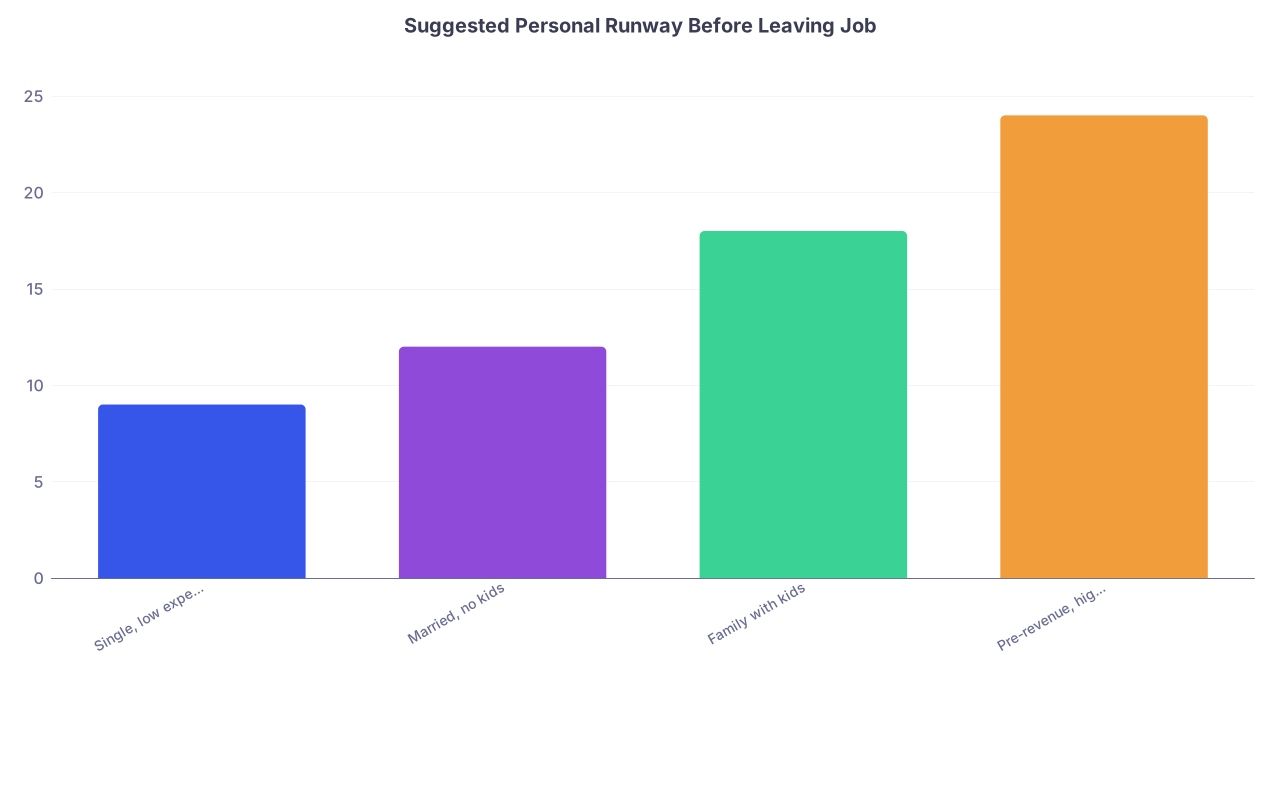
| Category | Value |
|---|---|
| Single, low expenses | 9 |
| Married, no kids | 12 |
| Family with kids | 18 |
| Pre-revenue, high burn | 24 |
If you’re counting on:
- “We’ll definitely close this seed in 3–6 months”
- “The hospital said they’re very interested in a contract”
- “We’ll launch and go viral”
…none of that is runway. That’s optimism.
Run the math harshly:
- List actual monthly spending: housing, loans, childcare, health insurance, food, etc.
- Multiply by 12–18.
- That’s your target cash buffer before walking away.
If you can’t get close, consider part‑time clinical instead of full exit. More on that later.
Step 3: Contract, Compliance, and “Can I Get Sued for This?”
This part gets ignored until someone’s GC sends a nasty letter.
You absolutely need to understand:
- Your employment contract.
- Non-compete: are you barred from practicing in a certain radius or segment?
- Non-solicitation: can you talk to your current patients or referral sources?
- IP assignment: does your employer own anything you created while employed? (Especially if you used hospital data, resources, or time.)
- Moonlighting/side business policies.
- Many hospitals explicitly require disclosure or pre-approval for outside ventures.
- Data/PHI issues.
- If your startup touches patient data, did you ever test it with internal systems, test accounts, or real PHI from your job? Big risk if yes.
This is one of the few times I say: pay a lawyer. Ideally:
- A healthcare attorney
- Who’s seen physician startup and employment disputes
- Who will review your contract + your idea and give you a clear “risk map”
You want to leave clean. No drama, no lawsuits, no board complaints.
Step 4: Time, Energy, and Burnout – Are You Escaping or Building?
I’ve seen this over and over: post‑residency attendings who are burned out 18 months into their first job decide, “I’ll just start a company.”
Be honest:
Are you leaving toward a startup or just away from a miserable job?
If:
- You hate your current employer
- You’re resentful about RVUs, call burden, or admin nonsense
- You’re daydreaming about quitting daily
…that’s understandable. But it’s a terrible reason by itself to start a company.
Because startup life is not “chill clinic with no admin.” It’s:
- Constant uncertainty
- Financial stress
- Pressure from cofounders, investors, early adopters
- Working more hours than residency some weeks
The right time to leave is when:
- You’re energized by the work you’re already doing on the startup at nights/weekends
- You feel pulled by opportunities, not just pushed by frustration
- Your main limitation is time and focus, not motivation or clarity
If you’re just fried, consider:
- Switching to a different employed role
- Negotiating a 0.6–0.8 FTE schedule
- Locums for flexibility and cash
And keep building in the background until your head is clearer.
Step 5: What Will You Actually Do With Full-Time Startup Hours?
This is the part almost no one prepares for. They have a vague “If I had more time, I’d grow faster” belief.
Write out your next 90 days as if you’d already quit. Specifically.
What will you do, week by week, with 40–60 extra hours?
Examples of good answers:
- “In 12 weeks, I’ll launch 3 paid pilots with independent PCP practices and collect NPS + outcomes data.”
- “I’ll ship v2 of the product, based on feedback from our first 10 paying clinics, and run a structured sales process to 50 prospects.”
- “I’ll open my micro-practice, onboard 30 new patients, and build a monthly content + referral flywheel.”
Bad answers:
- “I’ll work on the product more.”
- “I’ll focus on marketing.”
- “I’ll raise money.”
You want a plan that looks like a serious project, not a vibe.
Here’s a simple way to structure it:

| Step | Description |
|---|---|
| Step 1 | Have paying customers or strong pilots |
| Step 2 | Stay employed and keep validating |
| Step 3 | Calculate 9-18 months runway |
| Step 4 | Reduce expenses or go part time |
| Step 5 | Review contracts and legal risk |
| Step 6 | Adjust plan or wait |
| Step 7 | Write 90 day full time plan |
| Step 8 | Refine plan before quitting |
| Step 9 | Reasonable to consider leaving |
| Step 10 | Yes? |
| Step 11 | Runway sufficient? |
| Step 12 | Legal risk manageable? |
| Step 13 | Plan clear and concrete? |
If you can’t fill in that 90‑day plan with painful clarity, you’re not ready yet.
Step 6: Full Quit vs. Part-Time vs. Locums
Leaving your employed position doesn’t have to be binary: 1.0 FTE or nothing.
For most post‑residency physicians, the smartest sequence looks like this:
- Full-time employed + nights/weekends on the startup
- Drop to 0.6–0.8 FTE (if possible) OR switch to a lighter clinical role
- Move to flexible locums / telemedicine PRN to extend runway
- Fully step away from clinical only if the startup can truly carry your life
Why this works:
- You test whether you actually like working on the business
- You don’t freak out financially the moment a deal slips
- You still keep your clinical skills fresh and license active

For some types of startups (especially ones that sell to health systems), part‑time clinical is a strategic advantage. You stay in the ecosystem, hear the pain points, keep relationships alive.
Don’t romanticize the full break if you don’t need it yet.
Step 7: Check Your Support System (This Is Not a Solo Sport)
Your decision doesn’t just hit you. It hits:
- Your spouse or partner
- Your kids
- Your cofounders
- Any early investors or advisors
You want alignment on three things:
Timeline:
“We’re committing to give this 12–18 months before we reassess.”Financial boundaries:
“We’re okay using X of savings, but not touching Y (e.g., retirement).”Exit ramps:
“If after 12–18 months we’re not at [clear milestone], I’ll go back to 0.8–1.0 FTE clinical.”
Write this down. Literally. I’ve sat with founders whose marriages were hanging by a thread because this was never explicit.
Step 8: The Red Flags – Signs It’s Too Early to Leave
If several of these are true, don’t quit yet:
- You haven’t charged anyone anything “because we’re still early.”
- You’re still constantly changing your core idea every month.
- You haven’t talked to at least 30–50 potential customers in depth.
- Your cofounder (if you have one) is less committed than you.
- You’re telling yourself, “Once I quit, I’ll figure out the model.”
That last one is deadly. You figure out most of the model before you quit, not after.
When You Should Seriously Consider Leaving
I’d start giving you a green light when most of the following are true:
- You have paying customers or high‑quality pilots, not just “interest.”
- You’ve got 9–18 months of personal runway without depending on magic fundraising.
- You’ve mapped your contracts, non‑competes, and IP risk with a real lawyer.
- You have a concrete 90‑day full‑time execution plan.
- You can articulate what “success in 12–18 months” looks like in numbers (revenue/ARR, pilots, outcomes).
- You feel more alive working on this company than anything else you’re doing clinically.
At that point, staying full‑time employed may actually be the bigger risk—because you become the bottleneck.
A Quick Example Timeline
Here’s what a sane progression might look like for a post‑residency founder building a telehealth niche practice or simple B2B product.
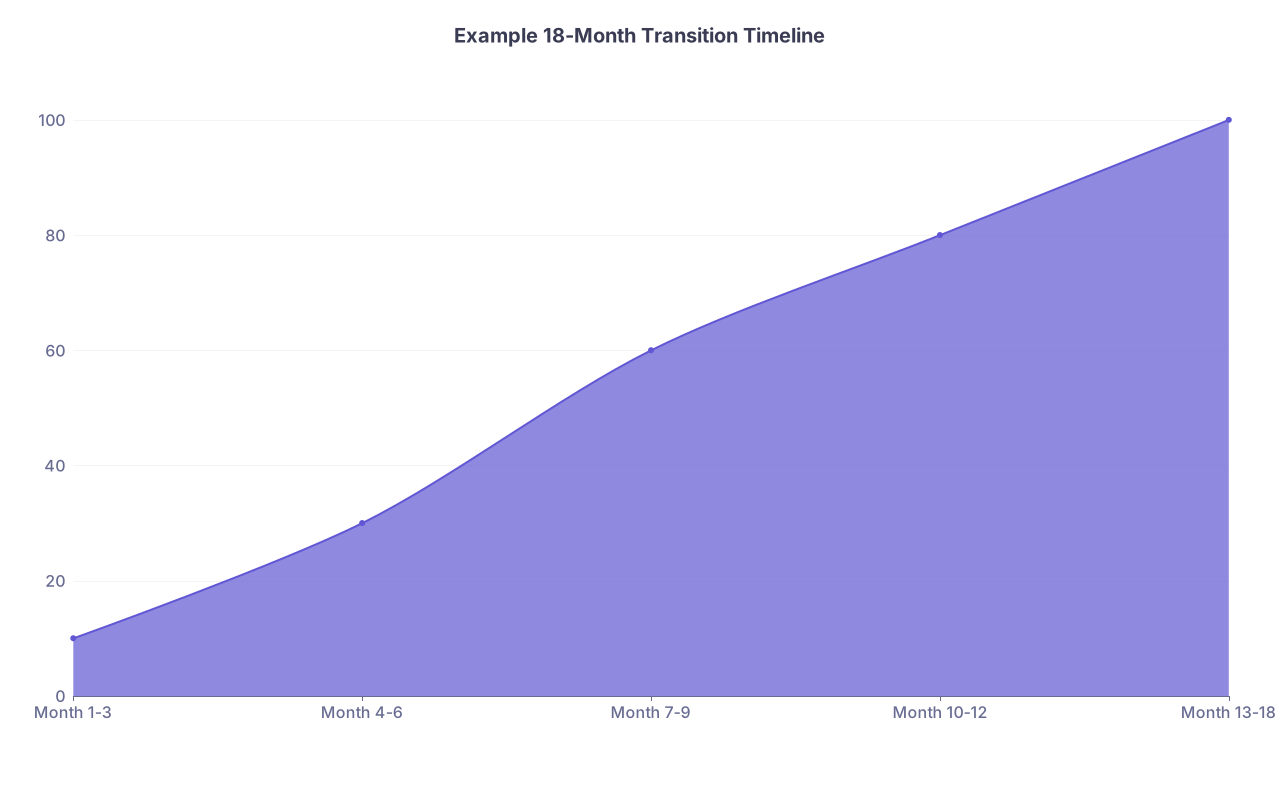
| Category | Value |
|---|---|
| Month 1-3 | 10 |
| Month 4-6 | 30 |
| Month 7-9 | 60 |
| Month 10-12 | 80 |
| Month 13-18 | 100 |
Interpretation (qualitative, not literal percentages):
- Months 1–3: Full‑time job, idea validation, 30–50 customer interviews
- Months 4–6: MVP built, 1–3 pilots, still full‑time
- Months 7–9: First paying customers, drop to 0.6–0.8 FTE or shift to flexible role
- Months 10–12: Revenue growing, 3–10 customers, real usage and retention
- Months 13–18: Raise a small round or hit enough revenue to justify full-time
This is boring. It’s also how most of the non‑fairytale success stories actually look.
The One Thing You Can Do Today
Open a blank page and write three headers:
- Traction I already have
- Runway I actually have
- My 90‑day full‑time plan
Fill those in honestly.
If one of those sections ends up basically empty, you’ve answered your own question: it’s not time to leave your employed position yet. Your job now is to fill that gap while you’re still getting a paycheck.
If all three look solid? Then start a serious conversation with your spouse, your lawyer, and maybe your cofounder about dates, transition plans, and contingencies.
You don’t need perfect certainty. You do need a real plan.
FAQ: Leaving an Employed Position for a Medical Startup
1. What’s the absolute earliest stage where it’s not insane to quit my job?
Earliest reasonable point: you’ve got a working product or service, a handful of real customers (or strong pilots with signed agreements), and at least 9–12 months of cash runway. Quitting earlier than that is gambling, not entrepreneurship. The exception: if you’ve already raised a solid seed round with enough salary built in for 18–24 months and a clear execution plan.
2. Should I try to raise money before I quit my job?
If you can, yes. Investors like seeing founders who’ve de‑risked some things while still employed. Show traction, pilots, or strong validation while you’re still getting paid. But don’t make fundraising your only plan for survival. The market is fickle, and “we’ll definitely raise in 6 months” has killed a lot of ventures. Think of capital as an accelerant, not your parachute.
3. How much part-time clinical work is realistic while running a startup?
Common sweet spot: 0.3–0.6 FTE or 3–6 clinical shifts per month, especially in EM, hospitalist work, urgent care, or telemed. Enough to cover basic living costs and keep skills fresh, not so much that you’re constantly context‑switching. If your startup is in a high‑growth or launch phase, you may need to dial that down even further for 3–6 month bursts.
4. Won’t staying employed too long hurt my startup’s chances of success?
Staying in a soul‑crushing 1.0 FTE job forever will, yes. But a deliberate 6–12 month period where you prove traction while employed usually helps, not hurts. Investors and cofounders respect founders who de‑risk before burning the ships. The real problem is when you use your job as an excuse to never actually launch, never charge, and never test your assumptions.
5. What if my spouse or family is very anxious about me quitting?
That’s not a “their problem.” It’s a signal you haven’t aligned expectations. Sit down and share numbers: runway, worst‑case scenarios, time boxes (e.g., “We reassess in 12 months”), and clear milestones. Ask what would help them feel safer: more savings, part‑time clinical instead of zero, or explicit “if we’re not at X by Y date, I’ll go back to employed work.” Make it a joint decision, not a unilateral leap.
Now, open that blank page and draft your honest 90‑day full‑time startup plan. If you can’t write it clearly, you’re not quitting yet—you’re still planning.