
You’ve just finished residency or a few years as an attending. You’re frustrated with how clunky everything is. Patients are confused, your inbox is on fire, the EMR feels like a punishment, and you’re thinking: “I could build something better.”
Now you’re stuck on the core strategic question:
Do you build for patients, for doctors, or for hospitals first?
If you get this wrong, you can burn 2–3 years and a lot of money on a product that was “liked” but never adopted, reimbursed, or renewed. I’ve seen it over and over: elegant tools that go nowhere because they solved the wrong stakeholder’s problem first.
Let’s walk through this like a decision tree, not a philosophy seminar.
The One-Line Answer
If you just want the blunt version:
If you want fast adoption, strong clinical insight, and a real shot at revenue:
Build for doctors first, but design so hospitals can justify paying and patients actually benefit.If you’re dead set on consumer-style growth and can live with a brutal path to monetization:
Build for patients first.If you’re ready for long sales cycles and enterprise politics, but want big contracts:
Build for hospitals first.
The rest of this is about deciding which of those actually fits you, your idea, and your stage of life.
Step 1: Understand Who Actually Pays
Before picking “who to build for,” you need to be honest about who pays and who decides.
| Stakeholder | Primary Role | Typically Pays? | Decides Adoption? |
|---|---|---|---|
| Patients | End user | Sometimes | Sometimes |
| Doctors | Power user | Rarely | Strong influence |
| Hospitals | Enterprise | Often | Yes |
| Payers | Buyer | Frequently | Indirectly |
| Employers | Buyer | Sometimes | Indirectly |
Three ground rules:
Users are not always buyers.
A doctor may love your tool, but IT, compliance, or the CFO blocks it.The person who feels the pain is not always the one with budget.
Your burned-out ED colleagues will rave about your triage tool. The hospital CFO only cares if it changes throughput, length of stay, penalties, or staffing cost.In healthcare, “who controls revenue” wins.
That can be payers, health systems, large groups, or self-insured employers—not always the clinic or the individual doc.
If you ignore this and “just build something great,” you’re gambling, not building a business.
Step 2: What Changes After Residency?
Your stage matters.
As a post-residency clinician or young attending:
- You have deep pain-point knowledge: workflow, documentation, patient confusion, burnout, inbox chaos.
- You have limited time and runway: loans, maybe a young family, attending salary you’d be giving up or cutting.
- You probably don’t have enterprise sales experience or a brand-name startup on your resume.
That combination makes one path clearly more realistic for most clinician-founders:
Doctor-first with a clear line to hospital or payer value.
You already are the user. You can test ideas in your own workflow or with colleagues quickly. You can get from idea → pilot → early revenue much faster than trying to land an enterprise contract out of nowhere.
We’ll come back to that. Let’s dissect each option.
Option 1: Build for Patients First
This is the most seductive. You imagine an elegant app that patients actually like using. Medication reminders, symptom trackers, AI health Q&A, chronic disease management. It feels intuitive and noble.
Here’s the tradeoff.
Pros
- Huge market. Everyone’s a patient eventually.
- Fast feedback loops. Ship, iterate, watch app analytics, talk to users directly.
- Fewer gatekeepers initially. No hospital IT committee to slow you down.
- You can start small. A usable MVP on nights and weekends is realistic.
Cons
Monetization is brutal.
Patients don’t like to pay subscription fees for health apps unless the value is obvious and immediate (weight loss, fertility, fitness). Even then, churn is high.Trust and distribution are hard.
Why should patients trust you instead of their existing portal, Dr. Google, or the big-name apps? Getting from 100 to 10,000+ users takes real marketing or partnerships.You’ll eventually hit the system wall.
To manage meds or refills, you need integration. To affect outcomes meaningfully, you need docs and systems to care. One day, a nurse will say “We can’t act on data from your app.”Venture capital is wary.
The graveyard of patient-facing digital health apps is enormous. Investors know it.
When patient-first can actually work
- You target a clear, high-intent niche (e.g., IVF tracking, migraine prediction, CGM coaching with clear ROI).
- You pair it with a cash-pay service (e.g., telehealth, coaching, specialty care).
- You design from day one for employer or payer partnerships if outcomes are strong.
If your idea is “general health companion” or “patient education app,” ignore the noise: it’s almost certainly a bad business out of the gate.
Option 2: Build for Doctors First
This is where most clinician-founders should start.
Doctor workflow is exactly where you have unfair advantage. You know where clicks go to die. You know what actually saves 30 minutes vs what just adds another screen.
Think things like:
- Smart templates and automation in documentation
- Tools that prevent errors or catch missed diagnoses
- Better inbox triage and message routing
- Imaging decision support
- Rapid pre-op or prior auth workflows
Pros
You deeply understand the user.
You can build something your colleagues actually beg to use because it cuts real pain.You can pilot quickly.
Start at your own clinic, group, or with 2–3 practices that trust you.Doctors are powerful influencers.
Hospital committees still listen when enough frontline physicians say, “We need this.”Easier to show clinical impact.
You can measure clicks reduced, time saved, errors prevented, throughput improved.
Cons
Docs rarely pay personally.
Unless it’s a high-earning specialist or a private practice running as a business, most physicians expect the hospital or group to pay.You must design for the real buyer anyway.
That might be the group, the health system, or a payer. They care about metrics like revenue, cost, risk—not just “it’s nice.”Integration still matters.
The second you touch the EHR, IT and compliance are involved. That slows you down.
Where doctor-first shines
Examples that have worked in the real world look like this:
- Tools that cut documentation time 20–40% while producing cleaner notes and better coding.
- Decision support that reduces unnecessary imaging or duplicative labs.
- ED or clinic tools that reduce door-to-doc time or length of stay.
- Remote monitoring dashboards that let one nurse handle twice the panel safely.
Those all start by being beloved by clinicians—but they are sold on the back of productivity, throughput, and risk reduction.
That’s the pattern you want.
Option 3: Build for Hospitals First
Some of you are tempted to “go big”: sell to health systems from day one. Analytics platforms, care coordination hubs, command centers, revenue-cycle tools.
You’re picturing one big contract solving all your revenue problems.
And yes, hospital-first can work. But let’s be clear: it’s the hardest starting point for a new clinician founder without a seasoned business partner.
Pros
Large contracts.
Land one decent-size health system and you’ve got 6–7 figure annual contracts.Direct tie to financial outcomes.
If you clearly reduce length of stay, readmissions, denials, or staffing cost, the CFO cares. A lot.Defensible position.
Once you’re integrated into workflows and data flows, you’re not easy to rip out.
Cons
Sales cycles are glacial.
9–24 months from first call to signed contract is normal. I’ve seen longer.You’re dealing with committees.
IT, security, compliance, legal, clinical leaders, operations, finance. All with veto power.You’re unproven.
As a fresh founder with no track record, selling to a major system is like a new grad applying to be CMO. It’s not impossible, but it’s stacked against you.You can spend years in pilot hell.
Endless “innovations” pilots that never convert to system-wide deployments or real revenue.
Hospital-first is high risk, high complexity. If you go this route, pair yourself with someone who’s already sold enterprise software into health systems. Otherwise you’ll burn out long before product–market fit.
The Real Question: Who Do You Build For vs Who Do You Sell To?
Here’s the nuance most people miss:
These are separate decisions:
- Primary user (who you build for)
- Economic buyer (who actually pays)
- Champion (who drags your product into the room and fights for it)
The winning pattern in healthcare software, again and again:
- Build for doctors (primary user)
- Improve patient outcomes and experience (value driver)
- Sell to hospitals/groups/payers/employers (economic buyer)
- Leverage doctors as champions (sales amplifier)
So when you ask, “Should I build for patients, doctors, or hospitals first?” my answer is:
Build for doctors, with clear, measurable benefits for patients, and a hard-nosed economic story for hospitals or payers.
That middle position keeps you grounded. You aren’t chasing consumer virality. But you’re also not trying to brute-force your way into enterprise deals with something nobody wants to use.
How to Decide for Your Startup in 15 Minutes
Here’s a simple exercise. No buzzwords. Just a forced choice.
Step 1: What’s the core outcome you care about?
Pick one main thing:
- Reduce clinician time / burnout
- Improve a specific clinical outcome (A1c, readmissions, access)
- Increase revenue (better coding, fewer denials, more visits)
- Reduce cost (staffing, LOS, unnecessary utilization)
Step 2: Who feels this pain the most, daily?
- If it’s patients (confusion, fear, side effects): you’re leaning patient-facing.
- If it’s doctors or nurses (workflow, documentation, chaos): you’re leaning doctor-first.
- If it’s administration (spreadsheets and dashboards): you’re leaning hospital-first.
Step 3: Who has the budget and authority to pay if you succeed?
- If the answer is “patients with cash,” be honest—how many, how much, how often?
- If the answer is “the hospital/system,” can they see the ROI in 1–2 metrics they already track?
- If the answer is “payers,” you’re in the world of utilization, risk adjustment, quality measures.
Now match:
- If the user and buyer are the same (e.g., private practices buying workflow tools), life is easier.
- If they’re different, you must build for the user but sell for the buyer’s ROI.
Do not build something only for the buyer while ignoring the user. That’s how you get tools that everyone resents and no one uses honestly.
Example Scenarios
Let’s run 3 quick, realistic examples that match where you probably are.
Scenario 1: Post-residency internist with an idea about inbox overload
You’re watching 200+ inbox messages a day melt your brain. You sketch an AI triage tool that categorizes, drafts replies, and routes tasks.
Best path:
- Build for doctors and nurses: Make it their best friend, remove clicks, reduce after-hours work.
- Articulate hospital/group value: Show that your tool cuts clinician overtime, reduces burnout and turnover risk, and improves response-time metrics.
- Sell to the group or health system: They’re the ones losing money on burnout and doctor churn.
You are not building a “patient messaging app.” You build a clinician productivity engine that also leads to faster, safer patient communication.
Scenario 2: Emergency physician wants to fix low-acuity ED visits
You want fewer “ED as urgent care” visits. You imagine a patient app that tells them where to go and when.
Most people try: patient app first. Wrong.
Better:
- Build a decision-support + routing tool for triage nurses or front-desk staff.
- Patients may see a side of it (texts, instructions), but your primary user is the clinical team.
- Sell to hospitals on reduced ED crowding, left-without-being-seen rates, and better throughput.
Patients are part of the story. Not your first buyer. Not your first major design constraint.
Scenario 3: Hospitalist obsessed with discharge disasters
You hate chaotic discharges, readmissions, and confused patients. You imagine a beautiful patient-facing discharge app.
Tweak it:
- Build a discharge workflow tool for the hospitalist + case manager team (checklist, status tracking, patient education templates).
- Patients get clear instructions and maybe app access, but your engine is making the clinical team more effective.
- Sell to hospitals on lowering readmissions and penalties, improving throughput, and cutting average length of stay.
Patients benefit. They’re not the one cutting you a check.
Visual: Stakeholder Focus vs Path to Revenue
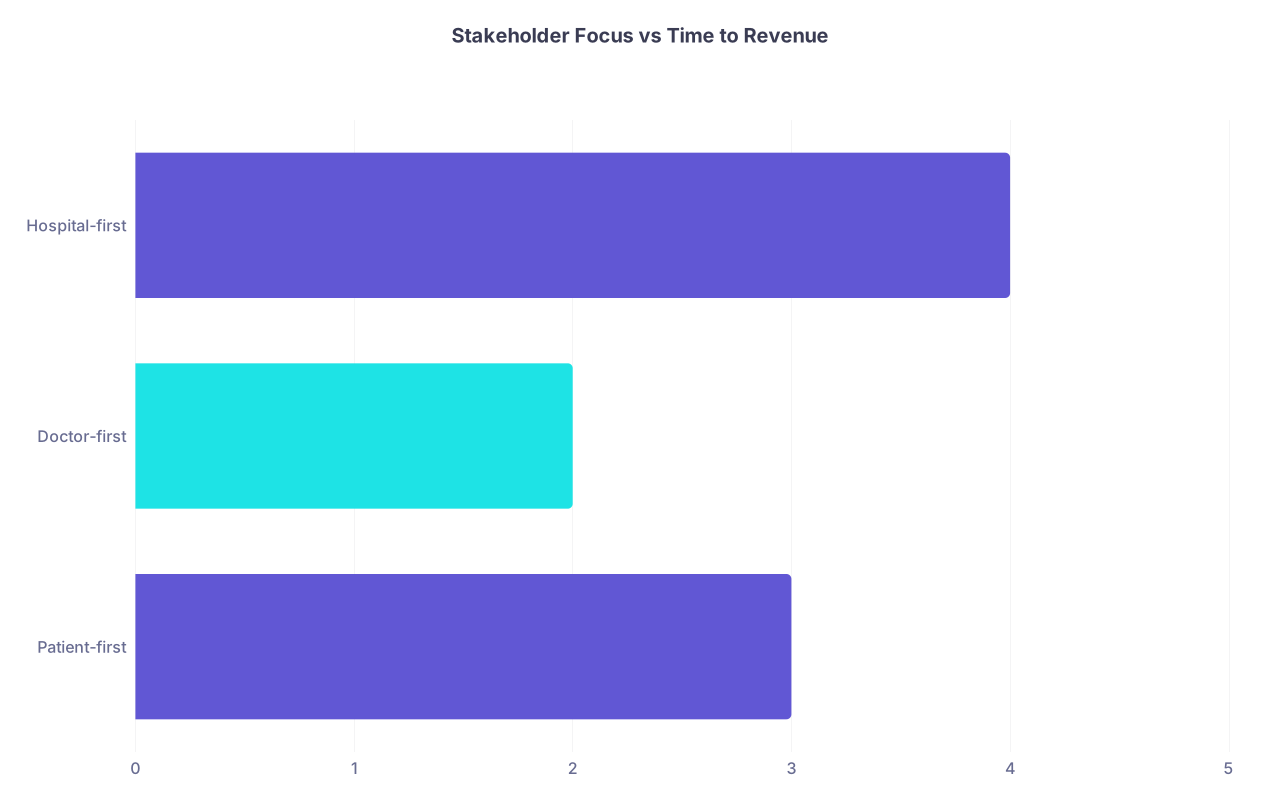
| Category | Value |
|---|---|
| Patient-first | 3 |
| Doctor-first | 2 |
| Hospital-first | 4 |
(Scale: 1 = fastest path to revenue, 5 = slowest. Rough, but directionally right.)
Practical Next Steps (This Week)
If you’re serious and want to move this from “idea” to “company,” here’s what to do in the next 7 days:
Write a one-sentence positioning line:
“We help [primary user] do [critical job] so that [economic buyer] gets [tangible ROI].”
If you can’t fill all three brackets, you’re not done.
Talk to 5–10 people in your target user group.
All doctors. Or all patients. Or all administrators. Not a mix. Deep interviews about one workflow.Ask one blunt question:
“If I could magically fix one part of your day and you had to pick just one, what would it be?”
Your product better line up with that answer.Identify 1–2 measurable outcomes that matter to buyers.
Time per note. No-show rate. Readmission rate. Prior auth approval time. Pick ones you can measure.Decide which stakeholder is your starting lens.
Don’t hedge with “it’s for everyone.” Pick. Commit for 6–12 months. You can expand later.
FAQ: “Should I Build for Patients, Doctors, or Hospitals First?”
If I’m a doctor-founder with limited time, what’s the safest starting point?
Build for doctors first. More precisely: build for a workflow you personally understand and hate. It gives you an unfair advantage, faster product feedback, and natural champions. Then design the product so it obviously supports metrics your group or system cares about—time saved, visits increased, or clinically relevant outcomes. Leave pure consumer plays and pure enterprise platforms for your second startup, after you’ve got some scar tissue.Is patient-first ever a good idea for a medical startup?
Yes, but only in narrow, high-intent niches where patients have clear willingness to pay or where outcomes can be sold to employers or payers later. Examples: fertility tracking with telehealth add-ons, migraine prediction linked to specialist care, CGM-based coaching for diabetes with strong A1c data. If your idea is “an app to help people be healthier,” that’s not a business. That’s a fantasy. Start tighter.Can I sell a doctor-focused tool directly to individual physicians?
Sometimes. It works better in private practice, procedural specialties, or high-income niches (e.g., aesthetics, concierge medicine) where docs think like business owners. Selling $30/month subscriptions to employed hospitalists is usually a dead end; they’ll say, “Love it, but administration has to pay.” Use them as champions and design your pricing for the group or system, not their personal credit card.How do I avoid building something hospitals like on paper but doctors hate using?
Ruthlessly prioritize the clinician workflow. Put a practicing doc or nurse in every design review, not just as a “consultant” who gets a slide deck. Make sure every feature either reduces clicks, reduces cognitive load, or reduces risk. If your product adds three more screens “for analytics,” you’ve already lost. Clinician resentment kills adoption, and the hospital will see through fake usage numbers eventually.What if my product really does need all three: patient app, doctor interface, and hospital dashboard?
Then stagger your focus. Phase 1: pick your primary user (usually doctors or nurses) and make their tool great. Phase 2: layer patient-facing features that make the clinician’s job easier, not harder. Phase 3: build the admin/analytics layer for buyers once you’ve proven usage and impact. Trying to launch all three at once gives you three mediocre products and no one who loves you.How do I know if I’m better off partnering with a hospital instead of starting a company solo?
If your idea is heavy on integration, compliance, and institutional change—bed management systems, command centers, enterprise analytics—you might be better off doing it as an internal innovation project first. Get the data, the outcomes, the proof. Then spin it out if it’s truly transferable. Going straight from attending to enterprise vendor, with no prior startup or enterprise sales experience, is a tough uphill climb.What’s the one metric I should obsess over early on?
Engaged usage by your primary user. Not downloads. Not pilots. Not LOIs. If you’re building for doctors, that means: do they voluntarily use your tool every shift or every clinic day without you begging them? If usage is weak, nothing else matters—no CFO will sign a big contract for something clinicians quietly ignore.
Key takeaways:
- Start by building for doctors (or nurses) where you have lived experience, but always connect that to hard ROI for hospitals or payers and real benefit for patients.
- Separate the user from the buyer and design explicitly for both: joy and simplicity for the user, measurable dollars and risk reduction for the buyer.