The fear that your startup will fail is not irrational. Most do. Even physician-led ones.
And the part nobody in the “founder hype” world talks about enough is the morning after: when you’ve burned years of training, maybe money, maybe credibility, and you’re staring at LinkedIn wondering if you’ve just permanently derailed your medical career.
Let me be blunt: your startup might fail. You can do everything “right” and it might still die. But that’s not the scary part. The scary part is not knowing what happens to you after. That’s what keeps you awake.
Let’s talk about that. Honestly. Like someone who’s seen people go through it, including physicians who thought they’d just made an unfixable mistake.
First, the nightmare scenarios you’re already thinking
You’re probably running some version of these mental scripts:
- “I stepped off the traditional path. If this fails, no one will hire me. I’ll look flaky.”
- “Program directors and chiefs will think I wasn’t serious about medicine.”
- “I’ll be the cautionary tale: ‘Remember Dr. X who tried that startup and disappeared?’”
- “What if I can’t get back into clinical work at all?”
- “What about my loans? My family? Did I just throw away the safest career path there is?”
You’re not crazy. These are rational fears. Medicine trains you to think in worst-case scenarios. Now your brain is just applying that to your career.
Here’s the unvarnished truth: failure will close some doors, temporarily. But it opens others you don’t even see yet. And very often, the scary “no one will hire me again” story is just that—a story.
The people who get wrecked by a failed startup aren’t doomed because it failed. They’re doomed because they don’t know how to frame it, own it, and pivot out of it.
Let’s walk through actual paths physicians take after a startup crashes and burns.
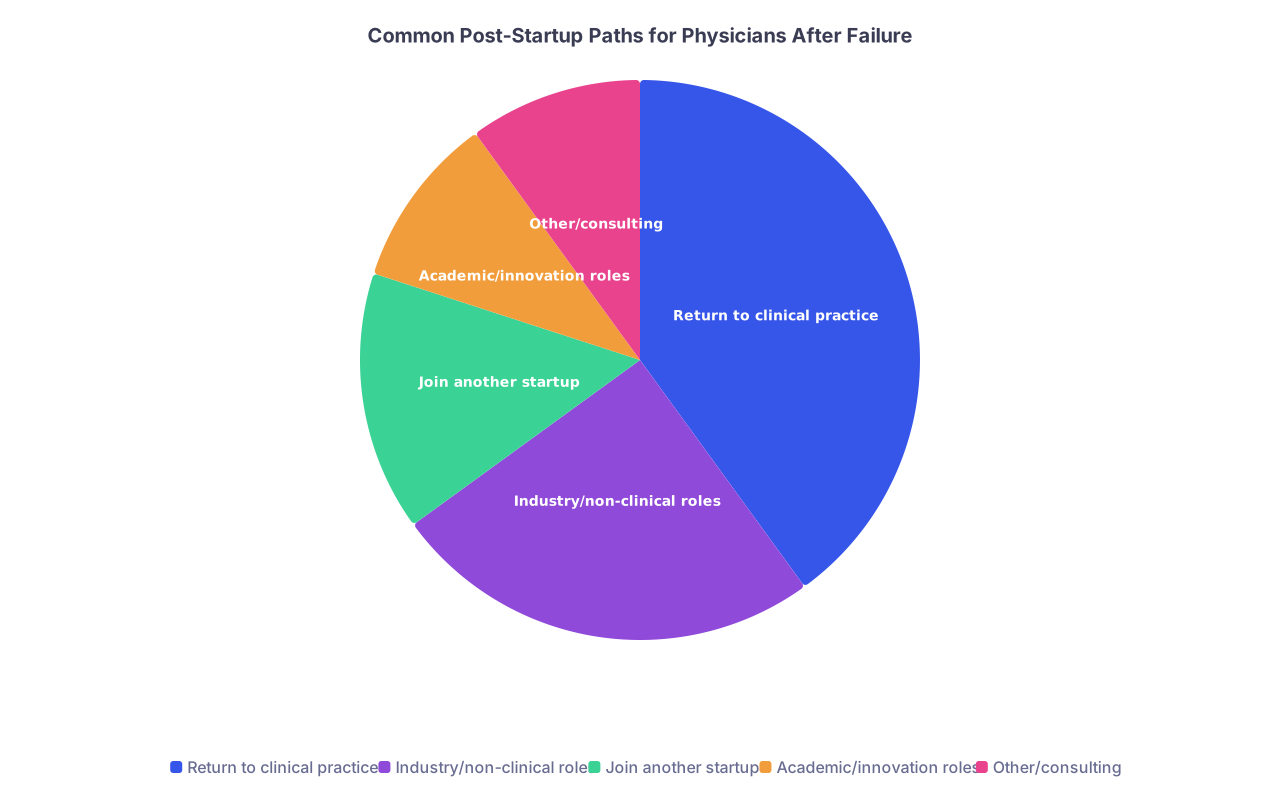
| Category | Value |
|---|---|
| Return to clinical practice | 40 |
| Industry/non-clinical roles | 25 |
| Join another startup | 15 |
| Academic/innovation roles | 10 |
| Other/consulting | 10 |
Path 1: Crawling back to clinical medicine (that’s not actually “crawling”)
This is the big one you’re obsessing about: “Will they still take me back?”
Short answer: yes, usually. With caveats.
I’ve watched attending physicians walk away for 1–3 years to build digital health tools, staffing platforms, revenue-cycle startups, you name it. Some got acquired. Many flopped. The ones who wanted to go back to clinical work… almost all did. But how easy it was depended on a few things:
- How long they were away
- How they told the story
- How current they kept their clinical skills (and licenses)
- How desperate the local market was for their specialty
If you’re post-residency, early attending, and you veer off into startup land, here’s the harsh part: the longer you’re out, the more you’ll need to explain and possibly re-train a bit. But “I did a startup” is not some scarlet letter. In some places (large systems, innovation-minded departments), it actually earns you points.
I’ve seen a hospitalist group in a midwestern system literally say, “Oh, you built a triage platform? Great, we’re rolling out telehealth. We could use that perspective.” They didn’t care that the startup failed. They cared that she could show up on time, manage patients, and not be a nightmare on the schedule.
Where you run into friction is when your story sounds like this: “I hated clinical work, so I left for a startup, and now that it failed I guess I have to come back.” That vibe? Red flag. People pick up on it.
If instead it sounds like: “I spent two years building a tool to streamline specialist referrals. We raised a small seed round, got decent adoption, but couldn’t scale revenue. I’ve missed direct patient care more than I expected, and I’d like to bring what I learned about systems and efficiency into a group that’s trying to improve operations”—suddenly, you’re not the desperate founder returning. You’re the attending with extra skills.
Does every program director/CMO see it that way? No. Some will think you’re flaky. Some are protective of “traditional” trajectories. You don’t need all of them to say yes. You need a few.
The key clinical recovery levers:
- Keep license and board certification active if at all possible (yes, this might mean moonlighting or per diem work while you build your company).
- Keep some touch with clinical reality: urgent care shifts, telemedicine, locums. Even 2–4 shifts a month is gold when you later say, “I never fully stepped away.”
- Be ready to talk concretely about your startup experience in terms of skills: workflow design, change management, communication with non-clinical stakeholders, understanding payor dynamics, etc.
If you’re already imagining the worst—“no one will hire me, I’ll be 39 and unemployable”—stop and actually look at your specialty’s job boards. Pulm/crit, anesthesia, EM (even with its current mess), IM hospitalists (especially rural), psych… there are still places desperate enough that your “nonlinear path” will be a curiosity, not a disqualifier.
Path 2: Industry jobs that secretly like failed founders
Here’s the thing no one told you in residency: outside of medicine, “I tried to build something and it died” is almost a badge of honor.
Product managers, medtech PMs, pharma MSL leads—they see “former founder” and think: this person knows how to deal with chaos.
I’ve watched a physician whose remote monitoring startup flopped land a clinical strategy role at a major telehealth company with a comp package better than their old attending job. Why did they hire her? Not because the startup succeeded, but because she understood:
- Claims data
- Integration with EMRs
- Why docs don’t use half the tools they’re given
- How to talk to investors and front-line clinicians
Your worst fear is: “They’ll see me as a loser whose company tanked.” The more accurate reality: “Most people in industry assume your early-stage startup failed because early-stage startups fail.” That’s baseline, not shame.
Where do physicians go after startup failure?
| Role Type | Typical Title | How Your Startup Story Helps |
|---|---|---|
| Tech / Digital Health | Medical Director, Product Lead | You understand users and workflows |
| Pharma / Biotech | MSL, Clinical Development | You know evidence and endpoints |
| Payer / Insurance | Medical Director, UM Lead | You get cost, utilization, outcomes |
| Consulting / Advisory | Healthcare Consultant | You’ve lived system pain points |
| Health System Innovation | Innovation Lead, CMIO track | You bridge clinicians and operations |
Companies like people who’ve seen the ugly side of building: dealing with bad product-market fit, failed pilots, reluctant clinicians, broken reimbursement. If you can speak that language, you’re ahead of the average attending who’s only lived inside one hospital.
But—and this is where anxious brains go wild—you have to prepare for the interviews. If you show up like, “My startup failed, it was awful, everything was unfair, investors didn’t get it,” that smells like blame and lack of insight.
What they want to hear is something more controlled, like:
“We built an AI triage layer for urgent care intake. We got strong engagement in initial pilots, but we underestimated integration complexity and didn’t find a sustainable payment model. I learned a ton about health system procurement, internal politics, and bi-directional data flow. I’m interested in applying those lessons inside a larger organization that already has distribution.”
Notice: no drama. No self-flagellation. Just “here’s what happened, here’s what I learned, here’s what I want to do next.” That’s what lets a failed startup become a credential instead of a liability.
Path 3: Joining someone else’s startup (yes, even after yours dies)
You’re probably thinking, “Who would trust me after I already crashed one?” But early-stage founders and investors quietly love ex-founders—even the failed ones.
Why? Because you:
- Know what pain feels like
- Are less naive about timelines and burn
- Understand how fragile everything is under the hood
- Won’t be shocked when the first MVP is embarrassingly bad
I’ve seen physician founders whose own company shut down later become Head of Clinical at another Series A startup doing something adjacent. They didn’t hide the failure. They leaned into it.
You’re not the wide-eyed doc founder anymore. You’re the person who knows how messy payor contracts are, how long it actually takes to get IRB approval, how physicians actually react to “disruption.”
The trick is to shift your own internal story from “I failed” to “I saw this movie once already, and I know how to make it slightly less horrible next time.”
That mindset shift is non-trivial, I know. When everything is collapsing, your default narrative is self-blame: “I was a bad CEO. I wasn’t cut out for this.” Sometimes you really did make serious mistakes. That doesn’t mean no one will trust you ever again. It means your next role might be better suited: not CEO, but CMO, Medical Director, or early clinical hire.
Another subtle upside: you’ll smell bad ideas now. If you join another startup post-failure, you’ll scrutinize the business model hard. That’s not pessimism. That’s survival.
Path 4: Academic and hospital innovation roles (the safe-ish hybrid)
Some physicians crawl out of the ruins of a startup and realize: “I like innovation, but I don’t ever want to worry about payroll again.”
So they go back into big institutions—but in roles that sit at the intersection: clinical + innovation office + digital health pilots.
A real-life pattern I’ve seen:
- Physician leaves fellowship → builds an AI-enabled triage system → fails to secure Series A → shuts down after 2 years.
- Goes back to a large academic center as an attending.
- Takes partial FTE in the system’s innovation hub / digital health team.
- Suddenly is the “former founder” voice in the room when they pick vendors, pilot tools, or try to build in-house solutions.
Do you lose some autonomy? Yes. You’re not the one calling the top-level shots. But you gain a floor: salary, benefits, stable schedule, safety. And you still get to scratch the “build something better” itch.
Hospitals and health systems are slowly waking up to the fact that you can’t improve care with a bunch of consultants who have never admitted a patient. A physician who:
- Trained here
- Left for a startup
- Failed
- Came back
…is actually a pretty perfect profile if the institution has any real appetite for innovation.
That said, not all places do. Some “innovation centers” are just window dressing. You’ll need to vet them: is this a place that has actually built or adopted new models, or is it all press releases and no execution?
How to protect your future self while you’re still in the startup
This is the part you won’t want to think about because it feels like jinxing things. But planning for failure doesn’t cause failure. It keeps you from getting totally wrecked.
A few unsexy guardrails, from watching people do this badly:
Don’t let your license lapse “because I’m busy.” Getting that back can be painful. Keep CME going. Pay the fees. Future you will be grateful.
Resist totally zeroing out clinical work unless you absolutely must. One telemedicine shift a week. A weekend urgent care every other month. Something to let you say “I stayed clinically active.”
Keep your LinkedIn and CV updated in real time. Don’t wait until the meltdown to reconstruct dates, responsibilities, metrics. When it’s time to move, you won’t have emotional bandwidth for that.
Don’t trash medicine publicly. That Medium post about how “medicine is broken and stupid and I escaped” might feel cathartic at 2 a.m., but it will look very different when you’re applying for a hospitalist job later. Vent in private.
Pay attention to your burn—personal burn. If your startup fails and you’re also in personal financial free fall, your options shrink. Keep a floor: low fixed expenses, emergency fund if at all possible, don’t personally guarantee things you don’t understand.
This isn’t cowardice. This is risk management—same muscle you use when you’re thinking about anticoagulating a frail 80-year-old with a fall risk.
What failure actually feels like (and why your brain lies about “forever”)
The part that will shock you isn’t the business dying. It’s how physical the shame and grief feel.
I’ve watched physician founders sit in their cars after telling their small teams it was over, hands shaking like they’d just finished a brutal code. There’s this mix of:
- “I let everyone down.”
- “I wasted years I could’ve been progressing as an attending.”
- “My co-residents are on partnership track and I’m…here.”
- “Maybe everyone secretly thought I was delusional.”
Your brain will tell you: this status—failed founder, career limbo—is permanent. That this is your new identity forever.
It’s not. But you won’t believe that in the moment. So write this down somewhere for your future self:
The job market will look different in 6–12 months than it does the week you shut down your company. Your own appetite for clinical work or industry jobs or another startup will also look different. Don’t hard-commit to your worst thoughts in the first 3 months after failure.
If you can, give yourself a decompression period. Locums. Telemed. Short-term contracts. Enough money to breathe while your nervous system resets. This is when self-sabotage happens: panicked, you sign a long-term, miserable job that you hate, just to “fix” the narrative quickly.
You don’t need to fix the narrative quickly. You need to survive it thoughtfully.
How to actually talk about the failure (without sounding pathetic)
Everyone’s nightmare: the interview question.
“So, tell me about what happened with your startup.”
You imagine yourself stumbling through a mix of excuses and self-blame. Here’s a simple structure that works better:
- One-line description of the company
- What went right (brief)
- What ultimately killed it (specific, no drama)
- What you learned that’s directly relevant to the role you’re applying for
- Why this role is your intentional next step, not just a rebound
Example:
“We built a platform to help primary care practices manage chronic care outreach more efficiently. We had strong engagement in a few independent practices and modest early revenue, but we struggled to scale sales into larger systems and underestimated how long procurement cycles would be. Ultimately we couldn’t raise another round and chose to wind down responsibly rather than drift. Through that, I learned a lot about workflow design, stakeholder alignment, and the actual barriers practices face when you ask them to adopt new tech. I’m interested in this hospitalist role at a system that’s actively implementing care redesign, because I want to combine hands-on patient care with that systems understanding instead of being entirely outside clinical work.”
No theatrics. No martyrdom. You’re not auditioning for a tragedy. You’re showing judgment.
The uncomfortable upside: you’ll never see your career the same way again
Here’s the thing: once you’ve watched a startup die, you can never totally buy into the illusion of stability again. Not in medicine, not in industry, not anywhere.
That sounds scary. But it’s also freeing.
You’ll see clearly that:
- Your “safe” hospital job can vanish with one merger.
- Your “solid” telehealth company can fire half the staff in a cost-cutting round.
- Your “secure” academic position depends on grant cycles and institutional politics.
Instead of that making you more anxious, it can actually push you toward a healthier stance:
You stop fantasizing about a perfect, risk-free career path. Instead, you start asking: “What skills am I building that travel with me no matter what blows up?”
After a startup, you’ll have more of those than you realize: negotiating, basic finance, hiring, firing, understanding incentives, thinking in systems. Medicine almost never teaches you those. Startups do, brutally.
And you’ll carry that into whatever you do next—clinical, industry, another company, or something you haven’t even imagined yet.
Quick reality check before you spin out again
Let me pin down the three things I want you to walk away with, so when your brain starts spiraling at 1 a.m., you have something concrete to push back with:
- Most early-stage startups fail. Physician-led ones too. That doesn’t make you uniquely broken; it makes you normal in a high-risk game.
- You are not “unemployable” after a failed startup if you keep your license alive, maintain at least a thread of clinical work when possible, and learn how to tell the story without drama or self-pity.
- There are multiple viable recovery paths—back to clinical care, into industry, into another startup, or into hybrid innovation roles. The real determinant is not the failure itself, but how you respond, how you frame it, and whether you protect your future options while you’re still chasing the dream.
You’re allowed to be scared of failing. Just don’t let that fear pretend it knows the end of the story. It doesn’t.