
The harsh truth: your clinical problem can be 100% real and still get 0% investor interest.
And that disconnect messes with your head.
You’re post‑residency or staring down the job market, you’ve watched patients get crushed by some stupidly fixable problem, and now you can’t unsee it. You build a deck, maybe a prototype, maybe even a pilot… and investors just shrug.
So your brain goes straight to: “If no one wants to fund this, maybe my idea is pointless. Maybe I’m wasting my life. Maybe I should just sign that hospital contract and forget this ever happened.”
Let me be blunt: investors ignoring your problem does not mean the problem isn’t real, important, or solvable. It usually means you’ve wandered into one (or several) ugly gaps between clinical reality and investor logic.
Let’s walk through those gaps, the worst‑case fears you’re probably spiraling through, and what you can actually do next.
1. Investors Don’t Care About Patients. They Care About Markets.
This is the first gut punch.
You’re thinking: “This kills people. How is that not enough?”
They’re thinking: “This kills people… and still might not be a scalable business.”
Those are not the same thing. At all.
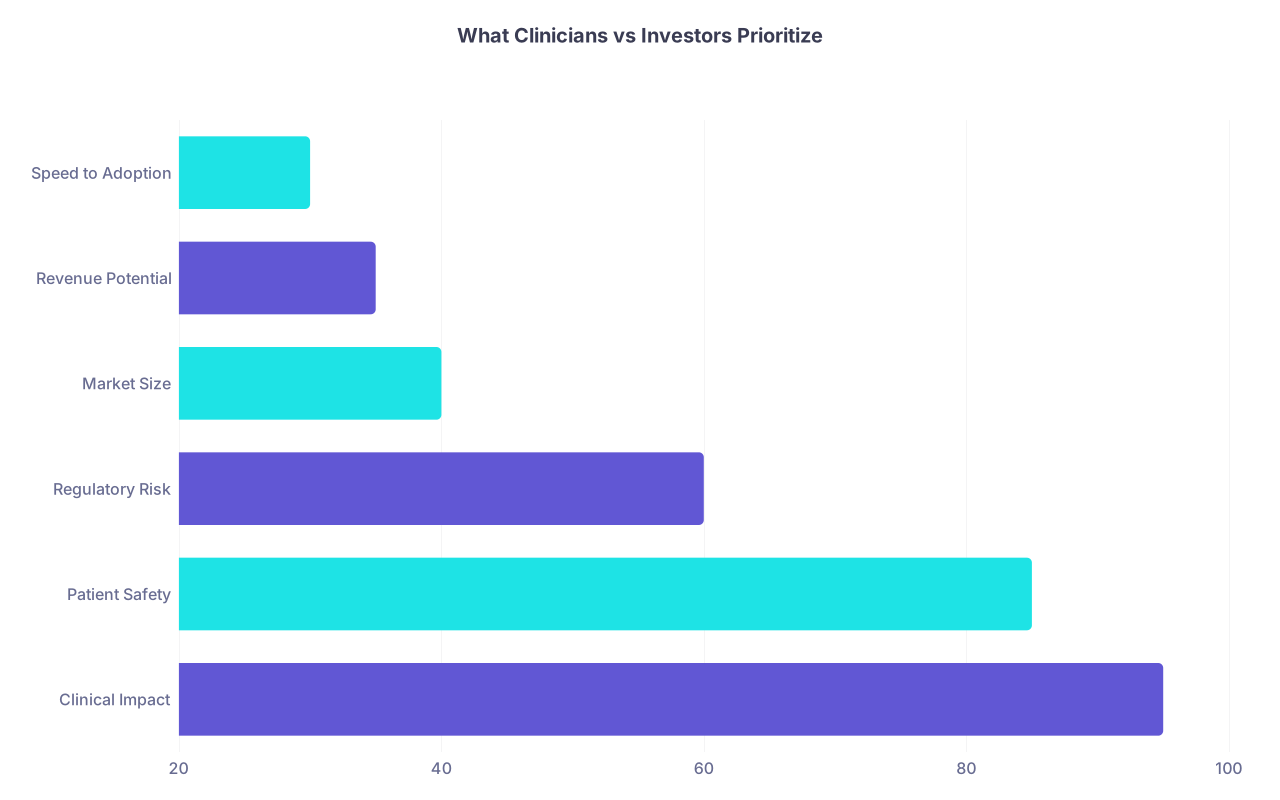
| Category | Value |
|---|---|
| Clinical Impact | 95 |
| Patient Safety | 85 |
| Regulatory Risk | 60 |
| Market Size | 40 |
| Revenue Potential | 35 |
| Speed to Adoption | 30 |
Here’s what usually happens:
You: “We can reduce sepsis mortality by 10% with this workflow tool.”
Investor (internally): “Sepsis workflow = hospital IT = brutal sales cycles = low margins = I’d rather poke my eyes out.”
They’re not monsters. They just play a different game. Their rules:
- Market size has to be big enough and fast enough
- Adoption can’t be a 3‑year slog through hospital committees
- The buyer must have a clear budget line and willingness to pay
- Revenue must be predictable, repeatable, and ideally recurring
So when you pitch “clinically obvious” problems like:
- Residents wasting 2 hours a day on prior auths
- Nurses double‑charting in EHRs and paper flowsheets
- Peri‑op communication failures causing delays
You feel like you’re describing a burning building.
They see: compliance‑driven buyers, endless pilots, 12–24 month sales cycles, and 20 different stakeholders who can say “no.”
The fear in your head:
“If they don’t care, I must be solving the wrong thing.”
More likely truth:
You’re solving a real problem in a terrible business environment.
That’s different.
2. The 3 Most Common Reasons Investors Ghost Clinical Startups
Let’s dissect the nightmare scenarios you’re probably imagining and put some structure on them.
| Objection Type | What They Actually Mean |
|---|---|
| “Too early” | No traction, no revenue, all theory |
| “Too small a market” | I don’t see a path to $100M+ revenue |
| “Go talk to strategics” | I don’t want to fund long hospital sales |
A. “Maybe my problem isn’t big enough.”
This one hurts, because on the wards it felt huge.
You saw:
- Delayed diagnoses because imaging reports were buried
- Discharges delayed 8 hours because no one called transport
- Burned‑out colleagues sobbing in the call room at 3 a.m.
You know it’s big.
But investors define “big” differently:
- Total addressable market (TAM): Usually they want billions
- Realistic obtainable market (SOM): Can you reliably grab a piece?
- Who pays: Hospitals? Payers? Employers? Patients? Pharma?
If your solution:
- Only works in ICU step‑down units using Epic
- Requires a custom integration per site
- Saves “time” but doesn’t clearly save money
It can feel huge clinically and still be “meh” commercially.
Worst‑case thought spiral:
“If this isn’t big enough, I’ll never find an idea that is. I’m just not cut out for this.”
Reality check:
You may need to rewire the framing, not scrap the idea.
Same problem, different angle:
- Instead of: “Helps residents round faster”
- Try: “Reduces length of stay by 0.2 days per patient” and back‑calculate revenue lift
Same real‑world impact. Different numbers on a slide. Different reaction in a partner meeting.
B. “Maybe I’m just not a ‘founder type.’”
You watch those polished Stanford MBAs on YouTube talking about “market dynamics” and “CAC/LTV ratios” like they were born pitching.
You feel like an imposter with call‑room energy and dark circles.
Random, painful truth: I’ve seen brilliant physicians with the right problem get dismissed in 5 minutes because they:
- Led with a 10‑minute story instead of 2 killer numbers
- Never mentioned who pays for this and why they’d urgently buy
- Couldn’t answer “How do you get from 1 pilot to 100 customers?”
That’s not about your worth. That’s about translation.
Most physician founders underestimate how different the language of startups is from clinical reasoning. It’s not intelligence. It’s dialect.
You’re fluent in:
- Pathophys, risk stratification, sensitivity/specificity
- System failure modes, real‑world workflows, patient harm
You’re expected to suddenly be fluent in:
- Market segmentation
- Pricing models
- Sales cycles
- Unit economics
You’re not broken. You’re just bilingual in the wrong order for Sand Hill Road.
3. How to Tell If the Problem Is Actually Bad… or Just Poorly Positioned
This is what keeps you up at 2 a.m.:
“What if the problem is just… dumb? And nobody wants to tell me.”
Here’s a harsh but useful filter.

| Category | Value |
|---|---|
| Niche Workflow | 1,20 |
| Moderate Ops | 3,40 |
| Big Cost Driver | 7,70 |
| Regulatory Must-Have | 8,80 |
| Revenue Generator | 9,90 |
Ask yourself 5 questions:
Does someone clearly lose or gain money because of this?
Not “time” in the abstract. Actual dollars. Reduced penalties, increased throughput, better coding, fewer readmissions.Is the buyer obvious?
CMO? CFO? VP of Revenue Cycle? Payer Medical Director? If your buyer is “the hospital,” that’s vague.Can you show something that looks like traction?
Even small: a pilot, a letter of intent, someone paying you anything.Is the problem urgent for the buyer this year?
Not “would be nice,” but “we have a budget line and performance metric tied to this.”Could this, in theory, get to $10M+ annual revenue in a sane timeframe?
If you get honest and the answer is clearly no, you might have a non‑VC‑backable idea.
If you score:
- Yes on 3–5 of these → Your problem is probably fine. You have a positioning/communication challenge.
- Yes on 0–1 → You may have a real clinical problem but a bad venture business. Not your fault. Just different goals.
4. What to Do When VC Isn’t Biting (and You’re Terrified This Is the End)
Here’s where your brain goes nuclear:
- “If venture capital doesn’t want it, it must be worthless.”
- “If I don’t raise now, I’ll be stuck in a job forever.”
- “If I go back to clinical work, it means I failed.”
No. No. And also no.
There are four paths you’re probably not taking seriously enough.
Path 1: Build a smaller, real business (not a VC rocket ship)
Unsexy truth: tons of MD‑founded companies quietly make:
- $300k–$1M/year
- Solve very specific problems
- Never raise a dollar of venture money
Examples I’ve actually seen:
- A call‑schedule and locums optimization tool for one specialty
- A niche RCM product that fixes one specific denial pattern
- A small SaaS that auto‑generates discharge instructions by specialty
These will never be unicorns. Investors yawn. But they change the founder’s life.
Your fear: “If it isn’t huge, it doesn’t ‘count.’”
Reality: Freedom counts. Paying your bills doing meaningful work counts.
Path 2: Target different investors entirely
If your “clinical problem” is heavily:
- Quality‑of‑care focused
- Burnout focused
- Health equity focused
- Safety / guideline adherence focused
Traditional VC might never bite early. But:
- Health system innovation funds
- Strategic investors (Epic App Orchard partners, device companies, pharma)
- Foundations and non‑profit grants
- Employer coalitions and payer innovation arms
These folks care more about outcomes, not just multiples.
You’ll have slower cycles but more aligned values.
Path 3: Use your MD job as your first “angel investor”
I know this sounds like selling out. It’s not.
Take a “bridge” attending job that:
- Has predictable hours or block schedules
- Gives you one or two fully free weekdays
- Maybe a lower salary but dramatically fewer nights/weekends
You essentially use your clinical work to:
- Fund your MVP or early hires
- Keep you from desperate, bad fundraising choices
- Let you build with actual headspace instead of panic
Is it perfect? No. You’ll be tired. You’ll feel split.
But it’s miles better than begging investors to care about a problem they will never see the way you do.
Path 4: Iterate the problem, not your identity
This fear is sneaky:
“If this problem isn’t fundable, I personally am not fundable. I missed my shot.”
Investors are actually biased in your favor longer than you think. Once they believe in you as a founder, the specific clinical wedge can change.
I’ve watched:
- A sepsis prediction startup morph into a generic hospital analytics tool
- A discharge coordination product pivot to skilled nursing and post‑acute
- An MD burnout tool become a scheduling and workforce optimization platform
The initial “clinical problem” is like your first attending job: not necessarily forever.
You’re allowed to pivot without erasing the fact your insight came from real patients.
5. Emotional Reality: It’s Going to Feel Like a Personal Rejection
Let’s not sugarcoat it.
Being told “no” after explaining something you watched harm patients is brutal. It feels like they’re saying:
- “That suffering doesn’t matter.”
- “Your judgment about what’s important is wrong.”
- “You’re naïve.”
You’ll want to:
- Abandon it completely
- Or double down and refuse to adapt “on principle”
Both are trauma responses, honestly.
A healthier middle move:
Write down the clinical core you won’t compromise on.
Example: “I will not build something that shifts burden to frontline staff with zero benefit to patients.”Write down the business parts you’re willing to flex:
The buyer, the feature set, the pricing, the workflow, the specific wedge.Talk to 10 buyers (not 10 investors). Ask brutal questions:
- “Is this even in your top 5 priorities this year?”
- “What are you actually measured on?”
- “What did you already try that failed?”
Translate what you learn into one sentence:
“We help [specific buyer] [do X metric] by [Y approach], so they can [avoid Z cost/pain].”
If you can’t write that sentence in a way that lands with buyers, that’s your problem—not that your idea is morally invalid.
6. A Quick Reality Check on Timelines (You’re Not Late)
Another anxiety: “If no one cares now, I missed the window. Someone else will build it, or the system will just stay broken, and I’ll be stuck.”
The healthcare graveyard is littered with “too early” startups that:
- Tried solving interoperability in 2008
- Tried telehealth before payers cared
- Tried remote monitoring without reimbursement
Many of those ideas are now multi‑billion‑dollar markets—just 5–10 years later.
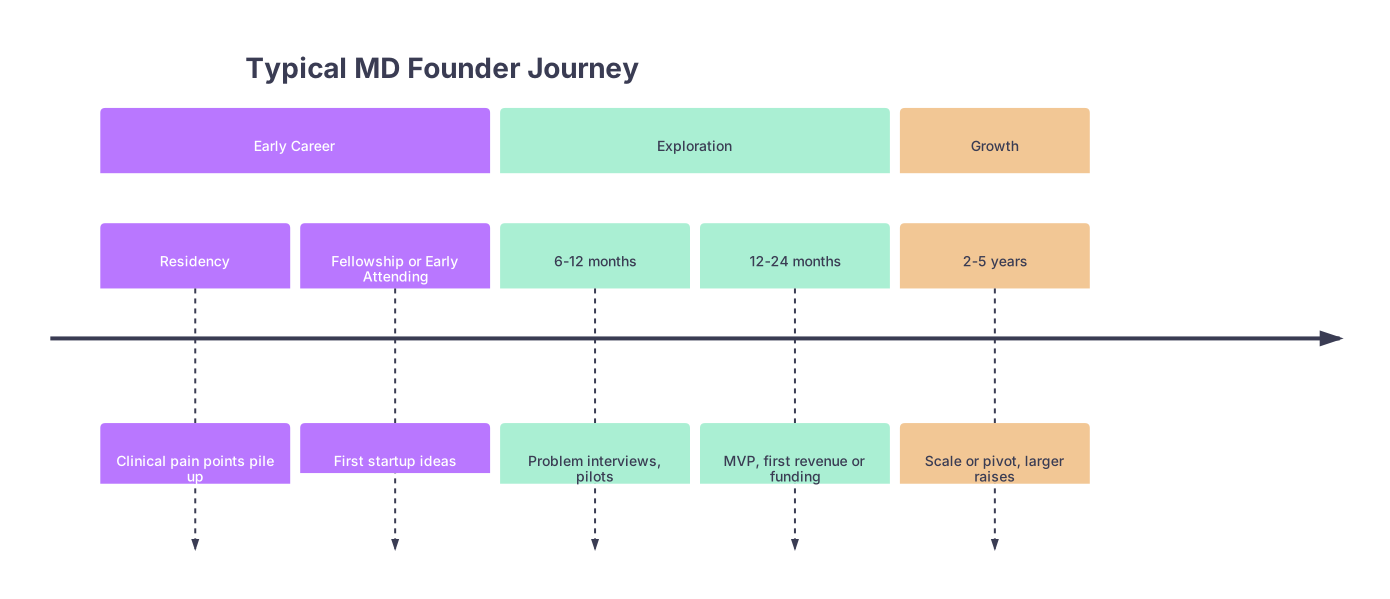
| Period | Event |
|---|---|
| Early Career - Residency | Clinical pain points pile up |
| Early Career - Fellowship or Early Attending | First startup ideas |
| Exploration - 6-12 months | Problem interviews, pilots |
| Exploration - 12-24 months | MVP, first revenue or funding |
| Growth - 2-5 years | Scale or pivot, larger raises |
You might be too early for VC but right on time for:
- Pilots
- Non‑dilutive grants
- Quiet bootstrap revenue
And that’s enough to keep the idea alive until the market catches up.
You’re not running out of time as fast as your brain is telling you.
FAQ (Exactly 6 Questions)
1. How do I know if I should just give up on this idea?
Give it a structured stress test. Talk to at least 10 real buyers (not clinicians unless they control budgets) and ask where your problem ranks in their top priorities for the year. If you consistently hear “this is #7 or #8 at best,” and you can’t find a way to reframe it into one of their top 3, it might be time to either pivot the product or accept it as a side project, not your main startup. That’s not failure; that’s triage.
2. What if another startup starts working on the same problem and actually gets funded?
This is a nightmare scenario in your head, but in practice, it’s often good news. It validates the problem and proves there’s a market. You can either differentiate (different segment, different buyer, different feature focus) or aim to be the “picks and shovels” tool that supports the broader space. And yes, occasionally you were just too early or too specific—seeing someone else succeed doesn’t mean you were wrong; it means timing and framing matter more than we’d like.
3. I keep hearing “come back when you have more traction.” How am I supposed to get traction without funding?
You bootstrap the smallest, ugliest version that proves the business, not just the tech. That might mean a no‑code prototype, a manual service version, or a physician consulting model that mimics what your software will automate. Your goal: get anyone to pay anything that shows willingness to pay for the outcome you promise. Investors don’t care if it’s duct‑taped behind the scenes—as long as the demand is real.
4. Should I bother learning “startup stuff” (unit economics, CAC, LTV) if investors don’t even care about my space right now?
Yes. Because those skills are portable. Even if this exact problem never becomes fundable, understanding how to think like an investor and an operator will make you dangerous—in a good way. You’ll evaluate future ideas faster, negotiate jobs better, and even be a better internal innovator if you end up in a hospital leadership role. This isn’t wasted time; it’s learning a new clinical language.
5. Does going back to a full‑time clinical job mean my startup days are over?
No. It just means you need stability right now. Plenty of founders cycle between full‑time, part‑time, and sabbatical‑style clinical work as their companies evolve. You can use a couple of stable years to pay down debt, stack savings, and refine your ideas. Companies die from founder burnout and financial panic as often as they die from bad markets. Protecting your baseline isn’t quitting; it’s buying yourself more runway.
6. How do I emotionally handle investors not caring about problems that traumatized me as a clinician?
You separate two truths:
- The suffering you saw is real, and it matters.
- Venture capital is a narrow financial tool, not a moral arbiter.
Talk about the trauma with people who get it—co‑residents, therapists, mentors—not with investors who are optimizing portfolios. Then, when you pitch, treat it like presenting a case to a tumor board: you’re there for a decision on a plan, not for validation of the pain itself. That validation has to come from your peers and yourself, not from a term sheet.
Bottom line:
Most likely, your clinical problem is real; the mismatch is with business logic, not reality.
You have more levers than “VC or nothing”—small business, grants, strategics, and clinical income can all be fuel.
You’re not behind, and you’re not disqualified as a founder just because a handful of investors don’t get it right now.