
The fantasy that you just “burn the boats” and leap from a stable attending job into a startup is dangerous. That’s how doctors go broke and end up crawling back to hospital employment on worse terms.
Let me say it bluntly: the smart physician founders are terrified too. They just manage their risk better than everybody else.
You’re not crazy for being scared. You’re responsible.
You’ve got loans, maybe kids, maybe aging parents, maybe a mortgage at 6.5%. You’ve watched colleagues get chewed up by “healthtech” people who talk a big game about “runway” and “burn rate” while your real fear is, “How do I pay childcare if this blows up?”
Let’s walk through this like an actual anxious, rational adult. Because the goal isn’t “be fearless.” The goal is “don’t destroy your life in the name of ‘entrepreneurship’ while still giving yourself a real shot.”
The real risks you’re actually scared of
Everyone online talks about “founder risk” like it’s some romantic badge of honor. That’s not what keeps you up at 2am staring at your phone.
You’re probably thinking:
- “What if my startup fails and I can’t get another attending job?”
- “What if I drag my family through financial stress for some stupid idea?”
- “What if I’m the doctor who left a 400k job for… nothing?”
- “What if my partners think I’m not ‘committed enough’ because I refuse to quit cold turkey?”
- “What if I burn out trying to do both and become unsafe clinically?”
That last one is a big one for a lot of people and they don’t say it out loud. “Am I going to be the attending who misses something because I was up all night on Zoom with a dev team in India?” That’s the kind of thought that sits like a rock in your chest.
You know what? Good. That fear is what separates you from the tech bros who gamble with other people’s health and walk away “onto the next thing.”
But fear without a framework turns into paralysis. That’s what I see most often: highly capable physicians stuck in “what if” loops for years, watching mediocre ideas get funded and built by people with half their insight but double their willingness to act.
So here’s the ugly truth: you can’t remove risk. You can only shift it, shrink it, and choose which flavor to accept.
How real doctor founders actually de-risk the leap
Almost no sane physician founder just quits a full-time attending job on a random Tuesday and prays. The people who make this work usually go through a few distinct stages.

| Step | Description |
|---|---|
| Step 1 | Full time attending |
| Step 2 | Side project nights weekends |
| Step 3 | Part time or 0.8 FTE |
| Step 4 | Time limited runway plan |
| Step 5 | Full time founder |
| Step 6 | Return to full time attending if needed |
Stage by stage, it looks something like this.
Stage 1: Prove it has any pulse while you’re full-time
This is the phase you probably already live in: charts until 6:30pm, dinner, then laptop until midnight messing with pitch decks, product drafts, or random emails to developers.
It feels chaotic and unsustainable. It is. But this is where you answer the first brutal question: “Is this a real thing or just me avoiding my burnout by fantasizing about a startup?”
Before any smart attending walks away from stable income, they usually have at least some of this:
- Concrete evidence that someone wants what they’re building: user interviews, letters of intent, early pilot, pre-sales, waitlist signups, clear problem-solution fit.
- A clear customer: not “hospitals” or “patients,” but “mid-size community hospitals with no in-house analytics team” or “private practice PCPs who hate their current care coordination solution.”
- A pathway to revenue: not “we’ll monetize later,” but “we charge $X for Y, here’s who signs the contract, here’s why they’d pay.”
If you don’t have this yet, your risk isn’t leaving your job. Your risk is not having a business at all.
Doctor founders who manage risk don’t treat “idea + enthusiasm” as enough. They treat their idea like a patient: test, gather data, adjust, or abandon.
Stage 2: Use your attending job as risk insurance
You probably see your job as the thing chaining you down. Look at it differently for a second.
Your attending role:
- Covers your basic life expenses
- Keeps your CV current and your skills sharp
- Preserves your professional reputation
- Keeps your network alive (referrals, intros, potential early customers)
- Gives you credibility when talking to hospitals/payers: “I still work as an attending at X”
When founders in other industries quit, they freefall. When doctors quit, they usually have a parachute: you can still practice. The trick is to preserve that parachute intentionally.
Here’s how I’ve seen cautious physician founders think:
They don’t blow up every financial safeguard for the sake of “more runway.”
They often:
- Keep licensure, board cert, and credentialing current—even when they go all-in on the startup
- Maintain at least one per diem or contingent relationship they can scale up if needed
- Avoid burning bridges when they reduce hours; they explicitly say, “I’m reducing to 0.6 FTE to build a clinical tool I really believe in. I’d love to continue working here in some capacity even if it evolves.”
They are paranoid (in a good way) about reversibility. “If this tanks in 12 months, can I be back to full-time work within 3–6 months without a career scarlet letter?” That’s the question.
The “sane” stepping-down path: not all or nothing
You don’t have to jump from 1.0 FTE to jobless founder overnight. In fact, you shouldn’t.
Let’s be concrete.
| Path | Clinical FTE | Time for startup | Main tradeoff |
|---|---|---|---|
| Nights/weekends only | 1.0 | ~10–15 hrs/wk | Very slow, high burnout risk |
| 0.8 FTE | 0.8 | ~20 hrs/wk | Lower income, more focus |
| 0.5 FTE | 0.5 | ~30 hrs/wk | Scary income drop, fast progress |
| Per diem blocks | Variable | Clusters of focus time | Income unpredictable |
Most risk-aware founders I’ve seen go something like:
Year 0–1: Full-time attending + idea validation
Year 1–2: 0.8 FTE + serious product/user traction
Year 2–3: 0.5 FTE or full-time founder + per-diem coverage
During those shifts, they’re constantly asking:
- “Do the results I’m seeing justify more time?”
- “Is the bottleneck now truly my hours, or is the idea still too fuzzy?”
- “If I cut 0.2 FTE, do I have a specific plan for those hours, or am I just hoping more time = magic?”
If you go to 0.8 FTE and nothing much changes in your startup after 6–9 months, that’s data. Painful data. But it might save you from going to 0.5 FTE and then discovering the idea wasn’t that strong.
The math nobody wants to look at (but you have to)
Here’s where anxiety spikes: money.
You don’t want to do this part. You feel the dread in your chest just thinking about spreadsheets. But this is where a lot of the fear quiets down—because you’re replacing vague doom with actual numbers.
You need three things:
- Your true monthly “must-have” expenses (not DoorDash, not boutique gym, not aspirational savings—bare bones life).
- Your guaranteed income at each stage (full-time, 0.8, 0.5, per diem realistic average, not fantasy).
- Your “runway” if startup income is zero for 12–24 months.
Let’s sketch a simple scenario, just to show what founders are actually looking at.
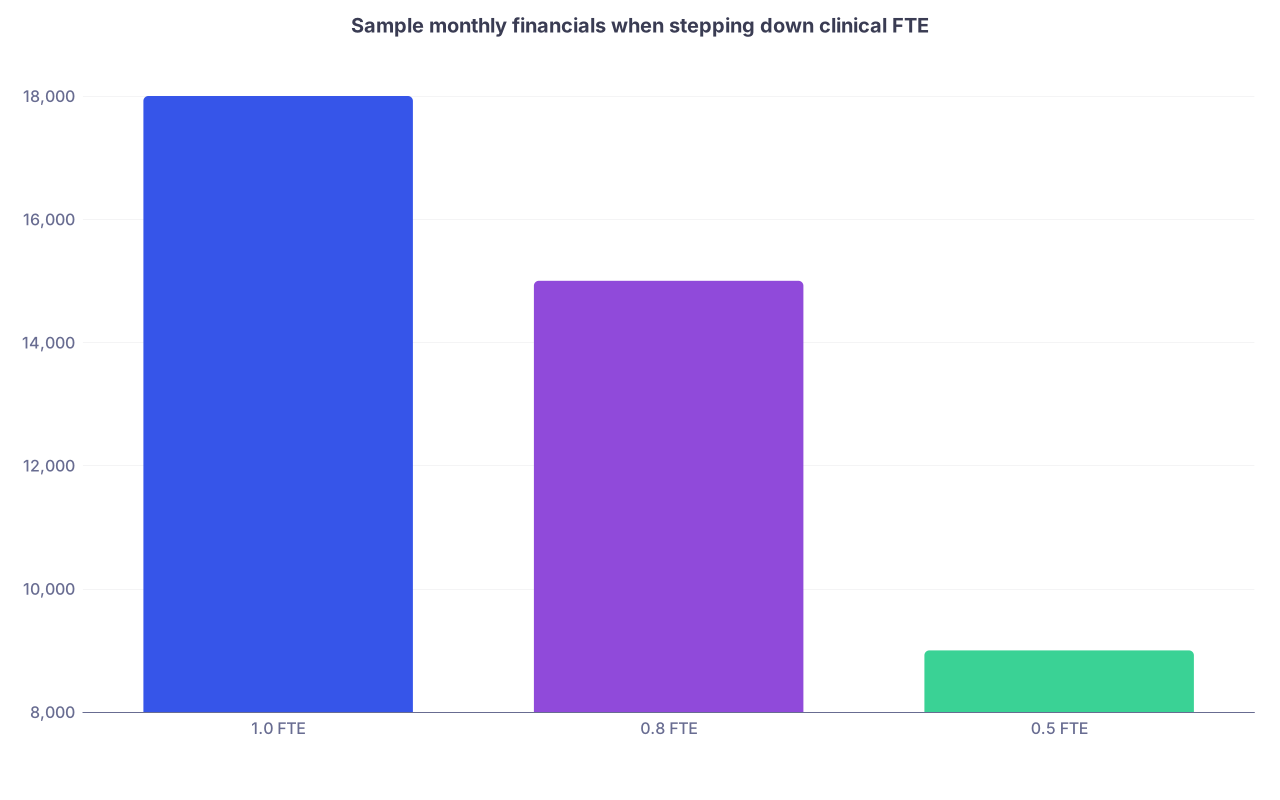
| Category | Value |
|---|---|
| 1.0 FTE | 18000 |
| 0.8 FTE | 15000 |
| 0.5 FTE | 9000 |
Say your bare-bones life is $8k/month (debt, rent/mortgage, basic food, basic childcare, minimal insurance). At:
- 1.0 FTE you clear ~18k/month
- 0.8 FTE you clear ~15k/month
- 0.5 FTE you clear ~9k/month
Now your questions become:
- At 0.8, can I still save a buffer while building?
- At 0.5, can I cover life with maybe small help from savings for a defined period?
- What’s my “I must go back up in hours” trigger? 6 months of savings left? 3?
Cautious doctor founders set explicit rules like:
“If cash savings ever drop below $X (say, 6 months of bare-bones expenses), I will immediately go back to 0.8 or 1.0 FTE, even if it hurts.”
Not “I’ll see how I feel.” Not “Let’s just stretch one more month.”
They pre-decide. Because they know once you’re in it, sunk cost and shame will mess with your judgment.
Reputation risk and the “what if I look like a failure?” problem
This one hurts more than the money for a lot of people.
You imagine: you tell your department chair you’re leaving to build a startup. They give you that tight smile. Two years later you’re emailing them asking if they have any openings.
It feels humiliating. Like “the doctor who thought they were too good for the wards and came crawling back.”
I won’t sugarcoat it—some people will judge you. Some will be weirdly gleeful. Medicine has a nasty streak of, “See what happens when you leave the flock?”
But here’s what I’ve actually seen play out:
- Many chairs and group leaders respect the attempt, especially if you left professionally and didn’t torch bridges.
- A failed startup on your CV, framed correctly, often reads as: leadership, systems thinking, understanding of healthtech/biz, tolerance of ambiguity. That’s valued in some settings.
- The only time it becomes a real problem is if you vanished without notice, behaved erratically, or let your clinical work slide while “foundering.”
Doctor founders who manage reputation risk do a few specific things:
They are upfront: “I’m building this thing. I don’t know how it will go. I want to do this without compromising care, so I’m stepping down gradually and very deliberately.”
They leave well: give plenty of notice, help recruit replacements, cover extra shifts on the way out, write handoff documents. People remember that.
They maintain ties: keep going to some grand rounds, maintain relationships, reply to emails. You don’t disappear into “startup land” and only reappear when you need a job.
And the big mental shift: “failure” isn’t “I tried a startup and it didn’t work.” Failure is “I stayed somewhere miserable and safe for 20 years and never tested what I was capable of.” That’s not motivational-poster nonsense. That’s just what regret looks like.
Patient safety and burnout: the thing you can’t just push through
This is the dark corner a lot of people avoid staring at too directly.
You know that “I’m holding it together by caffeine and vibes” feeling from residency. You can slip back into it by accident trying to be an attending + founder + parent + spouse.
Doctor founders I trust are almost neurotic about setting hard walls here. They know the line between tired and unsafe.
Some patterns they set up:
- They don’t do heavy overnight call if they’re also running high-intensity startup work. They pick roles with more predictable schedules when possible.
- They track their own error signals: more near-misses, more irritability, slow charting, forgetting small things. Those are not “personality flaws.” They’re warnings.
- They are willing to say no to “one more project” clinically. That QI thing. That committee. That extra teaching session. Not because they don’t care, but because their bandwidth is finite.
If you’re waking up at 4am with dread, snapping at nurses, and still trying to debug product requirements at midnight, you’re not “hustling.” You’re becoming a liability.
Risk-aware founders are willing to slow startup progress down a bit rather than let clinical care degrade. Because nobody wants to be haunted by, “Would I have caught that if I wasn’t so fried from Slack messages?”
Finding the right “floor” so you’re scared enough—but not paralyzed
The hardest thing here is balancing two types of fear:
- Too little fear → you leap recklessly, blow up your life, and swear off entrepreneurship forever.
- Too much fear → you never move, stay in a job that’s crushing your soul, and watch others build what you thought of first.
The doctor founders who thread this needle do something subtle: they intentionally choose a floor that feels uncomfortable but survivable.
Not “I can maintain my current lifestyle without any cuts.” That’s fantasy. Real tradeoffs usually look like:
- Smaller house or staying put instead of upgrading
- Delaying private school dreams for kids
- Fewer expensive vacations
- Driving a decent used car instead of leasing something flashy you “deserve”
It stings. Your co-attendings might be doing all of that while you’re hacking together prototypes or flying coach to some healthtech conference.
But that discomfort is part of your “investment.” Not in some grindset-hustle nonsense way. In a calculated, time-limited way.
The rule I like: if your worst-case realistic scenario is “I go back to 0.8–1.0 FTE, rebuild savings for 2–3 years, and my ego is bruised,” that’s annoying, not catastrophic.
If your worst-case scenario is “we can’t pay mortgage, I’m underwater on loans, my marriage collapses from stress,” you’re cutting too close.

How to know you’re actually ready to reduce your attending hours
Not emotionally ready. Nobody ever feels emotionally ready. I’m talking about objectively “I’m not being idiotic” ready.
Some strong signs:
- You’ve talked to at least 20–50 real target users/customers and can repeat their problem in their words.
- You’ve seen at least some version of “pull”: people asking, “When can I use this?” instead of you pushing everything uphill.
- You’ve tested the idea in cheap ways: mockups, pilots, manual versions, pre-sales—not just a 60-page Notion doc.
- You have a basic, boring financial runway plan written down, with numbers and dates.
- You know your clinical “floor”: what per diem/FTE mix you’d return to if needed.
- You’ve told at least 1–2 trusted colleagues/mentors who think you’re not delusional for trying.
And most importantly: you can answer, honestly, “If this fails, will I still be glad I gave it a real shot?” If the answer is yes, you’re closer than you think.
If your only acceptable outcome is “unicorn IPO or I hate myself,” that’s not entrepreneurship. That’s a self-esteem grenade.
You’re not choosing between “safe” and “risky.” You’re choosing your risk flavor.
Staying a stable attending is not actually “safe.” It has its own risks:
- Burnout that creeps up and never really goes away
- Administrative nonsense that gets worse every year
- Reimbursement changes that gut your specialty
- Hospital consolidation that slashes autonomy
- The quiet regret at 55 that you never tried anything else
Leaving for a startup is obviously risky in a different way:
- Income volatility
- Ego hits
- Uncertain timeline
- Real possibility of “this doesn’t work”
There’s no path where you don’t pay a price. There’s only the path where you pick your price on purpose.
So no, you’re not weak for being scared to leave a stable attending job. You’re rational. The doctors I worry about aren’t the scared ones. They’re the ones who blow up their life with no plan because someone on LinkedIn said “burn the boats.”
Real courage here looks boring from the outside: spreadsheets, gradual FTE changes, awkward conversations with chairs, saying no to lifestyle creep when your peers level up.
The anxiety probably won’t vanish. But it will change shape—from vague, suffocating “I’ll ruin everything” to specific, defined, “Here are my numbers, here’s my plan, here’s my stop-loss.”
Years from now, you won’t remember the exact day you decided to go from 1.0 to 0.8 FTE. You’ll remember whether you spent that decade trapped in fear—or whether you let yourself take a risk that your future self can respect.