
The default advice physicians get about “just forming an LLC” for their new company is lazy and often wrong.
If you are a physician founder post-residency, your corporate structure is not a paperwork detail. It is a weapon or a liability. Choose it well, and you can raise capital, protect your personal assets, optimize taxes, and add co-founders cleanly. Choose badly, and you will spend tens of thousands of dollars (and months of runway) fixing it under pressure from investors, acquirers, or regulators.
This guide is the version you should have gotten from a lawyer who actually understands physicians and startups, not just small practices.
Step 1: Get Clear On What You Are Actually Building
Before we touch LLCs, S corps, or C corps, you need to answer a more basic question:
What kind of “medical startup” are you really building?
Because structure depends heavily on what you do:
- A solo telemedicine practice serving one state
- A multi-state virtual clinic with plans to hire dozens of clinicians
- A software-only product (clinical decision support, scheduling, AI scribe, etc.)
- A hybrid model: tech + employed clinicians
- A device or diagnostics company aiming for FDA clearance and VC funding
- A consulting or expert witness business built around you personally
Those are not the same animal.
Here is a simple decision snapshot to orient you:
| Startup Type | Likely Best-Fit Structure |
|---|---|
| Solo or small group clinical practice | Professional LLC / PLLC or PC |
| Multi-state virtual clinic (scale) | Holding C Corp + clinical PC/PLLCs |
| Software-only, VC-backed | C Corporation (usually Delaware) |
| Hybrid tech + clinicians | C Corp + affiliated practice entities |
| Consulting / expert witness | LLC or S Corp (depending on taxes) |
Do not overcomplicate this early on. But do not pretend they are all the same either.
Ask yourself, bluntly:
- Will I want outside investors in the next 2–4 years? (Not just a “maybe someday” fantasy.)
- Will non-physicians ever own part of the core business?
- Will this operate across state lines delivering clinical care?
- Is this primarily a scalable product or primarily my personal labor?
Write down those answers. You will use them in the next decisions.
Step 2: Understand Your Core Options (Minus the Fluff)
You have five core structure buckets as a physician founder in the U.S.:
- LLC (or PLLC/PLLC-equivalent where required)
- S Corporation (an election layered on an LLC or corporation)
- C Corporation
- Professional Corporation (PC, sometimes called PA or P.C.)
- Hybrid / MSO + Practice Model (one tech/management entity + one or more professional entities)
Let me strip the jargon and give you the real-world differences that matter.
1. LLC / PLLC – The Default For Small, Service-Based Work
An LLC (or professional LLC where required for physicians) is:
- Flexible in ownership
- Simple to run
- Good for pass-through taxation
- Terrible if you want VC money or stock options at scale
Use an LLC/PLLC when:
- You are building consulting, expert witness, or small direct-pay practice revenue.
- You want simple accounting, pass-through income, and you are not planning to raise institutional capital.
- You may add one or two partners, but not a cap table full of angels, SAFEs, and seed funds.
You can elect S corp tax status later if it makes sense from a tax perspective. The legal shell (LLC) and tax status (S corp vs. partnership/sole prop) are different levers.
2. S Corporation – A Tax Election, Not a Business Type
Too many docs say “I have an S corp” when what they really mean is “I have an LLC or corporation taxed as an S corp.”
An S corporation is a tax status:
- Pass-through taxation
- Limits on number and type of shareholders
- Mandatory “reasonable salary” rules and payroll obligations
- No preferred shares (this alone makes VC investors roll their eyes and walk away)
S corp makes sense when:
- You have moderate, stable profits from a service-heavy business (like a niche concierge practice or consulting company).
- You want to reduce self-employment tax by paying a reasonable salary and taking the rest as distributions.
- You are not planning on institutional venture capital.
It is not the right vehicle for a serious, scalable tech startup.
3. C Corporation – The Default For Venture-Backed Startups
If you are talking about:
- Seed rounds, Series A, institutional investors
- Equity pools for employees
- Stock options, preferred shares, SAFEs, convertible notes
…you are talking about a C corporation, almost always a Delaware C Corp.
Pros:
- Investors understand it
- Clean cap table, multiple stock classes allowed
- Easy to implement stock option plans
- Corporate-level benefits, easier future exit structures
Cons:
- Double taxation (corporate tax + tax when dividends are paid)
- Slightly more complex compliance
- Stock-based compensation and QSBS rules need real advice
For a serious tech product, device, digital health platform, or national brand with scale ambitions, start as a C corp or plan a deliberate, early conversion.
4. Professional Corporation (PC) – For Clinical Care
Many states require physicians to use:
- Professional Corporation (PC, P.C., PA)
- Professional Limited Liability Company (PLLC)
for clinical practice, not standard LLCs.
Key rules:
- Usually must be owned by licensed physicians
- Used for activities deemed “the practice of medicine”
- Still may elect S corp taxation in some states, with constraints
If you are delivering care (telehealth, brick-and-mortar clinic, multi-site urgent care), you will likely need:
- A professional entity (PC/PLLC) for the clinical work
- A separate non-clinical entity for management, technology, or IP (more on this below)
5. Hybrid Structure: MSO + Professional Entity
If you plan to mix technology, operations, and clinical care—especially:
- Multi-state telemedicine
- Large multispecialty groups
- DPC networks or franchise-like rollouts
—the clean move is usually a Management Services Organization (MSO) plus one or more professional entities.
MSO (usually a C corp or LLC)
- Owns the software, brand, and non-clinical staff
- Can be owned by physicians and non-physicians
- Receives management fees from the professional practice
Professional Entity (PC/PLLC per state rules)
- Employs or contracts with physicians
- Holds clinical liability and medical decision making
- Often owned by physicians only (or subject to medical practice statutes)
This model also solves “corporate practice of medicine” problems in multiple states.
Step 3: Map Your Startup Type to a Structure
Now let’s connect reality (what you are building) to a recommendation.
Scenario A: Pure Consulting / Advisory / Expert Witness
Examples:
- Med-legal consulting
- Quality/peer review consulting
- Pharma advisory work
- Executive coaching for other physicians
Best structure path:
- Form a single-member LLC or PLLC in your home state.
- Start as disregarded entity (pass-through) for taxes.
- Once net profit > ~$150–200K consistently, talk to a CPA about S corp election for tax efficiency.
- Keep this separate from any future tech startup entity.
Scenario B: Small Direct-Pay or Concierge Practice, 1–3 Docs
Examples:
- High-touch concierge IM practice in one city
- Niche telepsychiatry for one state
- Lifestyle medicine clinic with limited footprint
Best structure path:
- Form a PLLC or PC if required, or an LLC if allowed for clinical practice in your state.
- Consider S corp election once revenue stabilizes and you are paying yourself a salary.
- If you build proprietary tech later, consider a second, non-clinical entity to own the IP.
Scenario C: VC-Backed SaaS or Digital Health Product (No Direct Care)
Examples:
- EHR plug-in or AI scribe
- Workflow automation for hospital systems
- Patient engagement app sold B2B
- Analytics platform for payers
Best structure path:
- Form a Delaware C Corporation from the start.
- Issue founder common stock to yourself and any co-founders.
- Implement a stock option pool for early employees and advisors.
- Qualify for QSBS (Section 1202) if possible (talk to tax counsel).
- If you own this personally while working in a hospital-employed role, review conflict of interest and IP policies with a lawyer.
Here, an LLC is a stall tactic. You will almost certainly have to convert to a C corp before serious funding. That conversion is not impossible, but it is extra legal cost right when money is tight.
Scenario D: Multi-State Telemedicine or Virtual Specialty Clinic
Examples:
- National teledermatology brand
- Virtual cardiology consult service operating in 10+ states
- Tele-psych with employed clinicians in many jurisdictions
You are dealing with:
- Corporate practice of medicine (CPOM) laws
- Stark, AKS, and state fee-splitting rules
- Multi-entity structures for compliance
Best structure path:
Form a holding C Corp (often Delaware) as your central “non-clinical” company.
For each state (or group of states), form a PC/PLLC for clinical operations.
Set up an MSO model:
- C corp (MSO) provides management, non-clinical staff, branding, and technology.
- PC/PLLC provides clinical care and hires/engages physicians.
- A Management Services Agreement (MSA) governs fees.
Keep investor equity in the C corp, not the PCs, to stay compliant with CPOM in restrictive states.
This is the structure I see again and again in serious telehealth companies.
Step 4: Clarify Ownership, Control, and Liability
You are not just choosing a tax outcome; you are choosing who owns what and who gets sued when things go sideways.
Protect Yourself Personally
For any entity:
- Use malpractice coverage for clinical work no matter what.
- Maintain separate bank accounts and clean accounting.
- Sign contracts as “Your Name, Title, on behalf of [Entity Name],” not just your name.
Do not operate serious businesses as a sole proprietorship just because you are “testing it.” That is how you wake up personally on the hook in a lawsuit.
Think Ahead About Co-Founders and Early Employees
Ask:
- Am I going to give equity to non-physician co-founders?
- Will I want advisors to have options or restricted stock?
- Are there early key hires I want to incentivize with ownership?
If the answer to any of those is yes, strongly favor:
- C corp for product/tech entities
- Equity only at the non-clinical entity level for MSO models
I have watched physicians try to shoehorn co-founders into an S corp structure. It is clumsy at best and a mess at worst.
Step 5: Tax Reality Check (Without Turning This Into a CPA Manual)
You should not choose structure just for taxes, but you would be foolish to ignore them.
Here is the quick comparison that matters for you:
| Structure | Tax Type | Best For |
|---|---|---|
| LLC (default) | Pass-through | Simple consulting, early small practice |
| LLC taxed as S | Pass-through with payroll | Service biz with steady profits |
| PC/PLLC as S | Pass-through with payroll | Clinical income with moderate-high profit |
| C Corp | Corporate-level tax | Scalable tech / VC-backed / MSO entity |
Now, a visual to show where you should start depending on your main income source:
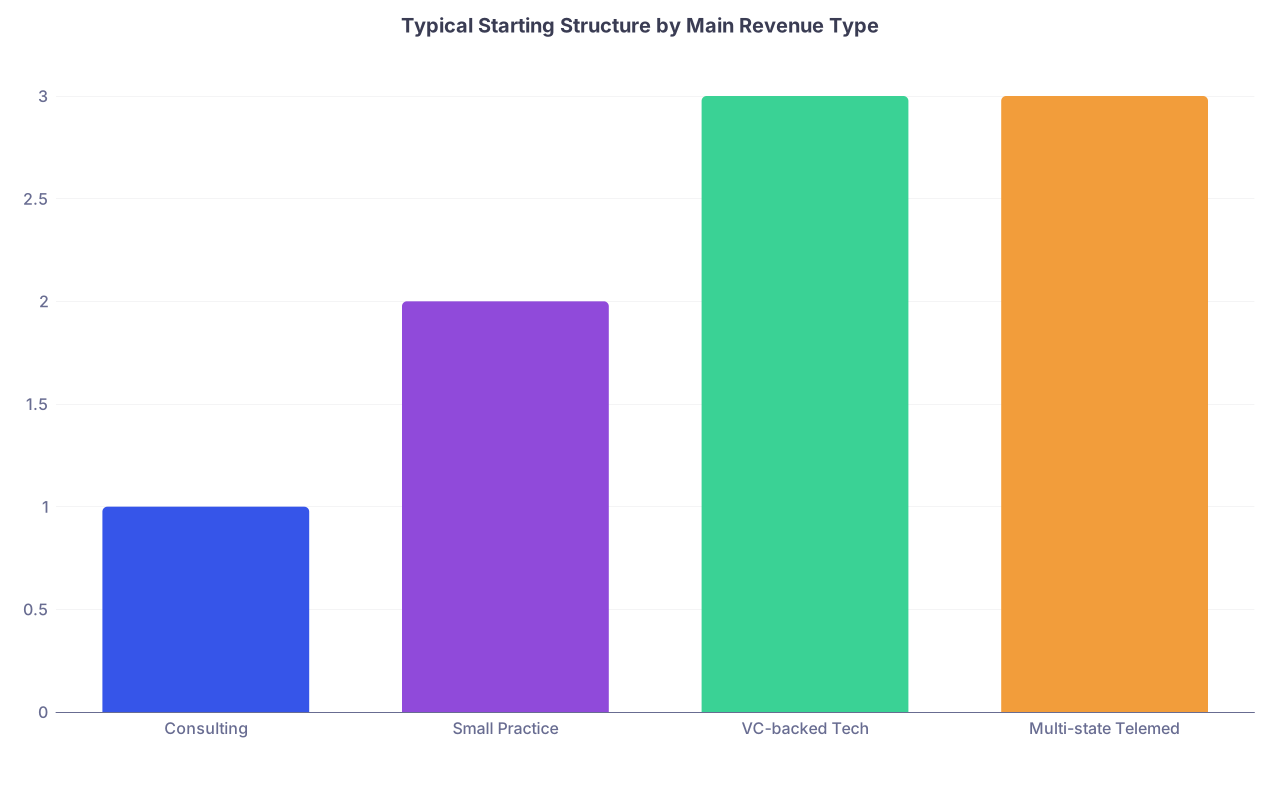
| Category | Value |
|---|---|
| Consulting | 1 |
| Small Practice | 2 |
| VC-backed Tech | 3 |
| Multi-state Telemed | 3 |
Legend (for your brain, not on the chart):
- 1 = LLC / PLLC
- 2 = PLLC or PC (often S election later)
- 3 = C Corp (with or without MSO + PC structure)
The main tax traps physicians stumble into:
- Electing S corp too early with volatile or low income.
- Running a C corp with lifestyle-level income and paying themselves mostly as W-2, creating unnecessary double tax.
- Mixing personal expenses inside the corporate account and wrecking liability protection.
Your sequence should look roughly like:
- Side consulting / idea stage → LLC (no S election yet)
- Stable, profitable service biz → evaluate S corp election
- Scalable product or MSO with investors → C corp plus supporting entities
Step 6: Plan for Funding and Exit Before You File Anything
You might think fundraising is 3–5 years away. Fine. But you should still align your structure now with the most likely future state.
Ask yourself:
- Do I want to be investable by angel and seed investors in the next 24 months?
- Is my best-case scenario an acquisition by a larger health system, payer, or tech company?
- Will my value be primarily IP/tech or my personal time?
If your real answer is:
“I want to build a product and maybe exit >$10M someday”
→ Start with a C corp for the product piece.“I want a high-income, low-headcount clinical operation serving my own panel”
→ PLLC/PC with tax optimization is fine.
Here is the pattern I keep seeing:
- The startups that cap out at “nice side income” are over-optimized for S corp tax savings.
- The startups that raise and scale were willing to accept C corp structure early, get their house in order, and look investable.
Step 7: Legal and Compliance Constraints for Physicians (You Do Not Get to Ignore These)
Physicians are not typical founders. You are licensed. You have boards. You have CPOM and Stark to worry about. Your structure must play by different rules.
Key constraints you cannot just Google away:
Corporate practice of medicine (CPOM)
- Some states prohibit non-physician-owned entities from employing physicians to provide clinical care.
- Solution: MSO + physician-owned PCs under tightly drafted MSAs.
Fee splitting and anti-kickback rules
- You cannot casually share clinical revenue with non-physician entities in many states.
- Your management fees must be fair market value and commercially reasonable.
Ownership and control rules for professional entities
- Many states require majority or 100% physician ownership of PCs/PLLCs.
- Non-physician spouses, investors, or corporate partners usually cannot “own the clinic” directly.
Hospital employer IP and conflict rules
- If you are employed by a hospital or academic center while building your startup, your employment contract may claim rights to inventions or require disclosure.
- Sometimes you need written waivers or side letters.
This is where an experienced healthcare startup attorney is non-negotiable. Not your cousin who does real estate closings.
Step 8: A Clean, Practical Formation Sequence
Let me give you a concrete path you can actually follow in the next 30 days.
If You Are Building Product-First (Tech / SaaS / Platform)
Engage a startup-savvy healthcare lawyer for a short, fixed-fee engagement. Ask for:
- Delaware C corp formation
- Founder stock issuance
- Basic IP assignment agreements
- Preliminary cap table setup
Form a Delaware C Corp:
- You as founder own 100% of common stock at inception.
- File in your home state as a foreign corporation if required for local operations.
Execute IP Assignment:
- Assign all your code, designs, algorithms, brand assets to the C corp.
- Ensure nothing is in your personal name.
Open a business bank account in the corporation’s name.
Set up basic accounting (QuickBooks, Xero, or similar).
If you will later layer on clinical services:
- Plan an MSO + PC/PLLC structure when you are ready to provide care.
If You Are Building Clinical-First (Telemed or Practice Model)
Use a simple mental flow like this:

| Step | Description |
|---|---|
| Step 1 | Will you provide clinical care? |
| Step 2 | Form Delaware C Corp |
| Step 3 | Plan MSO plus multiple PCs |
| Step 4 | Form PLLC or PC in home state |
| Step 5 | Form PLLC or PC plus MSO LLC |
| Step 6 | Form Delaware C Corp as MSO and PCs per state |
| Step 7 | One state only? |
| Step 8 | Small, physician-owned practice? |
Then:
Confirm your state’s professional entity requirements for physicians.
Form the required professional entity as your clinical practice vehicle.
If you have or will have non-clinical co-founders, tech, or brand:
- Form a separate MSO entity (LLC or C corp) to own these.
- Execute a Management Services Agreement between MSO and practice.
Get malpractice coverage in the entity’s name and your name.
Set up payor contracts under the correct clinical entity.
Step 9: Avoid the Five Most Common Mistakes I See
I have seen all of these more than once. You do not need to repeat them.
Starting as a sole proprietor under your SSN and personal bank account.
- Fix: Form an LLC or entity immediately and cleanly transfer contracts.
Putting everything into a single S corp because “my CPA said so.”
- Clinical practice, consulting, IP, and potential product all mixed together.
- Fix: Separate scalable IP/product into its own C corp or LLC before it has real value.
Trying to raise serious capital into an S corp or plain LLC.
- Investors balk or force you to convert under time pressure.
- Fix: Convert to a Delaware C corp as soon as you have credible investor interest.
Ignoring CPOM in restrictive states.
- Non-compliant models using revenue sharing or improper ownership structures.
- Fix: MSO + physician-owned PCs and carefully drafted MSAs.
Forming a corporation but never issuing stock or documenting anything.
- On paper, you do not actually own your company properly.
- Fix: Work with counsel to issue founder stock, adopt bylaws, board consents, etc.
Here is a simple table summarizing when each structure is plain wrong:
| Structure | Wrong When... |
|---|---|
| Sole Prop | Any meaningful liability or growth is expected |
| S Corp | You want VC or complex equity structures |
| Plain LLC | You are building a scalable, investable product |
| Single PC | You want multi-state telemedicine at scale |
| C Corp | Pure lifestyle consulting with no growth plans |
Step 10: Get Professional Help – But Ask the Right Questions
You do not need to become a corporate lawyer. You do need to ask better questions and push back when advice feels generic.
When talking to a lawyer, ask:
- How many healthcare startups like mine have you structured in the last 2–3 years?
- How do you usually handle CPOM and multi-state expansion for telehealth?
- What structure do you recommend if I want to eventually raise institutional capital?
- How do we keep IP clearly owned by the right entity from day one?
Ask your CPA:
- At my expected income level, is S corp election actually beneficial now, or should I wait?
- How will stock options or founder equity be taxed under this structure?
- How do we keep my W-2 income from my day job cleanly separate from startup income?
The wrong advisors will try to shove you into their favorite template. The right ones start from your real goals.
Quick Visual: How Your Structure Might Evolve Over Time
You are post-residency. Your structure will not be static. It will evolve like this:
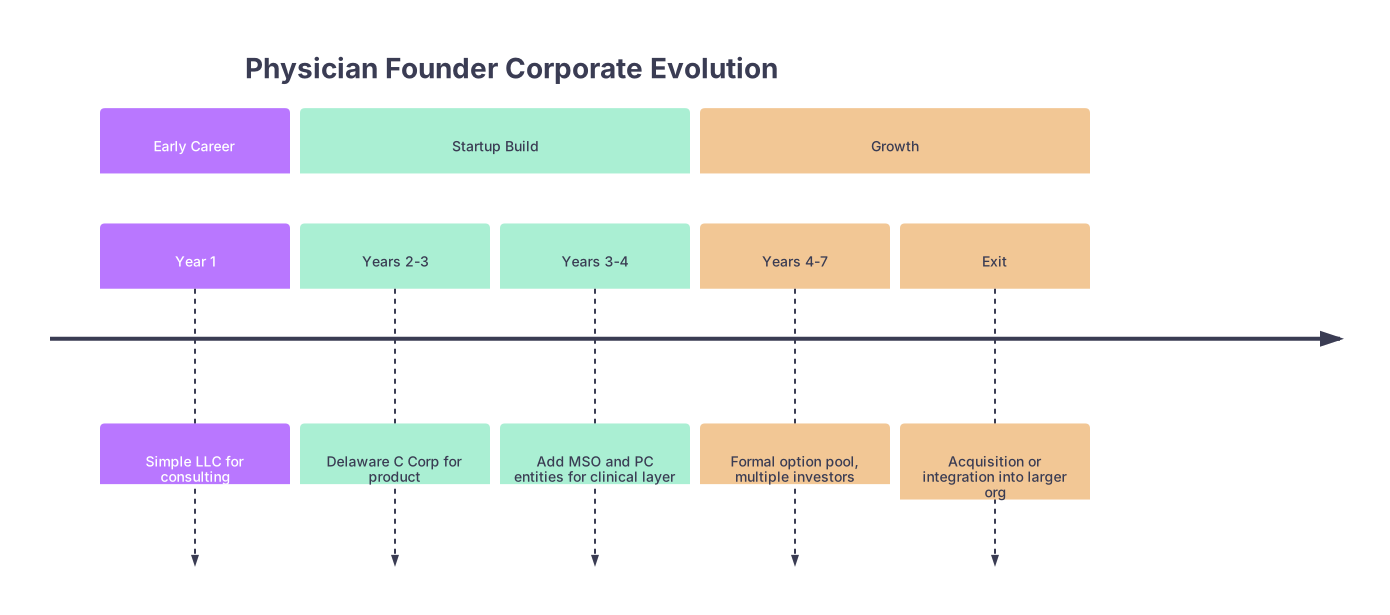
| Period | Event |
|---|---|
| Early Career - Year 1 | Simple LLC for consulting |
| Startup Build - Years 2-3 | Delaware C Corp for product |
| Startup Build - Years 3-4 | Add MSO and PC entities for clinical layer |
| Growth - Years 4-7 | Formal option pool, multiple investors |
| Growth - Exit | Acquisition or integration into larger org |
And yes, some physicians will stay happy at stage one with the consulting LLC. That is fine. Just do not accidentally trap a billion-dollar idea in the wrong entity because you were chasing a few thousand dollars of short-term tax savings.