
The fastest way to kill a promising medical startup is to botch your first clinic pilot and quietly get blacklisted. Not publicly. Privately. In the email threads and hallway conversations between medical directors that you never see.
You are not just testing a product. You are testing whether anyone in medicine will ever trust you again.
Here is how to pilot your startup in one clinic, get real data, and walk away with stronger relationships than when you started.
Step 1: Pick the Right First Clinic (Most Founders Get This Wrong)
Do not start with the biggest or “fanciest” system that returns your call.
Your first pilot partner is not a logo. It is a learning lab. You want:
- Someone who feels the pain your product solves.
- Someone who can decide quickly.
- A setting where the consequences of failure are contained.
What a good first clinic actually looks like
Aim for:
- 3–15 clinicians, not 300.
- A single empowered decision-maker (medical director or owner) who still sees patients.
- One relatively homogeneous patient population for your first use case (e.g., Type 2 diabetes, ADHD follow-up, post-op ortho, etc.).
- At least one staff champion who already tinkers with workflows and likes new tools.
Bad first pilots I have seen:
- A solo doc who wants you to “fix everything” and has zero staff buy-in.
- A large academic center where your contact is “very enthusiastic” but has no budget authority.
- A multi-specialty group that insists your product must immediately serve primary care, cardiology, ortho, and derm.
Build a short clinic target list
Stop “networking” generically. Pick 5–10 specific clinics that fit your criteria.
| Clinic | Size | Decision Speed | Pain Intensity | IT Complexity | Overall Fit |
|---|---|---|---|---|---|
| Clinic A | 8 MDs | Fast | High | Low | Strong |
| Clinic B | 3 MDs | Medium | High | Medium | Good |
| Clinic C | 20 MDs | Slow | Medium | High | Weak |
| Clinic D | 12 MDs | Fast | Medium | Low | Good |
| Clinic E | 5 MDs | Medium | High | Low | Strong |
Rank them. Go after the top 3. You want one yes, not ten maybe-laters.
Step 2: Frame the Pilot as a Joint Experiment, Not a Free Trial
If you position this as “we’ll give you the software free for 3 months,” you already lost. That frames your value as price, not outcome, and it trains clinics to expect free work.
You want a joint experiment mindset:
- There is a specific problem.
- You have a hypothesis.
- You will test it with clear metrics.
- You both decide what to do after.
Use a tight one-page pilot brief
Before anyone signs or commits, summarize the pilot on a single page. Send it as a living doc, not a glossy PDF.
Include:
Problem statement (clinic words, not yours)
“Our no-show rate for follow-up diabetes visits is ~18%, causing lost revenue and worse control.”Proposed solution
“Use [Your Product] to automate risk-based outreach and digital check-ins for patients with Type 2 diabetes.”Pilot scope
- One location
- 2–3 clinicians participating
- One patient segment (e.g., adults with A1c > 8.0)
- Duration: 60–90 days
Clinic commitments
- 1 physician champion + 1 ops/MA lead
- 30–60 minute weekly check-in for the first 4 weeks
- Access to de-identified metrics (no-show rate, A1c %, call volume, etc.)
Your commitments
- Rapid support (same or next business day response)
- Training and scripts for staff
- Pre/post metrics analysis
- Short summary deck they can share with leadership
Success criteria
- e.g., 25% reduction in no-show rate for target cohort
- e.g., staff time per follow-up reduced by 20%
- e.g., no increase in complaint rate
Decision point
“At 60–90 days, we review results together and decide: 1) expand, 2) adjust and extend pilot, or 3) end cleanly.”
Getting alignment here avoids 90% of “we’re not sure what happened” endings.
Step 3: Do a Ruthless Risk Assessment Before You Touch Their Workflow
You are post-residency. You know this: small workflow changes can blow up patient care.
Your product may look simple. It is not. Once it touches:
- Scheduling
- Messaging
- Orders
- or Documentation
…you are in patient-safety territory.
Map out the real-world workflow impact
Do this before talking to staff. On paper or a whiteboard. Then verify with them.
Ask:
- Where in the existing workflow will this live?
- Who touches it first?
- What do they stop doing once this is live?
- What happens when it fails or is down?
Turn that into a simple flow diagram you can show them.

| Step | Description |
|---|---|
| Step 1 | Patient identified for pilot |
| Step 2 | Staff reviews eligibility |
| Step 3 | Standard workflow |
| Step 4 | Enroll in startup tool |
| Step 5 | Automated outreach/check-in |
| Step 6 | Clinician reviews results |
| Step 7 | Document and continue |
| Step 8 | Schedule visit or adjust care |
| Step 9 | Eligible? |
| Step 10 | Action needed? |
Now you can have an adult conversation about risk, instead of hand-waving “it will be seamless.”
Define your “kill switches”
Before launch, explicitly define:
- Under what conditions you will pause the pilot.
- Who can call a temporary stop (clinic + your team).
- What constitutes a never again moment.
Typical kill switches:
- Any credible patient safety issue attributable to your system (misrouted critical results, lost high-risk messages, etc.).
- Significant increase in staff workload beyond agreed tolerances.
- Major tech downtime during clinic hours more than X times in Y days.
Say this out loud to the medical director. It builds trust.
Step 4: Negotiate a Clean, Boring, Protective Pilot Agreement
No, a handshake is not enough. And no, a 30-page enterprise contract for a 3-month pilot is not smart either.
You want a lightweight but real agreement.
The non-negotiables
At minimum, your pilot agreement needs:
Scope of use
Exactly where and how they will use the product. No quiet expansion you cannot support.Duration and exit
Start date, end date, and a simple way for either party to terminate with short notice (e.g., 15–30 days) without drama.Data ownership and access
- Clinic owns patient data.
- You have defined rights to use de-identified/aggregated data for analytics and product improvement.
- How you will return or delete data if requested.
Privacy and security
If PHI is involved, have a BAA. Pretending you are “just a communication tool” when you are clearly handling PHI is how you get quietly blacklisted by compliance folks.Liability boundaries
You are not practicing medicine. They control clinical decisions. Your product is a tool, not a clinician.
You can keep this to 5–10 pages. I have seen early pilots grind to a halt because some over-zealous attorney tried to import a Fortune 500 vendor agreement into a 6-doctor pilot.
Step 5: Set Success Metrics That Matter to Them, Not You
Your investor cares about “engagement” and “growth.” The clinic does not.
Clinics care about:
- RVUs and visit volume.
- Staff workload.
- Quality metrics and contracts (HEDIS, MIPS, value-based incentives).
- Patient complaints.
Tie your pilot to something on their dashboard.
Co-define 3–5 pilot metrics
Make these explicit:
Primary outcome metric (one only)
- E.g., “30% reduction in no-show rate for [cohort] across 60 days compared to baseline.”
Secondary metrics (2–3 max)
- Staff time per encounter (self-reported or time study).
- Number of manual calls/messages avoided.
- Proportion of patients who complete required forms before visit.
Safety and satisfaction metrics (1–2)
- Patient complaints directly referencing your tool.
- Any documented adverse clinical events linked to the new workflow.
Now separate what you care about that they do not:
- Activation rate.
- Click-through rate.
- Time-in-app.
These are internal metrics. Track them. Do not lead with them in clinic meetings.
Step 6: Design the Narrowest Possible Pilot
Founders love to “show the full value” of their system. This is how you create a swamp of half-implemented features.
You want the opposite: surgical scope.
Constrain four things
Patient segment
Pick one segment where you can win.- Not: “all chronic disease patients.”
- Use: “Adults with Type 2 diabetes with A1c > 8.0 and at least one visit in past 12 months.”
Clinician group
Start with 2–3 clinicians, ideally those who volunteered, not those “voluntold” by leadership.Features
Turn off almost everything that is not directly tied to your success metric.- You are measuring no-shows? Then you do not need complex survey features live right now.
- You want better pre-visit planning? You do not need full messaging threads.
Time
Most reasonable pilots run 60–90 days. Less than 30 and you have no real data. More than 90 and you risk drift and fatigue.
Then write your “not in scope this round” list:
- No custom EHR integration beyond [X].
- No after-hours coverage changes.
- No expansion beyond [clinic] and [providers] during the pilot.
This “no” list will save your relationship when the enthusiastic medical director starts brainstorming mid-pilot.
Step 7: Earn Trust From Staff Before Launch Day
If you treat staff like cogs, your pilot will die in the hallway before you ever go live.
Front desk, MAs, nurses, schedulers: they decide if your tool gets used correctly or sabotaged quietly.
Do a pre-launch staff session that respects their reality
Run one focused session (30–60 minutes). Not a 2-hour lecture.
Cover:
Why this matters for them personally
- Fewer repetitive calls.
- Less double documentation.
- Clear rules on what is changing and what is not.
The micro workflow change
Show them: “Here is what you do now. Here is what you will do differently with our tool. Step-by-step.”Scripts and templates
Give them ready-made phrases:- How to explain new texts/emails to patients.
- What to say if a patient is confused or suspicious.
- How to escalate problems.
Where to send issues
One channel. One email or Slack/Teams channel. Do not make them guess.
Then ask one dangerous but critical question:
“What do you think is most likely to go wrong here?”
Write down everything they say. Address the realistic ones immediately. You will both learn a lot.
Step 8: Treat the First 2 Weeks Like a Controlled Burn
The biggest risk window is right after go-live. Everyone is confused. Your system has edge cases you have not met yet. The IT guy is on vacation.
So for the first 2 weeks, act like a hawk.
Daily monitoring protocol
For the first 10 business days:
Check your logs and dashboards at least twice a day.
Proactively message the clinic champion every 2–3 days: “Any snags today?”
Track:
- Failed sends / failed tasks.
- Response times of your own support.
- Any manual workarounds staff are using.
If you see a pattern, fix it quickly, and tell them you fixed it. Silence kills trust.

Hold a mini “hot wash” at day 7–10
Short meeting (20–30 minutes) with:
- Medical director or champion
- 1–2 staff who actually use the tool
- You (founder/product lead)
Ask specifically:
- “What is slower than before?”
- “Where are you double documenting?”
- “What is the most annoying thing right now?”
Then commit to 1–3 improvements you can deliver within the pilot window. Not “in the future.” Now.
Step 9: Document Everything So You Can Exit Gracefully Either Way
You want to be remembered as:
“Those folks were serious, transparent, and they actually measured stuff.”
Even if the pilot does not continue.
Build a simple pilot tracking sheet
Nothing fancy. Use a shared spreadsheet or doc that both sides can see.
Include:
- Weekly active patients in cohort
- Core metric(s) values (e.g., no-show rate, completion rate, etc.)
- Qualitative notes from staff and clinicians
- Bugs/issues and resolution dates
Something like:
| Week | Active Patients | No-Show Rate | Staff Issues Logged | Major Changes Implemented |
|---|---|---|---|---|
| 1 | 45 | 18% | 6 | Script tweak |
| 2 | 72 | 15% | 4 | Reminder timing change |
| 3 | 89 | 13% | 2 | UI fix |
| 4 | 96 | 12% | 1 | None |
Now you have a memory. Clinics forget what life was like pre-pilot faster than you think.
Step 10: Run a Proper Debrief, Not a Vague “So What Do You Think?”
Near the end (week 6–10, depending on pilot length), schedule a formal debrief.
Not a casual hallway chat. A meeting.
Participants:
- Medical director or key decision-maker
- At least one clinician using the tool
- At least one staff member who touches it
- You + maybe one team member
Use a structured agenda
Restate the original problem and success criteria
Show the one-page pilot brief. Anchor the conversation.Walk through the data
- Show pre vs. post metrics in simple charts.
- Highlight both wins and misses. No spin.
Capture qualitative feedback
Ask explicitly:- “In your day-to-day, what got better?”
- “What got worse or stayed annoying?”
- “If we turned this off tomorrow, what would you miss?”
Discuss options clearly
You want one of three outcomes:
- Expand and formalize (paid or extended contract).
- Adjust scope and run another defined pilot.
- End the pilot cleanly but preserve relationship.
Explicitly name which outcome you recommend, and why.
Step 11: How to End a Pilot Without Burning Bridges
This is the part founders screw up because ego gets in the way.
Sometimes the right answer is to stop. Wrong fit. Wrong timing. Too much friction.
Your job is to make “no” feel safe—to them and to you.
If they decide not to continue
Your script is roughly:
“Thank you for taking the risk to try something new. We learned a lot from this pilot, including [2–3 specifics]. We are going to incorporate this into our roadmap. When we have [X improvements] in place, would you be open to a quick check-in to see if it is worth revisiting?”
Then:
- Send a short written summary of the pilot: goals, metrics, key learnings.
- Ask if they are willing to be a private reference for your process professionalism even if they did not adopt long-term.
- Follow through on data deletion or access changes exactly as promised.
This is how you get emails later like, “We are part of a new ACO now, could you come talk to our group?”
If you decide not to continue
Yes, that happens. Sometimes your product cannot realistically adapt to their constraints, or the use case is pulling you in the wrong direction.
Be honest, not vague.
“We realized during this pilot that to serve [your setting] really well, we would need to prioritize features that are outside our core roadmap. We do not want to give you a half-solution. So we are going to pause here rather than promise changes we cannot sustain.”
Again: send a summary, thank them, leave the door open for future intersecting needs.
Step 12: Turn One Pilot Into Leverage for the Next Three
Your first pilot’s real value is not revenue. It is the story and evidence you can carry into the next room.
Package your pilot learnings into a “clinic case file”
Create a 5–7 slide mini-deck:
Clinic profile (de-identified if needed)
- Size, specialty, patient panel type.
Starting pain points
e.g., “18% no-show rate in chronic disease follow-ups.”Pilot design
- Duration, cohort, features used.
Results
- Before vs. after.
- At most 3 charts. One main win, one neutral, one “we learned X.”
Workflow and staff feedback
Direct quotes (with permission):- “Now I do not have to call the same people 3 times.” – MA
- “Patients came in more prepared.” – MD
Where we improved during pilot
Shows you listen and iterate.What we would do differently next time
This is surprisingly persuasive. It signals maturity.
Now, when you talk to your next clinic, you are not pitching an idea. You are presenting a tested intervention with proof that you know how to run a low-drama pilot.
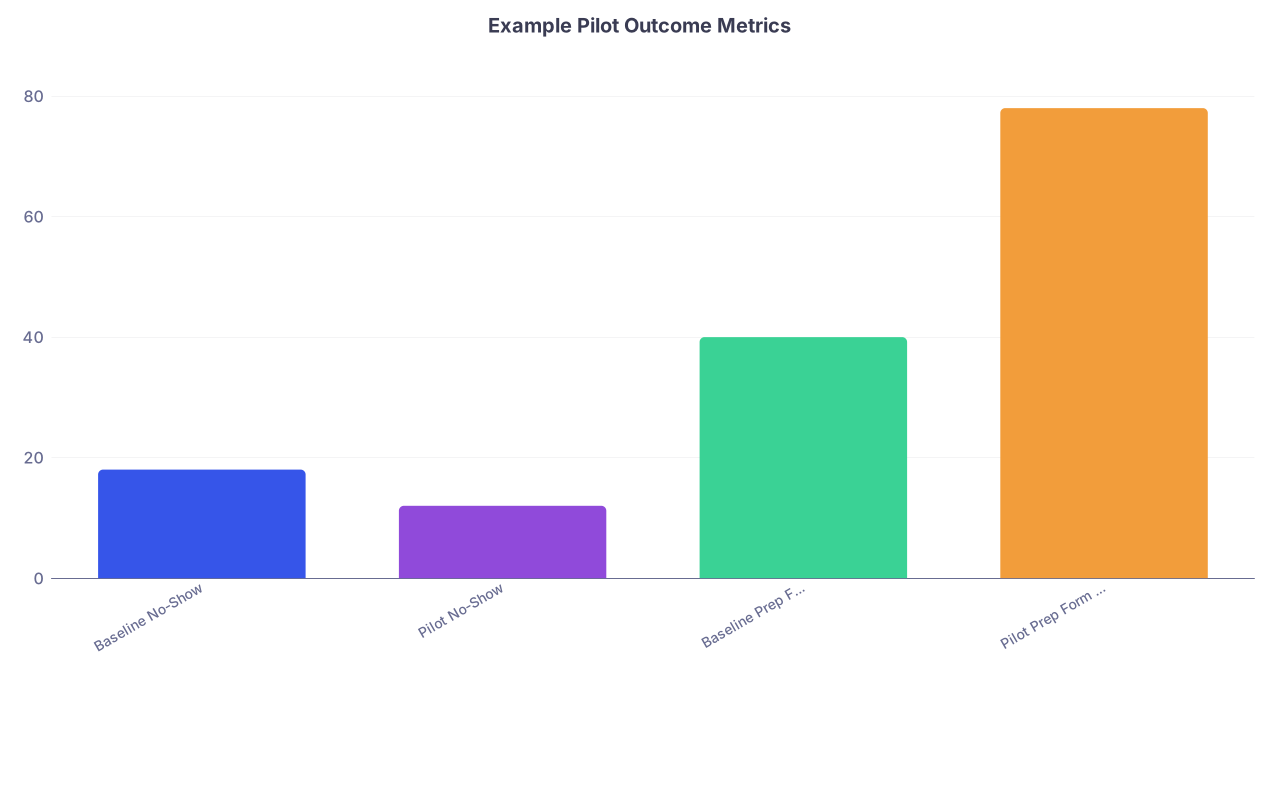
| Category | Value |
|---|---|
| Baseline No-Show | 18 |
| Pilot No-Show | 12 |
| Baseline Prep Form Completion | 40 |
| Pilot Prep Form Completion | 78 |
Step 13: Protect Your Clinical Reputation While You Experiment
You are not just a founder. You are a physician (or clinician) with a license and a name that will follow you long after this startup.
Protect it.
A few hard rules
- Do not oversell. If your tool is a reminder system, do not call it “AI care management.”
- Never imply your product replaces clinical judgment. Ever.
- If a workflow issue even might have contributed to a patient safety problem, own your part and help fix the system, not just your code.
- Keep your documentation tight: decisions, known risks, mitigations.
You want colleagues to say:
“They pushed innovation, but they never cut corners on patient care.”
That reputation is worth more than your first exit.
Today’s Concrete Next Step
Open a blank doc and draft a one-page pilot brief for your product and an ideal 1–3 physician clinic:
- Write the problem in their words.
- Define a 60–90 day scope.
- Pick one primary success metric.
- List what you are asking from them and what you are committing.
If you cannot make that one page clear and specific, you are not ready for a real clinic pilot. Fix that first, then start calling clinics.