
What do you do when you’re on your third night of q4 call, staring at the monitor at 2:17 a.m., thinking, “If I don’t start this company now, I’m going to be doing this exact thing 20 years from today”?
Good. Stay with that feeling. It’s the only thing strong enough to compete with your pager.
This is for you if:
- You are a practicing attending (or about to be one).
- You still have call.
- You have a real business or startup idea that won’t leave you alone.
- And you are sick of hearing vague advice like “just carve out time” from people who are not on 24‑hour call and do not understand your life.
Let me walk you through how real attendings actually get a company off the ground without blowing up their job, their license, or their relationships.
Step 1: Get Brutally Clear About Your Real Constraints
You’re not a 24‑year‑old in a coworking space. You’re an attending with a license, malpractice insurance, and people depending on you. Your constraints are real, so don’t pretend they aren’t. Map them.
Time constraints
Pull out last month’s schedule. Look at it like a project manager, not like a victim.
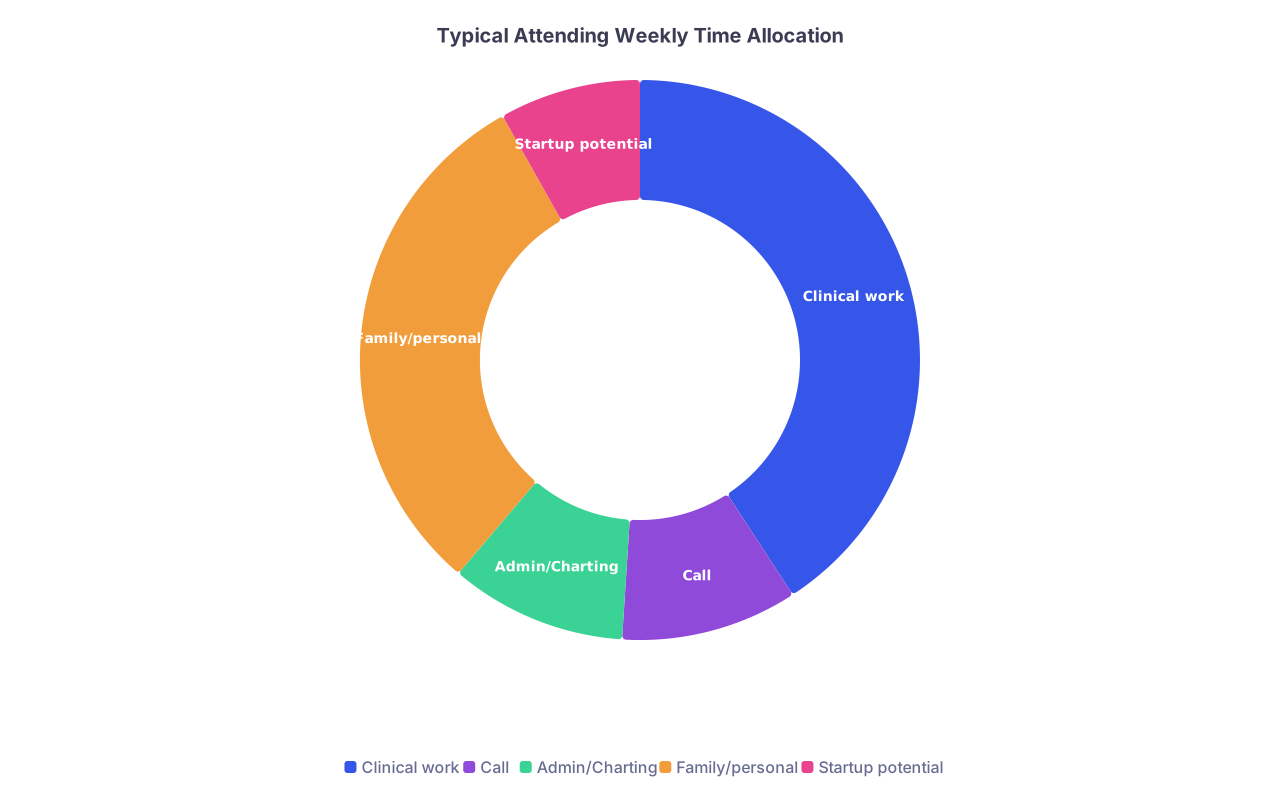
| Category | Value |
|---|---|
| Clinical work | 40 |
| Call | 10 |
| Admin/Charting | 10 |
| Family/personal | 30 |
| Startup potential | 8 |
Here’s what I have seen work:
Identify your “hard walls”
Things that don’t move:- Assigned clinic/OR sessions
- In-house call hours
- Required meetings (M&M, QI, etc.)
- Family anchors (kid pickup, partner’s non-movable work hours)
Identify “soft” time
The places you think are non-negotiable but aren’t:- Optional committees
- Extra clinic blocks you picked up “for the money”
- Teaching commitments you said yes to out of guilt
You need 6–10 focused hours per week to start a company in a sane way. If you say “that’s impossible,” what you actually mean is “I’m not willing to give something up yet.” Be honest with yourself.
- Decide what gets cut
For the next 6–12 months, I want you to explicitly choose:- 1–2 things you will stop doing at work
- 1–2 things you will pay for at home (cleaning, prepared meals, childcare blocks)
- 1–2 things you will say no to in advance (new committee, extra clinic, random side consults)
If you don’t cut, your startup “time” will get stolen from sleep. That works for exactly four weeks and then you crash.
Step 2: Choose the Right Kind of Company for a Call-Heavy Attending
Some business models are compatible with call. Some are not. This is where a lot of physicians make their first fatal mistake.
| Model Type | Call Compatibility | Why |
|---|---|---|
| Venture-backed SaaS | Medium | High upside, high intensity |
| Consulting/Advisory | High | Flexible, project-based |
| Niche service clinic | Medium | Operationally demanding |
| Content/Education | High | Asynchronous, scalable |
| Hardware/Device | Low-Medium | Capital and time intensive |
If you’re still taking q3/q4 call as a hospital-based doc, you need to optimize for:
- Asynchronous work
- Limited synchronous obligations during business hours
- Low operational overhead in the first 12–18 months
Good fits for a call-heavy attending:
- B2B SaaS with small early customer base (e.g., workflow tool for your specialty)
- Expert consulting firm or advisory service
- Course or training product for a niche audience (other clinicians, administrators)
- Tech-enabled service where ops can be handled by a small non-physician team
Terrible fits at your stage:
- Brick-and-mortar clinic that depends on you physically being there
- Anything requiring daily synchronous meetings with a big dev team spread across time zones
- Rapid-growth, “we need you full-time yesterday” VC rocket ship
You can evolve into those later. Right now you want survivable.
Step 3: Build Around Your Actual Call Pattern, Not Your Fantasy Life
Your call is not just “hours.” It’s cognitive fragmentation. That’s the killer.
You can’t do deep architecture thinking when you might be interrupted for a STEMI, status asthmaticus, or a consult from an intern who cannot interpret a troponin.
So you don’t plan that work for call days. You plan different work.
Here’s a simple framework that works for many attendings:

| Step | Description |
|---|---|
| Step 1 | Sunday |
| Step 2 | Plan week 30 minutes |
| Step 3 | Block 2 evenings - Deep work |
| Step 4 | Assign 1 admin block to startup |
| Step 5 | Call days |
| Step 6 | Light tasks only |
| Step 7 | Product or strategy work |
| Step 8 | Meetings or partner calls |
| Step 9 | Emails, idea capture, reading |
You divide your week into:
Deep-work blocks (non-call, predictable hours)
Use these for:- Product design and architecture
- Writing specs or outlines
- Strategic decisions
- Creating actual assets (code, slide decks, curriculum, prototypes)
Light-work blocks (call days, between pages)
Use these for:- Emails, DMs, Slack
- Customer discovery survey review
- Reading about your market
- Rough idea capture in a notes app
Synchronous blocks (scheduled meetings)
You need very few of these at the start:- 1–2 customer discovery calls a week
- 1–2 meetings with your co-founder or dev team
- Occasional investor/mentor calls
Be ruthless. If your week gets blown up clinically, you do not “gift” startup time from your sleep bucket. You move it, or you skip it. The game is consistency over 6–18 months, not heroics over 10 days.
Step 4: Set a 6-Month “Micro-Scope” So You Do Not Drown
You don’t need a 40‑page business plan. You need a 6‑month operating plan that fits your life and gets you to a real milestone.
Example of a reasonable 6‑month target for a call-heavy attending:
- 5+ paying customers at $200–$500/month for a B2B workflow tool
- Or: 50 pre-sales / deposits for your course or program
- Or: 2–3 large consulting clients under contract
From there, work backwards.
Your 6-Month Plan Should Answer 5 Concrete Questions
- What is the minimum viable offer I can realistically create with 6–10 hours/week?
- Who exactly is paying me, and how do I reach them (that is not a full-time job)?
- What are my red lines with my employer (no conflicts of interest, no EMR scraping, etc.)?
- What is my “kill or commit” trigger? (Revenue level, traction metric, or time horizon)
- What do I need to spend in cash to get there, and can that be covered by current income?
If you can’t answer those on paper in 1–2 pages, you’re not ready to build. You’re still fantasizing.
Step 5: Do Not Get Fired or Lose Your License
Let’s be blunt: the fastest way to blow this up is to:
- Build something that obviously competes with your group or hospital
- Use PHI or protected internal data in your product
- Work on your startup during hours you’re being paid for clinical or admin time
You have to handle two things like an adult: contracts and conflicts.
1. Read your damn employment contract
Specifically look for:
- IP assignment clauses (“inventions” language)
- Non-compete and non-solicitation language
- Moonlighting / outside work approval requirements
If the IP language says “anything you create during the term of employment, whether or not related to hospital business,” that’s a huge red flag. You likely need:
- To clarify in writing that your startup is outside scope
- Or to form the company in a way that clearly separates ownership and activities
Talk to a lawyer who actually knows physician contracts and startups. Not your cousin who does wills.
2. Avoid obvious conflict-of-interest moves
Stupid moves I’ve actually seen:
- Using screenshots from the hospital EMR, even “anonymized,” in pitch decks
- Emailing potential clients from a hospital email address about a private startup
- Having residents or fellows “help out” on the startup in exchange for “experience”
- Trying to sell your product first to your own department without proper COI disclosure
You do not need your hospital as your first customer. In fact, for many, that’s the worst first customer. You need compliant early adopters outside your employer, where the conflict mess is smaller.
Step 6: Decide Your Co-Founder and Team Strategy That Works With Call
You have three broad options, each with tradeoffs:
, Physician co-founder](https://cdn.residencyadvisor.com/images/articles_svg/chart-co-founder-options-for-a-busy-attending-4997.svg "Co-Founder Options for a Busy Attending")
| Category | Value |
|---|---|
| Solo + contractors | 60 |
| [Non-medical co-founder](https://residencyadvisor.com/resources/medical-startups/what-tech-cofounders-say-about-doctors-after-you-leave-the-room) | 25 |
| Physician co-founder | 15 |
Solo founder + contractors
- Best if: you’re decisive and can write checks instead of spending time
- Risk: you become the bottleneck; everything waits for your decisions
- Tactic: hire a fractional product manager or operations lead early
Non-medical co-founder (e.g., engineer, operator)
- Best if: you bring domain expertise and network; they bring build/ops
- Risk: misaligned expectations; they get frustrated with your limited hours
- Tactic: be brutally honest about your availability from day one; put it in writing
Physician co-founder
- Best if: both have aligned schedules and complementary skill sets
- Risk: you’re both overworked and under-available; company moves at glacial pace
- Tactic: between the two of you, at least one must commit more than 10 hours/week early
My bias: for a call-heavy attending, “solo + a strong contractor or part-time operator” is usually the most realistic starting point. You can add a co-founder later if it truly makes sense.
Step 7: Create a Startup Schedule That Survives a Typical Month
Theory is useless. Let’s ground this in a realistic example.
You’re a hospitalist attending:
- 7 on / 7 off schedule
- On your 7 on: 1–2 in-house calls
- You’ve got two kids, partner works full time
Here’s what a survival schedule can look like:
On-service week (7 on):
- Morning: clinical only
- Afternoon: clinical and charting
- Evening:
- 1 evening: nothing. You crash.
- 2 evenings: 45–60 minutes of “light work” (emails, market research, planning)
- Call nights: zero startup work unless you’re wide awake and pager is quiet; then only reading or notes, no “must-do” items
Off-service week (7 off):
- 2 mornings: 2–3 hours deep work each (your core startup time)
- 1 afternoon: 1–2 hours of calls/meetings
- 1–2 evenings: 60–90 minutes for follow-ups, documentation, or content
That’s roughly:
- 8–12 hours of real startup work per 2-week cycle
- 4–6 hours are deep, 4–6 light
You can do a surprising amount with that if:
- You keep the product simple
- You don’t spend all your time in meetings
- You avoid trying to look like a “full-time founder” on social media
Step 8: Money, Burn, and When to Consider Cutting Clinical Time
You have a huge advantage: attending income. Use it strategically.

Decide early:
- How much you’re willing to invest personally (dollars and months)
- Under what conditions you’ll cut back clinical time
A common, sane path I’ve seen:
Months 0–6:
- Stay at 1.0 FTE clinical
- Invest a set amount (for example, $10–30k total) in incorporation, minimal product build, initial marketing
- Goal: prove people will pay for something, at any price
Months 6–18 (if you have real revenue and traction):
- Drop to 0.8–0.9 FTE if allowed
- Or cluster your clinical days to create clean startup blocks
- Reinvest most startup revenue into the company
Beyond 18 months (if growth is real and consistent):
- Reassess with actual data: what’s your MRR (monthly recurring revenue), churn, pipeline?
- Only consider major clinical cuts (0.5–0.7 FTE) when you can:
- Cover your basic living expenses + health insurance from a mix of startup + savings, or
- See a line-of-sight to that within 6–12 months
Jumping to 0.5 FTE with zero revenue and “a great idea” is not brave. It’s reckless.
Step 9: Manage Your Energy Like a Limited Resource (Because It Is)
You’re probably already at or near burnout. Adding a company can either:
- Push you over the edge
- Or paradoxically help by giving you a sense of agency and creative outlet
The difference is how you manage energy.
Look for these warning signs:
- You’re chronically resentful: at patients, partners, family, and now your startup too
- You start cutting sleep regularly to “make time”
- Your clinical performance or chart completion slips
- You feel wired all the time but can’t focus deeply on anything
If you see those, adjust aggressively:
- Shrink your startup scope (smaller launch, fewer features, slower timeline)
- Cut non-essential startup tasks (social media nonsense, vanity metrics, endless logo tweaks)
- Take a 2–4 week “maintenance mode” break: only essential commitments, no new pushes
What you’re building will take years. Treat your brain like something you’ll need in 10 years, not like a disposable burn unit.
Step 10: Social, Political, and Family Realities
You cannot do this alone. But you also cannot tell everyone everything.
At work
You do not need to stand up in grand rounds and announce your company. But you also do not need to hide it like an affair.
I’ve seen this balance work:
Tell a small, carefully chosen set of colleagues who:
- Aren’t your direct bosses
- Have a history of supporting “nontraditional” careers
- Might actually help with intros or insight
With leadership, keep it simple:
- “I have a side business in [education/consulting/software] that is outside the scope of my clinical duties and does not use hospital resources or data. My clinical performance and availability will not be affected.”
- If they want more, involve legal or compliance, not gossip.
At home
If you have a partner, kids, or others depending on your time, you must make this explicit.
Have one real conversation that covers:
- Why this matters to you
- What you’re going to stop doing to make room
- What support you’re asking for (time, understanding, not more money)
- When you’ll re-evaluate if it’s not going anywhere
You do not get to unilaterally decide that every Saturday morning is now “founder time” and then be surprised your partner is pissed.
Step 11: What to Actually Do First (Next 4 Weeks)
If you’re serious and you’ve read this far, here’s a simple 4-week starter plan.
Week 1: Clarify and cut
- Outline your idea in one page: problem, customer, solution, how it makes money
- Look at your last 4 weeks. Decide what you will stop doing to free 6–10 hours/month.
- Block startup time on your calendar like it’s a case.
Week 2: Talk to humans
- Have 3–5 short calls with people who would be your buyer or user
- Ask what they’re already paying for, what sucks, what they’ve tried
- Do not pitch. Just listen and take aggressive notes.
Week 3: Define the smallest possible offer
- Design the tiniest, most embarrassing version of your product or service you’d be willing to sell
- Write a simple one-page landing description or PDF explaining:
- Who it’s for
- What it does
- What it costs
Week 4: Try to collect money
- Ask 3–5 people from Week 2 to pre-commit (deposit, pilot agreement, LOI)
- If you get zero traction, adjust the offer, not the logo
- If you get any yeses, you now have a real company problem: delivering
Now you’re in the game.

FAQs
1. Should I tell my department chair about my startup?
If your startup overlaps with your specialty or target customers are similar to your hospital’s, you probably should disclose something, but minimally and professionally. Keep it framed around conflict-of-interest and patient safety, not your “passion project.” Say: “I’m working on an external software/education/consulting project that does not use hospital data or time and is structured to avoid conflict with our services. I’ll coordinate with compliance if needed.” Do not ask for permission you don’t need; do seek clarity where your contract is vague.
2. When do I need to incorporate (LLC, C‑Corp, etc.)?
Not the first day you have an idea. Incorporate when:
- You’re taking in real money from customers or
- You’re working with other people where ownership or liability matters
For most early attending-founders, an LLC is fine to start, unless you’re planning to raise venture capital soon, in which case a Delaware C‑Corp is standard. Spend a few hundred on a lawyer, not thousands on a perfect structure you’ll change later anyway.
3. How many hours per week do I really need to make progress?
I’ve seen steady, real progress at 6–10 focused hours per week. Under 4 hours, you mostly just “think about” your startup without building anything. Over 15–20 hours while you’re full-time clinical? People burn out or their clinical work suffers. Focus less on hours and more on what you do with them: 2–3 deep-work blocks beat 10 hours of random Slack and “networking.”
4. Is it worth trying to get my hospital as my first customer?
Usually no. Your hospital is a slow, political, risk-averse giant. You’re one physician. That’s a bad power imbalance. Better to find smaller, more agile early adopters—private practices, smaller systems, individual departments outside your employer. Once you have proof and references, you can come back to your own institution from a position of strength, and with a clear COI plan.
5. How do I know when it’s time to seriously cut back my clinical work?
Track three numbers monthly: revenue (or signed contracts), pipeline (real interested prospects), and hours you wish you had for the company. When:
- Your startup revenue + savings can cover at least 50–70% of your essential expenses
- Your pipeline is real, not imaginary (actual customers in conversations, pilots, or trials)
- You consistently hit the ceiling with time, not with ideas or demand
then it’s rational to explore dropping to 0.7–0.8 FTE. Until then, assume the constraint is your execution, not your hours.
Open your calendar for the next four weeks and block three startup sessions—two deep, one light. Name them like cases on your OR board: “Startup – Customer Calls,” “Startup – Build V1,” “Startup – Strategy.” If it is not on that calendar, it will not happen.