
Last month a hospitalist called me from his car in the parking garage at 10:30 p.m. He’d just finished a 14‑hour shift, charting still unfinished, inbox still full. “I can’t do this for 20 more years,” he said. “I think I want to start something. A startup, consulting, anything. But I also can’t afford to flame out completely.”
If that’s roughly where you are—clinically burned out, eyeing entrepreneurship as a way out or a way to stay sane—let’s talk about how to use entrepreneurship without blowing up your life, your finances, or your health.
Step 1: Get Very Specific About Your Burnout
Do not skip this. “I’m burned out” is too vague to build a sane plan around.
You need to know what is burning you out so you don’t just recreate the same misery in a different wrapper.
Ask yourself, in writing, not in your head:
- What parts of my current work drain me the most?
- What parts (if any) still give me energy or meaning?
- What would I gladly never do again?
- What do I actually want more of in my week?
Be concrete. Not “I hate being a doctor.” Think more like:
- “I hate being double‑booked and constantly behind in clinic. The treadmill feeling.”
- “I hate the inbox, refill requests, and arguing with insurance.”
- “I hate nights and weekends. I want predictable days and real sleep.”
- “I still like complex diagnostic puzzles but not the endless documentation.”
Why this matters: if you start a company but keep the same conditions—unpredictable hours, zero boundaries, constant electronic messaging—you’ll burn out again, just with a different job title on LinkedIn.
This is also the moment to check how bad things really are. If you’re at the edge—panic attacks before work, thoughts of self‑harm, can’t sleep for days—that’s not a “start a business” moment. That’s a “talk to a therapist, maybe step back clinically, stabilize” moment. You can’t build anything solid from total collapse.
Step 2: Decide Your Real Goal (Escape, Offset, or Evolve)
Clinically burned‑out physicians tend to fall into three buckets when they look at entrepreneurship:
- “I want out, long term.”
- “I want less clinical, not zero. I need balance.”
- “I don’t know yet, but I need options on the table.”
Be honest. If your secret goal is to never see another clinic schedule again, say it. Your strategy is different from someone who likes patient care but hates their current setup.
Here’s a simple sanity check of what each path tends to look like:
| Path | Clinical % in 2–3 Years | Startup / Biz % in 2–3 Years | Risk Level |
|---|---|---|---|
| Side-Gig Buffer | 60–90% | 10–40% | Low |
| Parallel Track | 30–60% | 40–70% | Medium |
| Full Pivot | 0–30% | 70–100% | High |
If you’re already exhausted, jumping straight to “Full Pivot” is how people crash. They quit, try to build some vague “health tech startup,” burn their savings, then crawl back to a worse clinical job out of desperation.
My bias: use entrepreneurship first as a pressure valve and option creator, not as a dramatic escape hatch. You need stabilization before reinvention.
Step 3: Fix Your Financial Runway Before You Get Cute
Entrepreneurship without runway is just panic with a logo.
You do not need millions. But you do need to know your monthly “burn” and your minimum safe buffer.
Bare minimum:
- Calculate your lean monthly expenses (mortgage/rent, food, insurance, debt, childcare, basic life). Not your “ideal lifestyle” number. Your survival number.
- Multiply that by 6–12. That’s your target runway before you consider anything drastic clinically.
- Check how much of that buffer you have right now in cash or easily accessible funds.
Then fix the basics:
- Kill or shrink dumb recurring expenses. The $300 cable package you never watch is literally stealing months of runway from Future You.
- Refinance or consolidate any crazy high-interest debt if possible.
- Do not buy the $100k car “because I’m burned out and deserve it” while simultaneously talking about starting a business. That’s how people trap themselves.
If you’re early post‑residency and still digging out of negative net worth, your move may be:
- Keep a more tolerable clinical role for a couple of years.
- Aggressively build savings and runway.
- Use that time to quietly experiment with small entrepreneurial bets (we’ll get to those).
Entrepreneurship will already stress you. Don’t let “I literally can’t pay rent if this fails” sit on your chest while you’re trying to think clearly.
Step 4: Choose Entrepreneurial Paths That Don’t Wreck You
Not all entrepreneurship is created equal. Some models will compound your burnout. Others can actually help fix it.
Let’s sort a few common options physicians consider post‑residency:
| Path | Upfront Time | Capital Needed | Burnout Risk | Example Use Case |
|---|---|---|---|---|
| Expert Consulting | Low–Medium | Very Low | Low | Advisory, pharma |
| Niche Services | Medium | Low–Medium | Medium | Telehealth micro-niche |
| Product/Tech Startup | Very High | Medium–High | Very High | SaaS, devices |
| Content/Education | Medium | Very Low | Low–Medium | Courses, Substack |
| Small Practice/Direct Care | High | Medium–High | Medium | DPC, microclinic |
Low‑crash starting lanes
These tend to pair well with burnout because they can be done part‑time, with control over when and how you work:
Expert consulting
Things like clinical advisory for digital health startups, pharma, med‑device, payer organizations.
You trade your hard‑won knowledge and pattern recognition, not your physical presence on a shift.Content & education
Courses, niche CME, paid newsletters, small group teaching, exam prep, systems improvement training.
Lower stakes, asynchronous, and fit nicely into a predictable schedule.Very tightly‑scoped telehealth or micro‑services
Short, specific, repetitive problems you can solve efficiently (e.g., migraine management, ADHD in adults, fertility coaching).
Dangerous if you let it expand into a full on-call panel. Reasonable if you set strict boundaries.
High‑crash starting lanes
If you’re already crispy, be careful with:
Traditional “raise VC, build a platform” health tech startups
Investor expectations, insane timelines, and a second full‑time job building product and team. You’re trading one brand of overwork for another. With more public failure.Full brick‑and‑mortar practice from scratch
Leases, staff, regulatory overhead, marketing, EMR, billing, all landing at once.
Great later when you know your model and have capital. Rough as a first move if you’re exhausted.
Step 5: Build a “Side Business That Respects Your Nervous System”
Here’s how you actually start without crashing. I’ll lay it out like a protocol.
1. Shrink your entrepreneurial ambition by 70%
If your first idea is “I’ll build a platform to fix prior auth for all of healthcare,” scale it way down.
You’re not trying to “fix healthcare” this year. You’re trying to:
- Feel less trapped.
- Build skills and options.
- Prove to yourself you can make $1 outside of W‑2 or RVUs.
A reasonable first target:
“In 6–12 months, I want something that reliably brings in $500–$2,000/month, without wrecking my clinical job.”
Low glamour. Very functional.
2. Set hard constraints first, then pick ideas
Most people do the opposite. They chase cool ideas, then try to cram them into their life.
Do this instead. Define:
- Max hours per week you’ll give the business (usually 4–8 to start).
- No‑go times (e.g., no work after 9 p.m., no sacrificing one of your two real days off every single week).
- Financial cap for initial experiments (e.g., I’m willing to risk $2,000 total this year, not more).
Then only consider business models that fit inside that box.
If your idea requires you to break all those rules? It’s a no for this season of your life.
3. Start with a 90‑day “Micro‑Experiment”
You’re testing three things:
- Do I actually like this kind of work?
- Does anyone care enough to pay for it?
- Can I do it without my clinical performance or health falling apart?
Keep it brutally simple. For example:
You’re an internist who loves complex diagnostics but hates clinic chaos.
Micro‑experiment: paid virtual second‑opinion consults for a narrow group (e.g., complex anemia workups) 2 evenings a week.You’re an anesthesiologist interested in education.
Micro‑experiment: small paid Zoom cohort for CA‑1 residents on “first 6 months survival skills” including crisis management, OR communication, and self‑advocacy.You’re an EM doc with a knack for process.
Micro‑experiment: a paid workshop for smaller EDs on “reducing left‑without‑being‑seen and boarding times” with follow‑up office hours.
90 days. Defined start and end. Specific offer. Small group.
You’re not building an empire; you’re running an experiment.
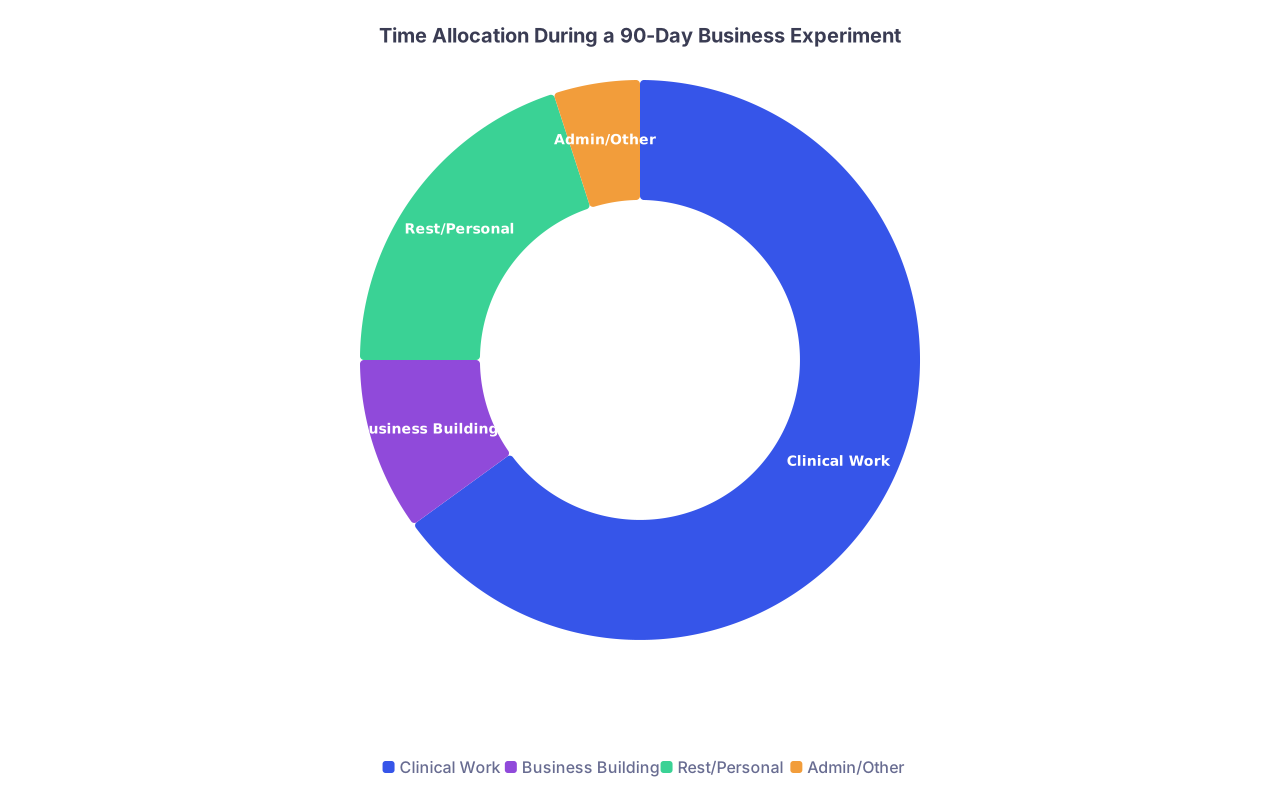
| Category | Value |
|---|---|
| Clinical Work | 65 |
| Business Building | 10 |
| Rest/Personal | 20 |
| Admin/Other | 5 |
Step 6: Guardrails So You Don’t Torch Yourself
Entrepreneurship can be surprisingly addictive. Especially if your clinical work feels soul‑sucking, the business becomes your “real” work and you start giving it everything.
That’s how people end up doing 1.5 jobs while already burned out.
You need guardrails:
Clinical minimums
Decide in advance: “If my chart completion drops below X” or “If my patient satisfaction or peer feedback dips,” I scale back business activities. Clinical care has real‑world stakes. Your MVP doesn’t.Sleep and energy rules
Hard rule: no business work that cuts your sleep below 6–7 hours more than 1–2 nights/week. Chronic sleep deprivation will nuke your decision‑making and your mood. I’ve watched residents try to code startups at 1 a.m. before 6 a.m. rounds. It doesn’t end well.Monthly honest review
Every 4 weeks, answer three questions:- Am I more or less exhausted than a month ago?
- Is this business giving me energy or draining it overall?
- If a friend described my schedule, would I tell them it’s sustainable?
If the honest answer is “this is making everything worse,” you stop or significantly reduce. That’s not failure; that’s triage.
Step 7: Use Your Physician Advantage Intelligently
You have unfair advantages non‑physicians would kill for. Use them smartly:
Access to real problems
You see broken workflows, confused patients, nonsense policies every day. That’s market research. Any entrepreneur would pay for that insight.Credibility
“Board‑certified cardiologist building X” opens doors—to customers, media, and partnerships. But only if you actually show up and talk to people.Pattern recognition
Years of clinical training honed your ability to see patterns from messy data. Product/market fit is the same skill applied elsewhere.
Types of problems you’re well‑positioned to work on without building a massive venture‑backed beast:
- Narrow, high‑painpoint operational issues (e.g., consult workflow, referral black holes, prior auth within a micro‑niche).
- Specific patient journeys (e.g., newly diagnosed type 1 adults, postpartum hypertension, surgical recovery adherence).
- Education/talent pipelines (e.g., better onboarding for new attendings, team communication, resident financial literacy, coding for clinicians).
But avoid the trap of “I’m a doctor, therefore I’m automatically a great CEO.” You’re not. That’s a different skillset. You can learn it, or you can intentionally stay in a role you’re good at (expert, product thinker, advisor) while partnering with operators.

Step 8: Common Dumb Mistakes That Make Burnout Worse
I’ve watched smart physicians repeat the same avoidable errors. If you recognize yourself in any of these, adjust early.
Quitting clinically too soon
You have an idea, maybe a prototype, zero paying customers, no revenue history—and you resign from your job. Now your business decisions are driven by fear and rent, not reality and strategy.Treating the startup like residency
You default to “I’ll just grind harder, sleep less, push through.” That’s not bravery; that’s how you replicate residency trauma under a new name.Building in isolation
You work alone on some platform or product for 12 months without showing it to actual users. Then you discover they don’t care. Burnout squared.Scattering your efforts
You’re “kinda” building a course, “kinda” doing some telehealth, “kinda” advising a startup, “kinda” writing a book. Nothing gets real traction. Your brain never rests.Ignoring your family or support system
You tell your partner, “I just need 6 intense months,” but it stretches into years. Resentment builds. That will burn you out faster than an evil EMR.
Set expectations early at home: “I’m going to try this project. Here’s how many hours I expect it to take and when. If it starts wrecking our time together, I’ll reassess.”
Step 9: Tactical Blueprint – First 6–12 Months
If you want a rough playbook, here’s one I’ve seen work for burned‑out attendings:
Months 0–1: Stabilize and Clarify
- Tighten your budget. Build or grow runway.
- Clean up anything clinically that’s on fire (scheduling disasters, EMR shortcuts, workflow tweaks).
- Do those burnout questions in writing. Maybe with a therapist or coach if you can.
Months 2–3: Explore and Prototype
- Talk to 10–20 people in spaces you’re curious about: other physician entrepreneurs, non‑clinical roles, startup founders, potential customers.
- Pick one narrow problem and one narrow audience you might help.
- Design a very small, paid experiment (offer, format, price).
Months 4–6: Run the Experiment
- Launch to a tiny audience—your network, local colleagues, a specific Facebook group, residency alumni list.
- Keep your hours within the strict limits you set.
- Collect feedback, refine, run a second round if it shows signs of life.
If after 6 months you’ve made any real revenue and it doesn’t make your life worse, you’ve earned the right to consider:
- Slightly reducing clinical hours.
- Doubling down on what’s working.
- Dropping side projects that are just noise.
Months 7–12: Decide the Track
At this point, with data instead of fantasy, you choose:
- Stay at “healthy side business” level and just enjoy the buffer and meaning it gives.
- Gradually shift to a 50/50 clinical/entrepreneur split over 1–3 years.
- Or, if the business is clearly taking off and you’re financially insulated, plan a stepwise exit from clinical work.
Notice the key word: stepwise. Not “rage quit.”

| Step | Description |
|---|---|
| Step 1 | Clinically Burned Out |
| Step 2 | Clarify Burnout Drivers |
| Step 3 | Stabilize Finances |
| Step 4 | Set Constraints and Runway |
| Step 5 | Design 90 Day Micro Experiment |
| Step 6 | Scale Gradually |
| Step 7 | Stop or Pivot |
| Step 8 | Keep as Side Gig |
| Step 9 | Reduce Clinical Time |
| Step 10 | Plan Stepwise Exit |
| Step 11 | Experiment Outcome |
| Step 12 | Business Traction |
Step 10: If You’re Already Right at the Edge
Sometimes by the time you’re reading pieces like this, you’re not “a bit tired.” You’re fried.
Signs:
- Dreading every shift, even the easy ones.
- Fantasizing about getting in a minor car accident just to have a break.
- Crying in call rooms or in your car.
- Numbness with patients, not just fatigue.
If that’s you, entrepreneurship is not the first line treatment. It’s downstream.
Your immediate priorities:
Get mental health care
Not optional. And you don’t announce it to everyone. You just do it.Talk to your leadership about adjustments
Yes, many systems are awful. Still: try. Reduced FTE, schedule pattern changes, locums instead of employed, swapping shifts, temporary leave. I’ve seen more flexibility than people expect once they ask with specifics.Simplify your life, aggressively
This is not the moment to be on eight committees, lead three QI projects, and coach your kid’s traveling soccer team.
When you’re out of the red zone—sleeping better, not crying between cases, not actively fantasizing about moving to a cabin in the woods forever—then you start thinking about entrepreneurship.

When Entrepreneurship Actually Helps Burnout
Used right, entrepreneurship can:
- Give you back a sense of control and agency.
- Let you use parts of your brain that have been dormant (creativity, building, teaching, strategy).
- Diversify your identity so you’re not only “a doctor who must see X patients or I’m worthless.”
- Create real financial and professional options besides “keep grinding or quit medicine.”
That’s the point. Not to become the next unicorn founder, unless that genuinely excites you and you’re not already half‑broken.
You’re allowed to build something small, sane, and profitable that makes your clinical life more bearable—or even optional—over time.
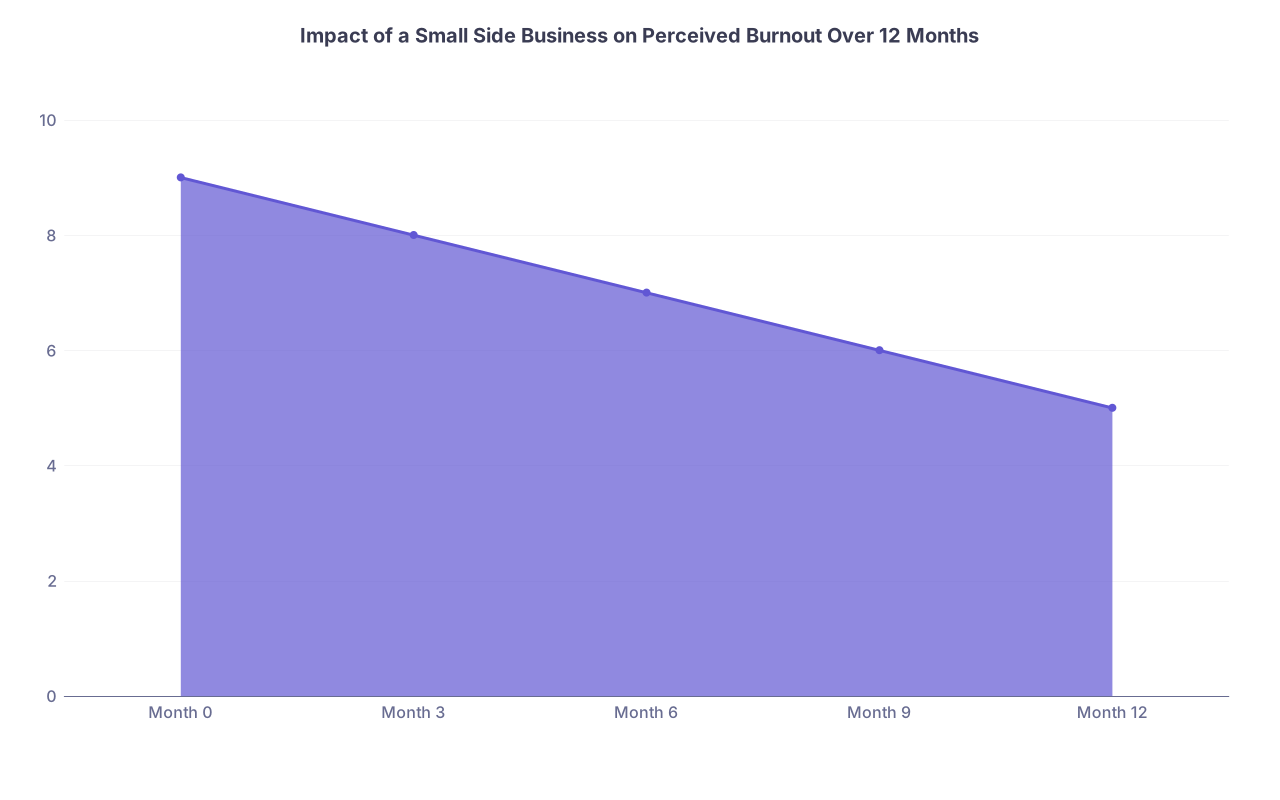
| Category | Value |
|---|---|
| Month 0 | 9 |
| Month 3 | 8 |
| Month 6 | 7 |
| Month 9 | 6 |
| Month 12 | 5 |
The Core Takeaways
- Use entrepreneurship first as a stabilizing valve and option‑builder, not as a dramatic escape.
- Put hard constraints around time, money, and energy and only choose business models that fit inside those limits.
- Run small, real‑world experiments before you even think about quitting clinically—and be willing to stop or pivot if they make your life worse, not better.