
The biggest competitive edge in telehealth right now is not your app, your branding, or your investors. It is multi‑state licensure, and most physicians are using it in a lazy, inefficient way.
If you’re post‑residency, thinking about or already building a telehealth startup, multi‑state licensure is not just a compliance box. It’s your growth engine, your pricing power, and your investor story. If you treat it like paperwork, you’ll get buried by the groups that treat it like strategy.
Let’s talk about how to actually leverage it.
1. First, understand what game you’re actually playing
You’re not “just” a doctor seeing patients online. You’re building a distributed clinical network governed by 50 different mini‑countries (states) that all think they’re special.
Core reality you cannot wish away: in almost all cases, you must be licensed in the state where the patient is located at the time of the visit. Not where you are. Not where your company is incorporated. The patient’s chair wins.
So if you:
- Live in Texas
- Are licensed in Texas and Florida
- Want to see a California patient on vacation in Nevada
You’re either:
(a) breaking the rules,
(b) turning them away, or
(c) building a structure that routes them to someone with the right license.
That’s the mental model: every visit is a routing problem driven by licensure + state rules.
Where founders screw this up:
They get licenses ad hoc (“We got a patient request from Colorado, let’s add CO”) instead of following a deliberate state expansion plan.
They don’t map reimbursement and demand to licensure cost, so they end up over‑licensed in low‑yield states and under‑licensed where the money is.
They ignore how licenses affect hiring, scheduling, malpractice, and valuation.
You can fix all three.
2. Decide your licensure strategy: founder‑centric vs. network‑centric
There are two main ways to play multi‑state licensure in a telehealth startup.
Strategy A: You as multi‑state “super‑doc” (early phase)
This is the “I’m the core clinical engine” stage. Typical if:
- You’re bootstrapping
- You’re pre‑revenue or very early
- You don’t want to (or can’t yet) hire a physician team
Your goal here: maximize revenue per license you hold.
Concretely, that means:
Prioritizing states with:
- High population
- Decent telehealth reimbursement (especially if you’re insurance‑based)
- Tolerable licensing timelines
Avoiding, at least early:
- States with painful licensure delays (California, New York)
- States with painful telehealth restrictions if your model conflicts with them
- Tiny states that add compliance noise without enough patients
Here’s how that looks in practice.
| State | Population Rank | IMLC Member | Typical License Time* | Telehealth Friendliness* |
|---|---|---|---|---|
| Texas | 2 | No | Medium | High |
| Florida | 3 | Yes | Fast | High |
| Pennsylvania | 5 | Yes | Fast | Medium |
| Illinois | 6 | Yes | Fast | Medium-High |
| Arizona | 14 | Yes | Fast | High |
*Relative, not exact. Check current data when you actually apply.
You don’t need 25 states early. You need 5–8 high‑leverage states where you:
- Actually have patients
- Actually can get paid
- Actually can handle volume yourself
Strategy B: Network‑centric (scale phase)
Once you’re not the only doc (or you don’t want to be), the licensure game shifts. Your job becomes orchestrating:
- Which provider holds which licenses
- Which states you’ll cover 7 days a week vs. 2‑3 days a week
- How to cover nights/weekends without blowing your budget
And that’s where multi‑state licensure becomes a routing and capacity problem, not just a “get more states” problem.
I’ve seen this work well when founders:
- Combine a few “super‑licensed” docs (10–20+ states)
- With a larger group of 1–3 state docs in high‑volume or complex states
- Plus at least one part‑time or per‑diem doc for coverage in annoying but strategically important states (e.g., your employer’s HQ, your biggest payer, etc.)
If you’re not thinking in those terms, you’re still in hobby mode, not startup mode.
3. Use the IMLC and other shortcuts intelligently (not blindly)
The Interstate Medical Licensure Compact (IMLC) is both overhyped and underused. Depends who you listen to.
Basic reality:
If your state of principal license (SPL) participates, and you meet their criteria, you can use the IMLC to get additional licenses in member states faster and with less redundancy.
Good use cases:
- You’re in a compact state like Arizona, Colorado, or Pennsylvania
- You want 5–15 more states over the next year
- Your business model truly benefits from that spread (national DTC, chronic disease telehealth, urgent care, etc.)
Bad use cases:
- You’re cash‑constrained and think more states will “magically” bring patients
- Your niche is hyper‑local (e.g., telepsychiatry for one employer group in one metro area)
- You haven’t validated demand yet
Do this instead of just “joining the IMLC because that’s what everyone says”:
| Category | Value |
|---|---|
| State A | 500 |
| State B | 1200 |
| State C | 300 |
| State D | 900 |
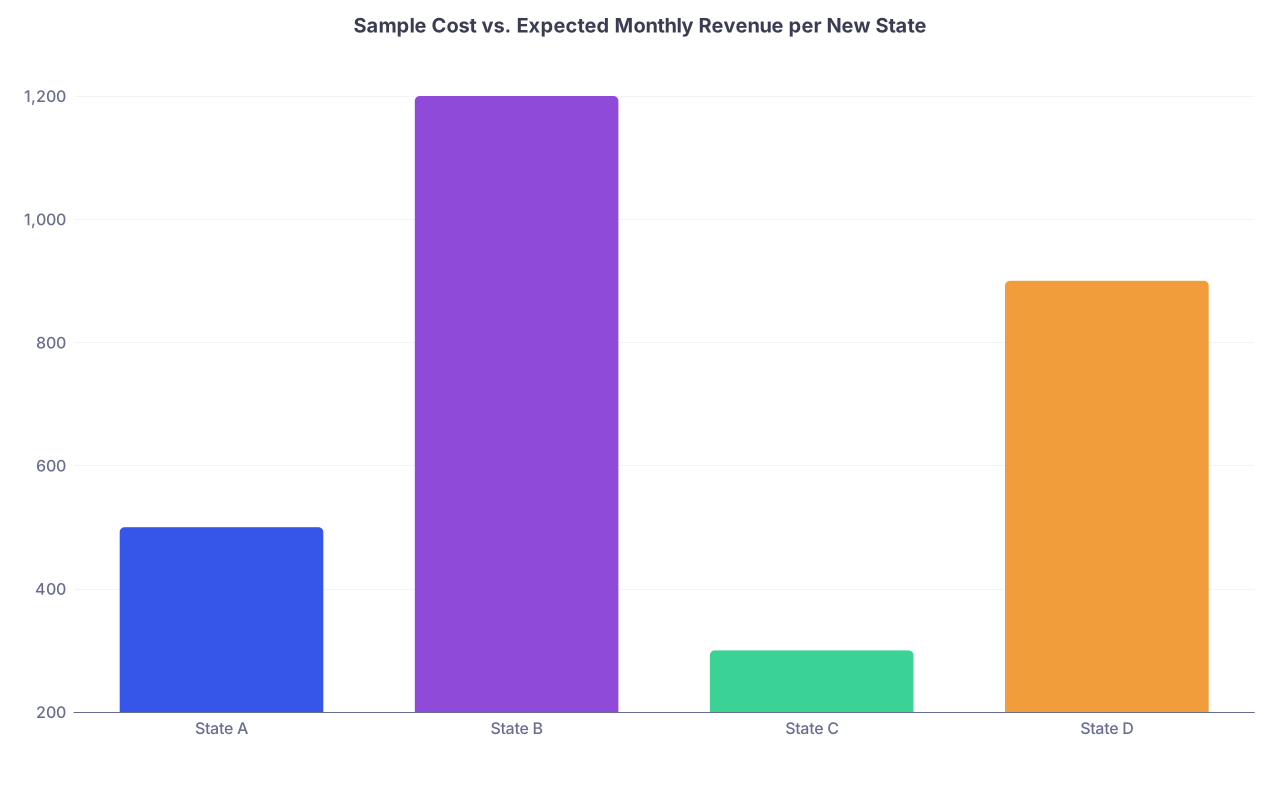
Let’s say each bar is net expected monthly revenue from adding that state (after platform fees, malpractice, etc.). If a state is going to generate $300/month and costs you $1,000+ to license and maintain, it’s a vanity license unless there’s a clear strategic reason.
I’d rather see you with 6 profitable states than 18 random ones that look impressive on a slide.
Also: compacts exist for other clinicians—NPs, PAs, nurses. If your model uses non‑physician providers heavily, map their compact options too, then overlay them on your physician strategy.
4. Design your startup model around state differences, not in spite of them
This is where smart founders make real money: they don’t just tolerate state variation; they monetize it.
Step 1: Map state rules to your clinical offering
Example telehealth niches:
- Weight loss / GLP‑1s
- ADHD / psych
- Tele‑urgent care
- Men’s/women’s health (ED, contraception, HRT)
- Chronic disease (diabetes, hypertension, CHF)
Each of these slams into different state rules about:
- Controlled substances
- In‑person visit requirements before e‑prescribing
- Remote prescribing of certain drug classes
- Corporate practice of medicine restrictions
- Remote supervision rules for NPs/PAs
If your startup is, say, ADHD med management, you cannot treat all states as identical. Some will be “green” (full service), some “yellow” (partial offerings), some “red” (not worth entering at all at your current stage).

So practically:
- Make a 50‑state sheet with columns for:
- Allowed services
- Controlled substance rules
- In‑person requirements
- Major payers you can work with
- Whether you’ll enter, and with what product variation
Then:
- Launch full offering only in green states at first
- Create “lite” versions for yellow states (e.g., non‑controlled options, coaching plus meds via local PCP, etc.)
- Ignore red states until you have legal budget and scale
Step 2: Price per state based on friction
Stop pretending $X per visit makes sense everywhere.
If State A:
- Has easy licensing
- Friendly telehealth rules
- Solid payer reimbursements
And State B:
- Has painful compliance
- Lower volume
- More fraud risk
Why are you charging the same?
I’ve seen smart founders:
- Use cash‑only in high‑headache states and insurance in others
- Add “state surcharge” baked into subscription pricing for most annoying states
- Only offer asynchronous or low‑touch options in problematic places
You’re allowed to let regulatory friction show up in your unit economics. It’s not charity.
5. Build scheduling and routing around licensure from day one
If you ignore everything else I say, don’t ignore this.
Most early‑stage telehealth startups die in scheduling and routing chaos once they add multiple states and a handful of clinicians.
Does this sound familiar?
- “Who can see this California patient at 8 pm PT?”
- “Our only New York license is on vacation this week.”
- “This doc is licensed in 10 states but only has 5 hours a week; we’re wasting capacity.”
This is solvable—but not if you rely on Excel, Slack, and vibes.

| Step | Description |
|---|---|
| Step 1 | Patient Request |
| Step 2 | Check Provider Licenses |
| Step 3 | Book Visit |
| Step 4 | Offer Alternate Time or Provider |
| Step 5 | Waitlist or Decline |
| Step 6 | Patient State |
| Step 7 | Provider Available? |
| Step 8 | No Match After 3 Options |
Here’s what to do when you’re still small:
In your EHR or scheduling tool, tag every provider with:
- State licenses
- Time zone
- Typical available hours
Force scheduling to check state + time zone + availability automatically.
If your software doesn’t support this, you chose the wrong software for a multi‑state play.Use “coverage matrices” for your top 5–10 states:
- Rows: days of week / time blocks
- Columns: states
- Cells: which doc(s) can cover
You want to be able to answer instantly:
“If we get 50 visits from Florida on Sunday, can we absorb it without breaking everything?”
Later, when you’re larger, you’ll probably build or buy a smarter routing layer. But if you don’t start with this mindset, you’ll drown in manual triage.
6. Use multi‑state licensure as a hiring and retention weapon
This is the part founders underestimate.
Clinicians with multiple licenses are annoying to recruit but extremely valuable once you have them. You can make your company “sticky” by:
- Offering to sponsor additional licenses (you pay the fees, they give you first rights on that state’s clinical time)
- Setting up structured “licensing sprints” where, for example, a new hire gets 3–5 states over 6 months with your admin support
- Tying bonuses to licensure expansion in strategic states (not random ones)
| Category | Value |
|---|---|
| 1 license | 1 |
| 3 licenses | 2.8 |
| 5 licenses | 4.5 |
| 8 licenses | 6.5 |
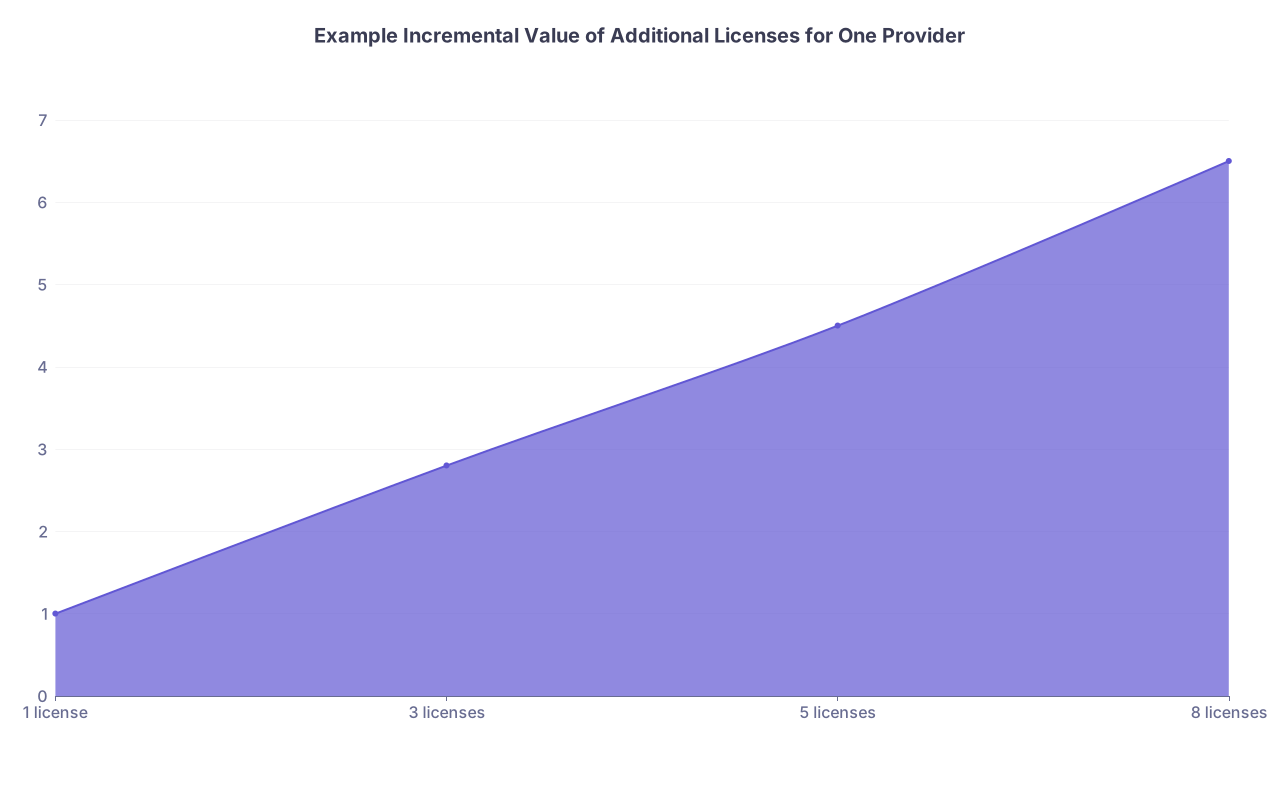
That area chart is the idea: the value of a provider doesn’t scale linearly with licenses. A doc licensed in 8 of your highest‑volume states is far more valuable than 8 different single‑state docs, because they smooth peaks and gaps.
Tactical moves:
In job postings, be explicit: “Strong preference for physicians already licensed in at least 3 of: FL, TX, AZ, IL, PA.”
This filters your pool upfront.For existing clinicians, have a written licensure roadmap:
“Q1: Add FL, Q2: Add AZ, Q3: Add PA.”
You handle paperwork and costs; they commit to staying X months.Protect yourself: build clauses that if they leave within a certain time frame after you pay for licenses, there’s some repayment or clawback. Seen it used; works as leverage.
7. Don’t forget malpractice, Rx, and corporate structure follow the same state lines
This is where the “I’ll just get more licenses” people get slapped.
Every time you add a state, you should ask three questions:
Do we have malpractice coverage that explicitly covers:
- That state
- That modality (synchronous video, async messaging, phone)
- Those services (e.g., controlled substances, procedures)
Are we compliant with that state’s:
- Prescription rules (esp. controlled substances, tele‑prescribing)
- Required PDMP registration and use
- eRx rules and pharmacy relationships
Do we need an in‑state professional entity or special structure because of corporate practice of medicine laws?
You don’t want to be the founder who proudly announces “We just opened in California!” while your malpractice policy specifically excludes California telemedicine. I have seen versions of that. More than once.

Do yourself a favor: for every new state you plan to enter, maintain a one‑page “state entry checklist” that a real healthcare attorney has blessed at least once. Then operationalize it with your ops staff.
8. Turn multi‑state licensure into part of your investor and payer story
If you’re going to raise money or sign big contracts, licenses are not just backstage compliance—they’re part of your pitch.
Investors listen differently when you say:
- “We’re already licensed in 7 states, covering ~35% of our target population, with a clear low‑friction path to 20 states via IMLC over the next 12 months.”
Compared to:
- “We’ll expand nationally as we grow.”
One sounds like a plan; the other sounds like a wish.
For payers and employers, multi‑state coverage lets you say:
- “We can cover your employees in these 10 states today, and we have a concrete licensing and hiring roadmap for the rest. Here’s the timeline.”
| Quarter | New States Go-Live | Coverage % of Target Population |
|---|---|---|
| Q1 | FL, TX | 20% |
| Q2 | AZ, IL, PA | 35% |
| Q3 | GA, NC, MI | 48% |
| Q4 | CO, WA, VA | 58% |
You look serious when you can show:
- Which docs will carry which new states
- Which services will be live in which states at which dates
- How you’ll manage malpractice and compliance for each wave
That’s multi‑state licensure as growth architecture, not paperwork.
9. Concrete “if you’re here, do this” scenarios
Let’s get hyper‑practical.
Scenario 1: You just finished residency, have 1 license, want a telehealth side gig that might become a startup
Do this:
- Keep your full‑time job for income and malpractice umbrella.
- Get licensed in 2–3 more strategic states via IMLC if possible (cheap ones with good demand, like AZ, CO, FL, depending on your SPL).
- Start with a narrow service line (e.g., migraine, sleep, simple tele‑urgent care) in those 3–4 states.
- Use this time to:
- Learn actual multi‑state operational pain
- See where patients are coming from
- Build your routing/scheduling discipline early
Don’t:
- Waste money getting 10 licenses before you have 10 paying patients.
- Promise any employer or payer “national” coverage when you can’t back it up.
Scenario 2: You’ve already launched, are in 5 states, drowning in ops chaos
Classic.
Do this in the next 30 days:
Freeze licensure expansion. No new states until you stop bleeding.
Map which states are actually driving:
- Visits
- Revenue
- Profit (not just volume)
For each clinician, list:
- Current licenses
- Actual hours worked for you
- Real utilization (how booked they are)
Rebuild scheduling around:
- Top 3–4 states with the best margins
- Ensuring continuous coverage in those first
Turn off or reduce marketing in low‑value states until you can cover them sanely.
Then, 60–90 days later, expand again—but deliberately.
Scenario 3: You want to pitch a national employer/payer in 12–18 months
You need a licensure plan on paper. Not vibes.
Do this:
Identify which states cover 70–80% of their member/employee base.
Prioritize those for:
- Licensing your core physicians
- Recruiting local PRN clinicians if you need in‑state presence
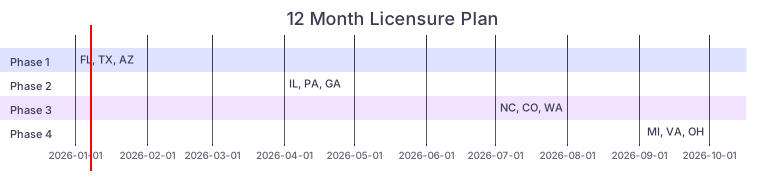
Build a simple Gantt‑style roadmap showing:
- Which quarters you’ll add which states
- Which clinicians will pick up which licenses
- When full vs. partial service will be available in each state
Then show that slide in the pitch. It makes you look like an operator, not a dreamer.
| Task | Details |
|---|---|
| Phase 1: FL, TX, AZ | a1, 2026-01, 3m |
| Phase 2: IL, PA, GA | a2, 2026-04, 3m |
| Phase 3: NC, CO, WA | a3, 2026-07, 3m |
| Phase 4: MI, VA, OH | a4, 2026-10, 3m |
10. Prep for regulatory drift: states will keep changing the rules
Last piece: whatever is true today will keep shifting.
To keep from getting blindsided:
Assign someone (maybe you at first) to be the “state rules hawk.”
Subscribe to updates from:
- FSMB
- Your malpractice carrier
- A telehealth‑savvy healthcare law firm’s mailing list
Once a quarter, review:
- Any new rules about telehealth, Rx, and licensure in your states
- Whether any state moved from green → yellow or yellow → red for your model
| Category | Value |
|---|---|
| 2020 | 10 |
| 2021 | 18 |
| 2022 | 22 |
| 2023 | 20 |
| 2024 | 25 |
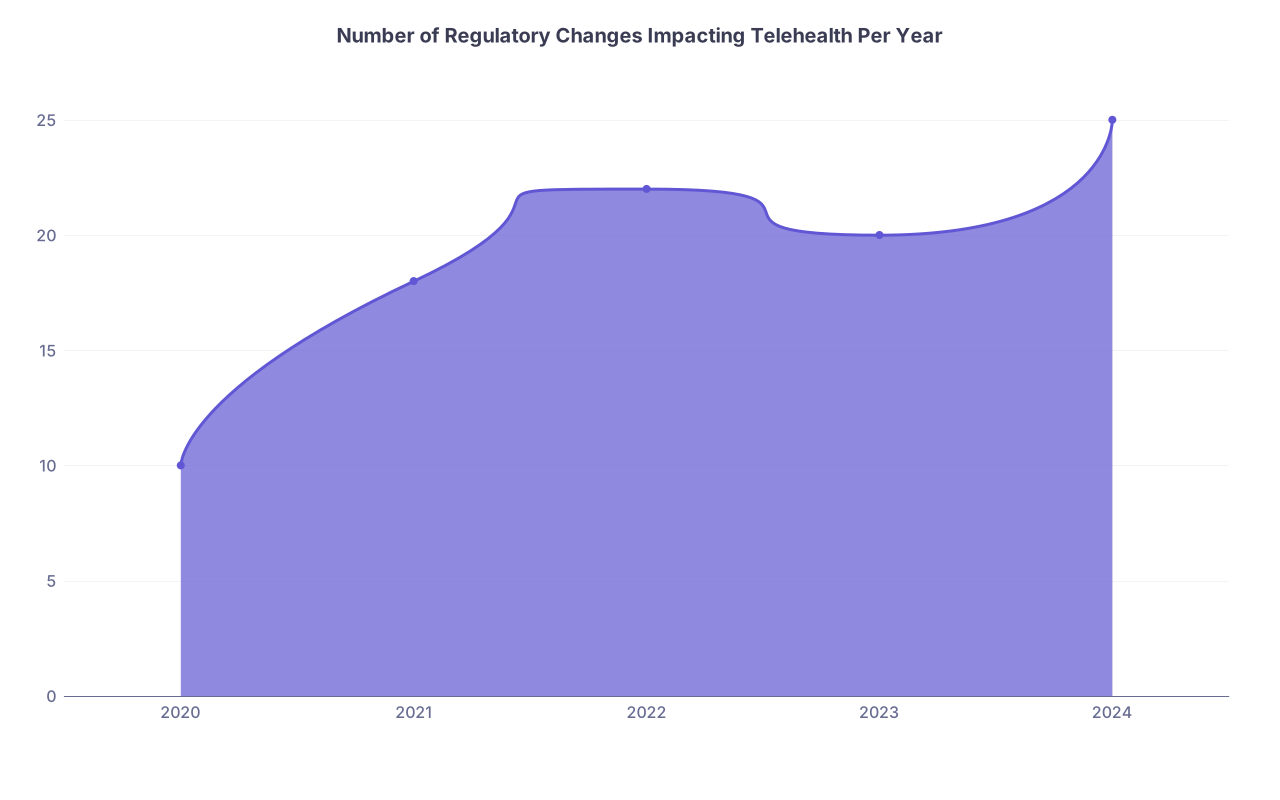
That line could easily keep climbing. If you build your startup assuming stability, you’re already behind.
Key takeaways
- Multi‑state licensure is not paperwork; it’s your operating system. Treat it like product and capacity design, not a checklist.
- Expand licenses only where demand, reimbursement, and state rules line up with your model—and route scheduling, hiring, and pricing around that map.
- Use licensure as leverage: to recruit better clinicians, win larger contracts, and tell an investor story that’s actually grounded in operational reality.