
What happens if your startup burns cash faster than expected and your spouse is staring at you across the table asking, “So… how are we paying the mortgage next month?”
If your spouse relies on your income, you do not get to play startup like a 25-year-old tech bro sleeping on an air mattress. You have obligations. Maybe kids. Maybe aging parents. Definitely student loans and a lifestyle that has already inflated because everyone told you, “You’re a doctor now, you’ll be fine.”
You can still build a medical startup. But you cannot do it recklessly. You need a structure, not vibes.
This is how you build a safer startup plan in the post-residency/job market phase when your income is the main pillar holding up your family.
Step 1: Decide Which Risk Profile You’re Actually In
Most physicians massively mislabel their situation. They say “I’m pretty risk-tolerant” while their spouse is a stay-at-home parent and they’re about to lose employer health insurance.
You’re in one of three buckets.

1. Primary Breadwinner, Single Income
Scenario:
- You’re an attending (maybe first 1–5 years)
- Spouse doesn’t work or has very low income
- Mortgage or high rent
- Kids, or planning them soon
- Student loans that are not trivial
Translation: A bad quarter could wreck you. You are not a burn-the-boats founder. You are a “plan the boats, buy life jackets, track the weather” founder.
2. Dual-Income, But Your Income Is Still Key
Scenario:
- Spouse works, has some income, maybe healthcare
- But your income is >50% of household
- Lifestyle scaled to both incomes (private school, big house, etc.)
- Fixed expenses are high
Better than bucket one, but you still can’t disappear into a no-salary startup for 18 months.
3. Cushioned / Independent
Scenario:
- Spouse has strong stable income (or you have savings >3–5 years of living costs)
- Or you sold a practice / exited something already
- Or you have serious passive income
If you’re here, you can tolerate true startup risk. Most people reading this are not here. Be honest about it.
Once you admit which group you’re in, you stop copying advice from people in a completely different category.
Step 2: Build a Hard “Family Floor” Budget First (Not a Startup Budget)
Do this before you open a single LLC document.
You need to know: “What is the absolute minimum monthly cash my family must receive to avoid financial damage?” That’s your Family Floor.
| Category | Monthly Amount |
|---|---|
| Mortgage/Rent | $3,000 |
| Utilities + Internet | $400 |
| Groceries | $900 |
| Health Insurance | $1,200 |
| Car + Insurance | $700 |
| Minimum Loan Payments | $1,000 |
| Childcare/School | $1,200 |
| Basic Miscellaneous | $500 |
That total: $8,900. Round it up to something clean like $9,500 for small stuff you forgot.
Now two critical moves:
Add a 20–30% buffer for “life happens.”
- $9,500 × 1.25 ≈ $11,875
- Call it $12,000/month minimum needed income.
Decide how much lifestyle you are actually willing to sacrifice for 12–24 months:
- Private school → public?
- Two cars → one car?
- Luxury vacations → gone.
- Eating out → rare.
I’ve watched founders blow up because they tried to keep attending-level lifestyle while doing a pre-revenue startup. It does not work. Something breaks—usually the marriage.
You and your spouse need a hard, agreed monthly number: “As long as $X hits our account every month, we’re okay with you building this.”
Step 3: Anchor to a “Safety Horizon” Before You Quit or Cut Back
You don’t jump without knowing how far the ground is.
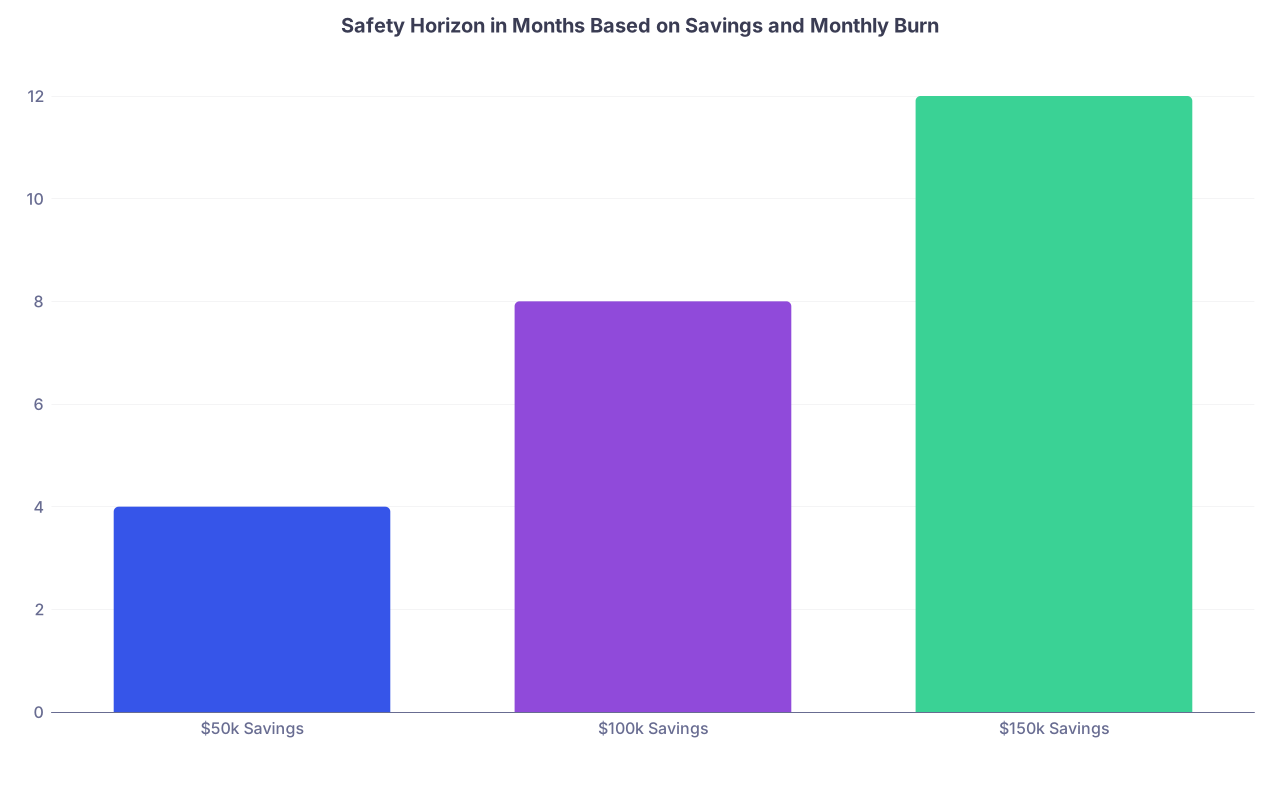
Your Safety Horizon = number of months you can guarantee your Family Floor is met, even if the startup makes $0.
Calculate it:
- Cash savings earmarked for living (not retirement, not kids’ 529s)
- Plus guaranteed income (part-time clinical, spouse job, etc.)
- Minus monthly Family Floor
| Category | Value |
|---|---|
| $50k Savings | 4 |
| $100k Savings | 8 |
| $150k Savings | 12 |
For most breadwinner physicians with a dependent spouse, I’d draw these lines:
- Under 6 months = do not go full-time on your startup. You’re playing with fire.
- 6–12 months = maybe, but you’d better have part-time clinical income or a very modest burn.
- 12–24 months = reasonable runway if you keep expenses lean and have a clear go/no-go plan.
- 24+ months = you have room to take real startup swings.
If your Safety Horizon is under 12 months, your plan is not “quit my job and build a medtech platform.” It’s “structure a ramp that keeps real income coming while I prove this concept.”
Step 4: Choose the Right Startup Structure for Your Situation
Not all “medical startups” require the same risk. A SaaS platform with no revenue for two years is a different beast from a virtual clinic that can bill in 60 days.
Here’s the blunt breakdown.
| Model | Time to Revenue | Typical Risk Level |
|---|---|---|
| Side-hustle consulting | 1–3 months | Low |
| Micro practice / telehealth | 1–6 months | Low–Medium |
| Niche service business | 3–9 months | Medium |
| Digital product / course | 3–12 months | Medium–High |
| Venture-style tech / app | 12–36+ months | High |
If your spouse relies on your income, your first move should not be the deep-tech, all-or-nothing platform with no revenue for 18 months. That can come later once you have a base.
Smarter path: build a “cash-flow-first” startup model that:
- Leans on your clinical credibility
- Starts generating some revenue in 3–6 months
- Can be run part-time initially
- Does not require a giant team or heavy fixed overhead
Examples:
- Micro specialty telehealth clinic targeting a narrow niche (e.g., ADHD in women physicians, post-COVID POTS patients, fertility optimization for PCOS).
- B2B consulting for health systems, payers, medtech, or digital health companies.
- Procedure-light, high-margin membership clinic or concierge telemedicine.
- A hybrid: clinical offering that also throws off data or workflows you can later productize into software.
This phase is about creating optionality—protect income now while building assets that could become a larger company later.
Step 5: Design a Work Structure That Feeds Both Family and Startup
Here’s where most physicians blow it: they think it’s binary. “Full-time job OR full-time founder.” Terrible frame.
You want a staged ramp.

| Step | Description |
|---|---|
| Step 1 | Full Time Clinician |
| Step 2 | Clinician + Nights and Weekends Startup |
| Step 3 | Part Time Clinician 0.6-0.8 FTE |
| Step 4 | Clinician 0.2-0.4 FTE + Growing Startup |
| Step 5 | Founder With Minimal Clinical |
Stage 1: Full-Time Clinical + Nights/Weekends Startup (3–6 months)
Goal:
- Validate your idea without blowing up your income.
Concrete structure:
- 1–2 protected evenings per week for startup work.
- One half-day on weekends.
- Outsource low-skill tasks early (e.g., research, simple design, basic admin) to protect your limited time.
You’re not optimizing for speed here. You’re buying information cheap.
Stage 2: Negotiate Partial FTE (0.6–0.8) Only After Early Validation
Once you have:
- A few paying customers or users
- Clear demand signals (people responding to a waitlist, advisors interested, clinics asking)
Then you move to:
- 3–4 clinical days/week with steady income.
- 1–1.5 full days + some evenings for the startup.
You can often negotiate this with a group or hospital: “I want to cut to 0.7 FTE.” They’ll roll their eyes, but post-COVID many systems are used to non-standard arrangements. You just have to ask and be willing to walk.
Stage 3: Further Step Down Clinical Only If Startup is Covering a Chunk of the Family Floor
Not “covering expenses someday.” I mean right now, for the last 3–6 months, your startup has reliably produced income.
Example rule you can set with your spouse:
- “We only drop below 0.6 FTE once the startup is consistently providing at least $5k/month in profit for 6 straight months.”
Write it down. Let that be the trigger. Not your excitement level after a good sales call.
Step 6: Separate Family Money From Startup Money Ruthlessly
I’ve sat with founders whose spouses had no idea how much of their savings had been quietly dumped into the company until the bank account was nearly empty. That’s how marriages implode.
Structure it like this:
- Open a dedicated business account for the startup.
- Decide a fixed “capital commitment” from family funds—for example: “We will invest up to $40,000 into this business over 12 months.”
- Transfer that money once or in clearly defined tranches into the business. When it’s gone, it’s gone unless you both explicitly agree to extend.
- Pay yourself from the business only when:
- There’s monthly profit after all necessary business expenses
- And you’ve kept aside some modest cash buffer inside the business
Think of your household as an investor. You wouldn’t casually keep writing checks to some random founder who blows their budget every month. Treat yourself the same way.
Step 7: Protect the Two Big Fragilities: Health Insurance and Disability
This is the part founders conveniently ignore until they have an accident or a family member gets sick.
When you walk away from a W-2 job, you usually lose:
- Employer-sponsored health insurance
- Group long-term disability coverage
- Retirement match
If your spouse relies on your income, losing health insurance for six months because you “forgot to sort it out” is not an option.
| Need | Option | Pros | Cons |
|---|---|---|---|
| Health | COBRA from old employer | Easy, no coverage gap | Expensive, time-limited |
| Health | Marketplace plan | Customizable, subsidies | Network/coverage variability |
| Disability | Individual own-occupation | Portable, tailored | Underwriting, cost |
| Disability | Association/group policy | Easier approval | Less flexible terms |
Bare minimum moves before you reduce FTE or quit:
- Lock in an individual own-occupation disability policy while you’re still full-time employed and healthy.
- Decide whether you’re doing COBRA vs marketplace vs spouse’s plan for health insurance.
- If your startup is going to employ others, speak with a broker about building group plans later—but don’t wait for that to protect your own family first.
Step 8: Build Formal Checkpoints With Your Spouse (Not Vague “Let’s See”)
If your spouse relies on your income, they are effectively your co-investor. Treat them that way.
You need:
- A written plan.
- Defined review checkpoints.
- Clear criteria for:
- Continue
- Modify
- Pause
- Shut down
| Category | Value |
|---|---|
| Month 0 | 0 |
| Month 6 | 10 |
| Month 12 | 40 |
| Month 18 | 80 |
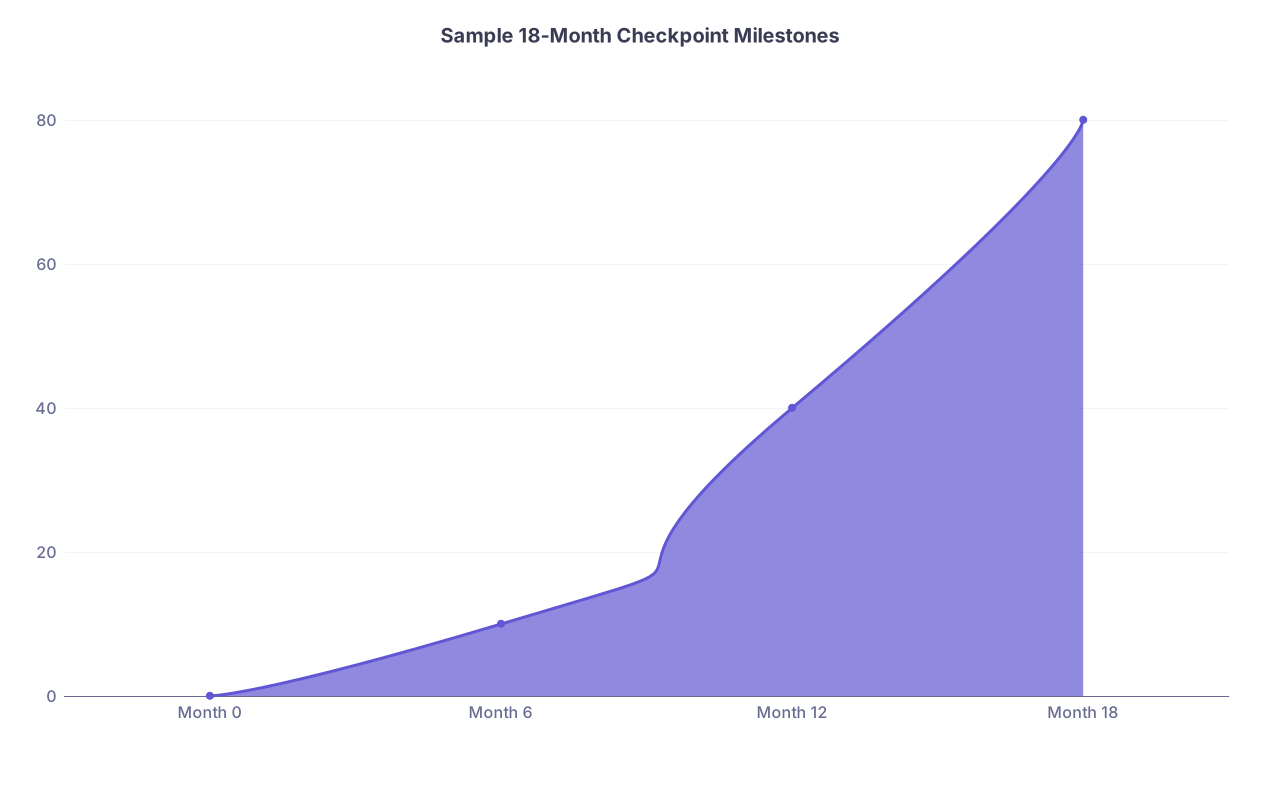
Example checkpoint plan:
- Month 0:
- Agree on capital commitment, Safety Horizon, minimum income.
- Month 6:
- Must have: defined product/service, early users, at least first revenue.
- Discussion: Is this worth 6 more months of effort and capital?
- Month 12:
- Must have: consistent monthly revenue; concrete growth path; clear customer who really cares.
- If still pre-revenue, you either radically pivot or set a near shutdown date.
- Month 18:
- Must have: covering at least 30–50% of your previous W-2 take-home or a path to that within 6–12 months with strong evidence.
- If not, you probably move this back to side-hustle status and restore clinical income.
This is not being pessimistic. It is being an adult. Your spouse does not want blind optimism. They want to know: “What happens if this doesn’t work?” Having that answer builds trust and actually makes it easier for them to support the risk.
Step 9: Use Debt Carefully (And Usually Less Than You Want To)
Medical culture trains you to see debt as “normal.” Med school loans, practice buy-ins, mortgages. So founders think, “I’ll just get a line of credit” and let the startup live on that.
For breadwinners, that’s dangerous.
Here’s how I’d frame it:
- High-interest personal credit cards for startup expenses = absolutely not.
- Personal loans collateralized by your home = almost always no.
- Modest business line of credit or 0% intro cards with a hard cap you and your spouse set together = maybe, but only after real traction.
- Revenue-based financing or small loans secured by actual business revenue = safer, but still needs a plan.
You should aim to prove your concept with as little debt as possible. Then, once you have paying customers and more predictable income, you can consider debt to scale, not to survive.
Step 10: Sequence Your Ambition: Cash Flow First, Big Vision Second
You want to change healthcare. Build platforms. Fix prior auth. Solve burnout. Great. Do it in stages.
Here’s the smarter sequence for someone whose spouse relies on them:

| Step | Description |
|---|---|
| Step 1 | Clinical Side Income |
| Step 2 | Cash Flow Niche Business |
| Step 3 | Systematize and Delegate |
| Step 4 | Productize Insights or Build Tech |
| Step 5 | Scale and Seek Investment |
Concrete example:
- Start: Niche telehealth clinic focused on migraine in high-performing women.
- Learn: Patterns about medication responses, digital tracking, workflow, and what patients actually want.
- Systematize: Protocols, SOPs, intake forms, follow-up flows.
- Productize: Turn those protocols into a clinical decision support tool, a patient-facing app, or a B2B solution for larger groups.
- Then consider: Raising money, building out a full tech platform, maybe stepping further away from clinical.
This way, even your “startup years” are earning clinical money while you build a bigger asset. You’re not doing a binary clinical vs startup split. You’re layering them.
FAQs
1. How much savings should I have before cutting back my clinical work to pursue a startup?
If your spouse relies on your income, I’d target:
- At least 12 months of Family Floor expenses in accessible savings or guaranteed income before you drop below ~0.6–0.7 FTE.
- If your startup is already generating consistent profit, you can count part of that, but be conservative—assume some months will be worse.
Under 6 months of runway and no meaningful startup revenue? Do not significantly cut clinical. Use nights/weekends and negotiate a safer, stepwise reduction later.
2. Is it ever reasonable to go “all in” and quit my job completely?
Yes—but only if multiple boxes are checked:
- You have at least 18–24 months of Family Floor expenses covered by savings/spouse income/startup income.
- You’ve validated your idea with real paying customers or contracts, not just conversations and enthusiasm.
- You and your spouse have a written plan with milestones and a hard “reassessment or re-entry to clinical” date.
- Your health insurance and disability coverage are already sorted.
If you’re missing two or more of those, “all in” is not brave—it’s reckless.
3. What’s the best startup model for a post-residency physician with a non-working spouse?
Best balance of risk and upside early on:
- A niche telehealth or micro practice that can bill cash/telemedicine quickly.
- Or consulting/B2B services that leverage your clinical expertise.
Both let you:
- Start part-time.
- Generate revenue in months, not years.
- Learn the market from the inside, which you can later turn into tech, content, or scalable products.
Pure tech SaaS with a 2-year R&D cycle is a bad first move when your spouse depends on your paycheck.
4. How do I handle student loans while building my startup?
You don’t pretend they don’t exist. You:
- Include minimum payments in your Family Floor.
- If you’re eligible and it fits your career, consider income-driven repayment or PSLF-qualifying roles before you cut back FTE.
- Avoid forbearance as your default “plan”—interest will quietly eat you alive.
- When in doubt, keep paying at least the minimum and treat any extra aggressive payoff as optional until your income stabilizes.
The startup plan has to coexist with a realistic loan strategy, not compete with it.
5. What if my spouse is nervous and wants me to delay the startup for several years?
Take that seriously, but don’t just shut the dream down. Do this:
- Ask, “What would make this feel safe enough for you?” Push for specifics: savings number, time horizon, income threshold.
- Propose a low-risk Phase 1: nights/weekends test, with zero change to your clinical FTE and a tiny, fixed budget.
- Schedule a 3–6 month review meeting where you share evidence: income, traction, stress level, impact on family.
- Be willing to slow the timeline. If your relationship blows up, the startup cost just became astronomically higher.
Sometimes the answer is: do a 12–18 month full-attending push, stockpile cash, then intentionally downshift into your structured startup plan. That’s not cowardice. That’s strategy.
Key points, stripped down:
- Protect the family first: define your Family Floor, Safety Horizon, and insurance before you touch your job.
- Structure the startup as a phased ramp—cash-flow-first models, part-time clinical, and clear checkpoints with your spouse.
- Separate family money from startup money, set hard limits, and be ruthless about revisiting the plan if the numbers don’t justify the risk.