
It’s 10:30 p.m. You’ve just finished a call with a potential pilot site who asked, “So is your department chair backing this?” You mumbled something vague about “institutional discussions” because the real answer is: no. Your chair thinks your startup is a distraction, your “protected time” is a joke, and the last time you tried to explain product–market fit you got, “Why don’t you just write an R01 instead?”
You finished residency, survived fellowship, landed an attending job, and somewhere in the cracks you’ve built a real thing: maybe a workflow automation tool for inpatient medicine, maybe a remote monitoring platform, maybe AI triage. It has users, or at least serious interest. But the person who technically “owns” your time and reputation at your institution wants none of it.
So now you’re stuck in the worst possible place: too serious about the startup to treat it like a hobby, but not supported enough to move it forward cleanly inside the system.
Here’s what you do next.
Step 1: Get Completely Honest About Your Situation
Before you jump to alternatives, you need a brutally clear starting point. Not vibes. Facts.
Ask yourself:
What exactly is my chair blocking?
- Use of institutional data?
- Permission to pilot on the unit/department?
- Using my faculty title in fundraising?
- FTE protection?
- Owning IP personally instead of routing through tech transfer?
- Just “cultural” disapproval and subtle sabotage?
What do you actually have?
- An appointment (even if unsupportive).
- Existing relationships with frontline staff who want to use your product.
- Maybe support from a division chief, CMIO, or QI director.
- Existing IRB approvals or informal pilots.
How much runway and leverage do you personally have?
- Savings or spouse/partner income?
- Burnout level.
- Visa situation (huge constraint if you’re on a work visa tied to the institution).
- Reputation; are you a star clinician everyone wants, or replaceable?
Write this out. Literally one page. Because the right alternative path depends heavily on the specifics.
Step 2: Map the Chair’s Objection Type (So You Don’t Fight the Wrong Battle)
Not all “no” is the same. I’ve seen three main flavors.
Philosophical “medicine is a calling” objector
They think startups are dirty, greedy, or unserious. They’ll smile while quietly blocking everything and framing it as “concern for patient care and your career trajectory.”Risk-averse institutional defender
They’re afraid of compliance, liability, optics (“What if this ends up in the news?”), or upsetting hospital IT. They’re not anti-innovation, they’re anti-anything that makes them personally vulnerable.Control/ownership blocker
They’d maybe support it—if the department or institution “owns” it, or if they’re given a formal role. They want credit, power, authorship, or control over IP.
You handle each type differently.
- With #1, you do not waste energy persuading. You route around them.
- With #2, you present de-risking moves (IRB, legal review, clear contracts, pilot scopes).
- With #3, you either structure them in (carefully) or deliberately separate and go external.
Step 3: Decide: Institutional, Hybrid, or Fully External?
This is the first real fork in the road.

| Step | Description |
|---|---|
| Step 1 | Chair unsupportive |
| Step 2 | Hybrid or new institution |
| Step 3 | Go fully external |
| Step 4 | Find new employer or clinical home |
| Step 5 | Route around chair with other champions |
| Step 6 | Spin out and keep job optional |
| Step 7 | Need hospital data or patients? |
| Step 8 | Chair block is absolute? |
Ask: Does this product fundamentally depend on my current hospital?
If your startup needs:
- Direct integration with the EHR at your institution,
- Real patient data from this system,
- Physical space or equipment only this hospital has,
then your choices are:
- Find another internal champion and bypass the chair, or
- Move institutions, or
- Pivot the product so you don’t depend on this specific place.
If your startup can:
- Work with any outpatient practice, ASC, telehealth group, or other system,
- Be built and validated on de-identified or synthetic data,
- Be piloted with partner clinics, FQHCs, private practices, employer groups,
then the best move is usually: go more external. Keep the job only as long as it buys you time, credibility, and money.
Step 4: Route Around the Chair Inside the Same Institution
You might not actually need chair blessing. You might just need enough institutional permission to run a pilot and say “Used at X Medical Center.”
Targets to approach:
- CMIO / CNIO
- CMO or Chief Quality Officer
- System Innovation / Digital Health / Transformation office
- Hospitalist or ED service line leads (if they control workflows you’re improving)
- IT leadership if it’s EHR-integrated (Epic, Cerner, etc.)
You’re not going to them as “my chair said no so I’m here.” You’re going as:
“I’m an attending in X department. Over the last year I’ve been building Y, a solution to Z problem that we face here daily. I’d like to explore a tightly scoped pilot in this unit / clinic with clear guardrails and measurable outcomes. I’m happy to align with institutional compliance, IRB, and legal.”
Concrete moves that often work:
IRB angle
Frame first deployment as a QI or implementation study. Get IRB approval. Chairs hate being bypassed, but they usually won’t outright fight IRB-approved QI that has leadership blessing.Pilot with a “friendlier” service
Your chair in cardiology hates this? Fine. Pilot in hospital medicine, primary care, or urgent care if your solution generalizes.Resident/nurse champion
If residents and nurses are loudly saying “We need this. This solves real pain,” leadership will sometimes overrule a chair blocking out of ego.
But if your chair is the kind who will retaliate—bad evals, blocked promotions, subtle character assassination—don’t be naive. You need an exit plan in parallel.
Step 5: Use External Clinical Work as Your Sandbox
If your chair truly won’t allow anything on “their” turf, stop asking permission there and build your sandbox elsewhere.
Options:
Per diem / part-time work in a friendlier system
- Community hospitalist gig
- Telemedicine platforms
- Urgent care chains
- FQHCs or rural centers
Direct contracts with independent practices
Small groups can move frighteningly faster than academic centers. The tradeoff: less prestige, more operational chaos.Partnering with digital health companies
If your product is a feature that fits neatly inside someone else’s offering, you can pilot through their clients rather than your hospital.
Your mental model: your W-2 academic job is now just revenue and baseline credibility. Your startup’s real “clinical lab” is wherever people will actually let you use the thing.
Step 6: Decide How Much of “Doctor You” Is Tied to the Institution
A lot of founders mess this part up. Your faculty title feels like your entire identity, so you assume your startup dies without it.
Reality: Many of the people writing checks and signing pilots no longer care if you’re “Assistant Professor of X at Y.” They care if:
- You deeply understand the problem.
- You can show early traction.
- Your product reduces cost, improves throughput, or helps recruitment.
You’ve got three levers:
Title leverage
Stay faculty for now, but run the company separately. Use the title on your LinkedIn and pitch decks while you still have it, but don’t let it control product decisions.Brand transplant
Move to an employer that actually wants physician founders. Some systems explicitly court this: large integrated delivery networks, academic-powered venture studios, health systems with internal innovation funds.Decoupling
Go full clinical mercenary: part-time telemed, urgent care, locums. Set your schedule around build time. Your brand becomes “practicing physician” rather than “Assistant Professor.”
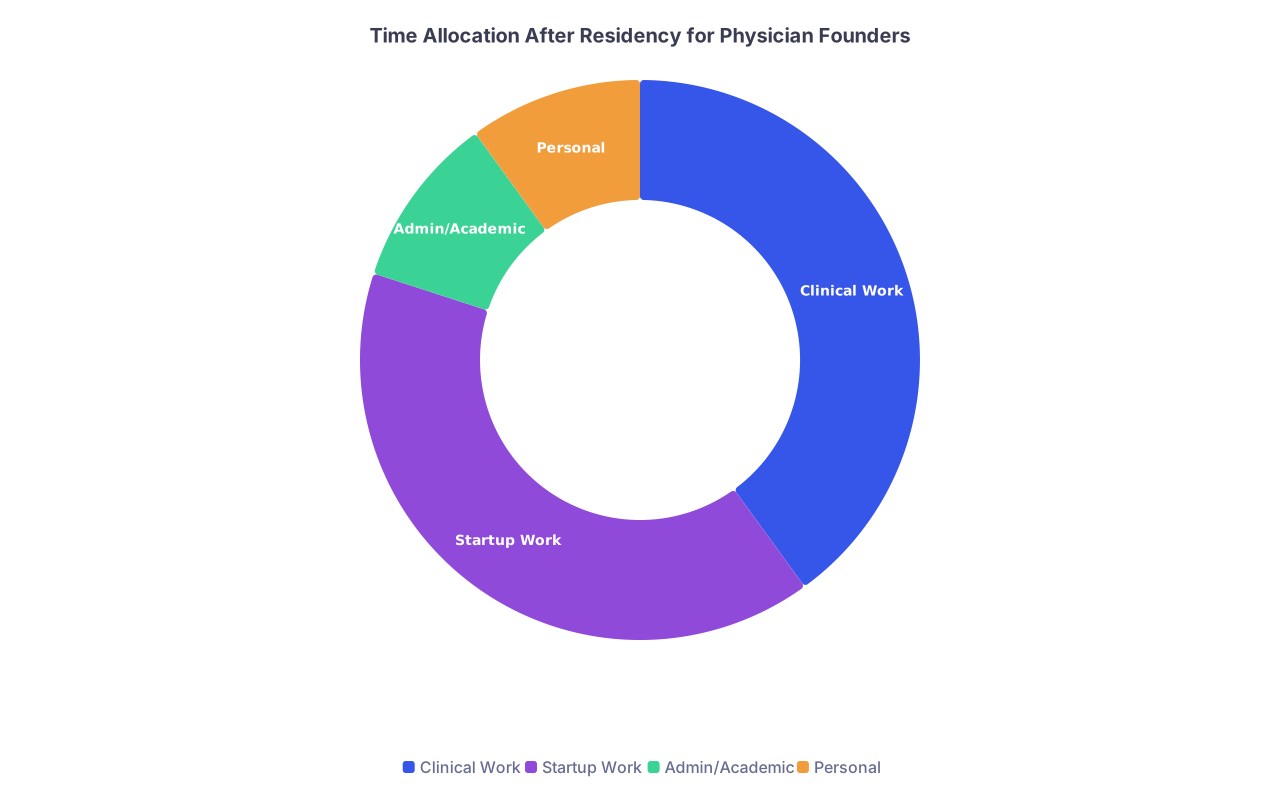
| Category | Value |
|---|---|
| Clinical Work | 40 |
| Startup Work | 40 |
| Admin/Academic | 10 |
| Personal | 10 |
The chairs who hate startups often weaponize tenure tracks, promotions, and committees. The more your identity depends on those, the more you’re stuck. Loosen that dependency.
Step 7: Handle IP, Conflict of Interest, and Legal Cleanly
If your institution smells “IP issue” or “conflict of interest,” they’ll slam the brakes. You need to be proactive here.
Non-negotiables:
Know what you signed.
Pull your employment agreement and any IP or moonlighting policies. Look for phrases like “work made for hire,” “scope of employment,” “use of institutional resources,” and “assignment of inventions.”Keep development off hospital time and tools.
- Your personal laptop, not the hospital-issued one.
- GitHub, not internal servers.
- Nights/weekends or clearly tracked non-hospital time.
If they ever challenge ownership, you want a clean story.
Formal conflict-of-interest declaration if you do anything on-site.
If you eventually pilot at your own institution, you want COI on file before someone accuses you of hiding it. Yes, the committee might be slow and annoying. Document everything.Consider a lawyer early.
Spend a few hundred to a couple thousand dollars to have a startup-savvy attorney—not just a friend who does divorces—review your situation. This is often the difference between “they own everything” and “they own nothing if you play it right.”
| Scenario | Who Likely Owns IP |
|---|---|
| Built on personal time, no hospital resources | You / your company |
| Built with hospital data, on hospital servers | Usually the institution |
| Funded by hospital or internal grant | Usually the institution |
| Joint with external company, no institutional contract | Messy – get legal input |
If your chair is blocking you and trying to pull IP into the institution, that’s your signal: you probably need to shift development fully outside and avoid using any institutional data until you have real leverage.
Step 8: Choose a Concrete Alternative Pathway
Let me lay out a few realistic “tracks” I’ve seen work when the chair is not on board.
Path A: “Stay Put, Go External, Build Quietly”
Who it’s for: You need the paycheck. You’re in a visa-constrained or geographically constrained situation. The chair is annoying but not actively punitive.
What you do:
- Stop asking your chair for support. Full stop.
- Do zero development on institutional time or equipment.
- Pilot your product with:
- Other hospitals in the region,
- Independent practices,
- Telemed groups,
- Employer health partners.
- Use your “Dr. X, board-certified in Y” brand, not your academic title, as your founder identity.
- Revisit institutional pilots only when you have external traction. Then you deal with the system, not just the chair.
Path B: “Switch Employer to One That Actually Wants This”
Who it’s for: You’re early-career, mobile, and not cemented in one city. You’d trade prestige for support.
What you do:
- Target hospitals and systems that:
- Have an innovation center or venture arm.
- Publicly talk about digital transformation.
- Have physician-founders actually on staff (stalk LinkedIn).
- Be explicit in job interviews:
- “I’m building X. I plan to continue building it. I’d love to pilot here if possible. I’m looking for an environment that supports that.”
- Accept a slightly lower salary or less traditional role if it buys you:
- Protected time actually honored.
- Warm intros to IT, legal, payers.
- A sandbox of forward-thinking clinicians.
This is not fantasy. I’ve watched people move from rigid academic jobs to large community systems that are hungry for innovation and much more practical.
Path C: “Go Part-Time Clinical, Full-Throttle Startup”
Who it’s for: You’re serious about the startup. Clinically competent but ready to be less “in the club.” You have some financial buffer or backing.
What you do:
- Negotiate down to 0.5–0.7 FTE. If your current chair won’t allow it, find someone who will (hospitalist, telemed, urgent care).
- Strip away all unpaid leadership/committee/extracurricular roles. You’re not playing the academic game now.
- Use the extra 1–2 days/week as true build time:
- Customer discovery,
- Product development,
- Pilots,
- Fundraising.
- Be very clear with yourself: your growth track is now founder-operator, not associate professor.
This is the path most doctors who successfully build real companies eventually take, whether they admit it publicly or not.
Step 9: Communicate Strategically with Your Chair (and When to Stop)
You still have to deal with this person. Do it like a professional, but don’t grovel.
What to do:
Have one clean, direct conversation.
“I’m building X. Here’s the problem it addresses. Here’s how it could eventually help our department. I understand your concern about time and focus. My plan is to keep clinical performance strong, handle this outside of protected patient care hours, and keep you in the loop periodically.”Ask for one small, specific allowance. Not global “support.”
- Permission to mention your departmental affiliation on a bio.
- Introduction to the innovation office.
- The ability to explore a small, low-risk pilot in one micro-setting.
Listen for the real answer, not the polite one.
If you hear phrases like “why don’t you focus on grant funding instead,” “this isn’t really our mission,” or “let’s revisit in a few years,” translate that as: they’re not going to help.
At that point, stop spending political capital there. Don’t fight a culture war in a place you don’t own.
Step 10: Guard Against the Two Biggest Risks: Burnout and Half-Measures
If you try to be a full-time ideal attending plus a real founder plus a stealth politician tiptoeing around an unsupportive chair, you’ll break. Eventually.
Watch for these early warning signs:
- Charting spillover every night, startup work starting at 10 p.m.
- Constant guilt—when you’re at work you feel guilty you’re not building; when you’re building you feel guilty you’re not “doing enough” clinically.
- Resentment spikes every time the chair says “we really need you on this new committee.”
If that’s you, simplify.
Practical ways to simplify:
- Drop non-essential academic stuff entirely: committees, extra lectures, the “nice to have” prestige projects that don’t move your startup.
- Cap your shift load where possible. Take the hit in income if you can.
- Set clear startup milestones (e.g., “3 paying pilots in 9 months” or “$X in LOIs”) and allow yourself to reassess your clinical FTE when you hit them.

| Category | Value |
|---|---|
| Clinical load | 80 |
| Admin tasks | 60 |
| Startup demands | 70 |
| Institutional politics | 75 |
The worst place to be is “always on” but never committing. You end up with a mediocre academic career and a half-built company. Pick a direction and align your time with it.
Step 11: Build Credibility Outside the Chair’s Shadow
If your chair won’t vouch for you, you need other validators.
Sources of external credibility:
- Early-adopter clinicians at partner sites who’ll say: “We use this. It helps.”
- Startup accelerators or health-tech programs (e.g., health system accelerators, digital health-focused programs).
- Advisors with real names: former CMIOs, health system execs, experienced founders.
- Outcomes from pilots: reduced LOS, less documentation time, fewer no-shows, whatever you’re targeting.

The more of that you accumulate, the less you’ll care that your department chair thinks you should have been chasing an R01 instead.
Step 12: Know When to Walk
There’s one last scenario that no one likes to say out loud.
Sometimes the chair isn’t just unsupportive. They’re actively hostile. Undermining your reputation. Blocking promotions. Hinting that “your focus seems divided” on evaluations.
If that’s happening, you’re not in a neutral environment anymore. You’re in enemy territory.
Clear signs it’s time to exit:
- Your evaluations suddenly mention “concerns about outside activities” despite solid clinical performance.
- You’re excluded from opportunities explicitly because of the startup.
- You find out about negative back-channel comments to other leaders about your “commitment.”
At that point, this is not a safe place to grow anything long-term. It’s a place to secure a bridge job while you quietly line up a better clinical home or prepare to go mostly independent.
You don’t need the institution’s blessing to do good work in healthcare. You just need one or two partners who actually want what you’re building.

You’re standing at that ugly but powerful junction after residency: stable job on one side, real innovation impulse on the other, and a chair trying to block the path between them. You don’t have to win them over to move forward. You just have to stop waiting for permission that isn’t coming.
Set your boundaries with the institution you’re in. Pick where your “doctor identity” actually needs to live. Clean up the IP and conflict-of-interest trapdoors before you fall in. Then move your startup forward in the environments that actually say yes—even if that means another health system, a small private clinic, a telemed platform, or a part-time clinical life that your residency program would never have imagined.
Once you’ve picked your track and started collecting real-world pilots and outcomes, the entire tone of the conversation changes. Suddenly you’re not the random attending with a “side project.” You’re a founder with traction. And at that point, whether your current chair approves or not is just background noise.
With that foundation laid, your next real challenge won’t be institutional politics. It’ll be scaling: turning a scrappy pilot into a repeatable product across multiple sites, with all the regulatory, integration, and people problems that follow. But that’s a problem for later—once you’ve stopped letting one unsupportive chair dictate the ceiling on your career.