
What do you actually do if you’re a physician on a visa who wants to build a startup—but your immigration status depends on that W‑2 job you cannot afford to lose?
If that’s you, this is the tightrope you’re walking: you want to create something of your own, but one wrong move with equity, “consulting,” or side work can blow up your status, your job, and your future in the U.S. I’ve seen people get dragged into HR offices by compliance, get RFEs on H‑1Bs because of a sloppy side gig, and even get quietly dropped from waiver jobs because the hospital’s lawyer freaked out.
Let’s walk through what’s actually possible, what’s risky, and how to structure things so you can build without burning your legal bridge.
1. Know Exactly What You’re Playing With: Your Current Status
Before you talk “startup,” you need to be painfully clear on what you are right now. Not your dream status—your actual one.
Most post‑residency visa‑dependent physicians fall into one of these buckets:
| Path | Typical Status | Key Constraint |
|---|---|---|
| Direct hire by hospital | H‑1B | Employer‑specific work only |
| J‑1 waiver job (Conrad, ARC, HHS) | H‑1B | 3‑year full‑time service obligation |
| Academic hospital faculty | H‑1B / O‑1 | Heavy employment compliance, IP issues |
| Marriage to U.S. citizen | Pending/approved green card + EAD | Most flexible |
| Independent after GC | Permanent resident | Essentially free to found/work |
If you are:
- On H‑1B sponsored by a hospital or clinic – this is the classic “I want to found a startup but I’m tied to my employer” case.
- On J‑1, still in training – different game; your startup window is more realistically after you transition to a waiver/H‑1B/green card, though you can sometimes be a passive founder.
- On O‑1 or have an EAD (marriage or adjustment of status) – you have more room, but hospitals can still restrict what you can do contractually.
For this article I’ll assume the most constrained, and most common, scenario:
You’re a post‑residency physician on an H‑1B (often as part of a J‑1 waiver obligation), full time with a hospital or clinic, and you want to build a medical startup.
That’s the pressure cooker.
2. What You Can and Cannot Do On an H‑1B While Building a Startup
Let me be blunt: the worst mistake I see is this sentence:
“My friend said I can just put myself as ‘advisor’ on the cap table; immigration will never know.”
Bad idea. Immigration, compliance, and sometimes even credentialing bodies can absolutely discover this stuff. LinkedIn, pitch competitions, AngelList, your own website—nothing stays invisible.
At a high level:
- Allowed: Passive ownership in a company.
- Not allowed without authorization: Active work for any entity other than your H‑1B sponsor.
That line—passive vs active—is where startups get messy.
Clear “No” for H‑1B (Without Additional Sponsorship)
If you’re on a hospital‑sponsored H‑1B, without any concurrent H‑1B or EAD, you generally cannot:
- Have a formal officer role (CEO, CTO, CMO, etc.) at your startup.
- Sign contracts on behalf of the startup (that’s active work).
- Do paid consulting for your own or anyone else’s company.
- Advertise yourself publicly as “working at” your startup (e.g., full profile as “Founder & CEO” with active responsibilities).
The government doesn’t care that you didn’t pay yourself yet. Unpaid work for an entity that is not your H‑1B sponsor can still violate your status.
What’s Usually Safe: Truly Passive Founder
What you can usually do (with good documentation and actual discipline):
- Own equity in a startup (LLC or C‑Corp).
- Be listed as a founder on incorporation documents (as long as you’re not simultaneously claiming to also be an “employee” there).
- Put in capital (you’re an investor).
- Attend board meetings and vote as a shareholder/board member who is not running day‑to‑day ops.
- Receive K‑1 or distribution income from investment (as opposed to W‑2 wages or 1099 for services).
The key is this: you can own, direct at a high level, and benefit financially—but you cannot “work” for the company unless that company also properly sponsors you.
If that sounds like handcuffs, you’re not wrong. But there are real, usable playbooks inside these constraints.

| Category | Value |
|---|---|
| J-1 in training | 1 |
| H-1B waiver | 2 |
| H-1B private | 3 |
| O-1 | 4 |
| EAD/GC | 5 |
3. Concrete Startup Structures That Work For Visa‑Dependent Physicians
Let’s go scenario by scenario. I’ll use real‑world types of companies physicians actually try to build.
Scenario A: You’re Building a Software or Platform Company (Non‑clinical Product)
Example: an AI scribes tool, a scheduling platform, patient engagement app, analytics dashboard.
You on H‑1B at a hospital. You want to build.
Here’s a defensible structure:
- Incorporate the startup as a C‑Corp (usually in Delaware).
- You are a founder and shareholder. Your role on paper:
- “Founder, non‑operating”
- “Board member”
- You do not sign employment agreements as an officer/employee.
- A U.S. citizen or green card holder co‑founder (or non‑clinical operator) holds the operational title:
- CEO, COO, etc.
- They:
- Sign customer contracts.
- Hire first employees/contractors.
- Manage day‑to‑day execution.
- You limit your activities to:
- High‑level strategy discussions.
- Board‑level votes.
- Introducing contacts.
- Using your personal time to “advise” only to the extent that it can be characterized as owner/board activity, not operational work.
Is it frustrating? Yes. But I’ve watched companies do this for 2‑3 years until the doc co‑founder got a green card or a concurrent H‑1B through the startup.
Make peace with this line: as long as you’re on your hospital H‑1B, you are a founder/investor/board member—not an operative staff member.

Scenario B: You’re Building a Clinical Service (Telehealth, Niche Clinic, Concierge Model)
This one is way hotter from a compliance perspective.
Suppose you want to start a telepsychiatry practice or a direct‑pay primary care micro‑clinic while on an H‑1B with a hospital job.
Here are the specific landmines:
- Your H‑1B employer’s LCA usually states you’re full‑time there. A parallel clinical job—even as an owner—can be seen as unauthorized employment.
- Many hospital employment contracts explicitly ban outside clinical work without permission. They’ll frame it as “conflict of interest” or “moonlighting,” and it can be grounds for termination.
- For J‑1 waiver folks, your waiver conditions often require full‑time clinical work at the waiver site. Side service work can technically jeopardize that.
In practice, safe options here are limited:
Passive owner in a clinical practice
- You can invest in a clinic or telehealth company.
- You do not see patients there.
- You do not bill under that entity.
- You’re essentially a “silent partner.”
Moonlighting only if:
- Your H‑1B is structured to allow concurrent H‑1B with the second entity; and
- Your employer and immigration lawyers explicitly set this up as separate authorized employment.
- This is complex and usually not done for an entity you also own, because then USCIS asks: “Who really employs you? Is this self‑sponsorship?”
So if your dream is your own clinical brand, the realistic path more often looks like:
- Step 1 (waiver / initial years): you are a passive founder, setting up the brand, infrastructure, protocols—through others.
- Step 2 (after green card or when you can structure a separate status): you transition clinically to that entity.
Anyone telling you, “Just bill a few patients on the side, nobody cares,” is giving you career‑suicide advice.
4. Making the Most of the “Passive Founder” Phase
You might be thinking: “If I cannot ‘work’ in my startup, what’s left?” A lot, actually, if you approach it strategically instead of emotionally.
Here’s what you can absolutely do and should lean into.
1. Capital, Cap Table, and Control
You can:
- Invest your own after‑tax money into the company as founder stock or SAFE.
- Define vesting schedules (e.g., your shares vest over 4 years—doesn’t require you to be “employed,” just to stay engaged as a founder/board member).
- Be on the board of directors with clear voting rights.
Control isn’t only about signing checks. It’s about:
- Setting the initial vision and guardrails.
- Choosing who gets officer roles.
- Approving major decisions at the board level (fundraising, sale, key hires).
You can do all of that without being “Head of Product” or “CMO” on paper.
2. IP and Ideas – Who Owns What?
Read your hospital employment contract. Many have a clause like:
“Inventions reasonably related to your job duties or created using employer resources belong to the employer.”
You do not want your employer claiming your startup’s IP.
What usually protects you:
- You work on the startup completely outside clinical hours.
- You don’t use hospital computers, EMR data, or research resources.
- The startup is meaningfully different from your exact job remit (e.g., you’re a hospitalist but building a billing analytics platform—not conducting funded research on it inside the hospital).
If there’s any doubt, your startup should:
- Clearly document that IP is assigned to the company, with you as founder.
- Keep a paper trail of where and how designs/code were created (e.g., your personal laptop, not the hospital’s secure drive).
If you’re faculty at an academic center, talk to Tech Transfer early or you might find out they already think they own half your idea.

3. Operator Co‑Founder: Your Most Important Hire
On a constraining visa, your first co‑founder or early hire should almost always be a non‑clinical operator who can legally do all the work you cannot.
They should:
- Be able to work full time in/for the startup.
- Be willing to take an official officer title.
- Understand and respect that your work involvement is constrained by immigration, not lack of commitment.
This person becomes the public “face” of the company. That sometimes hurts ego. But it’s often the only way the company can move fast while you protect your license and visa.
If you pick this person poorly—someone who wants full control and doesn’t respect your constraints—you’re in for both immigration risk and founder drama. Be careful.
5. Getting To “Active Founder”: Future Status Upgrades
Your real freedom comes when you’re no longer chained to a single employer for your right to live in the country.
Here are the main exits out of the cage and roughly what they can allow.
| Status | Startup Work Allowed | Typical Timing |
|---|---|---|
| Concurrent H‑1B | Active role at startup but employer‑sponsored | After founding, with strong counsel |
| O‑1 (extraordinary ability) | Active, multi‑employer work | 1–3 yrs post‑residency if CV strong |
| EAD (pending green card) | Almost full freedom to work | 1–2 yrs into marriage/EB process |
| Green card | Essentially full freedom | 2–6+ yrs depending on path |
Concurrent H‑1B With Your Startup
There’s a theoretical path where:
- Your startup becomes an H‑1B employer.
- It sponsors you for a concurrent H‑1B, so you have:
- H‑1B #1: hospital clinical work.
- H‑1B #2: startup executive or product role.
In reality, USCIS scrutinizes self‑sponsorship. To pull this off, you need:
- A real board with power to fire you.
- Clear employer‑employee relationship (you take direction from the board).
- Legit business plan, funding, and need for your role.
I’ve seen this done, but only with heavyweight immigration counsel and usually after the company had external capital and non‑founder board members. Not year one out of residency on your shoestring prototype.
For most physicians, it’s not the first step. It’s something you consider once:
- The startup is clearly real.
- You’ve survived initial hospital years.
- You’re ready to pivot your time and take some risk.
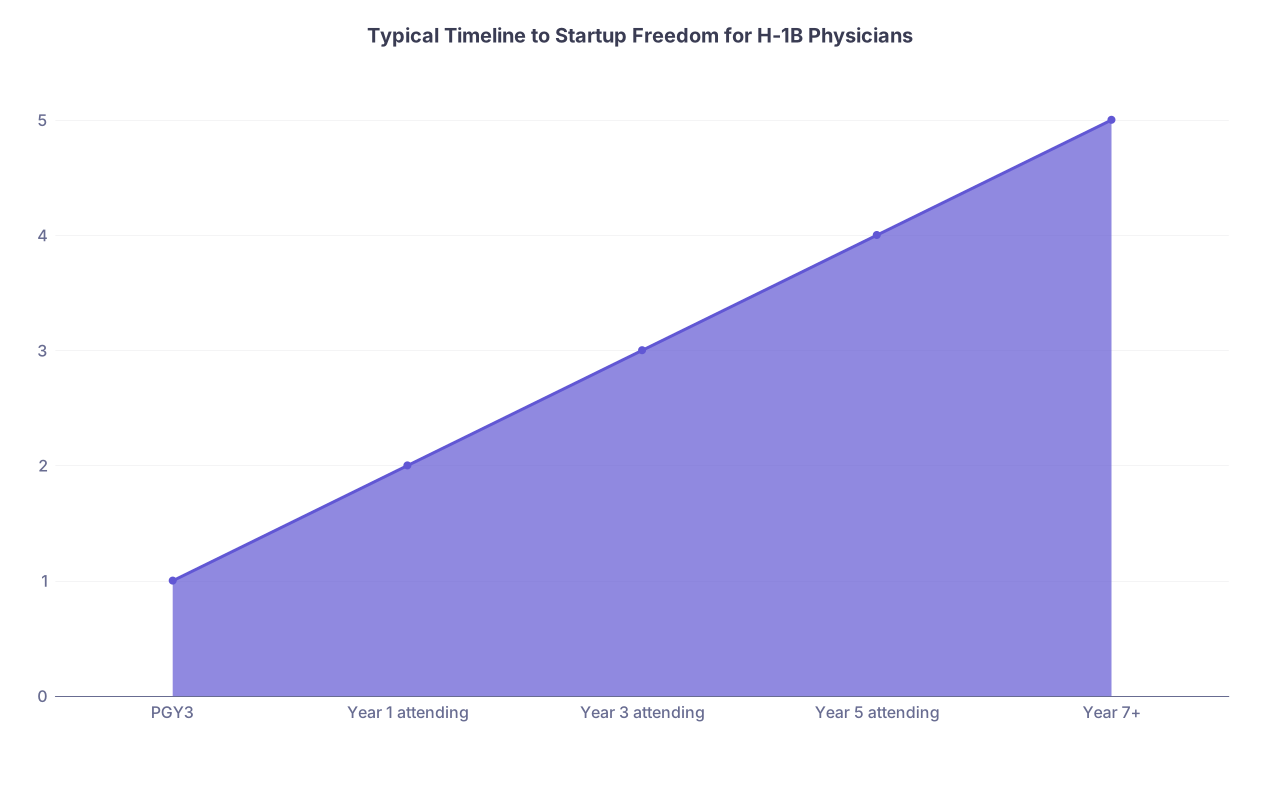
| Category | Value |
|---|---|
| PGY3 | 1 |
| Year 1 attending | 2 |
| Year 3 attending | 3 |
| Year 5 attending | 4 |
| Year 7+ | 5 |
O‑1: Extraordinary Ability Physician
If you have:
- Strong research record.
- National/international recognition.
- Major publications, talks, awards.
You may qualify for an O‑1, which is far more flexible. An O‑1 can be structured through:
- An academic institution.
- Or sometimes your own company (with similar “employer‑employee” guardrails as concurrent H‑1B).
With O‑1, you can often:
- Take multiple roles.
- Work across companies.
- More plausibly be “CMO and co‑founder” in an active way.
This is a whole separate strategic conversation with an immigration attorney, but if you have the CV, it’s worth pushing for. It’s one of the few realistic accelerants for visa‑dependent founders.
Marriage‑Based or Employment‑Based Green Card
Once you have:
- An EAD (work authorization card) through a pending I‑485, or
- A green card itself,
the game changes. You can:
- Work multiple jobs.
- Found and run a company.
- Pay yourself W‑2 wages from your own startup.
At that point the constraints are mostly:
- Your employment contract with your hospital.
- Medical ethics and conflict of interest rules.
Not immigration.
So your interim strategy is basically:
“Stay in status, don’t lie, don’t ‘moonlight’ illegally, build the structure and equity now, and design the company so you can step in aggressively once your status catches up.”
Not as sexy as the TechCrunch story, but much safer.

6. Practical To‑Do List If You’re A Visa‑Dependent Physician Founder
Let’s get very concrete. If you’re in that post‑residency, job‑locked phase and serious about a startup, here’s what I’d actually do.
Pull your paperwork
- H‑1B approval notice (I‑797).
- Employment contract.
- Any J‑1 waiver documents.
- Hospital policies on outside activities / conflict of interest.
Get a 30–60 minute paid consult with a real immigration attorney
- Not the hospital’s lawyer. Your own.
- Ask specifically:
- “What does passive vs active investment look like in my case?”
- “Can my startup safely list me as founder and board member?”
- “Under what conditions could we ever do concurrent H‑1B?”
Define your founder role in writing
- On the cap table: founder shares with vesting.
- In internal docs: board member, not officer.
- On LinkedIn: something like “Founder / Board Member (non‑operating while in clinical practice)”—sounds silly, but that kind of clarity can matter later.
Pick your operator co‑founder carefully
- They must understand:
- You’re constrained now, not forever.
- You own a meaningful stake.
- They run day‑to‑day; you are the clinical brain and long‑term strategic anchor.
- They must understand:
Work nights and weekends on what’s allowed
- Product vision (not coding under an employment contract).
- Clinical workflows, guidelines, and protocols on your own time/equipment.
- Researching the market, talking (informally) to potential users.
You’re not filing invoices for “consulting hours.” You’re behaving like an owner, not a freelance contractor.
Plan your status upgrade deliberately
- If you’re pursuing:
- Marriage‑based GC: understand the EAD timing.
- EB‑2 NIW or EB‑1: talk to an attorney about whether your startup actually helps your petition.
- Put rough dates to:
- “When can I realistically become active CEO/CMO?”
- “What milestones should the startup hit by then so that transition makes sense?”
- If you’re pursuing:
Keep a low but honest public profile
- Do not hide your involvement entirely (that looks shady later in diligence).
- But also don’t parade yourself as “CMO running day‑to‑day operations” when you’re on a hospital H‑1B.
- Be boring and accurate: “Founder and clinical advisor; full‑time attending at X hospital.”

| Step | Description |
|---|---|
| Step 1 | Residency Complete - H1B Job |
| Step 2 | Passive Founder Setup |
| Step 3 | Operator Cofounder Leads Ops |
| Step 4 | Limited Active Role |
| Step 5 | Expanded Role |
| Step 6 | Full Active CEO or CMO |
| Step 7 | Scale Startup |
| Step 8 | Status Upgrade Path |
FAQs
1. Can I list myself as “CEO” of my startup on LinkedIn if I’m on an H‑1B with a hospital?
You can type anything into LinkedIn; that’s not the question. The real question is: does that accurately reflect what you’re doing, and will it look like unauthorized work if someone connects the dots?
If you’re on a hospital‑sponsored H‑1B and not separately authorized to work for your startup, calling yourself “CEO” suggests:
- You manage employees.
- You sign deals.
- You handle day‑to‑day operations.
All of that is active work and not protected by “but I didn’t pay myself.” I’d avoid that title until you have a concurrent H‑1B, O‑1, EAD, or green card that actually lets you work there. Use “Founder / Board Member” or “Founder (non‑operating while in full‑time clinical practice)” instead.
2. Can my startup pay me as a 1099 “consultant” while I’m on a hospital H‑1B?
No, not without separate work authorization. A 1099 indicates you’re performing services for compensation for an entity that is not your H‑1B sponsor. That’s essentially the textbook definition of unauthorized employment.
Even unpaid “consulting” is not automatically safe—you’re still performing services. The safer posture is:
- No consulting contract.
- No invoices.
- No 1099.
- You’re contributing as a founder/owner/board member, not as a contractor.
If you want to do legitimate consulting, structure it through proper immigration channels (concurrent H‑1B, O‑1, or EAD).
3. What if my startup is completely non‑medical—like a restaurant or e‑commerce brand?
That makes life somewhat simpler, because you’re not colliding with hospital clinical duties or medical ethics. But immigration is agnostic to industry. The same rule applies:
- You can own the business.
- You cannot work for the business without authorization.
So you can invest in a restaurant, be on the LLC, share in the profits. But if you’re on the floor taking orders or managing staff, you’re working illegally. For a true side investment (where someone else runs the show), that’s fine. For an actual hands‑on startup, the same constraints apply as with a medical one.
4. Is it safer to keep my name off the company paperwork until I get a green card?
No, that just trades one set of problems for another. If you are a real founder, you want a paper trail of:
- When you acquired your equity.
- What your role was.
- How control and ownership evolved.
Future investors and acquirers will absolutely diligence this. If you “magically” appear on the cap table after you get a green card, they’ll ask why—and whether your former employer or the university might have rights to the IP.
The fix is not to disappear; it’s to structure your role correctly from day one: passive founder, shareholder, and board member, with clearly limited operational responsibility until your status catches up.
You are not the first visa‑dependent physician trying to build something real while staying in status, and you will not be the last. The path is narrow, but it is there. If you’re disciplined now—about titles, paperwork, and what you actually do—then when your status finally opens up, you’ll have a real company waiting for you, not just a good idea you were too scared to touch.
With those foundations in place, the next piece is even more fun: how you actually validate, fund, and grow that startup while still working full‑time in clinic. But that’s a story for another day.