
The biggest legal threat to your future startup might already be sitting in your inbox: the hospital contract you just signed.
If you’ve matched into an attending job and only now realized you want to build a company, you’re not doomed. But you also don’t have as much freedom as you think you do. Hospital employment agreements are written to protect the hospital, not your entrepreneurship dreams.
Here’s how to handle this specific situation: you already signed, you’re about to start or just started, and now you’re thinking about launching a medical startup.
Step 1: Stop Building Anything Until You Read What You Signed
Yes, seriously. Pause the “beta launch,” “soft rollout,” or whatever you’ve been calling it.
You need to know what you agreed to in writing, not what the recruiter casually said on a Zoom call.
Pull up the full contract and all attachments. Look specifically for these clauses:
| Clause Type | Immediate Risk Level | Needs Lawyer Review? |
|---|---|---|
| IP / Inventions | Extreme | Yes |
| Non-compete | High | Yes |
| Non-solicitation | Medium | Often |
| Moonlighting / Outside Work | High | Yes |
| Confidentiality | High | Usually |
Read it yourself first. Do not rely on memory. You’re looking for:
IP / Inventions / “Works for hire”
Key danger phrases:- “All inventions or discoveries conceived or reduced to practice during the term of employment…”
- “Whether or not related to the business of Employer…”
- “Whether developed on or off premises, during or outside working hours…”
If you see those combinations, your hospital may try to claim ownership of your startup’s IP if you build it while employed.
Outside Activities / Moonlighting / Conflict of Interest
Look for:- Requirements for prior written consent for “any outside professional activities”
- Restrictions on using your professional title with outside ventures
- Language about “business opportunities” being offered first to employer
Non-compete / Restrictive Covenant
Look for:- Any restrictions based on type of work (e.g., “cannot engage in any competing medical business within X miles”)
- Not just clinical practice, but “management of healthcare services,” “telemedicine,” “digital health”
Non-solicitation
Look for:- “Shall not solicit or attempt to solicit any patients, employees, independent contractors, or referral sources of Employer”
- This matters if your startup uses your hospital’s nurses, NPs, MA’s, or patients as early users/testers.
Confidentiality / Trade Secrets
Look for:- Extremely broad definitions of “confidential information” (often includes “methods,” “processes,” “business plans”)
- Clauses that prohibit using information “learned in the course of employment” for any other purpose
If reading this already made your stomach clench, good. That’s the appropriate level of concern.
Step 2: Get a Real Legal Read — And Ask the Right Questions
Do not ask your co-residents or your cousin who does divorces. You need someone who actually understands:
- Physician employment contracts
- Startup IP / founder issues
Ideally, a healthcare startup attorney or a firm that does both employment and early-stage company work.
Your script when you reach out should be something like:
“I’m a physician who recently signed a full-time hospital employment contract. I’m planning to start a healthcare-related company on the side. I need a review specifically focused on IP ownership, moonlighting/side ventures, and how to structure timing and work to avoid breach.”
Bring them:
- The full employment contract + any offer letter
- Any bonus/side-letter agreements
- Whatever you’ve already built or spec’d for the startup (pitch deck, Figma mockups, early code, etc.)
Here are the questions you actually want answered:
- Can my employer claim ownership of this startup or its IP under this contract?
- If yes, what concrete steps reduce that risk?
- What exactly counts as “competing” under this non-compete language?
- Am I required to disclose this startup to the employer? If so, when and how?
- Can I use my medical knowledge and clinical experience to build this, or is there any line I shouldn’t cross?
- Should I delay forming the company (LLC/C-corp) until after some specific date or contract change?
You’re not looking for a philosophical answer. You’re looking for a go/no-go with conditions: “You’re okay if you do X, Y, Z; you must avoid A, B, C.”
Step 3: Define the Line Between “Your Startup” and “Your Job”
Now assume you’ve had the legal review and you’re moving forward. You need clean separation, because hospitals get extremely anxious when they smell “competition” or “conflict of interest.”
Let me be blunt: If your employer can argue you used their time, resources, or data to build your startup, they’ll have leverage over you.
You draw the line in four dimensions:
Time
- Do zero startup work during paid working hours. That includes call, downtime in the ED, and “slow clinic” afternoons.
- Don’t touch startup Slack, code, email, or docs while on the hospital network or on hospital-owned devices.
Place & Devices
- No development on hospital computers. No hospital WiFi if you can avoid it.
- Use your own laptop and personal accounts for everything.
- Keep physical notebooks separate. If you write ideas related to your startup in a call-room notebook that’s technically hospital property, you’re asking for trouble.
Data
- Never use identifiable patient data. Ever. Not for testing, not for investor decks, not for “anonymous examples” unless they are truly de-identified per HIPAA and your institution’s standards.
- Don’t export EMR screenshots, care pathways, or internal protocols into your product.
People
- Don’t recruit coworkers or trainees to help “on the side” without being extremely sure it doesn’t violate non-solicitation or conflict policies.
- If a colleague later wants to join formally, handle that through proper agreements, not casual “do this on nights” arrangements.
To visualize this separation, the reality usually looks like this:

| Category | Value |
|---|---|
| Mon | 2 |
| Tue | 2 |
| Wed | 3 |
| Thu | 2 |
| Fri | 3 |
| Sat | 6 |
| Sun | 6 |
That “startup time” is nights and weekends. If it bleeds into your attending hours, you’re setting yourself up for a future HR meeting you don’t want.
Step 4: Be Strategic About Disclosure (and Timing)
Here’s the real tension: your contract might require you to disclose outside ventures, but early disclosure can spook an employer.
I’ve seen three patterns play out:
Total secrecy; no disclosure ever
Works only if:- Your contract does not require disclosure
- Your startup is clearly non-competitive and outside healthcare operations
- You’re disciplined about separation
Risk: if it surfaces later and looks connected to their business, they feel blindsided.
Early, naïve disclosure
“I’m thinking about building an app for X, is that okay?”
Risk: They say no in a vague email, or they route you to “Innovation” who wants ownership or control. Now there’s a paper trail that you asked permission.Targeted, documented disclosure
After legal review, you (or your lawyer) send a short, carefully worded notice that satisfies your contractual requirement without inviting them into your cap table.
If your contract requires written consent, you can’t just ignore that. But get your lawyer to help draft exactly what you disclose and what you don’t.
Example of something more defensible (obviously tailored by counsel):
“As required by Section X of my Employment Agreement, this is to notify you that I am a co-founder of a separate legal entity that develops general workflow productivity software for medical professionals. All work on this entity and its products is performed on my personal time and with my own resources, and it does not use hospital data, staff, or facilities. The product is not designed to provide clinical care or billable services to patients and does not compete with any current services of [Hospital].”
You’re drawing boundaries in your own words before they do it for you.
Step 5: Shape the Startup So It’s Less Threatening (At Least for Now)
Some businesses will always be seen as competition. If you build a direct-to-consumer telehealth platform while employed by a big health system that’s investing in virtual care, expect friction.
But there are ways to tilt your idea and roadmap to reduce conflict while you’re employed:
Aim first at a different customer segment
Example: If you work at a large academic center, maybe your MVP sells to small private practices, not enterprise systems.Focus on tools, not services
Developer tools, clinician productivity tools, patient education content — these are less likely to trigger “you’re stealing our patients” alarms.Avoid integrations with your employer’s systems
Don’t start by trying to integrate with their Epic/Cerner instance. That forces a relationship before you have leverage.Don’t pitch your employer as “first customer” in your deck
Founders love to write “First customer: my own hospital!” on slide 8. That’s fantasy if compliance and legal have never even heard of you.
This early positioning buys you time. Time to build value, raise a small round, maybe transition to part-time or per diem later with negotiation power.
Step 6: Sequence Your Career Moves Around the Startup
You are not just managing legal risk; you’re managing energy, attention, and cash flow.
There are four realistic roles you can occupy over the next 2–3 years:
| Role Type | Clinical FTE | Startup FTE | Typical Stage |
|---|---|---|---|
| Full-time Clinician | 1.0 | 0.2–0.4 | Idea/MVP |
| 0.6–0.8 Clinician | 0.6–0.8 | 0.4–0.6 | Early traction |
| Per Diem / Locums | 0.2–0.4 | 0.6–0.8 | Raised capital |
| Full-time Founder | 0.0–0.1 | 0.9–1.0 | Growth / scaling |
Since you already signed your hospital contract, your near-term reality is likely “Full-time Clinician, part-time founder.” So be honest about what’s sustainable.
Concrete sequencing advice:
Year 1 as attending:
- Learn your job. Build clinical credibility.
- Explore and pressure-test your startup idea. Get a prototype, talk to 30–50 users, maybe pilot outside your employer.
- Keep burn low; do not assume you’ll be raising a big round as a brand-new attending with a slide deck.
After initial contract term (often 1–3 years):
- Use renewal or re-negotiation as an opportunity to reduce FTE or adjust non-compete language.
- Or make a clean break to part-time/per diem elsewhere, ideally with a simpler contract and weaker IP claims.
Where people get burned: they quit without runway or traction because they’re “over it,” and then their startup can’t carry their weight yet. They end up crawling back into a full-time clinical role, now more contract-cautious but burned out.
Step 7: Protect Your IP and Equity From Day One
While you’re obsessing over the hospital contract, don’t forget that your own startup documents can screw you just as badly if you’re sloppy.
Basic protective moves, even if it’s just you and one co-founder:
Form a real entity (LLC or, more typically, a Delaware C-corp)
Don’t keep it as “a shared Google Drive” and verbal promises. Get equity allocations in writing.Assignment of IP
Every founder signs an IP Assignment to the company. That way:- You own it personally vis-à-vis the hospital (per the employment contract and legal advice)
- Then your person assigns it to the company formally
Use clean tools and accounts
- A separate GitHub org
- Company email domain
- Version control and document history that clearly shows timestamps and who did what, when
Why this matters: if the hospital ever challenges IP, you want a clean trail of development that doesn’t intersect with their systems or time. Legal disputes often come down to documentation and timeline.
Step 8: Don’t Use Your Hospital as a Sandbox Without Permission
The temptation is huge:
“I see the problem every day on rounds — I’ll just pilot my app with these patients / these residents / this clinic.”
Do that without approvals and you’re not “innovative,” you’re a compliance risk.
If your startup touches:
- Patients at your hospital
- Data from the EMR
- Hospital-owned devices
- Workflows that affect billing or documentation
…you are now squarely in the zone of IRB, IT security, compliance, and possibly contracts.
At that point you have two clean options:
Go through formal channels (innovation office, IRB, IT security)
- Expect it to be slow and bureaucratic.
- Understand that they may want an equity stake, license rights, or at least a say.
-
- A private clinic or different institution where you are not employed.
- Simpler contracts. Fewer conflicts.
For early-stage products, it’s often easier (and safer) to run pilots away from your employer. It feels counterintuitive, but practically it avoids a lot of “who owns this?” drama.
Step 9: Use Your Attending Job Strategically, Not Emotionally
Your hospital job is not the enemy. It’s a funding source, data source (in your head, not exported), and credibility source.
Use it for:
Deep understanding of the problem space
Keep a private list (no PHI) of “frustrations,” workflows, decision points, common errors. That’s gold for product design.Market research
Casual conversations with colleagues about their pain points. “If there was a tool that did X, would that actually change what you do?”Storytelling
Investors respond strongly to: “On Tuesday nights in the ED, I keep seeing the same failure pattern…” Your clinical life gives you real stories.
What you should not use it for:
Threatening leverage
“If you don’t buy my solution, I’ll take it to your competitor.”
That kind of thing gets around, and it doesn’t end well.Burning bridges on the way out
The physician startup world is small. The number of CMO/innovation leaders who know each other is even smaller. You want references and future customers, not enemies.
Step 10: Have a Plan If Things Go Sideways
Let me be realistic. There are a few common “oh, shit” moments:
- HR or your Chair hears about your startup through the grapevine and calls a meeting.
- An investor or potential customer wants a letter from your employer stating they don’t claim IP.
- You realize your startup is closer to your employer’s business than you originally thought.
You need a prepared response, not panic.
Bare-minimum prep:
A one-page memo (for yourself) that summarizes:
- What the startup does, in plain language
- How it does not compete with your employer’s core services
- How you keep work fully separate from your job (time, devices, data)
- Names of your lawyer and firm, in case things escalate
Financial fallback
- How many months can you survive if the worst happens and you need to leave the job earlier than planned?
- If that number is “zero,” adjust your startup tempo. You’re not in a position to pick a fight.
Negotiation mindset
If the hospital wants something — ownership, royalties, restrictive conditions — decide in advance what you’re willing to concede:- Is a small, non-voting equity slice acceptable if it means freedom to build?
- Or would you rather walk and rebuild somewhere without that baggage?
I’ve seen people give away 50% of a promising business out of fear in a single negotiation. Don’t improvise that at 7 pm in the CMO’s office.

| Step | Description |
|---|---|
| Step 1 | Signed Hospital Contract |
| Step 2 | Review Contract Clauses |
| Step 3 | Proceed With Startup Plan |
| Step 4 | Hire Healthcare Startup Lawyer |
| Step 5 | Delay or Redesign Startup |
| Step 6 | Define Clear Boundaries |
| Step 7 | Send Targeted Notice |
| Step 8 | Keep Clean Separation |
| Step 9 | Build On Personal Time |
| Step 10 | IP or Outside Work Restrictions? |
| Step 11 | High Risk to Proceed Now? |
| Step 12 | Disclosure Required? |

Quick Reality Check: What You Should Do This Week
If you’re post-residency, signed, and startup-curious, here’s the concrete, no-theory checklist:
- Read your contract specifically for IP, moonlighting, non-compete, and disclosure rules.
- Book a call with a healthcare/startup-savvy lawyer and get a targeted review.
- Lock down your separation: personal laptop, personal accounts, no hospital time, no hospital data.
- Decide how “close” your startup is to your employer’s core business, and adjust version 1.0 if needed.
- Map the next 12 months of your life in terms of hours and money so you don’t nuke your career or finances out of impatience.
And through all of this, remember: the goal is not to be a hero who “fights the system.” The goal is to build something valuable and keep control of it.
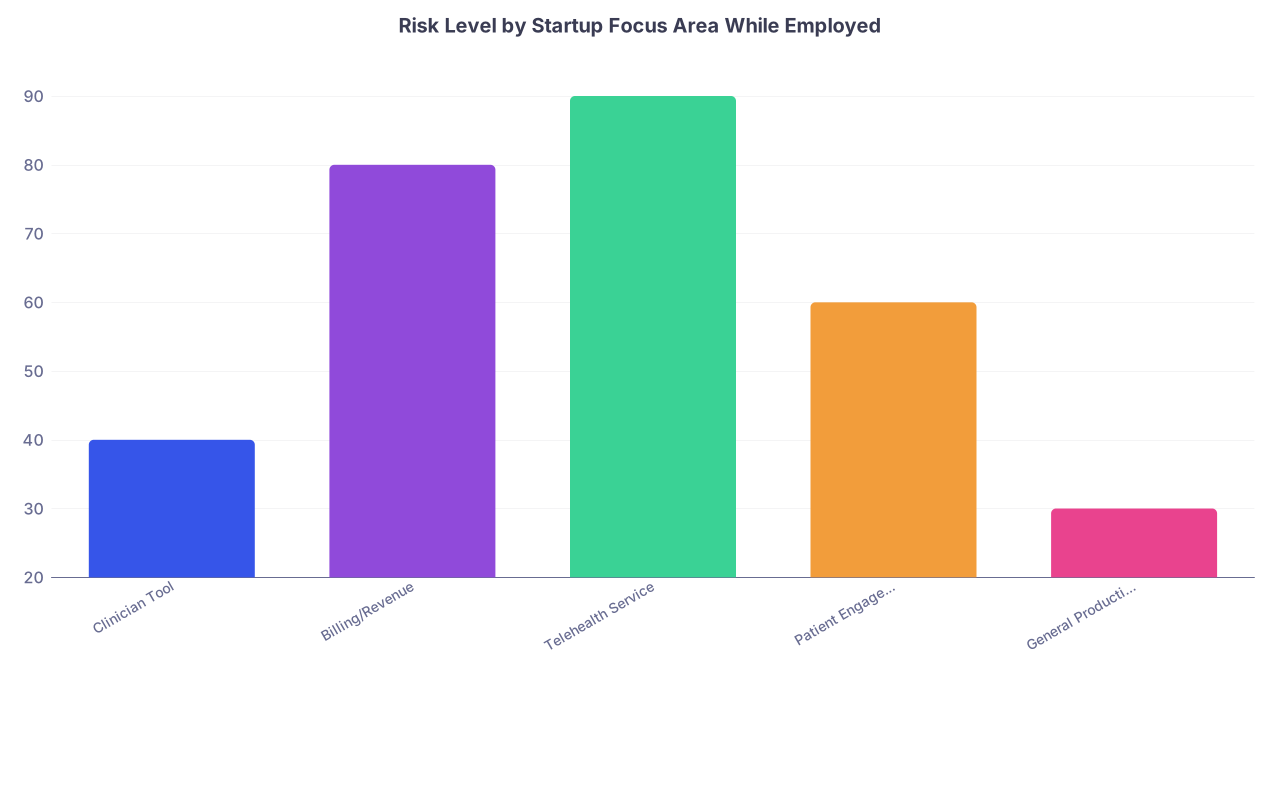
| Category | Value |
|---|---|
| Clinician Tool | 40 |
| Billing/Revenue | 80 |
| Telehealth Service | 90 |
| Patient Engagement | 60 |
| General Productivity | 30 |


Key takeaways:
- Your biggest risk is hidden in the contract you already signed — get it reviewed specifically for IP and outside work before you build another line of code.
- Keep a hard wall between your startup and your hospital job: time, devices, data, and people must stay separate if you want to keep control.
- Use your attending role strategically — for insight, credibility, and cash flow — while you quietly build something that can eventually stand on its own, without your hospital’s permission.