

The biggest NRMP violation I see is simple: people did not actually read the rules when it mattered.
You do not need to memorize the entire Match Participation Agreement. But you do need a timeline for when to read, re-read, and apply NRMP policies so you do not accidentally nuke your Match.
Below is a month‑by‑month, then week‑by‑week guide through fourth year: what to read, what to re-read, and what decisions you should anchor to specific NRMP rules at each point.
Big Picture: When NRMP Rules Actually Matter
At a high level, the NRMP policies become critical at four pressure points:
- When you register and agree to the Match Participation Agreement
- When you are interviewing and communicating with programs
- When you are building and certifying your rank list
- When Match results and post‑Match behavior come into play
Here’s how your attention should ramp up over the year:
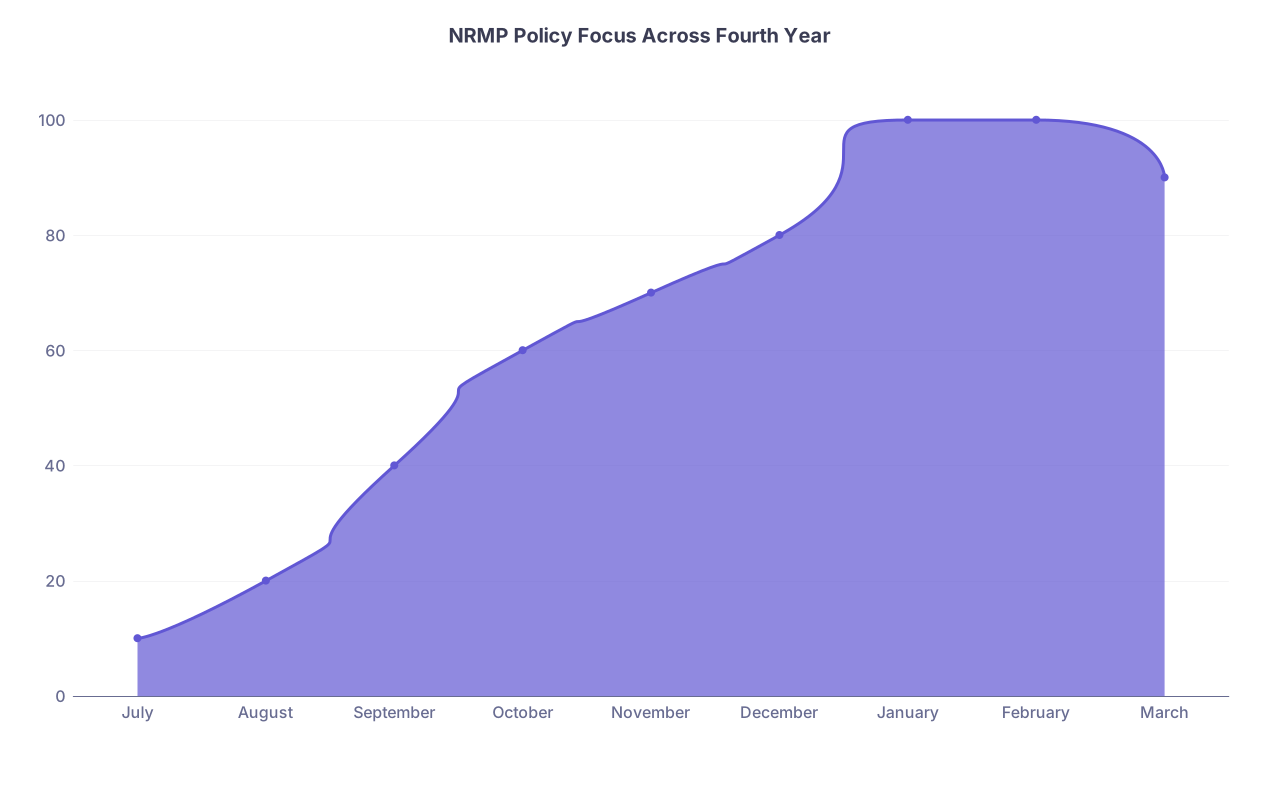
| Category | Value |
|---|---|
| July | 10 |
| August | 20 |
| September | 40 |
| October | 60 |
| November | 70 |
| December | 80 |
| January | 100 |
| February | 100 |
| March | 90 |
Translation: If you’re not reading the rules by October, you’re already behind.
July–August (Early Fourth Year): Baseline Read, No Panic
At this point you should stop relying on rumors from upperclassmen and actually open the NRMP website once.
Week 1–2 of Fourth Year (July)
At this point you should:
- Create or update your NRMP account (if it’s open yet for your Match year, or at least confirm you can log in once it opens).
- Do your first light read of:
- Match Participation Agreement (MPA) – Skim, don’t study.
- NRMP Code of Conduct.
- “Violations” and “Waiver” sections.
Focus on just three questions in this first pass:
- What counts as a binding commitment?
- What is forbidden communication (pressure, guarantees, requests for ranking info)?
- What happens if you back out after the Match?
You are not ranking anyone yet. But you are:
- Scheduling away rotations
- Emailing programs
- Setting expectations with mentors and advisors
You want all of that aligned with reality, not with myths like “If they promise you a top 3 spot, it’s binding” (it isn’t).
Late August: Start a “Policy Notes” Doc
At this point you should create a single, boring, life‑saving document:
- Title it: “NRMP Policy – My Rules”
- Add three sections:
- Before interviews
- During interviews
- After rank list
Every time you read or re‑read a policy, you’ll summarize the practical rule in your own words there. Example entries:
- “I can tell programs I’m very interested, but I never promise rank order or ask theirs.”
- “I cannot accept a position outside the Match with a program that participates in the Match, during the same year, without a NRMP waiver.”
That doc will keep you from scrolling PDFs at 1 AM in January trying to interpret a clause.
September–October: Before and At the Start of Interview Season
This is where people quietly violate policies in emails and conversations. Not dramatic. Just sloppy.
Early September: Second, Deeper Read (Communication & Commitments)
At this point you should re‑read key NRMP sections with interview season in mind:
Focus on:
- Communication policies:
- Programs may not ask how you will rank them.
- You are not required to tell anyone your rank list.
- You may voluntarily express interest, but cannot be coerced.
- Prohibited behaviors:
- Programs offering “pre‑Match” positions outside the NRMP when they’re registered for the Match (unless a separate, clearly non‑NRMP contract that doesn’t conflict).
- You agreeing to any side agreement that tries to override the Match results.
Update your “My Rules” doc with concrete phrases you will and will not use. For example:
Allowed (and safe):
- “You are one of my top choices.”
- “I’m very enthusiastic about your program.”
Dangerous / misleading (avoid):
- “I will rank you #1.” (Just don’t. Even if you think it’s true today.)
- “If you rank me high, I’ll rank you high.” (Quid pro quo vibes. Terrible idea.)
Late September–October: Interview Invitations Begin
At this point you should anchor specific actions to specific policies.
When you get invitations:
- Cross‑check: Are all these programs actually NRMP participants? (Most are. A small number are SOAP‑only or use a different system. Good to know early.)
When you respond to programs:
- Stick rigidly to your communication rules:
- No promising rank positions.
- No asking them how they’ll rank you.
- No hinting at side deals like “If I don’t match here, could you take me outside the Match?”
If any email or conversation feels off, flag it in your brain: “NRMP check.” Then:
- Go to your “My Rules” doc.
- Re‑read the relevant NRMP section.
- If still unclear, ask your dean’s office or GME office before responding.
November–December: Active Interview Season – Weekly Policy Touch
This is where you’re tired, flattered, anxious, and more likely to say something dumb.
At this point you should have a weekly NRMP check‑in with yourself. Ten minutes is enough.
Early November: Third Read (Interviews & Post‑Interview Contact)
Now you’re in the thick of it. Re‑read:
- NRMP guidelines on post‑interview communication
- Code of Conduct for:
- Programs
- Applicants
Pay attention to:
- What programs cannot do:
- Request that you reveal your rank list.
- Pressure you to rank them highly.
- Ask you to sign any “pledge” tied to ranking.
- What you should not do:
- Tell multiple programs they’re your clear #1.
- Misrepresent your ranking intentions in writing.
- Ask for any guarantee.
Update your doc with a template response for awkward questions. For example:
- “I’m still finalizing my rank list, but I can say that I’m very interested in your program and see it as a strong fit.”
- “Because of NRMP rules, I’m not able to discuss specific rank positions, but I appreciate your interest.”
You don’t want to improvise that on Zoom when an attending casually asks, “So, are we your top choice?”
Late November–December: Keep It Tight
At this point you should:
- Read your own “My Rules” document once a week.
- Before any big batch of interviews, skim:
- The NRMP FAQ on communication and ranking.
- Any AAMC/NRMP joint guidelines for interview season, if posted for your year.
You’re not memorizing legal text. You’re cementing habits: what you say, what you never say, and when you politely shut down inappropriate questions.
January: Rank List Brainstorm + Policy Deep Dive
January is where NRMP rules become real commitments, not just theory.

Early January: Fourth Read (Match Participation Agreement in Full)
At this point you should sit down for 30–45 minutes and seriously read:
- The full Match Participation Agreement
- Sections on:
- Ranking and matching
- Binding nature of the Match
- Waivers and penalties
- Couples Match rules (if relevant)
- SOAP participation rules
Do this with your “My Rules” doc open. Translate dense clauses into simple, ruthless statements. For example:
- “Once I certify my rank list and the Rank Order List deadline passes, I am committed to accept and start that position if I match.”
- “If I want to withdraw from the Match, I must do it before the Rank Order List deadline.”
- “If I match and then refuse to start or quit without a NRMP waiver, I can be barred from future Matches and programs can be penalized if they collude.”
Mid‑January: Rank List Drafting – Apply the Rules
At this point you should:
- Draft your preliminary rank list (not in NRMP yet, just on a spreadsheet or paper).
- Apply this rule – which is straight from how the algorithm works and protected by NRMP:
“I should rank programs in my true order of preference, not based on where I think I’m ‘more likely’ to match.”
The NRMP rules and algorithm are built on this assumption. Gaming it is both dumb and counterproductive.
Before you start entering anything into the NRMP system, re‑read:
- NRMP explanation of the algorithm
- The section explicitly stating: programs may not tell you how to rank them, and you should not alter your list based on pressure.
February: Rank List Certification and Final Commitments
This is the highest‑risk month for unforced errors.
Early February: Fifth Read (Targeted Re‑Check Before Certifying)
At this point you should block 1–2 hours on a single day and do all of this in one sitting:
- Log into NRMP.
- Open these sections in tabs:
- Match Participation Agreement
- Rank Order List FAQ
- Policy on Waivers and Violations
- Read your “My Rules” doc top to bottom.
Then:
- Enter your rank order list in NRMP.
- Double‑check:
- No program accidentally duplicated.
- No program you absolutely would not attend is on the list “just in case.”
- Remember: If you match there, you are committed. No “I changed my mind” escape clause in NRMP land.
At this point you should ask yourself three blunt questions:
- “If I match at my last choice on this list, will I still go?”
- If no, remove it.
- “Am I ranking purely in true preference order?”
- If not, fix it.
- “Am I in any kind of side conversation about ‘taking me outside the Match’?”
- If yes, pause and read the waiver/out‑of‑match rules carefully.
One Week Before Rank List Deadline
At this point you should:
- Re‑read the short NRMP statement about the binding nature of certified lists.
- Verify:
- Your personal situation: no sudden change making you unable to start residency (serious illness, visa catastrophe, etc.). If something major changed, talk to your dean or NRMP before certification.
- Certify your list a few days before the deadline, not at 11:57 PM the night of.
Then, stop editing. Constant tinkering the last 48 hours usually lowers satisfaction and doesn’t help your Match.
March: Match Week, SOAP, and Post‑Match Conduct
Match Week is where panicked people break rules and end up in NRMP violation stories. Do not be one of them.
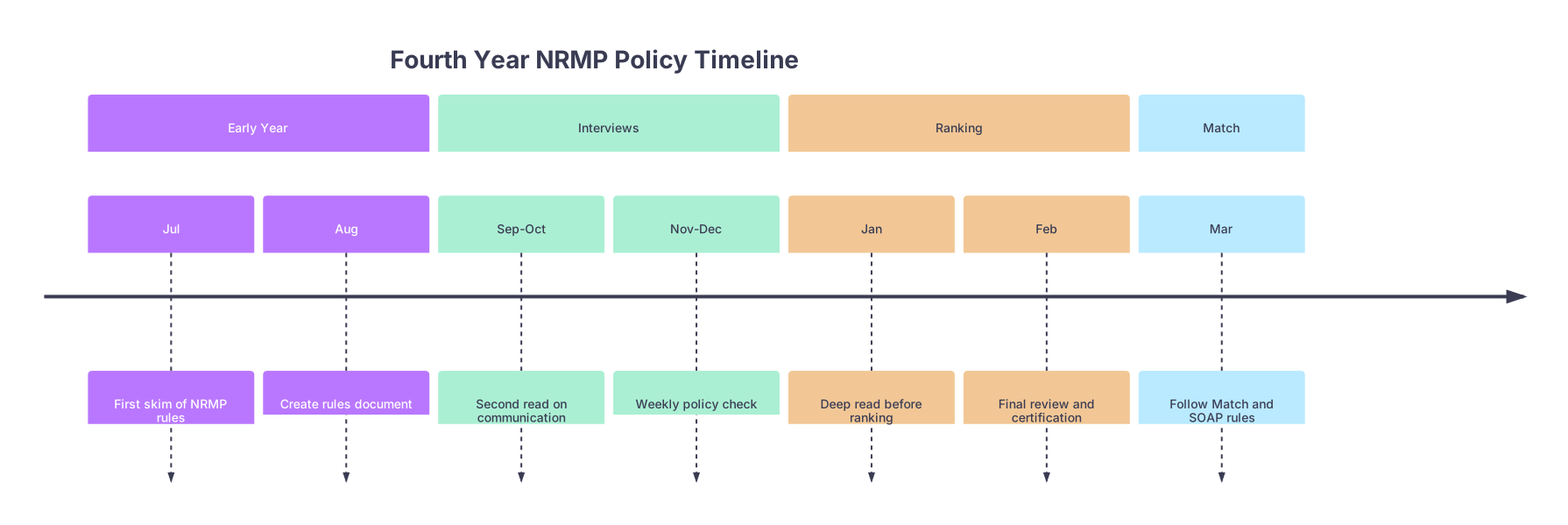
| Period | Event |
|---|---|
| Early Year - Jul | First skim of NRMP rules |
| Early Year - Aug | Create rules document |
| Interviews - Sep-Oct | Second read on communication |
| Interviews - Nov-Dec | Weekly policy check |
| Ranking - Jan | Deep read before ranking |
| Ranking - Feb | Final review and certification |
| Match - Mar | Follow Match and SOAP rules |
The Week Before Match Week
At this point you should re‑read:
- NRMP policies on:
- SOAP eligibility and conduct
- What you can and cannot do if you are unmatched or partially matched
- Your school’s SOAP guidance (if applicable).
Update your doc with:
- “If I go into SOAP, I cannot contact programs outside the ERAS/NRMP SOAP process.”
- “No verbal agreements outside SOAP; offers and acceptances occur within the SOAP system only.”
Monday of Match Week (You Learn: Matched vs. Not Matched)
If you matched:
- You are already committed to that program.
- No scrambling for “better offers.” No trying to back out because your friend got a cooler city.
If you did not match and are SOAP‑eligible:
At this point you should:
- Follow SOAP rules to the letter:
- Do not cold‑email programs outside SOAP asking for positions.
- Do not accept any offer outside the SOAP structure from NRMP‑participating programs.
- Keep NRMP policy on your screen as you:
- Apply to programs in SOAP.
- Respond to any program contact.
Match Day (Friday)
You see where you matched.
At this point you should be absolutely clear on this rule:
- The NRMP Match result is a binding commitment for you and the program, starting on the contract start date (usually July 1, but check your year/program).
If something drastic happens (health crisis, immigration catastrophe, major personal event):
- Do not ghost the program.
- Do not simply decide “I’m not going.”
- You or the program must engage in the waiver process outlined in NRMP policy.
Take 10–15 minutes Match weekend and re‑read:
- NRMP rules on:
- Waivers
- Resignation or dismissal from a matched program
- Consequences of breach
Not fun reading. But crucial.
April–June: Post‑Match Reality and Transition
At this point you should be done tweaking policies and starting to live them.
April: Contracts and Start Dates
Programs will send contracts. People often get spooked here and ask, “Can I still back out?”
The answer per NRMP rules:
- The Match result, not the contract, is the binding commitment.
- If you refuse to sign the contract or do not start, the NRMP can still sanction you unless a formal waiver is granted.
So in April, you should:
- Compare your contract with:
- The NRMP binding rules.
- Any timelines for waiver requests.
- If you have a serious reason you cannot start:
- Talk to your dean’s office and the program immediately.
- Pursue a formal waiver, not an informal “I’m just not coming.”
May–June: Clean Exit into Residency
At this point you should:
- Stop obsessing over NRMP policy. You’ve crossed the critical thresholds.
- Keep one rule in mind:
- Do not conspire with programs (yours or others) to sidestep Match rules for future positions (transfers, PGY‑2s, etc.) without understanding whether they fall inside NRMP jurisdiction.
If you’re planning a transfer or re‑entering a Match in the future, then yes, you’ll need another targeted policy read. But that’s a separate timeline.
Quick Reference Table: When to Read What
| Timeframe | Policy Focus |
|---|---|
| July–August | First skim of MPA, violations |
| Sept–October | Communication & interview rules |
| Nov–December | Post-interview contact, conduct |
| Early January | Full MPA, waivers, SOAP basics |
| Early February | Ranking, binding commitments |
| Match Week (March) | SOAP rules, post-Match conduct |

Common Traps to Avoid – Tied to Specific Months
A few landmines I’ve actually seen, and when they tend to happen:
October–December: “You’re our top candidate…”
- Program says: “We’re going to rank you very highly. Will you rank us #1?”
- Your move (grounded in NRMP rules):
- Thank them.
- Decline to state rank order.
- Reaffirm interest in neutral language.
January: “Should I drop this competitive program?”
- Anxiety says: “I shouldn’t rank them high, I’ll never match there.”
- NRMP rules + algorithm say: Rank by true preference.
- Your move: Keep it if you’d rather be there than anywhere below it.
February: “I’ll just leave that program at the bottom in case”
- You hesitate to delete a program you really don’t want.
- NRMP rules: If you match there, you are committed.
- Your move: If you’d rather go unmatched than go there, remove it.
March: “I didn’t match, but my mentor knows a PD…”
- Temptation: Back‑channel outside SOAP.
- NRMP SOAP rules: Prohibit side arrangements with participating programs during SOAP.
- Your move: Use the SOAP process properly or wait until after SOAP to discuss any non‑NRMP options that are actually allowed.

Final Checklists by Phase
Before Interview Season (by October 15)
At this point you should have:
- Skimmed NRMP Match Participation Agreement once.
- Read communication / interview rules twice.
- Created your “My Rules” doc with:
- What you’ll never say to programs.
- How you’ll respond to rank‑related questions.
Before Ranking (by January 31)
At this point you should have:
- Done a full, careful read of:
- Match Participation Agreement
- Waivers & violations section
- SOAP basics
- Drafted a preliminary rank list by true preference.
- Updated your rules doc to include:
- Binding nature of results
- Process if your circumstances change
Before Rank List Deadline (early February)
At this point you should:
- Log in, enter, and double‑check your rank list.
- Re‑read binding commitment language.
- Confirm:
- No program on the list that you would refuse to attend.
- No ongoing conversations that conflict with NRMP rules.

Key points to walk away with:
- Treat NRMP rules as a schedule, not a single painful reading – skim early, re‑read before interviews, study deeply before ranking, and refresh before Match Week.
- Anchor concrete behaviors to the policies at each phase: what you say (or don’t say) to programs, how you build your rank list, and how you handle Match and SOAP outcomes.
- Never keep a program on your list “just in case” if you would not actually go there; under NRMP rules, a Match is a binding commitment, not a suggestion.


