
It’s 10:32 a.m. on interview day. You’ve just finished the program overview, the chief resident cracked a joke about Q3 call “back in the day,” and now you’re in a one‑on‑one Zoom room. The interviewer smiles and says the question that messes with everyone:
“So, tell me a bit about yourself.”
You freeze for half a second. How much “yourself” are they actually asking for here? Your hobbies? Your divorce? Your mom’s cancer? Your kid with special needs? Your mental health history?
Let’s cut through the noise. Here’s exactly how much personal life is appropriate to share in residency interviews—and where the line is.
The Core Rule: Personal, Yes. Private, No.
You should be a person in residency interviews. Programs want that. What you don’t want is to slide into “oversharing” or using the interview as therapy.
Use this filter:
If it helps them trust you as a future colleague, it’s fair game.
If it makes them wonder if you’ll be unreliable, burned out, or hard to work with, keep it out.
That sounds harsh, but it’s the reality of a high-stakes hiring process disguised as “education.”
Think in three buckets:
- Green light – Safe and usually helpful
- Yellow light – Sometimes useful, needs careful framing
- Red light – Do not go there

Green-Light Topics: Share Freely (And You Probably Should)
These are personal, but not private. They help humanize you and give programs something to remember you by.
1. Hobbies and interests
Totally fair game, as long as you sound like someone who will still show up for rounds at 6 a.m.
Examples that work well:
- Running, lifting, hiking, yoga, intramural sports
- Cooking, baking, coffee, wine tasting (don’t make alcohol your entire personality)
- Reading, writing, music, photography, board games
- Travel (with a bit of specificity: “national parks,” “food-focused travel,” etc.)
How to talk about it: connect to traits that matter in residency.
“Outside of medicine I’m really into distance running. I’ve run three half-marathons during med school. It’s been my way of keeping structure in my week and a pretty good built-in stress outlet.”
What you avoid:
- Extreme risk stuff that screams “ED consult waiting to happen” (free soloing, street racing, etc.)
- Anything that hints at heavy time commitments that compete with residency (“I’m a semi-pro gamer and stream 20 hours a week.” No.)
2. Family background (light version)
Surface-level family info is fine:
- “I grew up in a big family in a rural town.”
- “I’m a first-gen college student; my parents immigrated when I was 5.”
- “My partner and I moved here for med school and we love the city.”
Keep it descriptive, not dramatic. You’re giving context, not a trauma narrative.
3. Geographic & cultural ties
Programs actually care about this because it predicts how long you’ll stay and how well you’ll fit their patient population.
Good to share:
- You grew up in the region
- You have extended family nearby
- You speak a language that’s common in their community
- You’ve lived in similar settings (rural/urban/underserved)
Example:
“I grew up in a small town in the Midwest and went to undergrad in a similar area. I really like practicing in communities where the hospital is a central part of the town.”
4. Low‑stakes adversity or growth stories
Minor setbacks that show resilience are fine:
- Switching majors
- Struggling with time management M1 and improving
- A low exam score that led to better study habits
Just keep it professional, not confessional.
Yellow-Light Topics: Share Only If They’re Central and You Can Frame Them Well
These areas can be powerful if they’re tightly framed, clearly resolved, and obviously not going to interfere with residency performance.
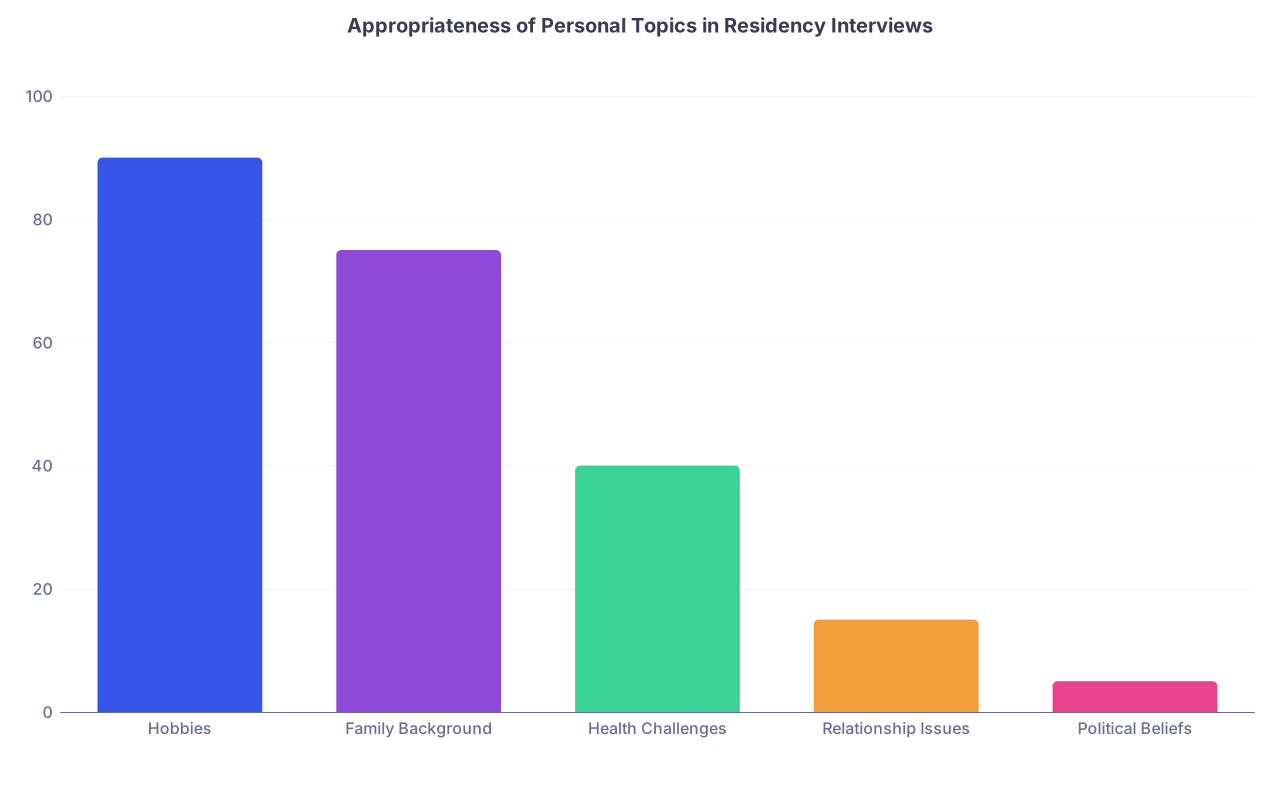
| Category | Value |
|---|---|
| Hobbies | 90 |
| Family Background | 75 |
| Health Challenges | 40 |
| Relationship Issues | 15 |
| Political Beliefs | 5 |
1. Personal health issues (including mental health)
Programs are not allowed to ask directly about this, but you sometimes feel like you “should” explain a leave of absence, a Step gap, or a red flag.
You can, but follow these rules:
- Keep diagnoses vague or omit them (“a health issue” is enough)
- Emphasize resolution and stability
- Explicitly address reliability and performance
Example of acceptable framing: “During my second year I took a one‑semester leave of absence for a health issue. It’s fully treated and I’ve been back at my usual workload for over two years now, including sub‑Is without any problems. What I took from that experience is a much better understanding of what patients feel when they’re on the other side of the bed.”
You do not need to list diagnoses, medications, hospitalizations, or therapy details. This is not your psychiatrist’s office.
2. Major family illness or loss
This can absolutely be part of your “why this specialty” story. Just avoid turning the interview into a grief session.
Good approach:
- One or two sentences of context
- Transition quickly to what you learned and how it shaped your career goals
- Keep your emotions controlled; if you know you’ll cry, do not use that story
Example:
“My interest in oncology started when my grandfather went through treatment. Seeing how the team communicated with our family made a big impression on me, and that’s a big reason I value patient-centered communication now.”
3. Being a parent
You can mention kids. Plenty of residents have them. Where people mess up is:
- Oversharing logistics (“We’re still scrambling for childcare…”)
- Framing kids as a reason they can’t be flexible or stay late ever
If it’s relevant (e.g., you’re applying to a very family-friendly program, or they directly volunteer that many residents have kids), you can say something like:
“My partner and I have a toddler, which has definitely made me more efficient with my time. We’ve built a solid childcare setup and my med school schedule this year has been very similar to an intern schedule in terms of hours.”
Never imply: “My kids are my priority, so I can’t really stay late or be too overloaded.” That may be true personally, but you don’t say it in an interview.
4. Overcoming serious adversity
Things like poverty, unstable housing, or being a refugee can be powerful context. Just make sure:
- It doesn’t consume the whole interview
- You’re not asking for pity
- You clearly show how it makes you an asset (grit, empathy, commitment to certain patient populations)
If you find yourself about to unpack childhood trauma in detail, you’ve gone too far.
Red-Light Topics: Keep These Out of Your Mouth
These are the things that make interviewers uncomfortable, worried, or both.
1. Ongoing, unresolved personal crises
Examples:
- “We’re not sure if my marriage will survive this move.”
- “My dad is really sick, so I might need a lot of time off.”
- “I’m still working through some major anxiety so I might need extra support.”
Even if all of that is true, the interview is not where you say it. They’re hiring for reliability and stability. If they sense chaos, they pass.
2. Explicit political opinions or culture-war topics
No matter how strongly you feel, this is not Twitter.
You can say:
- “I’m really interested in health policy and worked on Medicaid expansion research.”
- “I care a lot about reproductive health access and did a rotation at a family planning clinic.”
You don’t say:
- “I think people who vote X are the problem.”
- “I could never work with someone who supports Y.”
If your advocacy is central to who you are (LGBTQ+ activism, reproductive justice, harm reduction), you can mention it—carefully, fact-focused, and framed around patient care.
3. Details of your romantic/sex life
You can say:
- “My partner and I are excited about staying in this region if possible.”
- “My spouse is a software engineer and can work remotely.”
You do not share:
- Infidelity, breakups, open relationships, fertility struggles, or anything you’d hesitate to tell a new attending at work.
4. Complaints about your school, classmates, or program
This technically isn’t “personal life,” but it’s revealing. Negativity about:
- Your med school
- Specific faculty
- Other students or specialties
…tells them what you’re going to say about them in three years.
Keep criticism systemic and measured if it comes up (“Our school historically had limited exposure to X, which is why I sought out away rotations in that area.”)
How to Structure a Personal Answer Without Oversharing
Here’s a simple template for answering “Tell me about yourself” or “What do you like to do outside of medicine?” without wandering into bad territory.

| Step | Description |
|---|---|
| Step 1 | Question about yourself |
| Step 2 | Quick identity snapshot |
| Step 3 | 1-2 personal background points |
| Step 4 | 1-2 hobbies/interests |
| Step 5 | Optional brief value/lesson |
| Step 6 | Stop talking |
Example answer using the template:
Identity snapshot
“I’m originally from Texas and did med school at X University.”Background points
“I’m a first-gen college grad; my parents run a small restaurant, so I grew up around a lot of hard work and late nights. I’ve really carried that into how I approach clinical work.”Hobbies
“Outside of medicine, I run and do a lot of cooking. I’ve done a couple of half-marathons and I host a small dinner night for my classmates once a month when we’re not on crazy rotations.”Value/lesson
“Having that structure and community outside the hospital has honestly been what keeps me grounded during tough rotations.”Stop talking
Don’t keep going until you accidentally explain your cousin’s addiction history.
Special Situations: What If They Ask Something Invasive?
Sometimes an interviewer asks something that hits a nerve: “Are you planning to have kids during residency?” “Do you have any health problems?” “Are you religious?”
Those are illegal or at least inappropriate, but it still happens.
You’ve got three options:
Answer at a surface level and pivot
“Family is important to me, but my focus right now is training and contributing to the program. I’m confident I’ll be able to meet the demands of residency.”
Then move to something program-related.Deflect politely
“I haven’t made any specific plans in that area yet, but I’m very committed to my training and the schedule that comes with it.”Decline gently (if you’re comfortable)
“I’d prefer to focus on my training and fit with the program if that’s okay.”
You don’t need to deliver a legal lecture in the moment. Just don’t feel forced into a level of personal disclosure you don’t want to give.

Red Flag Check: Before You Share It, Ask Yourself This
Before you bring up anything personal, mentally run it through this quick checklist:
| Question | If Answer is Yes | If Answer is No |
|---|---|---|
| Does this make me look more human and relatable? | Consider sharing | Maybe skip |
| Is it clearly resolved or stable? | Safer to share | Don’t share |
| Does it show qualities they value? | Good to include | Probably irrelevant |
| Could this make them doubt my reliability? | Reframe or omit | Safer territory |
| Would I tell this to my future program director? | Likely appropriate | Keep private |
If you hesitate on more than one of these, leave it out.
Concrete Examples: Too Much vs. Just Right
Topic: Parent’s illness
Too much:
“My mom has metastatic cancer. It’s been extremely hard, I’m flying back every month, and I’m not sure how long she has. I’m really worried about how I’ll handle it during residency.”Just right:
“My interest in palliative care really solidified when my mom went through treatment a few years ago. Seeing how her team managed both symptoms and communication really shaped how I want to practice.”
Topic: Breakup/relationship issues
Too much:
“My fiancé and I broke up during surgery clerkship, which totally wrecked me…”Just right:
You don’t mention it. At all. You talk about what you learned from your surgery clerkship, period.
Topic: Mental health
Too much:
“I’ve struggled a lot with depression and had a couple of really dark times during med school…”Just right (if you must explain a gap):
“I took a brief leave during second year for a health issue. Since then I’ve been fully back, completed rotations on time, and have put strong systems in place to maintain my wellbeing even on heavy services.”
What To Do Today
Open a blank document and create three columns: Share, Maybe, Never.
Fill them in:
- In Share, put hobbies, light family background, geographic ties, and 1–2 safe “growth” stories.
- In Maybe, put anything involving health, family crises, parenting, or major adversity. Rewrite those into tight, professional, one‑paragraph versions. If you can’t frame them confidently, move them to Never.
- In Never, put every detail that belongs with your therapist, not your PD.
Then practice out loud—seriously, say the words. If you feel like you’re giving a TED talk about your trauma, trim it.