
You should absolutely admit when you don’t know an answer in residency interviews — but you have to do it the right way or you’ll tank the moment.
That’s the whole game here. Not “Do I admit it?” but “How do I admit it without looking clueless or unsafe?”
Let me walk you through how good applicants handle this and how weaker applicants blow it.
The Real Question Programs Are Asking
Residency interviews are not Jeopardy. They’re not testing your trivia bank. They’re testing how you think and how you behave when you hit the limits of your knowledge.
When you get a question you don’t know, interviewers are silently asking:
- Are you safe or dangerous?
- Are you teachable or defensive?
- Do you have insight into your own limits?
- Can you think on your feet without faking competence?
If you try to bluff, overconfidently guess, or BS your way through a question, that’s a red flag. I’ve heard attendings say verbatim after an interview:
“He didn’t know, and instead of just saying so, he made stuff up. I would not want him writing orders at 2 AM.”
So yes, it’s better to admit you don’t know — if you follow a simple structure.
The Gold-Standard Response When You Don’t Know
Use this three-part formula:
- Acknowledge the gap clearly
- Reason through what you can say
- Show how you’d close the gap in real life
It sounds like this:
“I’m not completely sure about the exact guideline recommendation here. What I do know is that in a patient with [X situation] I’d be concerned about [Y], and I’d want to make sure I [basic safe steps]. In real life, I’d look up the most recent guideline and confirm with my senior or attending before making a final decision.”
That hits all the things they care about: insight, reasoning, safety, teachability.
Here’s the wrong way:
“Uh… I think you’d probably give steroids? And maybe admit them? I’m not totally sure.”
Vague. Hesitant. No self-awareness. No structure. That sounds like someone who will guess at 3 AM instead of asking for help.
Concrete Phrases You Can Actually Use
You don’t need to memorize scripts, but having a few go-to phrases helps when your brain locks up.
Use these as templates and make them sound like you:
For clinical questions:
“I don’t know the exact answer off the top of my head. What I’m thinking through is [pathophysiology / differential / key risks]. My initial steps would be [concrete safe actions]. Then I’d check [UpToDate/guidelines/attending] to make sure I’m following current recommendations.”For knowledge gaps:
“I’m not sure about the specific number/threshold, but I know the principle is [X], and I’d use that to guide my decision while confirming the details.”For non-clinical questions (policy, program specifics, obscure research):
“I don’t know the specific policy on that, but I’d approach it by [framework] and make sure I understood the local guidelines.”
You’re not just saying “I don’t know.” You’re saying “Here’s how I think when I don’t know.”
When Admitting You Don’t Know Helps You
Handled well, “I don’t know” can actually raise your stock with interviewers. Here’s when it helps:
Highly specific or obscure questions
Some interviewers toss out curveballs:
“What’s the mechanism of action of that second-line drug for resistant TB?”
You’re not supposed to know every detail. Showing humility and reasoning is the test.Ethical or systems questions with no perfect answer
“What would you do if your attending asked you to do something you thought was unsafe?”
It’s fine to say:
“There isn’t a perfect answer here, and I’m sure as a resident I’d learn more nuance, but here’s how I’d approach it…”Step-style clinical vignettes that push your level
When they pitch something at fellowship level, they want to see if you’ll pretend or be honest.
In all these cases, an honest, structured “I don’t know, but here’s how I’d think about it” is the right move.
When Saying “I Don’t Know” Starts Looking Bad
Let’s be blunt: you can’t say “I don’t know” to everything and expect to match.
Red flags:
You can’t answer basic questions:
“How do you manage DKA?”
“What’s in the differential for chest pain?”
“How do you work up suspected sepsis?”
If you whiff on core stuff repeatedly, they’ll assume you’re not ready to function as an intern.You shut down instead of thinking:
“Honestly, I have no idea,” followed by silence is a bad look. Always try to reason through something.You overuse it on behavioral questions:
“What’s your biggest weakness?”
“Describe a conflict you had on the team.”
Saying “I don’t know” here isn’t honest — it’s unprepared.
Here’s the key line: It’s okay not to know. It’s not okay not to think.
How to Practice This Before the Interview
You can absolutely train this skill so you don’t panic live in front of a PD.
Do this:
- Have a friend, senior, or mentor rapid-fire you 15–20 mixed questions: a few clinical, a few ethics, a few “tell me about a time” questions.
- Ask them deliberately to include things you probably don’t know.
- Every time you don’t know, force yourself to:
- Admit it out loud
- Reason for 30–45 seconds anyway
- Close with how you’d look it up or ask for help
Record yourself for 10 minutes. You’ll hear:
- Whether you sound confident or apologetic
- Whether you ramble or actually think logically
- Whether you default to filler junk like “I’m really bad at this”
Then tighten it up.
What Interviewers Actually Say About This
Here’s what I’ve heard in real debriefs after interviews:
- “She didn’t know the guideline number, but she walked us through a clear, safe plan. I’d trust her to call me if she was stuck.”
- “He tried to fake an answer about anticoagulating a patient and confidently said something dangerous. Huge concern.”
- “She said, ‘I’m not sure, but here’s what I do know…’ and then reasoned it out better than some residents.”
- “He said ‘I don’t know’ three times in a row and just stopped talking. Felt like he hadn’t seen patients in months.”
Programs don’t need encyclopedias. They need residents who won’t hurt people and who can learn.
Admitting you don’t know — with structure — screams “safe and teachable.”
How This Plays Out In Different Question Types
Let’s run a few quick scenarios so you can hear what “good” sounds like.
1. Clinical management question
Question: “You’re the intern on nights. A 65-year-old with a history of CHF is suddenly short of breath and hypoxic. What do you do?”
Weak:
“I’m not really sure. Probably give oxygen and maybe diuresis?”
Strong:
“I may not recall every detail of the guideline, but my priorities are airway, breathing, circulation. I’d go see the patient immediately, assess vitals, mental status, and work of breathing, put them on supplemental oxygen, get a stat set of vitals, and quickly examine lung sounds and JVP. I’d suspect acute decompensated heart failure, so I’d consider IV diuretics and get labs, a CXR, and EKG. I’d also call my senior early because if they’re tiring out or unstable, they may need higher level care.”
You didn’t pretend to know everything. You showed you’d be safe.
2. Knowledge-detail question
Question: “What’s the exact A1c cutoff for diagnosing diabetes?”
Strong response when you don’t know:
“I don’t want to guess on the exact number and be wrong. I know the A1c threshold is in the 6-ish range and is one of several diagnostic options along with fasting glucose and OGTT. In practice I’d always confirm the current threshold from guidelines or our institutional policy before documenting a new diagnosis.”
Admitting “I don’t know the exact number” is fine if your approach is solid.
3. Behavioral question
Question: “Tell me about a time you made a clinical mistake.”
Weak:
“I honestly can’t think of any. I usually double-check everything.”
Strong (even if you’re unsure what example to pick):
“That’s a tough one only because I’m trying to think of one that had meaningful impact. One example that comes to mind is…”
Then you walk through one specific story.
Here, “I don’t know” is not acceptable. It sounds like a lack of reflection.
Quick Comparison: Bluffing vs. Admitting You Don’t Know
| Approach | How It Sounds | How Programs Interpret It |
|---|---|---|
| Bluff confidently | Over-sure, superficial | Dangerous, lacks insight |
| Ramble without saying you don’t know | Disorganized, evasive | Poor communication, low self-awareness |
| Shut down: “I have no idea” | Anxious, passive | Not ready for residency stress |
| Clear “I don’t know” + reasoning + plan | Honest, thoughtful | Safe, teachable, realistic |
A Simple Decision Rule For Your Brain
When you get a question and you’re on the fence — “Do I know this or not?” — use this mental flow:

| Step | Description |
|---|---|
| Step 1 | Hear question |
| Step 2 | Answer directly |
| Step 3 | Say: Im not completely sure |
| Step 4 | Share what you DO know and your reasoning |
| Step 5 | State how youd verify or get help in real life |
| Step 6 | Do I know the answer confidently? |
That’s it. That’s the algorithm.
One More Thing: Your Tone Matters As Much As Your Words
Two people can say “I don’t know” and land completely differently.
Bad tone:
- Apologetic: “Sorry, I just don’t know… I’m really bad at this stuff.”
- Defensive: “Well, we never really learned that at my school.”
- Dismissive: “I mean, that’s more attending-level knowledge.”
Good tone:
- Calm and matter-of-fact
- Slightly curious: “That’s a good teaching point, I’d like to read more about it.”
- Ownership: “I don’t know that now, but I’d make sure I looked it up afterwards.”
You want to come across like a future colleague, not a scared student trying to avoid getting “pimped.”
Visual: How Often You’ll Actually Need to Say “I Don’t Know”
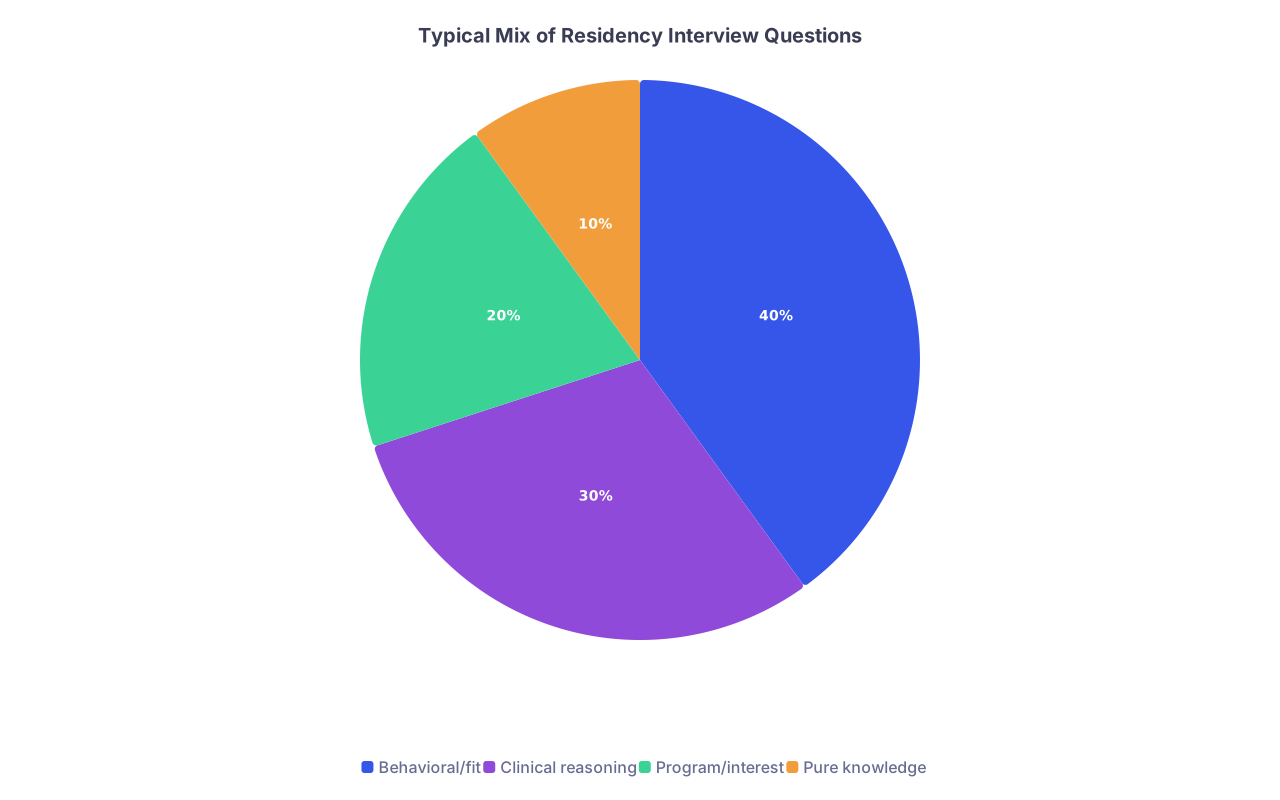
| Category | Value |
|---|---|
| Behavioral/fit | 40 |
| Clinical reasoning | 30 |
| Program/interest | 20 |
| Pure knowledge | 10 |
Most questions are not pure fact-recall. Which means you’ll rarely be punished for not knowing some obscure detail — and often rewarded for handling uncertainty well.
How to Get Comfortable With This Before Interview Season
Practical prep plan:
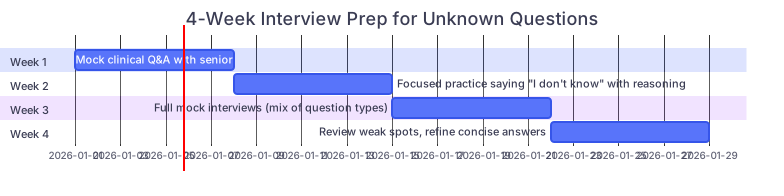
| Task | Details |
|---|---|
| Week 1: Mock clinical Q&A with senior | a1, 2026-01-01, 7d |
| Week 2: Focused practice saying "I don't know" with reasoning | a2, 2026-01-08, 7d |
| Week 3: Full mock interviews (mix of question types) | a3, 2026-01-15, 7d |
| Week 4: Review weak spots, refine concise answers | a4, 2026-01-22, 7d |
If you do even two serious mock sessions where people intentionally stump you, you’ll feel drastically calmer on interview day. You’ll have heard yourself survive it.

FAQ: Admitting You Don’t Know in Residency Interviews
1. Will saying “I don’t know” hurt my chances of matching?
No — not by itself. Programs expect you not to know everything. What hurts you is how you handle it. If you admit you don’t know, then logically reason through what you can and explain how you’d verify or ask for help, you look safe and honest. If you repeatedly say “I don’t know” to basic questions or completely shut down, that’s when it becomes a problem.
2. What if I know “part” of the answer — should I still say I don’t know?
Yes, but be specific about what you do and don’t know. For example: “I don’t know the exact guideline number, but I know the principle is X, and I’d apply it by doing Y and checking Z.” That shows nuance and self-awareness. It’s way better than pretending you’re 100% sure when you’re not.
3. Is it ever okay just to guess confidently?
For clinical questions, no. In residency, confident guessing without backup is how patients get hurt. In an interview, that behavior is a huge red flag. You can offer a hypothesis: “My best guess, based on what I know about X, would be Y — but I’d confirm that by checking the latest guideline and discussing it with my senior.” That’s reasoning, not blind guessing.
4. What do I do if I blank on a very basic question?
Own it briefly and recover with structure: “I’m honestly blanking on the exact term right now, but here’s how I’d approach the situation clinically…” Then after the interview, look it up — if you have a second look or follow-up email, you can even mention you reviewed it. Everyone has brain-freeze moments; what matters is your recovery, not perfection.
5. Can I tell the interviewer I’d look it up on UpToDate? Does that sound bad?
Saying you’d use UpToDate or guidelines is completely normal. Residents do this all the time. Just don’t make it sound like your only move is “I’d Google it.” Pair it with clinical reasoning and teamwork: “I’d start with [initial safe steps], then check UpToDate or our institutional guidelines, and discuss with my senior/attending before finalizing the plan.”
6. How many “I don’t know” moments are too many in one interview?
There’s no fixed number, but if it’s happening repeatedly on core topics, that’s a red flag. A couple of honest “I’m not completely sure, but here’s how I’d think about it” responses are totally fine and often positive. If you’re missing basic bread-and-butter questions, you need more clinical review before interviewing.
Key takeaways:
Admitting you don’t know in residency interviews is not only okay, it’s often the best answer — as long as you pair it with clear reasoning and a plan for how you’d get the right answer safely. Programs are judging your judgment, humility, and teachability, not your ability to recite minutiae from memory.