
Turning a gap in your training into a strength is not a branding trick. It is a discipline. Most candidates either over-explain, under-own, or flat-out avoid their gap—then wonder why interviewers keep circling back with skeptical faces.
You can do better than that.
You can walk into interviews with a gap in your timeline and have program directors think, “This person knows exactly who they are and what they bring now.” That is the goal. Let me show you the system to get there.
Step 1: Diagnose the Type of Gap You Have
Do not start wordsmithing. Start with clarity. You cannot fix what you have not named precisely.
Most “gaps in training” fall into a few buckets:
- Time away from medical school or residency
- Failure or repeat of an exam or rotation
- Extended LOA (leave of absence) for any reason
- Switching specialties or programs
- Failure to match (or SOAP-only positions) in a prior cycle
- Disciplinary action or professionalism concern
Different gap types require different handling. Get very specific.
A. Map Your Actual Timeline
Grab a sheet of paper or a blank document. Lay out your timeline in months, not vague years.
- M1 start → M4 graduation
- Rotations dates
- LOA start/end dates
- Exam attempts with dates
- Previous match cycles and outcomes
- Any non-clinical work or “unstructured” periods
Your first task: make the gap visually obvious. No hiding.
Now summarize the gap in one direct sentence. No adjectives. No excuses. Just facts.
Examples:
- “I took a one-year leave of absence between M2 and M3.”
- “I failed Step 1 on my first attempt and passed on the second.”
- “I completed one year of internal medicine residency, resigned, and am reapplying to psychiatry.”
- “I applied to residency last year, did not match, and spent this year in research and clinical work.”
If you cannot say your situation in one plain sentence, that is the first problem.
Step 2: Strip the Story Down to the Core Facts
Interviewers hate three things about gap explanations:
- Rambling.
- Blame-shifting.
- Vague euphemisms.
You avoid all three by separating facts from interpretation.
Write two short lists.
List 1 – Facts (no opinions, no explanations):
- Dates
- Official status (LOA, withdrawal, failure, remediation, resignation)
- Exam results
- Documented events (probation, committee decision, etc.)
List 2 – Interpretations (why it happened, how you felt, what you learned):
- Burnout
- Family crisis
- Mental health
- Misalignment with specialty
- Immaturity / poor habits / lack of structure
- Financial pressure
- Illness or disability
Your interview answer must be rooted in List 1. List 2 appears only as much as needed to (a) show insight, and (b) show growth. Not to win sympathy.
If you are not sure what programs actually care about, let me be blunt:
| Concern | What They Actually Ask Themselves |
|---|---|
| Duration of gap | Is this a short event or a chronic pattern? |
| Reason for gap | Will this happen again here? |
| Recovery from gap | Did they come back stronger or just survive? |
| Insight and ownership | Do they understand their role in it? |
| Current functioning | Are they stable, reliable, and ready now? |
If your narrative does not answer these questions clearly, it will not land.
Step 3: Build a Three-Part Narrative Structure
You need a script. Not a memorized speech, but a consistent structure.
The cleanest framework:
- What happened (brief, factual)
- What changed (actions, not feelings)
- Who you are now (evidence you are stronger)
Aim for 60–90 seconds. Anything longer feels like a justification tour.
1. What Happened (20–30 seconds)
This is the part most people overdo. Keep it boringly factual.
Bad:
“I was going through a very challenging period, with a lot of personal and academic stress, and I struggled to balance my responsibilities, which led to some setbacks…”
Better:
“In my third year, I failed Internal Medicine because my performance on the shelf exam did not meet the required standard. I remediated the rotation and passed on the second attempt.”
Checklist for this section:
- One or two sentences
- Clear event + consequence
- No emotional oversharing
- No blame on the system, faculty, school, exam
2. What Changed (30–40 seconds)
This is where most applicants hand-wave: “I learned a lot and improved.” That is meaningless.
Talk systems and behaviors, not vague “growth.”
Concrete examples:
- You started using a daily study schedule and tracking question blocks.
- You changed how early you asked for help.
- You worked with counseling, coaching, or occupational health.
- You implemented a step-by-step workflow for notes, pre-rounding, and follow-up.
- You adjusted your specialty choice after structured reflection and mentorship.
You want at least 2–3 specific changes you made.
Phrase pattern:
- “I realized X, so I did Y.”
- “I was missing A, so I started doing B and C consistently.”
3. Who You Are Now (20–30 seconds)
You close by proving this is a resolved issue, not an ongoing saga.
You do this by pointing to recent performance under pressure.
Examples:
- “Since returning, I completed all third- and fourth-year rotations on time with strong clinical evaluations.”
- “On my most recent Step 2 CK, I scored 245, which reflects the new approach I adopted.”
- “In this last application cycle, I took on a 1.0 FTE research position, precepted students, and maintained consistent clinical work.”
You are answering: “Why should we trust you now?”
Step 4: Concrete Scripts for Common Gap Scenarios
You do not need to reinvent phrasing. Use these as starting templates and customize.
Scenario 1: Medical School LOA for Health or Personal Reasons
You:
- Took 6–12 months off
- Returned in good standing
- Are clinically functioning well now
Script:
“Between my second and third year, I took a one-year leave of absence for personal health reasons. During that time, I worked closely with student affairs and my healthcare team to stabilize my situation and put concrete supports in place. Before returning, I adjusted my schedule, set up regular follow-up care, and built a more structured study and work routine. Since coming back, I have completed all my clerkships on time, with strong evaluations, and have not needed any further time away. The experience forced me to be much more proactive about my limits and communication, and I carry that forward in how I manage my responsibilities now.”
Notice what this does:
- States the LOA without details of diagnosis
- Emphasizes planning and collaboration
- Ends on current stability and performance
Scenario 2: Step Failure
You:
- Failed Step 1 or 2
- Passed on second attempt
- Are embarrassed and tense about it
Script:
“In my third year, I failed Step 2 CK on the first attempt. Looking back, I underestimated the dedicated time I needed and relied too heavily on passive review. After that result, I met with our dean and a learning specialist and completely overhauled my study system. I built a daily question block schedule, did timed practice exams every two weeks, and treated the dedicated period like a full-time job with protected hours. On the second attempt, I passed with a 237. Since then, I have applied that same structured approach to my rotations, and my most recent clinical evaluations and in-service scores reflect that consistency.”
No drama. You are not a victim of the test. You changed your system and have data showing it works.
Scenario 3: Did Not Match Last Cycle
You:
- Applied last year
- Did not match
- Spent this year doing research, prelim, or other work
Script:
“Last year I applied to internal medicine and did not match. My application had two weaknesses: limited U.S. clinical experience and less-than-competitive Step 2 timing. After the match, I met with my dean and two faculty mentors and created a structured plan. This year, I have been working as a full-time research fellow in cardiology, with one day a week in clinic, and I have secured strong updated letters from U.S. faculty. I also brought my Step 2 score up and submitted everything early this cycle. The experience forced me to face the gaps in my application honestly, and I feel I am now bringing a much stronger, more realistic candidacy.”
Again: ownership + specific actions + current strength.
Scenario 4: Switching Specialties or Leaving a Program
This one makes programs nervous. You must show this is not flakiness.
Script for leaving a residency year:
“After completing my intern year in general surgery, I resigned from the program because I realized my long-term fit was in anesthesiology. This was not a sudden decision; over the course of the year, I found that I was most engaged in the OR, working closely with anesthesia teams, managing physiology, and procedural work with shorter, focused interactions rather than longitudinal clinic care. Before making any moves, I spoke with my program director, mentors in both fields, and my family. We agreed that a transition made sense. I finished the academic year in good standing, with positive evaluations, and then took a research position in perioperative medicine while I reapplied. That year in surgery built my work ethic and comfort in the OR, and I am very clear now about why anesthesia is the right home for me.”
Key points:
- Explicitly state you left in good standing
- Show a thoughtful process, not impulsive exit
- Connect prior training to value in the new field
Step 5: Translate the Gap into a Clear Strength
Here is where most advice gets fluffy. “Turn your weakness into a strength” gets interpreted as “pretend your failure was actually good.” That is dishonest and transparent.
You are doing something different:
You are showing that your response to the gap built a specific competency the program actually needs.
Think in terms of residency-relevant strengths:
- Reliability under stress
- Self-awareness and coachability
- Time management and prioritization
- Resilience and recovery after setbacks
- Communication and early help-seeking
- Empathy for struggling patients and peers
- Systems thinking and process improvement
Pick 1–2 that genuinely fit your situation. Tie them directly to the gap.
Example transformations:
- Step failure → Better learning system + humility about asking for help
- LOA for mental health → Proactive boundary setting + sustainable workload habits
- Not matching → Persistence, realistic self-assessment, and long-term planning
- Disciplinary professionalism issue → Clear behavioral change and respect for policies
Say it plainly:
- “Because of that experience, I am much quicker now to ask for help early instead of waiting until I am overwhelmed.”
- “Going through that failure forced me to build a real system for learning, and that system is exactly how I approach new content on the wards now.”
- “After not matching, I learned how to take hard feedback without getting defensive and turn it into an action plan.”
Step 6: Practice Delivery Until It Sounds Boring to You
If you sound anxious, performative, or overly rehearsed, interviewers will focus on your emotion, not your message.
Your goal: your explanation should feel as emotionally loaded as reading a lab result.
Run These Reps
- Write it out using the three-part structure.
- Record yourself answering a version of:
- “I see you have a gap here—can you tell me about that?”
- Watch it back and look for:
- Over-smiling or laughing nervously
- Over-apologizing (“I’m really, really sorry about…”)
- Digressions into unnecessary detail
- Excessive justifications or blaming
- Trim any sentence that starts with:
- “The problem was really that…”
- “If only…”
- “What you have to understand is…”
Your tone should be:
- Calm
- Direct
- Matter-of-fact
- Slightly forward-looking
Here is a testing trick:
If someone who does not know you (friend of a friend, co-resident, faculty at another site) listens to your answer and says, “Okay, so what’s the big deal?”—you are in the right zone.
Step 7: Prepare for Follow-Up Questions (They Are Coming)
Interviewers rarely stop at your first answer. They test for consistency.
Here are common follow-ups and how to prepare:
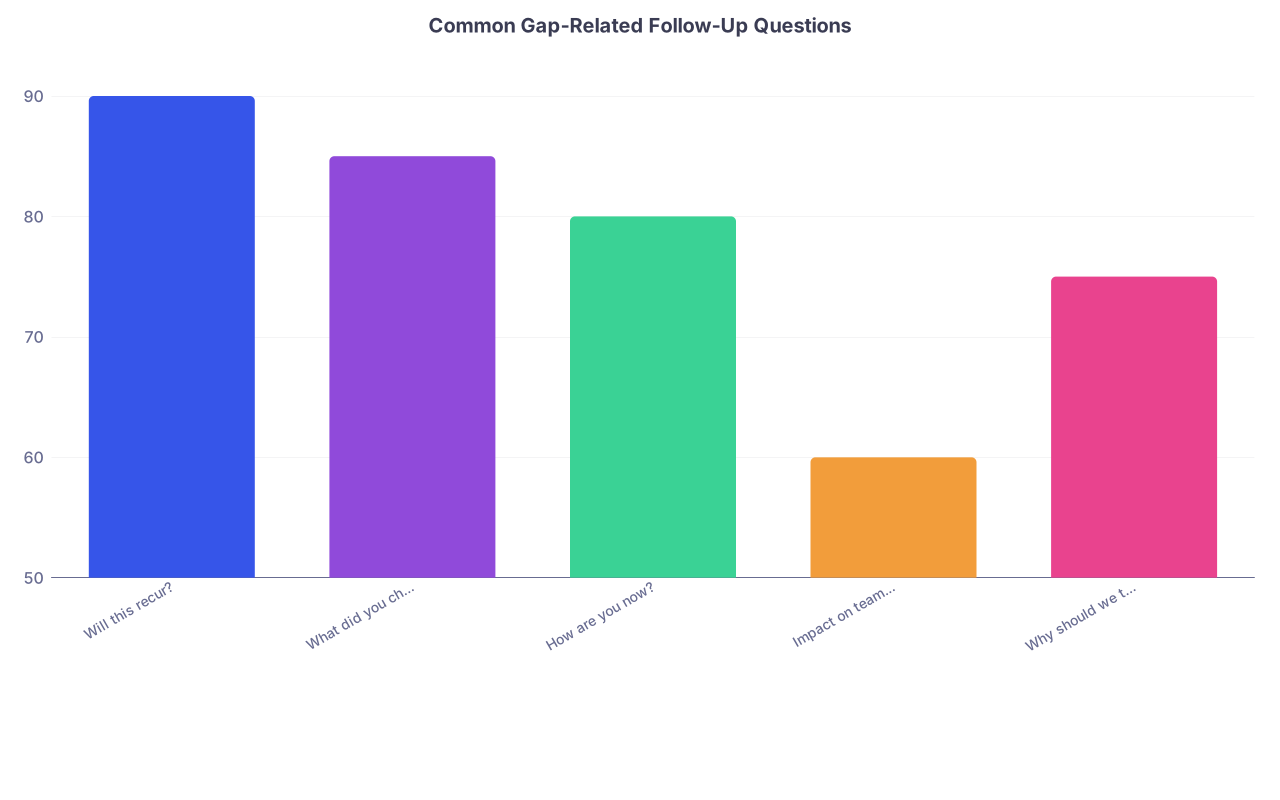
| Category | Value |
|---|---|
| Will this recur? | 90 |
| What did you change? | 85 |
| How are you now? | 80 |
| Impact on teamwork | 60 |
| Why should we trust you? | 75 |
(Values here loosely represent how often these themes show up in my experience.)
Common Follow-Up Themes
Risk of recurrence
- “How can we be sure this will not happen again during residency?”
Your move: point to stable functioning over time + supports in place.
- “How can we be sure this will not happen again during residency?”
Concrete changes
- “What specifically do you do differently now when you feel overwhelmed?”
Your move: list 2–3 clear behaviors (early communication, schedule blocks, checklists).
- “What specifically do you do differently now when you feel overwhelmed?”
Impact on patients/teams
- “How did this affect your team or your patients at the time?”
Your move: acknowledge any impact briefly + what you learned about responsibility.
- “How did this affect your team or your patients at the time?”
Insight and ownership
- “Looking back, what was your role in this?”
Your move: name your contribution without self-attack. Responsibility, not self-loathing.
- “Looking back, what was your role in this?”
Prepare 1–2 sentences for each of these angles. Keep them aligned with your main script.
Step 8: Integrate the Gap Into Your Overall Narrative
Big mistake: treating the gap as a separate “problem section” of your life.
Programs are asking: Does this gap fit into a coherent story about who you are and why you are choosing this specialty?
Use your gap as connective tissue:
- In your “Why this specialty?” answer, you can reference what your gap clarified for you about how you want to work, the population you want to serve, or your limits.
- In responses about resilience or a time you faced adversity, you can use the gap story—but only if you frame it as resolved and mature, not raw and unfinished.
- In conversations about teamwork or leadership, you can mention how the experience changed how you show up for struggling peers.
Example integration:
“My leave of absence forced me to confront the mismatch between how I was working and what was sustainable. Since then, I have been much more attentive to how my teammates are doing and quicker to check in if someone seems off. On my sub-I, I actually helped a colleague connect with student affairs when they were clearly struggling with burnout, because I recognized a lot of my own earlier patterns.”
Now the gap is not a stain. It is a source of credibility.
Step 9: Avoid These Common Self-Sabotaging Moves
I have seen all of these in real interviews. They tank otherwise solid candidates.
Over-disclosure of personal or medical details
- You are not required to reveal diagnoses, therapy details, or intimate family circumstances. Stick to function and response.
Blaming faculty, exams, or the system
- You can acknowledge context (e.g., schedule changes, curriculum shifts), but if your main theme is “they were unfair,” you lose.
Angling for pity
- Programs respect resilience, not martyrdom. “It was very hard, but I’m proud of how I responded” beats “No one helped me and it was awful.”
Pretending it was secretly a blessing without cost
- Do not spin. You can say, “I would not choose to repeat it, but I am grateful for what it forced me to change.”
Minimizing or denying the impact
- “It wasn’t that big a deal” when it clearly was (e.g., probation, dismissal threat) destroys trust.
You want sober realism, not dramatics or downplay.
Step 10: Stress-Test Your Narrative Before Interview Season
Do not wait for your first real interview to figure this out.
Run your explanation past:
- A trusted attending or advisor who is not overly protective
- A co-resident or peer who will be honest
- A mentor in your specialty of interest
Ask them three direct questions:
- “What concerns would you still have about me after hearing this?”
- “Where do I sound defensive or unclear?”
- “If you were a PD, what follow-up question would you ask next?”
Then refine.
If you can, also put your narrative next to your ERAS application and personal statement. Make sure the story is consistent across:
- Dates and events in ERAS
- How you reference the gap (if at all) in your personal statement
- How your letters of recommendation describe your recent performance
Misalignment here is a red flag. Clean it up.
A Quick Visual: The Flow of a Strong Gap Narrative

| Step | Description |
|---|---|
| Step 1 | Interviewer notices gap |
| Step 2 | Candidate states brief facts |
| Step 3 | Candidate explains specific changes |
| Step 4 | Candidate cites current strong performance |
| Step 5 | Interviewer asks follow-up |
| Step 6 | Candidate answers with ownership & calm |
| Step 7 | Interviewer sees issue as resolved risk |
If you do this right, by the end, the interviewer mentally moves your gap from “active concern” to “historical context.”
Final Step: Do This Today
Do not just nod along and move on.
Right now, do this:
- Open a blank document.
- Write one blunt sentence describing your gap (“I…”).
- Underneath, write three bullet points:
- One line for What happened (facts).
- Two lines for What changed (specific actions).
- Two lines for Who you are now (current performance data).
- Read it out loud and time it. Aim for under 90 seconds.
If it sounds messy, defensive, or apologetic, keep editing until it sounds like you are reading a consult note: clear, concise, and confident.
Then, schedule a mock interview with someone who will not sugarcoat feedback.
You cannot erase a gap in training. But you can absolutely decide whether it looks like unfinished business or hard-earned strength. Start rewriting that narrative today.