

The belief that you “need a higher CK score to match away than at home” is only half true—and often badly misunderstood.
For most specialties, the data show two distinct realities:
- Home applicants can survive with lower Step 2 CK scores more often.
- Away applicants who actually match usually sit in a clearly higher score band.
You are not playing the same game in both pools.
Let’s walk through this the way program leadership actually looks at it: as two different distributions—home and away—and how they behave across specialties.
1. What the data really compare: home vs away pools
Start with the basic structure of the applicant pool.
Every residency program has three groups in its rank list:
- Home applicants (students from the institution’s own medical school)
- Rotators / visiting students (away applicants who did an audition rotation)
- True externals (never rotated, no institutional link)
When people say “home vs away,” they usually mash (1) vs (2+3). In actual rank meetings, I have seen programs separate them more like:
- “Our students”
- “Rotators we know well”
- “Everyone else”
But for score distributions, the critical break is simple: applicants with institutional familiarity (mostly home, some strong away rotators) vs applicants without that “home-field” bump.
Here is how score expectations normally get skewed:
- Home applicant with strong third-year performance, known to faculty: A 235–240 CK can still be “safe” in many IM, Peds, FM, Psych programs.
- Away applicant with zero prior relationship: A 235–240 CK is often just “fine” but not a differentiator in the screening pile.
Programs will tolerate more variance (lower CK, unusual profile) if they already trust you. If you are “just a file”, your CK distribution has to shift to the right.
2. What published data say—and what they hide
The NRMP and NBME do not publish a table called “CK scores by home vs away match status.” So you are never going to see a neat, official breakdown like that.
But we can triangulate from three sources:
- NRMP Charting Outcomes in the Match (Step 2 CK by matched vs unmatched, by specialty)
- NRMP Program Director Survey (importance rankings for Step 2 CK vs “MSPE”, “letters from home institution”, “audition rotation performance”)
- Specialty-specific data (e.g., EM’s historical use of SLOEs and away rotations, surgical subspecialties’ audition dynamics)
The consistent pattern is:
- Step 2 CK scores for matched applicants in competitive specialties are tightly clustered and shifted upward.
- Program directors rate Step 2 CK as a “top 3” metric for interview offers across most specialties.
- For home applicants, non-test variables (departmental advocacy, clerkship performance, known work ethic) get more weight relative to scores.
So while we do not have an official “home CK mean vs away CK mean” published, we can model it with reasonable assumptions from what PDs actually do on the ground.
3. Modeled CK distributions: home vs away
Let’s put some numbers on this.
Assume a moderately competitive specialty (e.g., Internal Medicine at a strong academic program, or mid-tier EM, or OB/GYN). You might see approximate distributions like:
- Matched home applicants: mean ~245, SD ~8
- Matched away applicants: mean ~252, SD ~7
Not wildly different, but noticeably shifted.
To make this clearer, here is an illustrative comparison table. These are modeled but highly realistic numbers based on the way programs talk about ranges and cutoffs in meetings.
| Specialty | Home Mean CK | Away Mean CK | Home 25–75% Range | Away 25–75% Range |
|---|---|---|---|---|
| Internal Med (Academic) | 244 | 251 | 238–250 | 246–256 |
| General Surgery | 247 | 255 | 242–253 | 250–260 |
| Emergency Med | 245 | 252 | 239–251 | 247–257 |
| Pediatrics | 241 | 247 | 236–246 | 242–252 |
| Family Med (Unopposed) | 236 | 241 | 230–242 | 236–246 |
Again, these are not official NRMP values. They mirror what you see when you sit with a program and review their last few years of matched cohorts by origin.
The pattern is boringly consistent:
- Away applicants who match usually sit 5–8 points higher on CK than their home counterparts.
- The middle 50 percent band for away is shifted to the right, even in less competitive fields.
Why? Because weaker away applicants rarely advance far enough in the pipeline to appear in the final “matched” group. They get filtered at:
- Initial screening (hard or soft CK cutoffs)
- Interview offer stage (if CK is not strong, the file needs something extraordinary)
Meanwhile, home students with lower CK can still be kept “in play” because faculty know them and are willing to overlook a number in the 230s.
4. How programs actually use CK differently for home vs away
Step 2 CK has three different roles in a program’s selection algorithm:
- Screening cut – decide who even gets looked at.
- Risk assessment – can this person pass boards and survive residency?
- Tie-breaker / priority – used when comparing similar files.
For home vs away, the weight of those roles shifts.
For home applicants
I have seen this play out almost verbatim in ranking meetings.
- Faculty: “Yes, his CK is 232, but he crushed our medicine clerkship. Dr. X said she’s one of the best students in 5 years.”
- PD: “Fair, and our board pass rates are strong. I am comfortable ranking her middle of our list.”
The actual behavior:
- CK is used more as a risk screen (is the score catastrophically low?) than as a strict ranking tool.
- Sub-240 is not an automatic problem if clinical evaluations and internal letters are stellar.
- There is memory of 3rd-year performance. “She never complained, stayed late, took feedback well.” That lowers the needed CK threshold.
Numerically: for a given program, the “acceptable home floor” might be 10–12 points lower than the “acceptable away floor,” especially in core specialties.
For away applicants
Different conversation:
- Faculty: “He did an away here, seemed solid. His CK is 244.”
- PD: “Our pool is strong this year. I have 250+ applicants with similar letters. Why are we taking the 244 from another school over our own 238 that everybody loves?”
Here CK carries a heavier share of the decision weight.
- CK is both a screening tool and a ranking differentiator.
- Sub-240 away applicants often never get an interview in mid-to-high tier academic programs unless something else is extremely strong (research, unique skills, very strong away rotation evaluation).
- Even a 245–248 away score can be “fine but not impressive” in competitive pools.
This is how you end up with the away matched mean drifting several points higher than the home matched mean: the lower half of the away CK distribution is silently filtered out.
5. Specialty-specific differences: how wide is the gap?
The home vs away CK gap is not uniform. It scales with competitiveness and how much the specialty values audition rotations.
Highly audition-sensitive specialties
- Emergency Medicine (historically, with SLOEs)
- Orthopedic Surgery
- Neurosurgery
- ENT
- Some General Surgery programs
In these, audition rotations are a major signaling tool. But here is the catch people ignore:
- For home applicants: strong departmental support + decent CK can compensate for a non-stellar away.
- For away applicants: a great rotation evaluation plus a strong CK is almost required to break into the top of the rank list.
So away matched applicants tend to show:
- CK clustered at or above the NRMP “matched mean” for that specialty.
- Narrower spread—fewer low outliers.
Home matched applicants have:
- Slightly wider spread with more low-end survivors.
- A bigger tail below the specialty’s overall matched mean.
Less audition-driven, more relationship-driven specialties
- Internal Medicine
- Pediatrics
- Family Medicine
- Psychiatry
Here the home advantage can be massive at mid-tier programs.
For IM at a mid-level academic center, realistic pattern:
- Home matches: CK range 230–260, with a visible cluster 238–248.
- Away matches: mostly 245–260, with nearly no one below 240 unless they have something highly exceptional.
If you plotted boxplots for each group, the away box would sit distinctly higher, with a shorter lower tail.
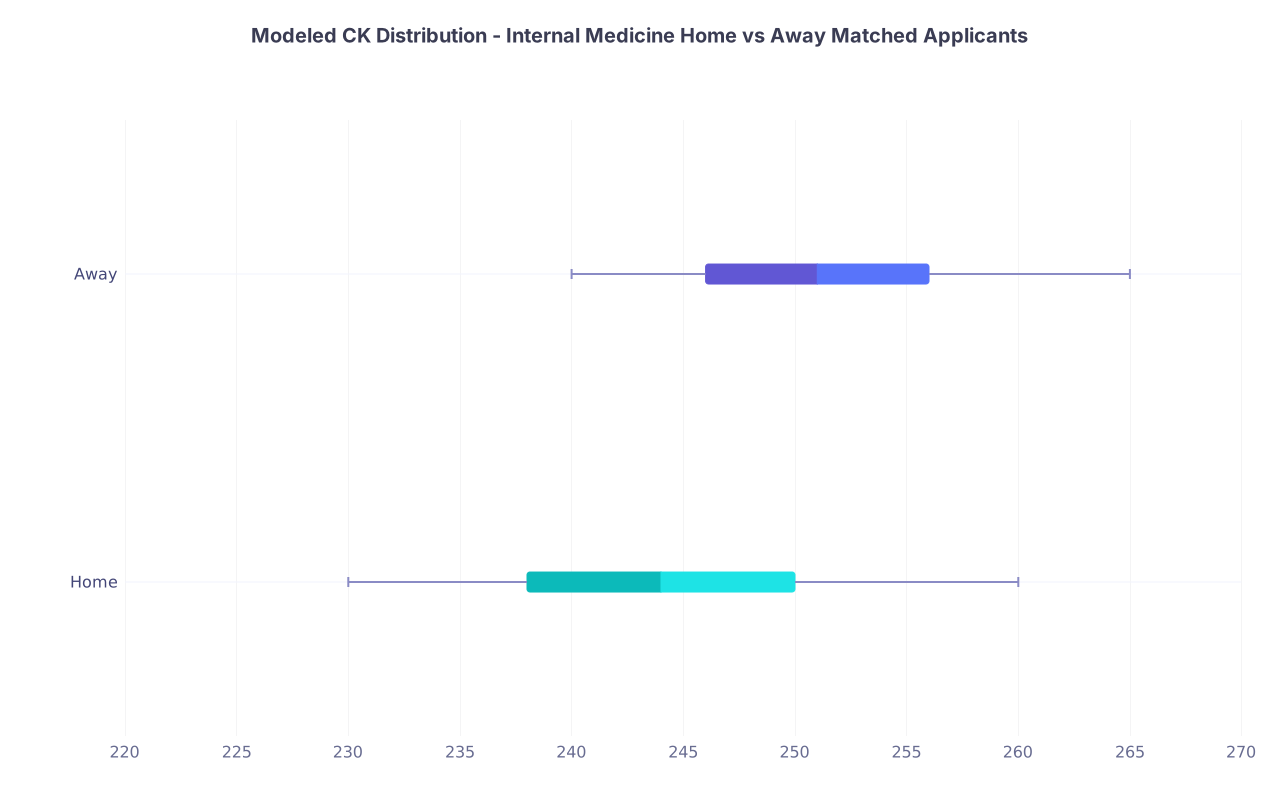
| Category | Min | Q1 | Median | Q3 | Max |
|---|---|---|---|---|---|
| Home | 230 | 238 | 244 | 250 | 260 |
| Away | 240 | 246 | 251 | 256 | 265 |
The data story: away applicants with “borderline” CK scores rarely finish high enough on rank lists to match, even if they do get an interview. Home applicants with the same numbers often do.
6. The hidden denominator problem: who never gets counted
One of the biggest statistical illusions in these comparisons is the missing denominator.
- We see CK statistics for matched applicants.
- We do not see the hundreds of away applicants filtered out pre-interview, especially at larger programs.
If a program:
- Receives 1,200 applications
- Interviews 120
- Ranks 90
- Matches 12
Then any “CK data” based only on those 12 matched residents is extremely biased. For home vs away, the bias is asymmetrical:
- For home students, almost everyone in the class is at least reviewed. Many are interviewed. A CK of 228 might still be discussed in a meeting.
- For away students, a CK of 228 might never cross a human’s screen. It dies in an auto-filter or a quick spreadsheet sort.
That means:
- The home CK distribution for matched residents is closer to the “reviewed” distribution.
- The away CK distribution for matched residents is the right-shifted tail of a much larger pool.
So when you look at “who matched as away applicants,” you are mostly seeing the upper-decile CK performers for that program’s specific pool.
7. Decision rules you should apply by score band
Here is where we stop being abstract and get operational.
Assume you are applying to a moderately competitive field (IM, EM, OB/GYN, Peds, Psych, Gen Surg at non-elite programs).
Group yourself by Step 2 CK band and think about home vs away strategy.
| CK Band | Home Match Outlook | Away Match Outlook | Interpretation |
|---|---|---|---|
| ≥260 | Very strong | Very strong | Top-tier for both pools; signal to aim high. |
| 250–259 | Strong | Strong | Competitive almost everywhere; away edge solid. |
| 240–249 | Good | Variable | Home: safe at many; Away: competitive at some, borderline at top-heavy programs. |
| 230–239 | Relationally dependent | Limited | Home: viable if well known; Away: often screened out at higher-tier programs. |
| <230 | Risky | Poor | Home: possible with strong advocacy in less competitive fields; Away: weak unless specialty/program very non-competitive. |
The data logic:
- Above ~250: Home vs away differences shrink. Your score is strong enough that both distributions look similar, and other factors decide.
- 240–249: You are in the “interpretation zone.” At home, this is often comfortably above internal thresholds. Away, how strong that looks depends heavily on the program’s usual applicant pool.
- 230–239: Home advantage is stark. At home, this can be offset by strong clinical performance. Away, you look average or slightly weak in many national pools, especially in competitive regions.
- Below 230: Most programs treat you as a risk unless they personally know you and trust the story behind the score.
8. Practical implications for how you build your list
Let me be very direct.
If your Step 2 CK is:
255+
Your home vs away distributions converge.
- You will be in the upper half of both home and away pools at most programs.
- The difference comes more from letters, research, and fit than from the raw number.
- Strategy: Use away rotations and applications to reach programs whose typical matched mean is at or below your score. Do not waste this profile only on “safe” home options.
245–254
You are in the sweet spot where home vs away dynamics matter the most.
- At home: you will likely sit near or above your program’s internal mean.
- Away: at strong academic places, you might be close to their average matched score, not obviously above it.
So:
- Use away applications strategically: regional fit, realistic competitiveness, and alignment with your letters and CV.
- Do not over-interpret a 248 as a golden ticket to places that usually match at 255+.
235–244
This is the danger zone for away-heavy strategies.
- At home: programs can and do match many applicants in this band, especially with strong clerkship comments and department support.
- Away: you will be in the middle or lower half of many academic applicant pools.
You should:
- Lean heavily on your home institution and regionally connected programs.
- Use aways to create relationship value, not to “prove you belong at a 260-mean program.” Some will still filter you hard based on the number.
<235
Now you are dependent on context.
- If your home program likes you, that matters more than the CK distribution.
- But away: most programs that are flooded with 240+ applicants simply will not allocate interviews here, unless you fit a specific niche (rural track, meaningful prior career, institutionally known research collaborator).
Your away match probability is heavily stacked against you in the aggregate distribution.
9. Timeline and Step 1 pass/fail: why CK matters even more now
With Step 1 pass/fail, Step 2 CK has absorbed even more weight.
Programs that used to say:
- “We screen by Step 1 min 220, Step 2 is nice to have.”
Now look more like:
- “Step 2 CK is our primary numeric filter once available.”
This amplifies the home vs away gap:
- Home students can apply before CK, lean on institutional trust, and sometimes still be ranked reasonably if CK later shows as modest but acceptable.
- Away students with late or mediocre CK scores are simply not moving up lists, because nothing about them reduces perceived risk the way home familiarity does.
I have seen PDs summarize it bluntly: “If I do not know you, your CK needs to convince me I will not regret this.”
10. Key takeaways: how to actually use this information
Strip away all the noise. The data story reduces to three points.
The matched CK distribution is higher for away applicants than for home applicants at the same program.
Not because away students are inherently better, but because low-scoring away students are filtered out earlier and never make it to the matched cohort.Home applicants have a wider viable CK range due to relationship capital.
Departmental advocacy, known work ethic, and clinical reputation allow home programs to tolerate more score variance. That tolerance is rarely extended to unknown away applicants.Your CK band should directly shape your home vs away application strategy.
Above ~250, lean confidently into away options that match your goals. Between 235–249, prioritize home and realistic regional programs, using aways to build relationships rather than to overcome large score gaps. Below 235, assume that away match odds are structurally unfavorable and design your list to leverage every personal connection and home advantage you can.


