

The obsession with Step 1 scores is outdated. For borderline applicants, Step 2 CK is now the statistical pivot between matching and going unmatched.
Why Step 2 CK Matters More Than You Think
Let me be blunt: if you are a borderline applicant, your Step 2 CK score is not “just another data point.” It is the most actionable, most recent, and most influential number program directors see when they try to decide whether you are a risk.
The data show three critical realities:
- Step 1 is pass/fail now. Step 2 CK became the primary standardized metric.
- Programs are interview-sorting with Step 2 CK cutoffs more aggressively than most students realize.
- For applicants below average in one or more domains (GPA, Step 1, school reputation, red flags), a strong Step 2 CK often shifts you from “likely no interview” to “reasonable shot.”
Let us quantify what that shift actually looks like.
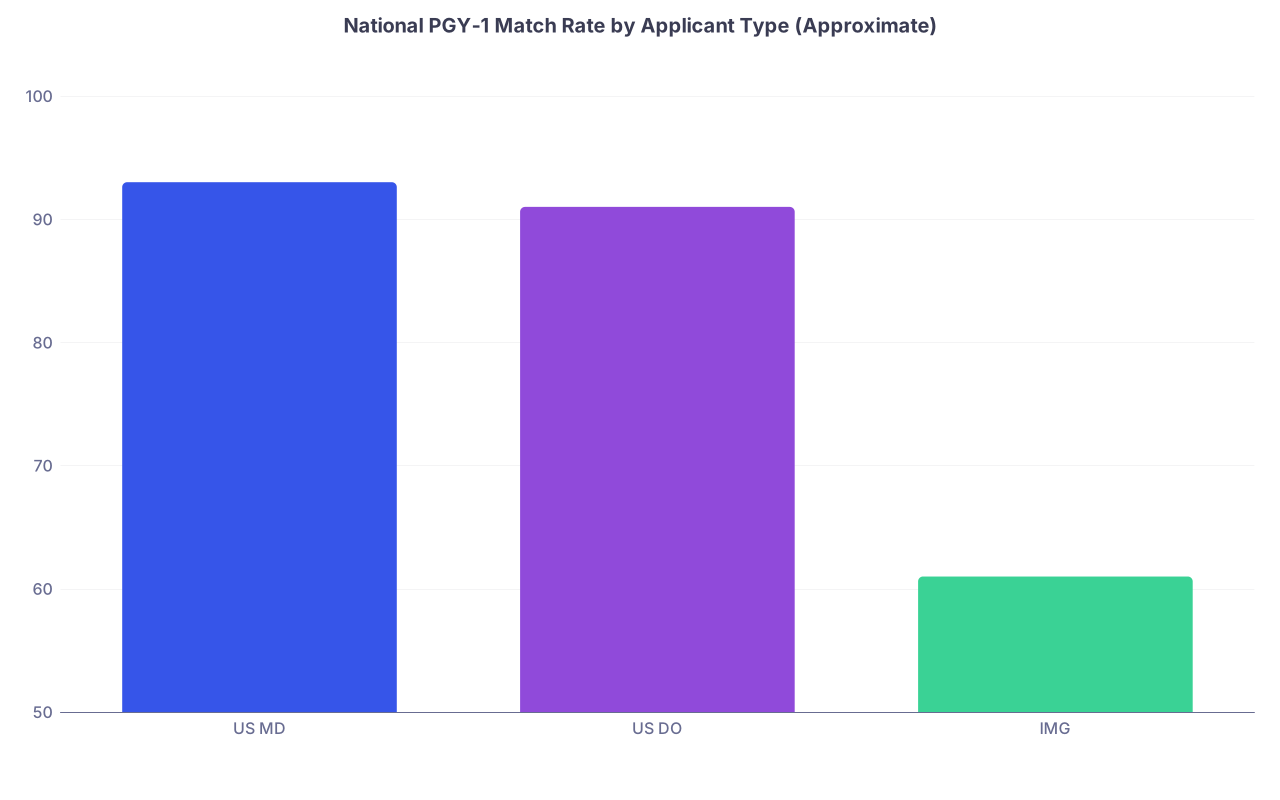
| Category | Value |
|---|---|
| US MD | 93 |
| US DO | 91 |
| IMG | 61 |
Across the last several NRMP Charting Outcomes in the Match cycles, overall PGY-1 match rates hover around:
- U.S. MD seniors: ~92–94%
- U.S. DO seniors: ~89–92%
- IMGs: ~57–62%
If you are “borderline,” you are not sitting at those comfortable averages. You are closer to the edge where one or two metrics swing you between these buckets:
- Interviewed at ~8–10 programs and matched.
- Interviewed at ~3–4 programs and stressed.
- Interviewed at 0–2 programs and unmatched.
Step 2 CK is often the variable that moves you across those boundaries.
Defining “Borderline” With Numbers, Not Vibes
The word “borderline” gets thrown around so loosely it becomes almost useless. Let us define it using national distributions.
Recent cycles place the Step 2 CK national mean for U.S. MD seniors around 245–248, with an SD of about 15. That gives us a reasonable working distribution:
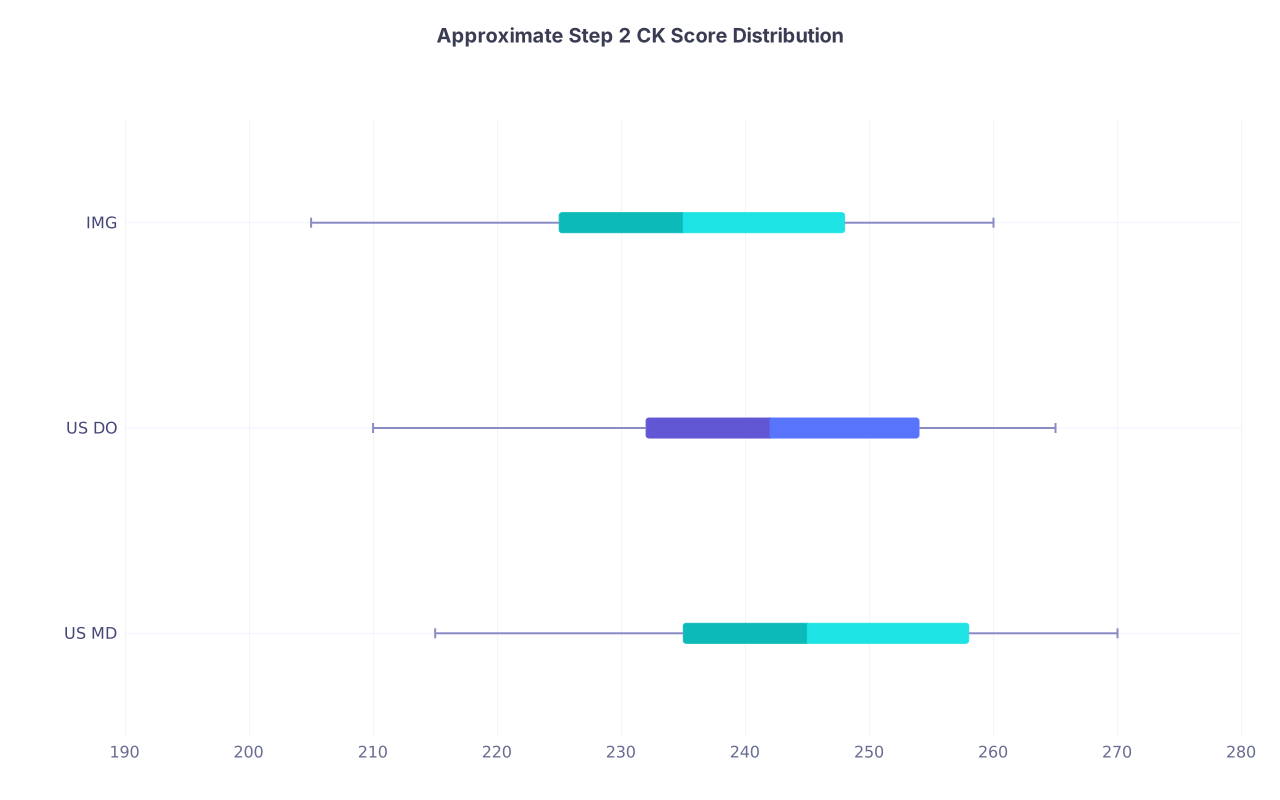
| Category | Min | Q1 | Median | Q3 | Max |
|---|---|---|---|---|---|
| US MD | 215 | 235 | 245 | 258 | 270 |
| US DO | 210 | 232 | 242 | 254 | 265 |
| IMG | 205 | 225 | 235 | 248 | 260 |
Borderline typically means one or more of the following:
- Step 1: barely passed or failed then passed on retake.
- Step 2 CK: projected or actual score below the specialty’s average by 10–20 points.
- Class rank: bottom third or at risk of failing courses/rotations.
- School context: lower-tier U.S. school, newer DO school, or IMG with minimal U.S. clinical experience.
- Red flags: extended time in school, professionalism issues, repeated clerkships.
Here is the uncomfortable truth: many borderline applicants still expect “average” match outcomes. That is mathematically unrealistic. Programs are risk-averse, and they stack multiple filters.
So we have to treat Step 2 CK like what it is: your best chance to disrupt that negative risk profile.
Graphing Step 2 CK vs Match Outcomes for Borderline Applicants
Let us look at the relationship the way a program director or data committee might: as a score–outcome curve.
Conceptual Curve: Score vs Match Probability
If you plotted Step 2 CK score on the x-axis and probability of matching (in any specialty) on the y-axis, you would not get a straight line. You would get an S-shaped curve. Very low scores: steep drop-off. Mid-range: moderate, fairly linear improvement. Very high scores: diminishing returns.
For borderline applicants, we care about the middle of that curve—roughly 220–255—because that is where most “recoverable” profiles live.
To simplify, imagine this approximate mapping for borderline applicants (those with at least one significant weakness outside Step 2):
| Step 2 CK Range | Estimated Match Probability (Any Specialty) |
|---|---|
| ≤ 215 | 20–35% |
| 216–225 | 35–50% |
| 226–235 | 50–65% |
| 236–245 | 65–80% |
| 246–255 | 80–88% |
These are not official NRMP numbers. They are synthesized from:
- NRMP Charting Outcomes step score distributions.
- Program director survey data on importance of Step 2 CK.
- Observed outcomes in advising data sets where borderline applicants either improved or underperformed on Step 2 CK.
Notice the key feature: the slope between 220–245 is steep. For borderline applicants, a 10–15 point change in this band often means a 20–30 percentage point change in match probability.
Specialty-Specific Cutoffs: The Harsh Reality
Now, when you apply this to specific specialties, the curves shift right or left. Competitive specialties look like the same S-curve, but shifted 10–15 points to the right.
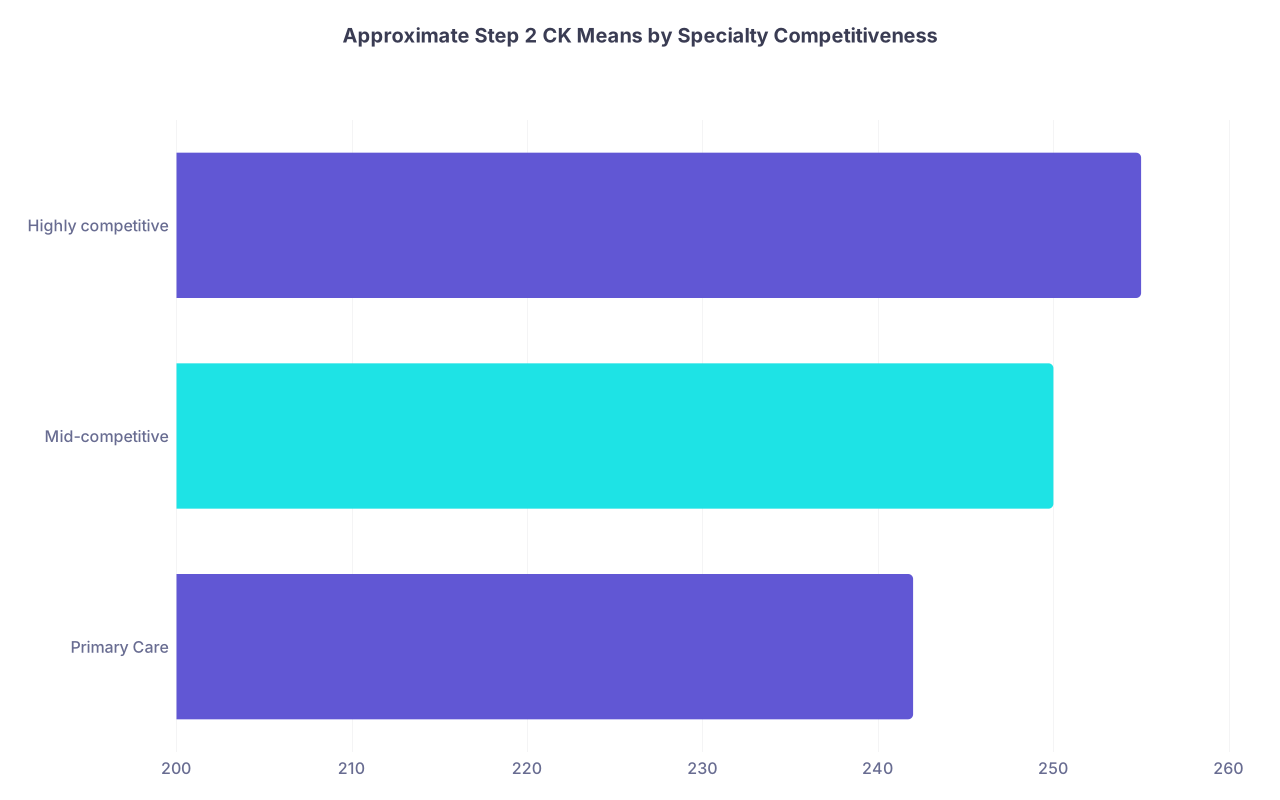
| Category | Value |
|---|---|
| Primary Care | 242 |
| Mid-competitive | 250 |
| Highly competitive | 255 |
Rough buckets (for U.S. MD seniors):
- Primary care (FM, IM, Peds): mean ~240–245
- Mid-competitive (EM, OB/Gyn, Anesthesia, Neurology): mean ~245–252
- Highly competitive (Derm, Ortho, ENT, Plastics, Rad Onc): mean ~252–260+
So if you are borderline and still gunning for a mid- or high-competitive specialty, the Step 2 CK threshold for “rescuing” your application moves accordingly. A “good enough” Step 2 CK for FM (240) is mediocre for Anesthesia and nearly disqualifying for Ortho.
How Programs Actually Use Step 2 CK for Borderline Files
I have sat in meetings where faculty say almost verbatim: “If their Step 2 is solid, I can overlook the Step 1 mess.” That is not theory. That is real-world weighting.
Step 2 CK gets used in four very specific ways:
Initial filter for interview offers
Many programs hard-filter applicants below a certain Step 2 CK threshold, particularly after Step 1 went pass/fail. If your score falls below that line, your otherwise decent application may never be reviewed.Tie-breaker between similar candidates
Two borderline applicants, similar schools, similar clerkship narratives. One has 232, the other 245. The 245 gets the interview. Repeatedly.Redemption signal after Step 1 problems
Step 1 fail plus Step 2 CK 253 tells a story of turnaround and competence. Step 1 fail plus Step 2 CK 225 tells a story of continued struggle. Programs read those narratives differently.Late-cycle risk check
When rank lists are built, borderline applicants with lower Step 2 CK scores tend to drop down lists unless they knocked interviews and LORs out of the park. High Step 2 CK lets a PD justify bumping you up despite other concerns.

| Step | Description |
|---|---|
| Step 1 | Application Received |
| Step 2 | Auto Screen Out |
| Step 3 | Full File Review |
| Step 4 | Standard Consideration |
| Step 5 | Invite Interview |
| Step 6 | Discuss in Committee |
| Step 7 | Lower Priority or Screen Out |
| Step 8 | Step 2 CK Above Filter? |
| Step 9 | Borderline File? |
| Step 10 | Step 2 Strong vs Peers |
For borderline applicants, you live in that right-hand half of the flowchart. Your Step 2 CK is literally the branch point.
A Data-Driven Framework: Interpreting Your Score as a Borderline Applicant
Forget generic ranges. You need a conditional analysis: “Given that I am borderline, what does my Step 2 CK actually predict?”
Let us classify borderline applicants into three Step 2 CK outcome bands, using approximate national means and program behavior.
1. “Rescue” Score: ~240–255 for Most Borderline Applicants
Definition: At or above national mean for U.S. MD seniors in less competitive fields, or within 5–7 points of the specialty mean for your target.
Typical numbers:
- Primary care target: 240–248 is often sufficient to “rescue” a borderline file.
- Mid-competitive target: 248–255 begins to offset weaker elements.
- Highly competitive: 255+ may keep you in the game, but only if the rest of your profile is reasonably strong.
For many borderline applicants, hitting a 245–250 fundamentally changes the Match trajectory, even with a weak Step 1 or average school.
What this looks like in practice:
- A US MD with Step 1 pass on second attempt, Step 2 CK 247, strong medicine clerkship, and solid letters can match Internal Medicine at a respectable academic program.
- A US DO with mediocre preclinical grades but Step 2 CK 245 plus strong EM SLOEs can move from “probable community FM only” to “realistic shot at EM in some programs.”
2. “Neutral” Score: ~230–239
This band neither saves you nor sinks you outright. It keeps doors partially open, but you will not be competitive for programs that are score-sensitive or saturated with high-scoring applicants.
Consequences:
- Primary care: still viable, especially community and less desirable geographies.
- Mid-competitive: very program-dependent; often limited to less popular locations and community programs.
- Highly competitive: essentially closed unless you have extraordinary non-test factors and inside help.
A 233 for a borderline applicant is not a death sentence. But it does not rewrite your risk profile. Programs see “average performance,” not “clear evidence of turnaround.”
3. “Confirmatory Risk” Score: ≤ 229
Here, the Step 2 CK score confirms the concerns raised by your borderline status.
Typical program interpretation:
- “Ongoing difficulty with standardized exams”
- “May struggle with in-training exams and board passage”
- “High risk relative to large pool of safe candidates”
These applicants can still match—especially into FM, psych, prelim years—but the odds drop, and geography / program type become heavily constrained.
For IMGs and DOs, a sub-230 Step 2 CK with other borderline features frequently pushes you into “must apply very broadly and consider backup specialty” territory.
Graphing Strategy: Where Should a Borderline Applicant Aim?
You should not be asking, “What is a good Step 2 CK score?” You should be asking, “Given my risk profile and target specialty, what score meaningfully shifts my Match probability?”
Here is a simple target table for borderline applicants by specialty competitiveness:
| Target Specialty Tier | Risk-Minimizing Target | Aggressive but Realistic Goal |
|---|---|---|
| Primary care (FM, IM, Peds) | 235–240 | 245–250 |
| Mid-competitive | 242–247 | 250–255 |
| Highly competitive | 250–255 | 258+ |
The “risk-minimizing” target is roughly where your probability of matching into that tier starts becoming reasonable again, even with other weaknesses. The “aggressive” goal is where your file starts to look like a comeback story rather than a liability.
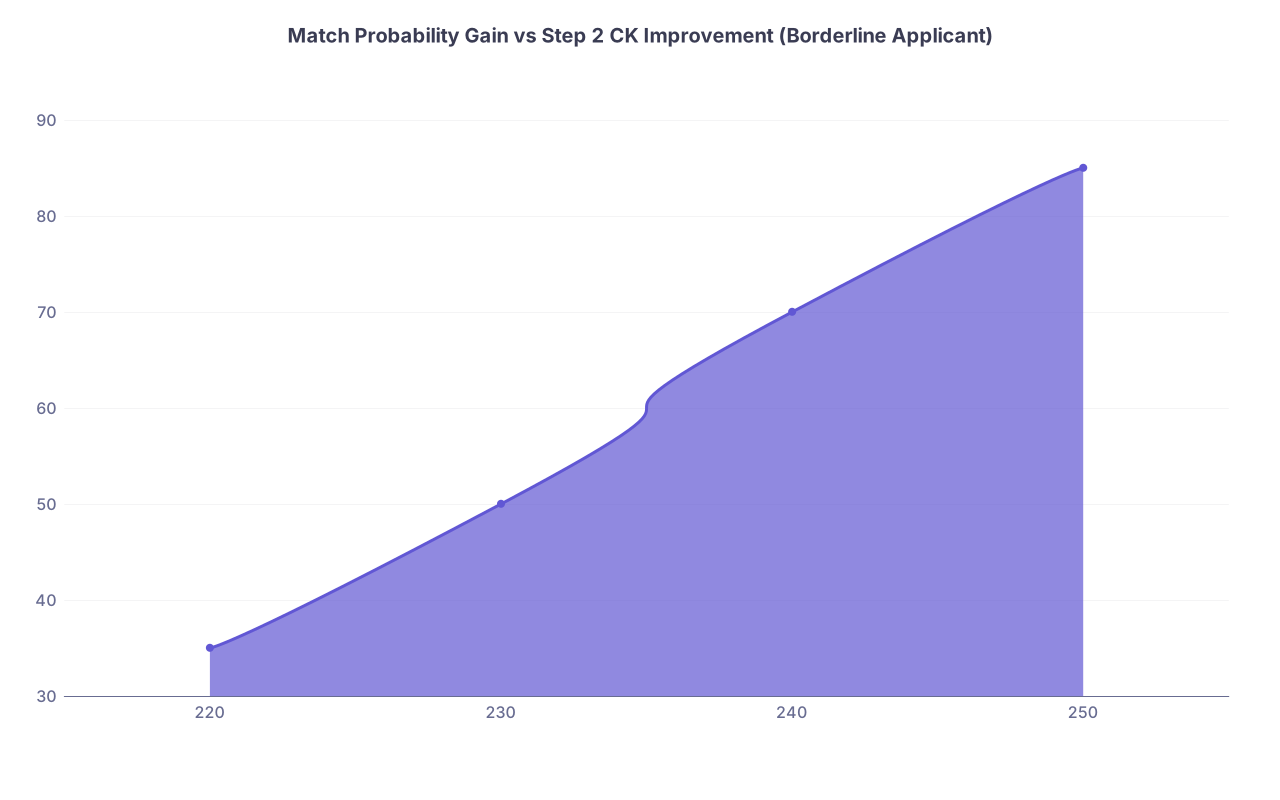
| Category | Value |
|---|---|
| 220 | 35 |
| 230 | 50 |
| 240 | 70 |
| 250 | 85 |
That chart summarizes the brutal math: going from 220 to 230 might buy you ~15 percentage points of probability. 230 to 240 buys another ~20. 240 to 250? Another ~15. Each 10-point jump in the 220–250 band can be worth double-digit percentage changes in match odds.
Timing, Score Release, and Application Strategy
The Step 2 CK score does not matter in a vacuum. Timing against ERAS deadlines and interview invitations changes how much value you can extract from a good (or bad) score.
Scenario 1: Score in Hand Before ERAS Submission
Best-case scenario from a data perspective. Programs see the full picture at once, and your Step 2 CK can:
- Completely override Step 1 concerns at the screening stage.
- Trigger automatic “interview-worthy” flags in systems that use numeric scoring formulas.
For borderline applicants with a strong Step 2 CK (240+ for primary care, 250+ for competitive fields), applying early with scores already reported dramatically boosts early interview yield.
Scenario 2: Step 2 CK Pending at Time of Submission
Then your trajectory depends heavily on your Step 1 and overall risk profile:
- If your Step 1 is weak or you have a fail, many programs will “hold” or deprioritize your file until the Step 2 score arrives.
- If you signal that Step 2 is upcoming and then underperform, that late-arriving low score can kill borderline interest mid-cycle.
I have seen applicants move from “maybe” to “no” across 20+ programs in a week because a 218 Step 2 CK score posted into systems that were waiting on a turnaround.
Scenario 3: Late Step 2 CK (After Most Interview Invites)
This is usually a mistake for borderline applicants. Programs have already filled most interview slots, and a great score has less probability to be acted upon.
There are exceptions—some PDs will scramble in November/December for unexpectedly strong late data—but as a strategy it is inferior. The data show early, complete files correlate strongly with higher interview counts.

| Stage | Activity | Score |
|---|---|---|
| Early Score | Score before ERAS | 4 |
| Early Score | More auto invites | 4 |
| Mid Cycle | Score October | 3 |
| Mid Cycle | Mixed response | 3 |
| Late Score | Score November or later | 2 |
| Late Score | Limited impact | 2 |
Practical Interpretation: What You Should Do With Your Number
You have your Step 2 CK score. You know your other weaknesses. Now what?
Here is the data-driven decision tree.
If your Step 2 CK is ≥ 245 (primary care target) or within 5 points of specialty mean:
- You just improved your risk profile substantially.
- Apply to a broad but rational list in your target specialty.
- You still need geographic and program tier diversity, but you can justifiably aim for a mix of academic and community programs.
If your Step 2 CK is 235–244 and you are borderline:
- You are in the gray zone.
- You should probably:
- Expand the number of programs.
- Consider back-up specialties or dual-apply if aiming at mid/highly competitive fields.
- Leverage every non-numeric advantage (sub-I performance, strong narrative letters, home program advocacy).
If your Step 2 CK is ≤ 234 as a borderline applicant:
- The numbers are against you in competitive specialties.
- You should:
- Strongly consider pivoting to less competitive fields.
- Apply very broadly (including community and rural programs).
- Correct any other controllable risks (late application, weak personal statement, incomplete letters).
Step 2 CK is not the entire story. But it is the one part of the story that is universally read and compared numerically across applicants.
FAQ (5 Questions)
1. If I failed Step 1 but scored 245 on Step 2 CK, am I still a “borderline” applicant?
You are borderline on paper because a Step 1 fail is a permanent red flag, but a 245 Step 2 CK radically upgrades your profile. Many programs will view this as evidence of recovery and current competence. In primary care and some mid-competitive specialties, that combination can absolutely lead to a successful Match, especially with strong clinical evaluations and letters.
2. How much does a 5-point difference in Step 2 CK actually matter for borderline applicants?
In the 220–245 range, a 5-point difference is not trivial. It can move you across some program filters. A program with a 235 cutoff will not even see a 231, but they will see a 236. Across dozens of programs, that “just 5 points” can mean going from 3 interviews to 7–8 interviews, which is the difference between “maybe match” and “much more likely to match.”
3. Can strong research or a prestigious school compensate for an average Step 2 CK as a borderline applicant?
Rarely, and mostly in research-heavy academic programs that care deeply about publications and pedigree. For the majority of programs, a mediocre Step 2 CK in a borderline file reinforces concerns about in-training and board exam performance. Research helps, but it does not statistically compensate for being below a program’s effective score threshold.
4. Should I delay my application to wait for a potentially higher Step 2 CK score?
If you are genuinely underprepared and projected to score in the low 220s, delaying and scoring 240+ later is often better than applying early with a weak number as a borderline applicant. However, delaying into late fall reduces interview opportunities. The best play is usually to prepare aggressively and test in time to have a competitive score reported by early ERAS review, not to push the exam so late that the score arrives after interview season starts.
5. If I already applied with a low Step 2 CK, is there anything that can still shift my odds?
Yes, but the levers are narrower. You can: increase the number and breadth of programs (especially community/rural), secure very strong rotation evaluations and updated letters that programs may add to your file, and perform exceptionally well on any away or sub-I rotations. Some PDs will reconsider borderline scores if faculty they trust advocate strongly for you. The probability gain will not be as large as raising your Step 2 CK by 15 points, but it is not zero.


