

The one-point difference in Step 2 CK you’re obsessing over is almost never meaningful to residency programs.
Let me be blunt: nobody is sitting in a conference room arguing the merits of the 248 vs the 249. That’s not how this works.
What does matter is where your Step 2 CK score sits in broad bands relative to the specialty, your application context, and any cutoff lines the program uses. I’ll walk you through exactly how programs actually look at Step 2 CK and when a few points can matter—and when they absolutely don’t.
How Programs Actually Use Step 2 CK
Here’s the real structure behind the chaos. Most programs use Step 2 CK in three main ways:
- As a minimum screen (hard or soft cutoff) to manage volume
- As a rough competitiveness marker within a pool
- As a context check against the rest of your application
Notice what’s missing: “precise numerical comparison of applicants who differ by 1–2 points.”
Programs are drowning in applications. They don’t have the time or interest to micro-analyze the difference between 246 and 247.
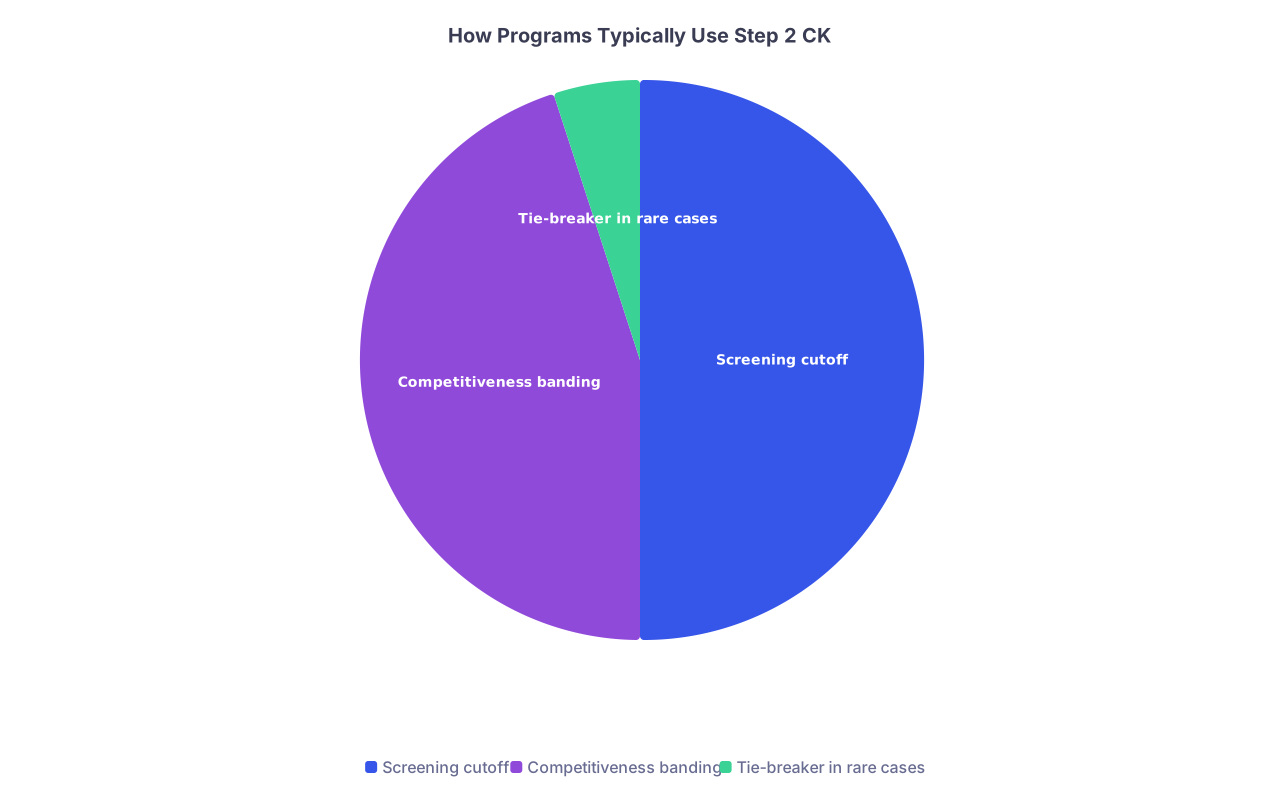
| Category | Value |
|---|---|
| Screening cutoff | 50 |
| Competitiveness banding | 45 |
| Tie-breaker in rare cases | 5 |
Half the time Step 2 CK is just a gatekeeper: Are you above the line? Yes or no. Once you’re above, the granularity rapidly stops mattering.
When a 1-Point Difference Is NOT Meaningful
Let’s start with the scenario 95% of people are in: the one-point difference does not matter at all.
A 1-point difference is borderline meaningless when:
- You’re well above typical cutoffs for your specialty
- You’re not sitting on a known threshold (230, 240, 250, etc.)
- There are bigger forces in play: school, grades, research, LORs, red flags
Programs think in ranges and bands, not single points. Here’s closer to how they see your score:
| Band (example) | How programs often think about it* |
|---|---|
| < 220 | May struggle at many university programs |
| 220–229 | Possibly fine for less competitive / community-heavy |
| 230–239 | Solid for many IM/FM/Peds, marginal for competitive |
| 240–249 | Strong for most, decent for many competitive specialties |
| 250–259 | Very strong, competitive almost everywhere |
| ≥ 260 | Top-tier score, no concern about test-taking ability |
*Not official. Just how people in selection meetings actually talk.
Inside those bands, nobody cares about 1 point. If the program thinks “This applicant has a strong Step 2,” they’re not then downgrading you because another person is “1 point stronger.”
Concrete examples
245 vs 246 for Internal Medicine at a mid-tier university program
Same band. Same impression. Effectively identical.252 vs 253 applying Dermatology
Both are “good but not magical” numbers. The rest of your file drives the decision.236 vs 237 with no red flags, applying Family Medicine
They are not even reading that digit carefully. You’re fine.
If you’re hovering anywhere inside a comfortable range, your “what if I had 2 more points?” anxiety is completely one-sided. The program doesn’t care.
When a Few Points Can Matter
Here’s where things get more nuanced. A 1–3 point difference can matter, but only in very narrow situations.
1. When You’re Right at a Cutoff
Some programs use specific numeric screens. Common behavior:
- Hard ERAS screen at something like 220, 230, or 240
- Or a soft expectation like “we rarely interview < 230”
If a program has a hard screen at 240:
- 239 → auto-filtered
- 240 → makes it through to human review
That’s not “they think 240 is meaningfully more intelligent than 239.” It’s just a bureaucratic line drawn in the sand. If they moved the cutoff to 239, you’d be in. If they moved it to 241, you’d be out.
So yes, at that exact point, 1 point creates a difference in real-world outcome. But it’s due to the cutoff, not interpretation. And you can’t retroactively do anything about it.
2. When You’re Barely in Range for a Hyper-Competitive Specialty
For fields like Derm, Ortho, Plastics, ENT, Ortho, Neurosurgery, Rad Onc, programs pay more attention to score bands.
If their typical interview range is, say, 250–260, then:
- 242 vs 243 → both probably below their usual sweet spot, equally non-competitive
- 249 vs 252 → you’re moving from “on the lower edge” toward “within our comfort zone”
Now, is the jump from 248 to 249 meaningful? No.
Is the jump from 243 to 253 meaningful? Yes. That’s a different band.
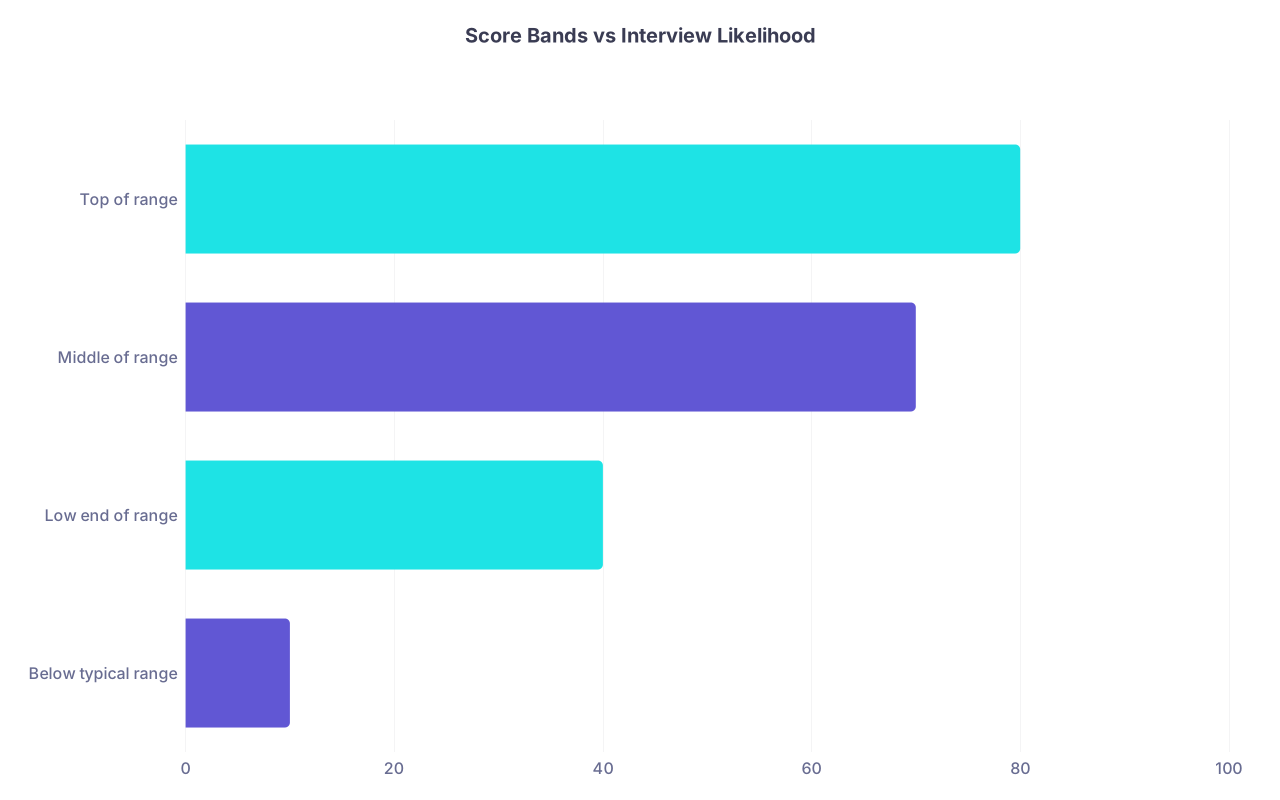
The real importance isn’t 1–2 points. It’s which bucket you’re in:
| Category | Value |
|---|---|
| Below typical range | 10 |
| Low end of range | 40 |
| Middle of range | 70 |
| Top of range | 80 |
The exact numbers here aren’t real data, but the pattern is. Where you sit relative to the pack matters; a single point inside the pack does not.
3. When You Have Major Red Flags
If you have:
- Step 1 failure
- Prior academic probation
- A big professionalism issue
Then Step 2 CK becomes proof of academic recovery. A jump from 218 to 245 means something. It tells a story of rebound.
But again, within that, 244 vs 246 is noise. If someone says, “We need evidence they can pass boards,” they’re talking in broad strokes. Not decimals.
What Program Directors Actually Say in Meetings
I’ve sat in on these conversations. Here’s the flavor of what you actually hear:
- “He’s got a 246 Step 2—fine, move on.”
- “She’s a 260+, no worries about testing.”
- “This one’s under 220, I’m nervous about them keeping up.”
- “Scores are okay, but the narrative evals are concerning.”
- “Great score, but the letters are generic and weak.”
What you don’t hear:
- “We should rank the 248 above the 249 because that one point is meaningful.”
- “Her 243 edges out his 242; she’s a better candidate.”
- “Let’s re-order the list according to the second decimal place of percentiles.”
Directors and faculty are busy. They’re looking for patterns, not precision. They use the score to answer simple questions:
- Are they likely to pass boards?
- Are they above our comfort threshold?
- Are they competitive for our specialty?
- Is there obvious academic risk?
Once those boxes are checked, they move on to your letters, your narrative, your clinical performance, and whether you’d be tolerable to work with at 3 a.m.
Step 2 CK in the Post–Step 1 Score Era
With Step 1 now pass/fail, Step 2 CK took on more weight. That’s true.
But that extra weight doesn’t mean programs suddenly care about 1-point differences. It means:
- More programs are using Step 2 CK for initial screening
- More competitiveness judgments ride on Step 2 CK bands
- There’s more pressure on students to not bomb it
Think of it as shifting the focus, not tightening the ruler. They’re still looking at ranges.

| Step | Description |
|---|---|
| Step 1 | All Applicants |
| Step 2 | Auto screen out |
| Step 3 | Lower priority review |
| Step 4 | Full holistic review |
| Step 5 | Step 2 above minimum? |
| Step 6 | Within typical range for specialty? |
Your score determines which door you go through. But once you’re through the door, scoring 1–2 points above the person next to you doesn’t buy you much.
What You Should Focus On Instead of 1 Point
If you’re mid-application cycle and already have your Step 2 CK score, here’s what actually moves the needle:
- How your score looks relative to your target specialty
- Whether your clinical grades and narrative comments match that story
- The quality and specificity of your letters of recommendation
- A coherent, believable overall narrative: why this specialty, why you, why now
- For borderline scores: evidence of reliability and steady performance elsewhere

If you’re pre-exam and worrying whether 1–2 points matters, you’re stressing about the wrong margin. The big jumps matter:
- 225 vs 240
- 232 vs 252
- 245 vs 260
Those gaps change how programs categorize you. The single-point nibbling inside those ranges is statistical noise.
A Simple Framework: Does My Step 2 CK Score “Work” For Me?
Forget about 1-point differences. Ask three questions:
Am I above likely cutoffs for my target specialty and type of programs?
If yes, good. You’re in the realm of possibility.Does my score strengthen or weaken my story?
- Future academic or hospitalist, IM, score 240+ → coherent with “strong medicine student”
- Aspiring neurosurgeon with 225 → now you need something else truly exceptional
It’s not about perfection. It’s about alignment.
If my score is borderline, do I have clear compensating strengths?
Strong research, glowing letters, upward trend, unique background. Those matter more than 3 extra points ever will.

When You Might Consider Re-Exam (Rare Case)
Some people ask: “Should I delay applying and try to improve my Step 2 by a few points?”
Usually no. But here’s the rare case:
- You scored well below the typical range for your dream specialty
- You haven’t applied yet
- A retake would be expected to yield a major jump (think 20+ points)
- You’re realistically okay with altering your timeline or back-up plan
If you’re at 241 and hoping to get to 245, that’s not a good enough reason to blow up your timing. Programs aren’t slicing that thin.
Quick Reality Check: How Much Does Step 2 CK Actually Matter?
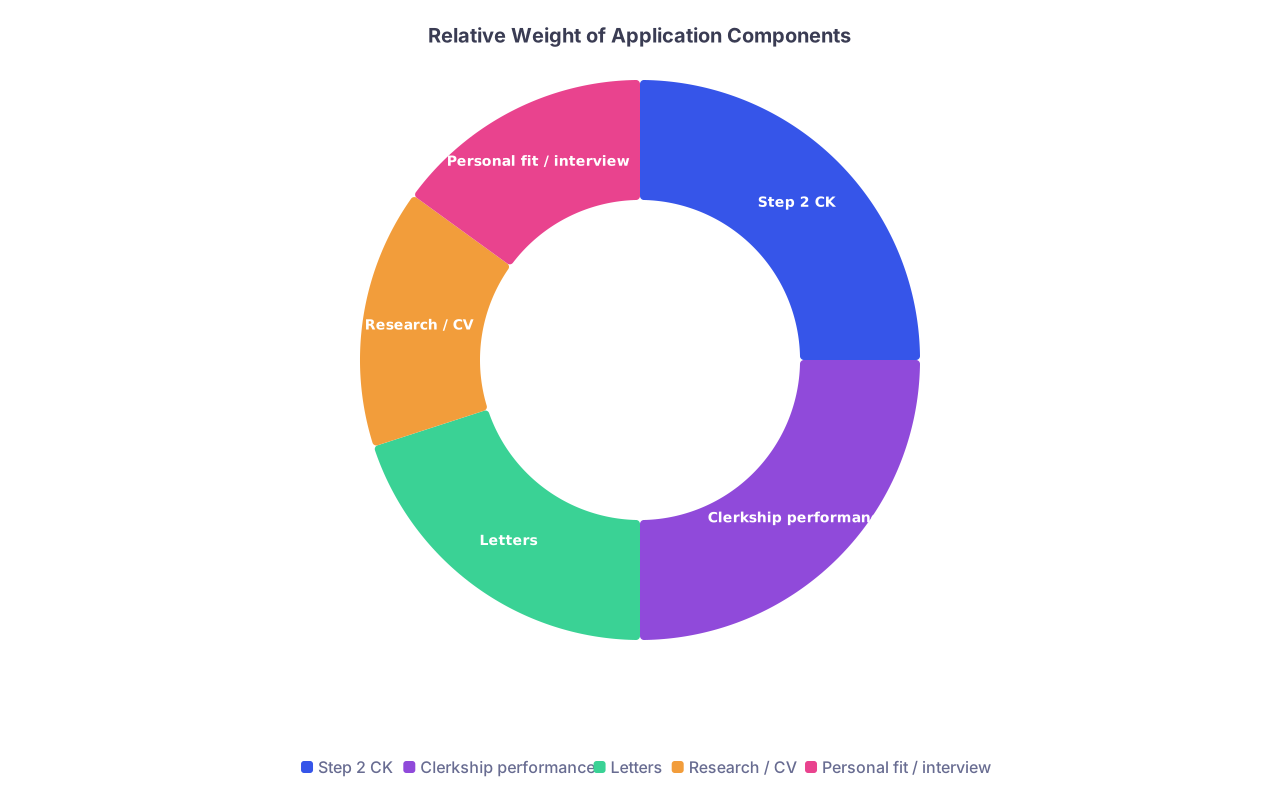
Think of Step 2 CK as one pillar among several. Strong, but not the whole building.
| Category | Value |
|---|---|
| Step 2 CK | 25 |
| Clerkship performance | 25 |
| Letters | 20 |
| Research / CV | 15 |
| Personal fit / interview | 15 |
Again, not hard numbers, but directionally right for many programs:
- Step 2 CK: Opens doors or closes them, rarely decides by itself
- Clerkships + letters: Show how you are on the wards
- Interview: Decides if people can imagine you on their team
If Step 2 CK opened the door and doesn’t actively scare anyone, you’re past the “does 1 point matter?” phase. Now they’re deciding whether they like you, trust you, and believe you’ll function at 2 a.m. on a terrible call night.

FAQ: Step 2 CK One-Point Difference
1. Will a 1-point difference in Step 2 CK affect my chance of getting interviews?
Almost never. Programs use score ranges and cutoffs, not hyper-precise comparisons. A 241 and 242 are functionally identical to programs unless one of them falls just above or below an arbitrary cutoff (e.g., 240). Once you’re above that line, 1 point doesn’t move the needle.
2. Do competitive specialties care about 1–2 point differences more?
They care more about bands, not single points. Derm, Ortho, ENT, etc. will notice the difference between 235 and 255. They won’t care about 249 vs 251 in any meaningful way. Being broadly in the “competitive band” for that specialty matters far more than tiny gaps within that band.
3. Could a 1-point difference keep me from matching at a top program?
Almost certainly not. Top programs reject plenty of people with stellar scores because of fit, letters, research focus, or interview performance. At that level, many applicants share similar high scores. They’re not ranking you by the last digit—they’re ranking you by the whole package.
4. Do programs ever literally sort applicants by Step 2 CK score?
Some use Step 2 CK as a sorting field for initial spreadsheet views, but that just means “rough ordering,” not “final decision.” Most selection meetings are driven by: “Who do we like? Who fits our program?” The number may get you into the room; after that, it’s about everything else.
5. If I’m slightly below a specialty’s average Step 2 CK, am I out?
Not automatically. A slightly below-average score can be offset by strong clerkship grades, standout letters, solid research, or a unique background. A 5–10 point deficit can be overcome; a 30–40 point deficit is much harder. Again, the magnitude matters, not 1–2 points.
6. I’m stuck comparing my 24X to friends with 25X. Should I be worried?
Stop. You’re comparing noise. Programs don’t line up your group chat and rank you by score. If you’re all within the same general band for your specialty, the differences that will matter are: who has stronger letters, more consistent clinical performance, and a clearer story. Put your energy there, not on the single digit.
Bottom line:
- A 1-point difference in Step 2 CK is almost never meaningful to programs except at hard cutoffs.
- Programs care about score bands, not micro-differences—your overall range and fit with the specialty matter far more.
- Once your score gets you through the door, your clinical performance, letters, and interview are what actually decide your fate.


