
The worst Step 2 CK mistake is not a low score. It is taking the exam at the wrong time and neutralizing a strong score’s impact on your Match.
If you want Step 2 CK to actually move the needle for residency, you need a calendar, not vibes. Dates, not guesses. From MS3 spring through MS4 fall, every month you delay or rush this exam changes how programs view you.
Below is the timeline I use when I advise students. Month-by-month, then week-by-week as you approach test day. Read it as: “At this point, you should be doing X, or you are already behind.”
Big-Picture: When Step 2 CK Actually Matters for Match
Before we zoom into the calendar, you need the constraints.
Programs mainly care about Step 2 CK at three specific points:
| Phase | Rough Timing | Step 2 CK Impact Level |
|---|---|---|
| ERAS Application Review | Sep–Oct (MS4) | Maximum |
| Interview Offers | Oct–Dec (MS4) | High |
| Rank List Decisions | Jan–Feb (MS4) | Moderate |
To maximize impact:
- Your Step 2 CK score must be in ERAS by early September to fully help your application.
- If Step 1 was weak or Pass only, Step 2 CK becomes your main standardized metric.
- Taking Step 2 CK after October is strategically weak unless you are repairing damage.
So the “ideal” timing for most students:
- Test window: Late June through early August after MS3
- Score release: By early–mid August
- Goal: Score posted in ERAS before programs start initial screens
Everything below works backward and forward from that target.
MS3 Spring (February–May): Set Up the Win, Do Not Drift
At this point you should stop pretending Step 2 CK is “future you’s problem.”
You are in late MS3. You still have clerkships, shelf exams, maybe Step 1 wounds. You do not have time to do everything. So you have to pick the right things.
February–March (MS3 Spring Start)
At this point you should:
Decide your target Step 2 CK window
- Aim for:
- Late June if:
- Step 1 was mediocre and you need redemption.
- You want to apply to competitive specialties (Derm, Ortho, ENT, Plastics, Rad Onc).
- July if:
- Step 1 was solid and you want a more comfortable prep window.
- Early August (latest) if:
- You absolutely cannot find earlier time due to rotations or life.
- Late June if:
- Anything later than mid-August: stop pretending it is “ideal” for Match impact. It is a repair strategy.
- Aim for:
Audit your MS3 schedule
- Identify:
- Last core rotation end date
- Light vs brutal services (easy vs call-heavy)
- Vacation weeks
- Your goal: carve out a 4–6 week dedicated period or a 6–8 week semi-dedicated period.
- Identify:
Pick your resources and commit
- Do this now, not two weeks before studying:
- Question bank: UWorld Step 2 CK (non-negotiable).
- Question-style companion: Amboss or USMLE-Rx if you burn through UWorld early.
- An outline resource: Online MedEd, Emma Holliday videos, or Boards & Beyond for weaker topics.
- Anki deck if you already use it; do not start fresh massive decks this late.
- Do this now, not two weeks before studying:
Start low-intensity “background” prep
- During clerkships, at this point you should:
- Use UWorld by rotation (IM questions during IM, Peds during Peds).
- Tag hard questions for later Step 2-specific review.
- Build a running “weak topics” list: acid–base, OB triage, peds milestones, rashes, psych meds, etc.
- During clerkships, at this point you should:
This is setup phase. You are not cramming yet. You are building the tracks your future intense studying will run on.
MS3 Late Spring (April–May): Lock the Exam Date and Structure
This is where most students mess up: they “plan” to take Step 2 CK in July but do not actually book a date. Then suddenly it is July 18, and they are still “thinking about it.”
April: Commit on the Calendar
At this point you should:
-
- Pick a date in late June, July, or very early August.
- Book it with Prometric. Not “I’ll see what’s available later.”
- Choose:
- A non-call heavy week before.
- A location you can reach easily, ideally where you took Step 1 (less stress).
Backwards plan from test day
If your test date is July 15, for example, then:
- Dedicated starts: Around June 10–15 (4–5 weeks)
- Core rotations completed by: Early June
- Heavy specialty rotations you want to shine on: Preferably before April/May, not overlapping with dedicated
- Coordinate with your school
- Some schools:
- Require Step 2 CK by a certain date (often December).
- Offer a built-in dedicated period.
- Make sure:
- Your planned exam does not collide with sub-I or away rotations.
- You know your school’s internal transcript/Dean’s letter deadlines, which can reference Step 2.
- Some schools:
May: Transition From Shelf Mode to Step 2 CK Mode
At this point you should:
Use last clerkships strategically
- If you still have IM, Surgery, or Peds late:
- Treat these as Step 2 bootcamps.
- Shelf studying = Step 2 studying, using UWorld and NBME-style thinking.
- Start mixing in:
- Multisystem questions.
- Ethics, biostats, and epidemiology questions (reliably testable and often neglected).
- If you still have IM, Surgery, or Peds late:
Schedule your first baseline NBME
- Near the end of May, pencil in:
- NBME or UWSA to see where you stand.
- This is not to feel good. This is to decide:
- Do you need 4, 6, or 8 weeks real prep?
- Is your current test date realistic or suicidal?
- Near the end of May, pencil in:
Clean up admin tasks early
- Do not wait until dedicated to:
- Start your personal statement.
- Build your program list.
- Ask for letters.
- Every email or meeting during dedicated is a leak in your focus.
- Do not wait until dedicated to:
Dedicated Prep: 4–6 Weeks Before Step 2 CK
Assume you are aiming for late June to late July test date. Let us walk it week by week.
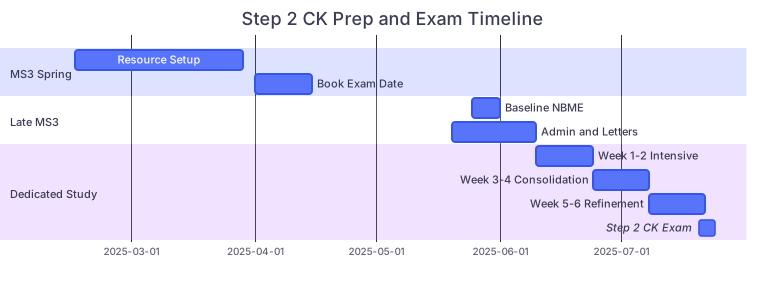
| Task | Details |
|---|---|
| MS3 Spring: Resource Setup | a1, 2025-02-15, 6w |
| MS3 Spring: Book Exam Date | a2, 2025-04-01, 2w |
| Late MS3: Baseline NBME | a3, 2025-05-25, 7d |
| Late MS3: Admin and Letters | a4, 2025-05-20, 3w |
| Dedicated Study: Week 1-2 Intensive | a5, 2025-06-10, 2w |
| Dedicated Study: Week 3-4 Consolidation | a6, 2025-06-24, 2w |
| Dedicated Study: Week 5-6 Refinement | a7, 2025-07-08, 2w |
| Dedicated Study: Step 2 CK Exam | milestone, a8, 2025-07-22, 1d |
Dedicated: Week 1–2 – Volume and Exposure
At this point you should be:
- Doing:
- 60–80 UWorld questions per day, timed, random or by systems early on.
- Reviewing every explanation in detail.
- Watching:
- Targeted videos on weak systems (OB triage, cardiology, nephrology, heme-onc).
- Hitting:
- 1–2 small blocks of biostats/ethics each week.
Rough daily structure:
- 40 Qs morning → full review
- 40 Qs afternoon → full review
- 1–2 hours evening: notes, flashcards, quick reference.
End of Week 2:
- Take your first UWSA or NBME during dedicated to recalibrate.
Dedicated: Week 3–4 – Precision and Pacing
At this point you should:
Increase focus on weaknesses
- Use performance analytics:
- If OB/GYN is 40% correct, that gets priority.
- Build or refine a “high-yield error log”:
- Not paragraphs.
- Just: condition, key findings, trap answer.
- Use performance analytics:
Simulate test conditions
- By the end of Week 4:
- Take a full-length simulation:
- 7–8 blocks, timed.
- Real breaks, real food, no phone mid-blocks.
- Take a full-length simulation:
- By the end of Week 4:
Trim distractions
- Social commitments: almost zero.
- Administrative tasks: done before dedicated, or defer unless absolutely critical.
End of Week 4:
- Scores from UWSA/NBME should be:
- At or above your target specialty’s typical range, or:
- Improving enough that two more weeks will plausibly get you there.
If they are stagnant and far below target, you should seriously reconsider:
- Pushing the exam 1–2 weeks (if still staying within July/early August).
- Or adjusting expectations for specialty/program tier.
Dedicated: Week 5–6 (If You Have Them) – Refinement, Not Panic
At this point you should:
Prioritize breadth over cramming new resources
- Finish UWorld (or close to it).
- Re-do marked questions and weak blocks.
- Re-watch only key, high-yield videos.
Run 1–2 more NBMEs/UWSAs
- Space them:
- One ~10 days before exam.
- One ~4–5 days before exam.
- Use them to:
- Confirm plateau near your target.
- Identify dangerous blind spots.
- Space them:
Practice test-day routine
- Wake time.
- Breakfast and snacks.
- Layering clothing for Prometric’s bipolar thermostat.
The final 3–4 days are not for learning every rare disease. They are for:
- Sleep stabilization.
- Light review.
- Confidence maintenance.
The Exam Itself (Late June–Early August)
At this point you should be:
- Sleeping decently.
- Not starting new content the night before.
- Trusting your question bank and NBME practice.
Day before:
- Half day of light review:
- Quick hits: OB algorithms, emergency management (ACLS, trauma), peds milestones, biostats formulas.
- Print:
- Prometric confirmation.
- ID check.
- Pack:
- Earplugs (if allowed), small snacks, water, jacket.
Exam day:
- Treat it like eight shelf blocks in a row.
- If you are stuck between two answers, lean on:
- Guidelines > pathophysiologic overthinking.
- Safety and stability first: airway, hemodynamics, pregnancy status.
Now the painful part: wait for the score.
Scores typically release in about 2–3 weeks. While you wait, you are rolling into…
MS4 Early Summer (July–August): Scores, ERAS, and Using Step 2 CK
Your score arrives. Here is where timing actually shows its value.
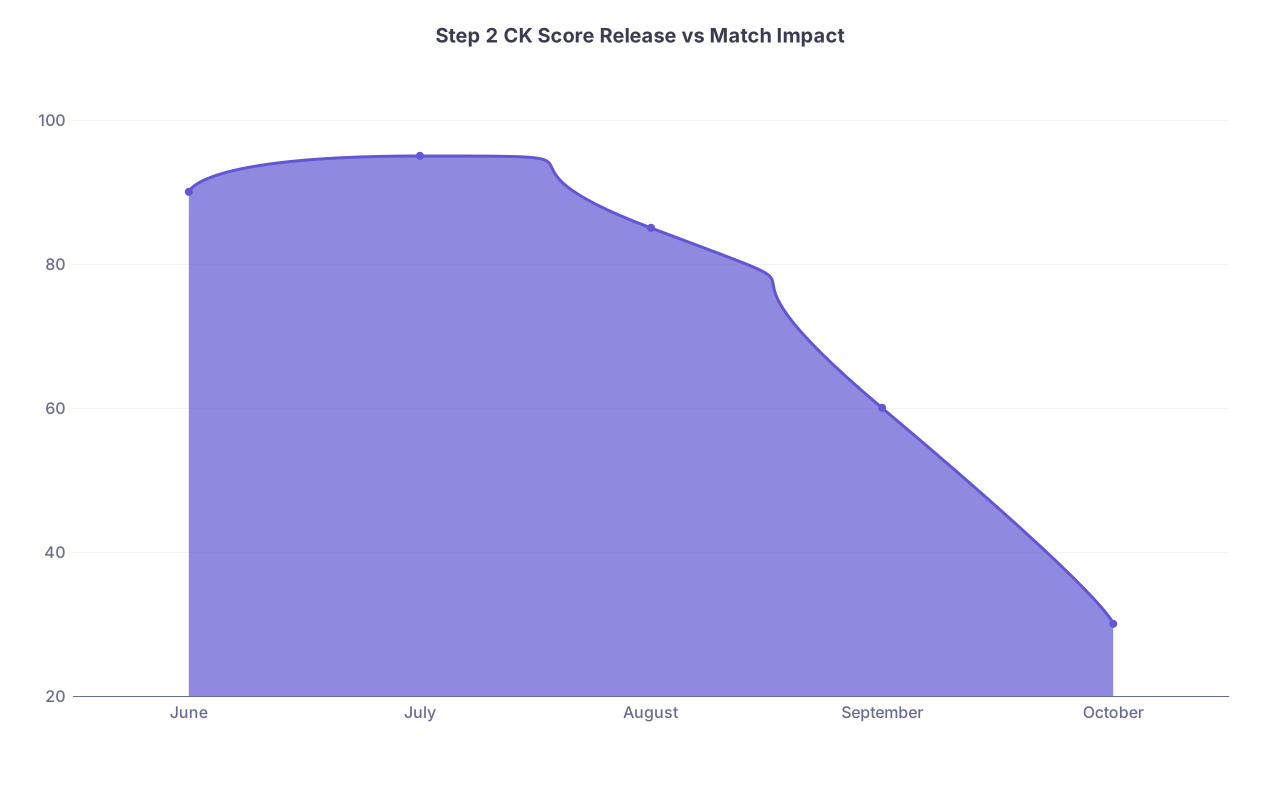
| Category | Value |
|---|---|
| June | 90 |
| July | 95 |
| August | 85 |
| September | 60 |
| October | 30 |
(Values here represent relative impact on application strength, not percentages.)
Scenario 1: Score Released by Early–Mid August
At this point you should:
-
- Your Step 2 CK becomes:
- Front-and-center metric for programs.
- Work with your Dean’s office:
- Ensure your MSPE / Dean’s letter references your performance if relevant.
- Your Step 2 CK becomes:
Tune your program list
- If your score:
- Exceeds specialty norms: you can safely include more reach programs.
- Is borderline: you must balance with more mid-tier and safety programs.
- Also factor:
- Step 1 performance.
- Clerkship honors vs passes.
- If your score:
Align personal statement and narrative
- Strong Step 2 CK:
- Reinforces consistency and clinical strength.
- Jump from weak Step 1 to strong Step 2:
- You can briefly frame this as growth, adaptation to clinical reasoning.
- Strong Step 2 CK:
Scenario 2: Score Released Late August or Early September
Still usable, but the window is narrower.
At this point you should:
- Make sure your score is uploaded before programs start mass screening (~mid-September).
- Understand:
- Some programs will pre-screen before your score posts.
- But many will refresh and update your file as scores trickle in.
- Action items:
- Email programs only if:
- Score is a dramatic positive change.
- You are very interested and they review holistically.
- Email programs only if:
MS4 Fall (September–November): When Late Step 2 CK Hurts or Helps
If you took Step 2 CK after August, you have deliberately chosen a lower-impact path. Sometimes that is necessary. But do not lie to yourself about the trade-offs.
If You Took Step 2 CK in September
At this point you should:
Understand screening reality
- Many programs:
- Start interview offers late September to October.
- May not wait for late scores if initial metrics are weak.
- If Step 1 was poor:
- Your file may be auto-filtered before Step 2 arrives.
- Many programs:
Use score tactically if strong
- Once published:
- Update ERAS.
- You may send targeted, concise interest emails:
- Include: specialty fit, geographic ties, and that new Step 2 CK score.
- Once published:
Be realistic about impact
- A strong September Step 2 CK:
- Might rescue some interview opportunities.
- Will still meaningfully influence rank lists for programs that already invited you.
- But it is not as powerful as an August score.
- A strong September Step 2 CK:
If You Take Step 2 CK October or Later
This is damage-control territory.
At this point you should:
- Recognize:
- For most programs, Step 2 CK will:
- Have minimal influence on interview invitations this cycle.
- Still matter for rank decisions if uploaded by January, but limited.
- For most programs, Step 2 CK will:
- Why this timing:
- Maybe you:
- Needed more time to remediate cores.
- Bombed NBME practice and had to rebuild.
- Maybe you:
- Strategy:
- Focus on:
- Strong rotations (sub-Is), letters, and interviews.
- Use Step 2 CK mainly to:
- Avoid failing.
- Clear graduation requirements.
- Possibly support SOAP or a later application cycle.
- Focus on:
Special Cases: When You Should Shift Earlier or Later
You Had a Weak Step 1
If Step 1 was low or borderline:
At this point (MS3 spring) you should:
- Prioritize earlier Step 2 CK (late June / early July).
- Aim for:
- A score noticeably above your Step 1 percentile.
- Why:
- Programs will watch for “trajectory.”
- A jump makes them re-evaluate you positively.
You Are Targeting a Hyper-Competitive Specialty
Derm, Ortho, ENT, Plastics, Neurosurgery, some Radiology programs.
At this point you should:
- Treat June–early July Step 2 as highly advantageous.
- Reason:
- These programs often:
- Screen aggressively on scores.
- Initiate interview invites early.
- These programs often:
- You want:
- A high Step 2 already sitting in ERAS by September 15.
You Need Extra Time Due to Life / Health
Then the “ideal” Match-timing window may not be your primary goal. Sanity and safety win.
At this point you should:
- Talk to:
- Your Dean.
- A trusted mentor in your desired specialty.
- Design:
- A modified plan:
- Maybe a September exam.
- Maybe a gap year with a later exam and research.
- A modified plan:
- Do not:
- Hide from the reality of how later timing affects interviews. Adjust your specialty or cycle if needed.
One-Week Countdown: Day-by-Day Priorities
Assume your exam is on a Tuesday.
At this point you should:
T-7 days (Tuesday):
- Last NBME/UWSA.
- Identify 3–4 final weak categories.
T-6 to T-4 (Wed–Fri):
- 40–60 mixed UWorld Qs/day.
- Review key algorithms: chest pain, SOB, pregnancy bleeding, trauma, sepsis.
- Quick pass through biostats/ethics.
T-3 (Saturday):
- Light questions, mostly review.
- Finalize test-day logistics: route, parking, food, ID.
T-2 (Sunday):
- No full blocks.
- Skim notes and key images (rashes, murmurs, imaging patterns).
- Early bedtime.
T-1 (Monday):
- Minimal work:
- 10–20 easy questions or flashcards just to stay warm.
- Physical prep over mental haze:
- Walk, hydrate, eat a normal dinner.
- Sleep window aligned with wake time for exam.
- Minimal work:
T-0 (Tuesday – Exam Day):
- Wake early.
- Light breakfast.
- No last-minute frenzied reading in the parking lot.
The Core Takeaways
- Step 2 CK only changes your Match story if the score is in ERAS by early September, which makes late June through July the prime testing window.
- Your dedicated study period, clerkship choices, and ERAS prep must be back-planned from your exact Step 2 date, not improvised a month before.
- Late exams (September or later) can still help, but they shift Step 2 CK from a power move to a partial rescue; treat that as a conscious trade, not an accident.