
It is mid‑January of your M3 year. Your classmates are complaining about night float, your surgery attending just asked when you are taking Step 2 CK, and your dean keeps saying, “Programs will want to see that score early.”
You want your ERAS application ready to submit day 1. You also do not want to tank Step 2 CK by rushing it. This is where timing stops being theoretical and starts being a hard calendar problem.
Here is the timeline, month by month and then week by week, for when to schedule Step 2 CK if you are serious about an early ERAS submit.
Big Picture: What You Are Trying To Achieve
At this point, your goals are threefold:
- Step 2 CK score available by the time programs first review applications.
- Enough dedicated study time to improve or protect your Step 1 story.
- Minimal overlap with brutal rotations, sub‑Is, and away rotations.
Step 2 CK scores usually post about 2–3 weeks after your test date. ERAS “opening day” for submission is typically early September; programs usually download a few days later.
So if you want the score:
- In ERAS on day 1 filtering: you should be testing no later than mid‑August (too late, in my opinion, if you care about early read).
- Visible when most programs do their serious first pass: you want it in by late September. That pushes your test date to no later than early September.
- Best‑practice for someone prioritizing early submit: target a test date between mid‑June and late July of M3–M4 summer.
Let’s turn that into an actual timeline.
M3 Year: January–March — Set the Strategy, Not the Date
At this point you should not be booking Prometric yet. You should be setting the constraints.
January–February (18–20 months before residency start)
Your tasks:
- Confirm your graduation and ERAS cycle with your school.
- Look up the projected ERAS opening and program download dates for your match year.
- Talk to your dean’s office (or recent grads) about:
- When most students at your school take Step 2 CK.
- How much dedicated time people actually get vs what the handbook claims.
You should also classify yourself:
- Category A – Strong Step 1 (Pass early, historically strong exams, aiming competitive specialty like derm, ortho, ENT).
- Category B – Middle of the road (Pass, decent clinical grades, mid‑tier or broad specialties).
- Category C – Step 1 “rescuer” (Pass with concern, marginal preclinical, need Step 2 CK to prove yourself).
Why this matters: Category C should avoid very early dates with minimal prep. Category A can be more aggressive and earlier. Category B sits in the middle.
M3 Spring: April–May — Lock the Target Month
By April, you have a decent sense of your core rotation schedule into early M4.
At this point you should:
Pull up your M3 and early M4 calendar:
- Note which months are:
- Light (easier electives, outpatient, psych, FM).
- Medium (IM wards, OB, peds wards).
- Heavy (surgery, ICU, night float, sub‑Is).
- Note which months are:
Decide on your ideal Step 2 window:
- If you want maximum study time + early score:
- Aim for late June or July test date, with 2–3 weeks “soft” dedicated.
- If you had a rough Step 1 and need more runway:
- Consider late July to early August, but understand that is flirting with later score availability.
- If you want maximum study time + early score:
Check Prometric centers near you for availability patterns.
- Busy cities and competitive med schools fill up quickly in June/July.
- If you see June almost gone by May, that is your warning to move.
Do not book yet if your core schedule is still in flux. But you should be narrowing down to a 4‑week testing window.
The Critical Table: Test Month vs Score Availability
Here is the rough relationship between test date and when your score will likely hit ERAS, assuming the usual 2–3 week score release.
| Test Date Range | Approx Score Release | ERAS Impact |
|---|---|---|
| Early June | Late June / Early July | Safely in system before September; excellent for early filters |
| Late June | Mid July | Very safe for early ERAS; strong choice |
| Early July | Late July / Early August | Still ideal for early submission; widely visible |
| Late July | Mid August | Usually visible by ERAS open, but tighter margin |
| Early August | Late August | Risky for day‑1 visibility; may miss early filters |
| Late August | Mid September | Score often arrives after many initial screens |
If you actually care about “early ERAS submit” as a strategic advantage, your zoned‑in target should be:
Test date between June 15 and July 31.
Late M3: June–July — Book the Actual Date
By now, you know which rotations you have in May–August.
At this point you should:
1. Identify your “soft dedicated” period
You are looking for:
- 10–21 days with:
- No overnight call.
- Predictable hours (outpatient, consults, easy elective).
- A reasonable attending who does not lose their mind if you leave at 4:00 pm.
Do not kid yourself. A surgery sub‑I is not “soft dedicated.” Peds wards with q4 call is not “soft dedicated.”
2. Decide your exact testing week
Use this rule:
If you are:
- Generally strong test‑taker
- Passed Step 1 comfortably
- Have been doing UWorld all year
→ You can test toward the earlier side (late June / early July) with about 2 weeks of focused prep.
If you are:
- Anxious about Step 1 performance
- Slower on questions
- Have inconsistent shelf scores
→ You want more like 3–4 weeks of blended prep and a late July test.
Now you book.
Book 6–8 weeks in advance of your desired date to have any real choice of center, date, and time. Earlier if you are in a high‑density area (NYC, Chicago, SoCal).
A Concrete Month‑By‑Month Example
Let us walk through a common scenario: You are M3, aiming for IM or EM, Step 1 pass, decent but not stellar shelves, want early ERAS.
January–March (M3)
- You are on IM then OB.
- At this point you should:
- Start a running UWorld Step 2 CK block habit — 10–20 questions/day.
- Track performance by system so you know your weak spots.
- Ask your upper‑class friends when they took Step 2 and how it impacted them.
April (M3)
- You are on psych (lighter month).
- You should:
- Identify summer schedule:
- May: Surgery (heavy)
- June: Peds shelf, then 1 week elective
- July: FM outpatient (medium‑light)
- Decide: “I am going to test mid‑July.”
- Identify summer schedule:
May (M3)
- Brutal surgery month. Shelf looming.
- At this point:
- Keep Step 2 prep simmering: 10–15 mixed questions several days a week. Not perfect, but not zero.
- Do not schedule Step 2 during or right after this month.
June (End of M3)
You have peds then a free week.
This becomes your ramp‑up period:
- Begin NBME or UWSA practice around mid‑June.
- After the peds shelf, take 1–2 days off to reset.
- Then hit 40–80 questions/day plus targeted review.
You book Step 2 CK for July 18.
July (Early M4)
FM outpatient.
At this point you should:
- Use evenings and weekends heavily for:
- Remaining UWorld blocks
- 1–2 more full‑length practice exams
- Targeted review of worst systems (OB, peds, heme‑onc, renal).
- Use evenings and weekends heavily for:
Test July 18.
Score posts about July 31 or August 7.
By mid‑August, you have your score in hand. When ERAS opens in early September, the score is already sitting there, ready to be pulled into every filter.
Week‑By‑Week: 4‑Week Countdown to Step 2 CK
Assume you picked a mid‑July test. Here is how your final month should look.
Week −4 (28–21 days before exam)
At this point you should:
- Finish any remaining “first pass” through your question bank.
- Start mixed‑discipline blocks (not just one shelf at a time).
- Schedule your practice tests:
- One practice exam end of week −3.
- One practice exam end of week −2.
- Optional NBME/UWSA in week −1 if mentally sane.
Focus: Identify weak systems and patterns (misreading, rushing, stats, ethics).
Week −3
Now you:
- Do 60–80 questions/day on days off or light clinic days.
- Review explanations carefully, especially wrongs and lucky guesses.
- Summarize recurring misses in a short “stupid mistakes” list.
End of week −3:
- Take a full‑length practice (NBME or UWSA) on a realistic schedule.
- If your score is wildly below target, consider whether your date is too early. Postpone now, not later.
Week −2
This is your highest‑output study week for most people.
Solidify:
- Rapid review of high‑yield systems (cardio, pulm, renal, neuro).
- Quick passes through OB, peds, psych if they are weak.
End of week −2:
- Another practice exam.
- Accept that your score will not jump 30 points in 10 days. You are refining, not reinventing.
Week −1
At this point you should:
Taper the volume slightly:
- 40–60 questions/day.
- More emphasis on review and consolidating notes.
Two to three days before:
- Do shorter blocks (20–40 questions).
- Focus on sleep schedule, nutrition, logistics.
Day before:
- Light review only.
- No full blocks, no new content marathons.
This timeline assumes you built a base all year by doing questions during rotations. If you saved everything for the last 10 days, you boxed yourself in.
How Specialty Choice Shifts Your Timeline
Some specialties “forgive” later Step 2 CK scores. Others do not. Here is the quick breakdown.
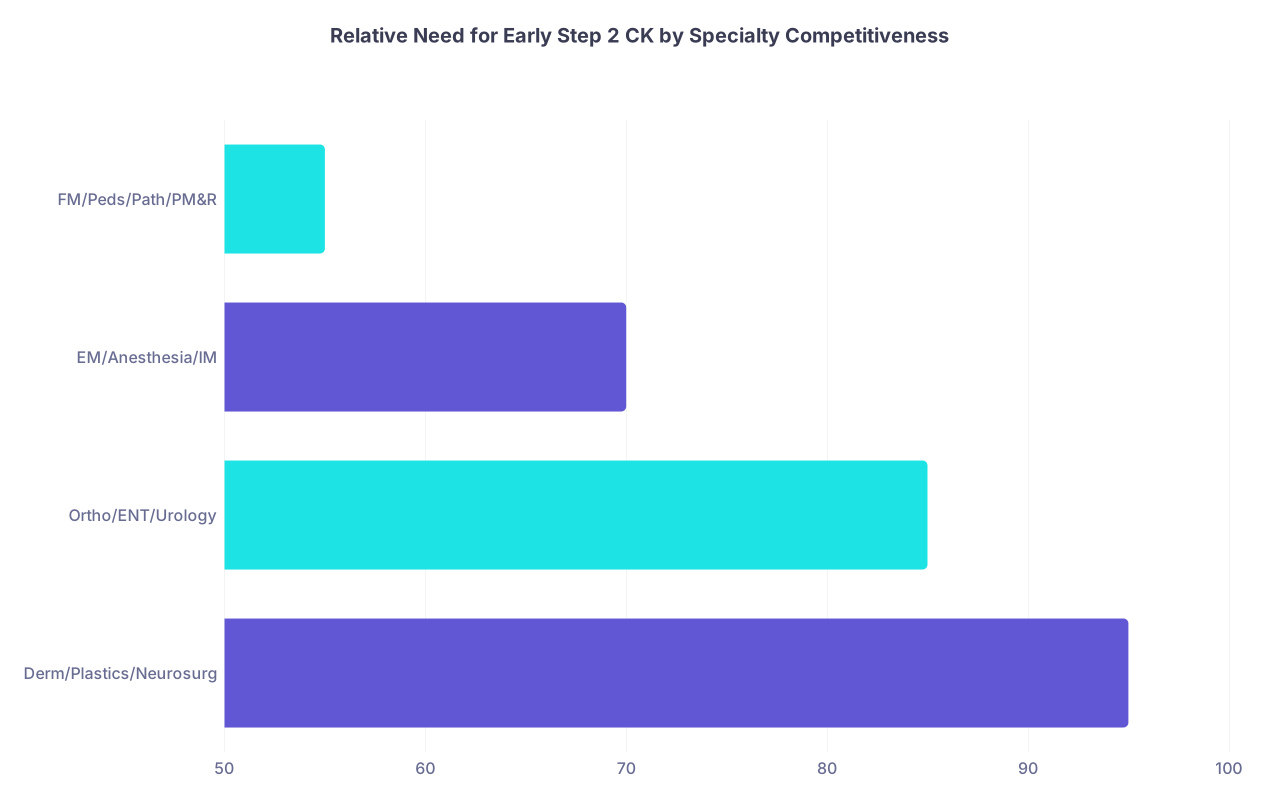
| Category | Value |
|---|---|
| Derm/Plastics/Neurosurg | 95 |
| Ortho/ENT/Urology | 85 |
| EM/Anesthesia/IM | 70 |
| FM/Peds/Path/PM&R | 55 |
Highly competitive (Derm, Plastics, Ortho, ENT, Neurosurg)
- Programs often pre‑screen heavily.
- Early score helps a lot, especially if:
- Step 1 was just “Pass” with no signal.
- You are from a newer or less‑known school.
You should strongly favor a June or early July exam date. You want that number in as early as possible.
Moderately competitive (EM, Anesthesia, IM at strong programs, OB/GYN)
- Early score is helpful but you can get away with late July.
- EM in particular likes to see the score during interview decisions at many programs.
Less competitive or broader fields (FM, Peds, Path, PM&R, Psych)
- You have more flexibility.
- Late July or even early August can still work fine, though I still prefer July if you want maximum options.
When You Should Consider Delaying Step 2 CK
There are a few scenarios where the “early ERAS” obsession becomes counterproductive.
You should delay (even if it means later score availability) if:
- Your practice exams 2–3 weeks out are consistently below pass level.
- You have major life events/health crises in the 2 weeks before your date.
- You need Step 2 CK to rescue a weak Step 1 and your practice scores suggest you could raise by 15–20+ points with 3–4 more weeks of focused work.
An early ERAS submit with a mediocre or failing Step 2 CK does not help you. Programs see the score. They rarely care that it posted on August 1 instead of September 10.
Visual: Step 2 CK Prep and ERAS on a Gantt‑Style Timeline
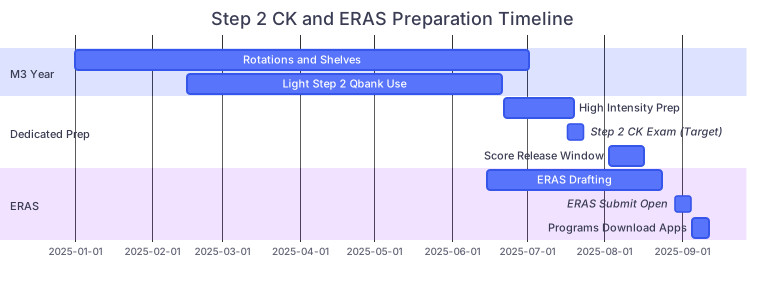
| Task | Details |
|---|---|
| M3 Year: Rotations and Shelves | a1, 2025-01-01, 26w |
| M3 Year: Light Step 2 Qbank Use | a2, 2025-02-15, 18w |
| Dedicated Prep: High Intensity Prep | b1, 2025-06-22, 4w |
| Dedicated Prep: Step 2 CK Exam (Target) | milestone, b2, 2025-07-20, 1d |
| Dedicated Prep: Score Release Window | b3, 2025-08-03, 2w |
| ERAS: ERAS Drafting | c1, 2025-06-15, 10w |
| ERAS: ERAS Submit Open | milestone, c2, 2025-09-01, 1d |
| ERAS: Programs Download Apps | c3, 2025-09-05, 1w |
Coordinating Step 2 CK With Sub‑Is and Away Rotations
Common mistake: scheduling Step 2 CK in the middle of an away rotation. Then trying to study in a call room at 1:30 a.m. while the resident yells about consult notes.
At this point (when selecting sub‑Is and aways) you should:
- Front‑load:
- Do Step 2 CK before your most important sub‑I or away if possible. That way you are not divided.
- Or, if impossible:
- Put Step 2 CK between two heavy months, not inside them.
Bad pattern I have seen:
- July: Away EM
- August: Away EM #2
- Step 2 CK jammed into August 5.
- Result: thin prep, tired brain, okay but not great score.
Better pattern:
- June: Finish M3
- Early July: Step 2 CK
- Late July/August: Aways
- Result: solid score and full focus on performance, SLOEs, and networking during aways.
How Early to Start ERAS Work Around Step 2 CK
If you want an early ERAS submit, you cannot wait until your Step 2 CK score posts to start writing.
At this point (the same June–July window) you should:
- Draft your personal statement in June, polish in July.
- Build and update your CV and activity descriptions as you go.
- Ask for letters of recommendation before or during your Step 2 prep, not after.
The ideal sequence:
- Early June: Personal statement v1, CV skeleton.
- Late June: Ask for letters.
- Mid‑July: Step 2 CK.
- Early August: Incorporate your score into your strategy (reach vs safety programs).
- Late August: Final polish and submit ERAS within a few days of opening.
Inline Snapshot: Time Allocation in Final 4 Weeks
One more quick visual to reality‑check your last month.
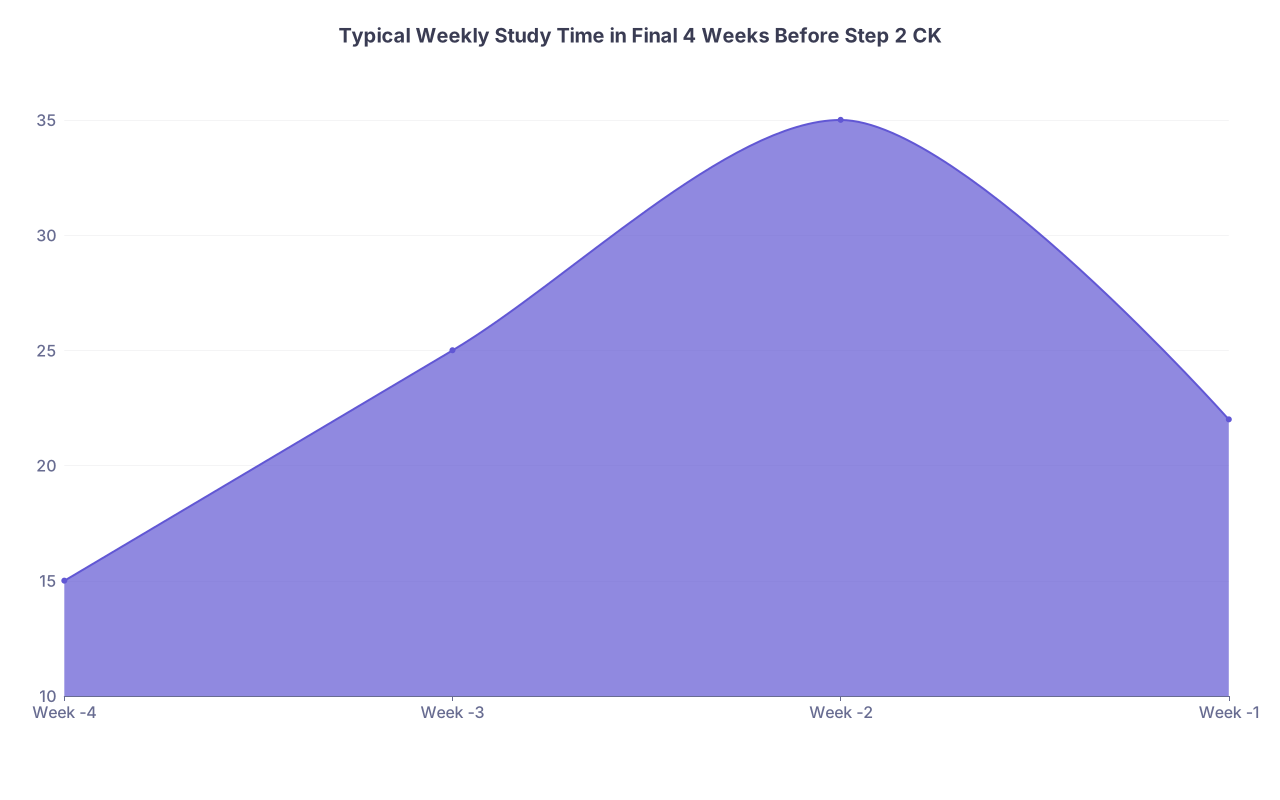
| Category | Value |
|---|---|
| Week -4 | 15 |
| Week -3 | 25 |
| Week -2 | 35 |
| Week -1 | 22 |
If your reality is “6 hours a week” because you are on trauma call every third night, your early date is fake. You either move the exam or accept a weaker performance.
FAQ (Exactly 4 Questions)
1. Is it better to take Step 2 CK as early as possible, even with less prep, just to have it in ERAS?
No. An “early but mediocre” score hurts more than a “slightly later but strong” score helps. For most applicants, a test date in late June to late July balances early availability with adequate preparation. Only sacrifice significant prep time if your practice scores are already at or above your realistic target.
2. If my Step 1 was weak, should I delay Step 2 CK until after ERAS so I can at least submit without it?
In most cases, no. If programs see only a vague Step 1 “Pass” and no Step 2 CK, they will assume risk. A strong Step 2 CK is your chance to change that narrative. The exception: if your practice exams close to test date suggest you are at real risk of failing; then you should delay, prepare longer, and accept a later ERAS impact rather than adding a fail to your record.
3. How late can I take Step 2 CK and still have it count for interview season?
If you test in early September, your score may appear by late September or early October, which is still within the interview invite window for many programs. But you will absolutely miss some early filters and you might stress about programs holding your file. If you care about “early read,” do not plan on September. Treat August as the true backstop, and July as the preferred zone.
4. Should I prioritize Step 2 CK timing over doing an away rotation or sub‑I at a dream program?
No. You need both. Do not sacrifice a critical away entirely, but do not stack everything in the same 4 weeks either. The best pattern is: Step 2 CK first, then aways/sub‑Is, or separate them by at least a week buffer. If scheduling forces you to choose, protect the away at your dream institution but move Step 2 CK earlier or later so you are not preparing during the away itself.
Key points to leave with:
- If you want an early ERAS submit with Step 2 CK visible, aim for a test date between mid‑June and late July.
- Do not schedule Step 2 CK in the middle of a heavy rotation or away; align it with at least 2–3 weeks of lighter clinical time and a year of consistent question practice.
- A slightly later, higher score is usually better than an early, weak one—early timing helps, but performance still wins.