
The biggest mistake students make six months before ERAS is pretending Step 2 CK is “just another test.” It is not. At this point, it is the one piece of hard data most programs will actually use to decide if you get an interview.
I am going to walk you month by month, then week by week, through the milestones you must hit starting six months before ERAS submission. If you are off by a month or two on any of these, your odds drop fast—especially in competitive specialties.
Big Picture: Your Six‑Month Step 2 CK Timeline
At six months out, you are not “cramming.” You are engineering a score that programs cannot ignore.
Here is the high‑level sequence you are aiming for:
| Time Before ERAS | Primary Focus | Key Milestone |
|---|---|---|
| 6 months | Reality check, planning | Score target, exam month chosen |
| 5 months | Content + early QBank | 25–30% of UWorld done, baseline NBME |
| 4 months | Heavy QBank | 60% of UWorld, +10–15 points on NBME |
| 3 months | Dedicated date locked | Exam date scheduled, rotation aligned |
| 2 months | Exam-ready push | 90–100% UWorld, 2–3 recent NBMEs |
| 1 month | Final polish & buffer | Step 2 CK taken ≥4 weeks before ERAS |
Now let us zoom in and get chronological.
Six Months Before ERAS: Commit To A Strategy, Not A Fantasy
At this point you should stop guessing and quantify exactly what Step 2 CK score you need for your target specialty and programs.
Week 1–2: Reality Check And Score Target
Clarify your target range
- Pull recent Step 2 CK expectations for your specialty. For example:
- Dermatology / Ortho / ENT: aim 255+ if you are gunning for top programs.
- Radiology / Anesthesia / EM: solidly competitive at 245–250+.
- Internal Medicine (university): 240–250+; community: 230+ is usually safe.
- Compare this against your:
- Step 1 (even pass/fail, programs still see “low pass” vs “strong pass” in context).
- Shelf exam performance (what you actually scored, not how you “felt”).
- Pull recent Step 2 CK expectations for your specialty. For example:
Pick an exam month window
- You want your Step 2 CK score reported to ERAS by opening day or very shortly after.
- Translation: exam should be taken at least 4 weeks before ERAS submission (ideally 6–8 weeks).
- For most students submitting ERAS in mid‑September:
- Target Step 2 CK date: mid‑July to early August.
Audit your rotation schedule
- At this point you should:
- Identify which rotations are “light” and which are malignant.
- Find a 4–6 week period where you control your evenings (sub‑I right before Step 2 is how people sink their scores).
- If your heaviest rotation is right before your ideal test window, start talking to your dean / scheduler now. Not later.
- At this point you should:
Week 3–4: Build The Framework
Your goals in this two‑week block:
- Lock your study hours per week (realistic, not fantasy).
- Choose your core resources.
- Sketch out a high‑level calendar for six months.
Core resource stack (do not overcomplicate this):
- QBank: UWorld Step 2 CK, 1 full pass is non‑negotiable. Two passes only if you start very early and move quickly.
- Explanations reference:
- Online MedEd / Boards & Beyond–style videos for weak areas.
- A concise text (Master the Boards, Step Up to Medicine for IM‑heavy parts if needed).
- Assessment tools:
- NBMEs (at least 3, preferably 4).
- UWSAs in the last 4–5 weeks pre‑exam.
At this point you should:
- Decide your weekly QBank question minimum (on rotations, 80–120 mixed questions/week is typical).
- Block recurring study times in your calendar:
- Example: 90 minutes after work Mon–Thu, 4–5 hours Sat/Sun.
Five Months Before ERAS: Start The Engine, Establish Baseline
Now you move from planning to actual data.
Week 1–2: Initial QBank Push + First Assessment
Start UWorld in mixed, timed tutor or timed mode
- Do not cling to subject blocks forever; Step 2 CK is integrated.
- At this point you should aim for:
- 10–15 questions per weekday.
- 20–40 questions per weekend day.
- Focus is not just on “getting through” questions but:
- Reviewing explanations thoroughly.
- Writing very short notes (or tagging) for repeats of your errors.
Baseline self‑assessment
- After ~200–300 QBank questions, take:
- One NBME (or UWorld SA) to see where you actually stand.
- Use this to:
- Confirm if your target specialty is realistic.
- Identify worst two systems (e.g., OB/GYN, psych, renal).
- After ~200–300 QBank questions, take:
Adjust your target if you are delusional
- If your baseline is 210 and you want derm in California, something has to give:
- Either the specialty or the specific programs.
- You have five months, not magic.
- If your baseline is 210 and you want derm in California, something has to give:
Week 3–4: Fix The Leaks While Volume Stays Modest
At this point you should have:
- 20–30% of UWorld completed.
- A list of your bottom‑tier systems and question types.
Your tasks:
- Pick 2 systems to focus on for the next 2 weeks (e.g., OB/GYN + endocrine).
- Add:
- 1–2 targeted video lectures per week on those weak areas.
- A short, daily 20–30 minute “error log review.”
Do not chase perfect Anki decks if you have never used them effectively before. At five months out, you want questions and reflection, not building giant card collections you will never finish.
Four Months Before ERAS: Volume, Consistency, And Rotation Tetris
Four months before ERAS, Step 2 CK prep has to be visible in your schedule, not theoretical.
Week 1–2: Increase Question Volume
At this point you should:
- Be doing at least 20–25 questions per day on weekdays during lighter rotations.
- Hit 40–60 questions per day on weekends.
Milestones for the end of this two‑week block:
- UWorld completion: 40–50%.
- Score trend: QBank percentage in mid‑60s or higher (raw percent, not curve).
Week 3–4: Second NBME + Rotation Negotiations
Second major assessment
- Take another NBME or UWSA after:
- ~50–60% of QBank completed.
- You should see:
- At least a 10–15 point increase from your baseline if you are serious.
- Take another NBME or UWSA after:
Decide Your Exact Exam Date Window
- Look at your schedule for the 3 months ahead.
- Identify:
- The 2–3 weeks where you could do “quasi‑dedicated” (lighter rotation or vacation).
- At this point you should talk to:
- Whoever controls your MS4 schedule about swapping anything malignant away from the 4–6 weeks before your planned exam.
Start ruthless triage of commitments
- Step 2 CK trumps:
- Extra shadowing.
- Random case reports your attending wanted.
- “Maybe I’ll help with that QI project.”
- You can do those after your score is locked.
- Step 2 CK trumps:
Three Months Before ERAS: Lock The Date, Build Dedicated
Three months out is decision time. No more vague.
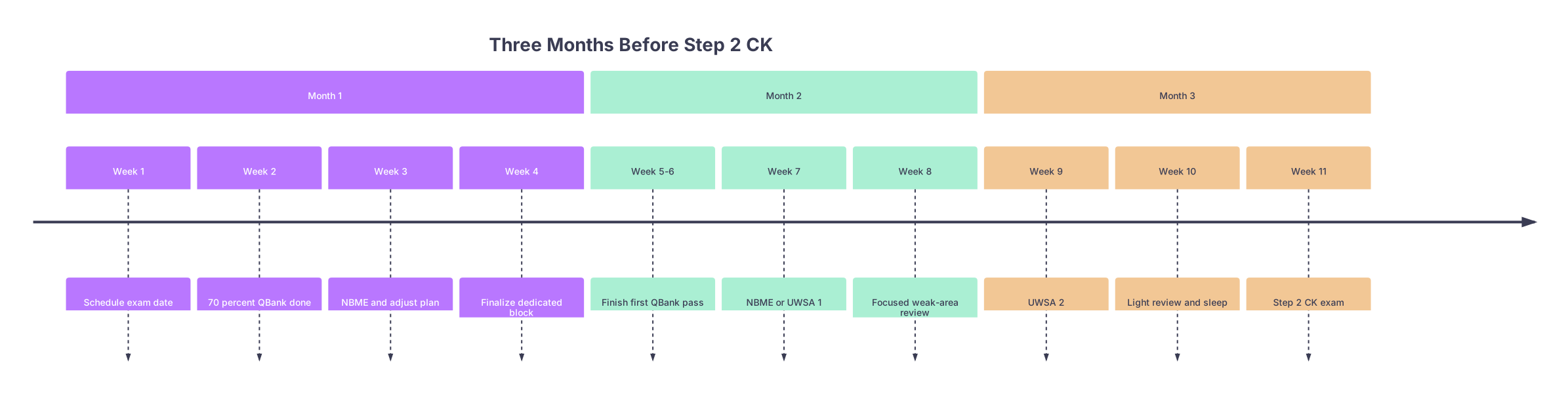
| Period | Event |
|---|---|
| Month 1 - Week 1 | Schedule exam date |
| Month 1 - Week 2 | 70 percent QBank done |
| Month 1 - Week 3 | NBME and adjust plan |
| Month 1 - Week 4 | Finalize dedicated block |
| Month 2 - Week 5-6 | Finish first QBank pass |
| Month 2 - Week 7 | NBME or UWSA 1 |
| Month 2 - Week 8 | Focused weak-area review |
| Month 3 - Week 9 | UWSA 2 |
| Month 3 - Week 10 | Light review and sleep |
| Month 3 - Week 11 | Step 2 CK exam |
Week 1: Schedule The Exam
By this week you should:
- Schedule your Step 2 CK date in the Prometric system.
- Place it:
- 4–8 weeks before ERAS opens.
- During or immediately after your lightest rotation / vacation.
If the only available dates are terrible:
- Expand your test center radius.
- Grab the best option now and keep checking for cancellations.
Week 2–3: Push To 70% UWorld Completion
During these two weeks:
- UWorld daily volume:
- 40 questions on busy days.
- 60–80 questions on lighter days or weekends.
- Review:
- Timed blocks, then detailed review that same day, not “later.”
Milestone by end of Week 3:
- 70% of UWorld completed.
- NBME 3rd attempt:
- You want to be within 10–15 points of your target score now.
Week 4: Finalize Dedicated Block Structure
At this point you should:
- Know exactly which 2–3 weeks will serve as your heavy push.
- Design a standard “dedicated day” (even if you are on an easy elective):
Typical dedicated‑style day:
- 2 blocks UWorld (80 questions) in the morning.
- 3–4 hours review in the afternoon.
- 1–2 hours of targeted content / notes review in the evening.
No, you do not need 14‑hour days. You need consistent, high‑quality 8–10 hour days for 2–3 weeks.
Two Months Before ERAS: Exam-Ready Or Exposed
This window is where your Step 2 CK trajectory becomes clear. Programs care whether your score is in by ERAS; this is your last realistic chance to adjust.
Week 1–2: Finish First QBank Pass
At this point you should:
- Complete 100% of UWorld by the middle of this month.
- Have:
- A short list of topic clusters you constantly miss:
- Example: diabetic management nuances, OB triage, psych meds side effects.
- A short list of topic clusters you constantly miss:
Chart your QBank progress if you need a visual sanity check:
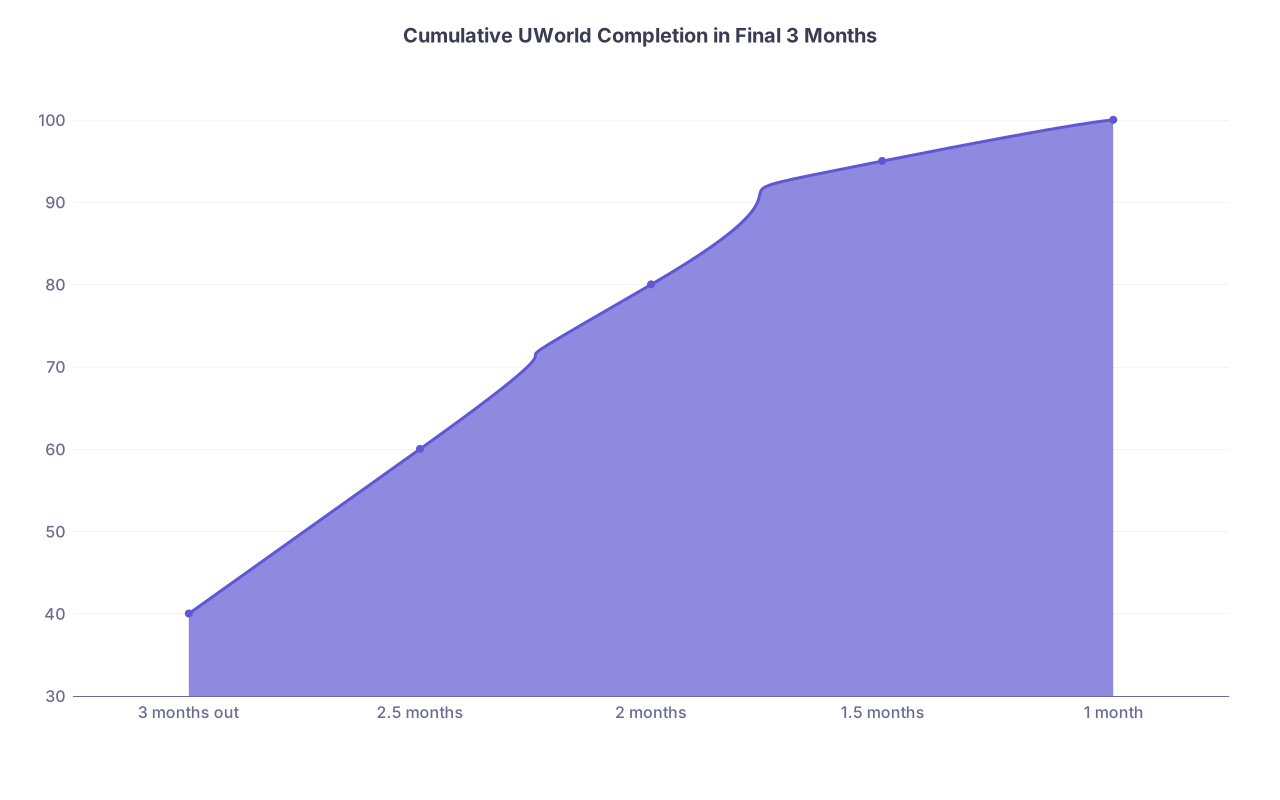
| Category | Value |
|---|---|
| 3 months out | 40 |
| 2.5 months | 60 |
| 2 months | 80 |
| 1.5 months | 95 |
| 1 month | 100 |
Week 3: Third NBME / First UWSA In True Test Conditions
This exam is critical.
Conditions:
- Full length, one sitting.
- Timed, no pausing to “just check one thing.”
- No distractions, same start time as your actual test.
At this point you should:
- Be within 5–10 points of your target.
- Realistically ask:
- If you are >15–20 points below target, is your exam date too early?
- Would delaying 2–3 weeks move your score enough to matter?
If your NBME is surprisingly low despite feeling prepared, dig into:
- Are you running out of time each block?
- Are you making careless errors on “easy” items?
Those are adjust‑able in 2–3 weeks with focused work.
Week 4: Begin Selective Second Pass / Incorrects
After finishing UWorld once, do not restart blindly.
At this point you should:
- Create a filtered second pass:
- Only incorrects.
- Maybe also “marked” questions where you guessed.
- Target 1–2 blocks per day, mixed.
Pair with:
- Daily 30–45 minutes reading of high‑yield notes or “cheat sheets” you built, not random new resources.
One Month Before ERAS: Score Lock And Risk Management
This is where Step 2 CK must move from “upcoming problem” to “completed asset” on your ERAS.
Timing Rule: Score Report Buffer
You need your score available in ERAS when programs start screening.
Score reporting window:
- USMLE reports Step 2 CK scores typically 2–4 weeks after the exam.
- Buffer: take the exam at least 4 weeks before ERAS to be safe.
Week 1–2: Final Assessments And Exam Readiness
At this point you should:
- Take:
- One NBME and one UWSA in the last 3–4 weeks pre‑exam.
- Ideal pattern:
- Scores within 5 points of each other.
- Ideally at or above your target.
If you see erratic swings (250 one week, 230 the next):
- You have an issue with sleep, test‑day stamina, or anxiety.
- Fixable with:
- Strict sleep schedule the week before practice tests.
- Practicing full 8–9 hour test days.
Week 3: Taper, Do Not Panic Cram
Common mistake: students try to “learn all of OB” in the final 5 days. They fry their brains.
At this point you should:
- Protect sleep.
- Focus on:
- Rapid review of your most missed topics (use your own notes, not new videos).
- Lightly cycling through incorrects / marked questions.
- Reduce daily question load:
- 40–60 per day earlier in the week.
- 0–20 day before.
Day before test:
- No full blocks.
- Short, targeted review only.
- Early bedtime, no heroic last‑minute content.
How This All Aligns With ERAS Screening
Programs do not care how touching your personal statement is if your Step 2 CK is missing or weak.
At this point in the cycle (ERAS opening), here is how many programs effectively think:
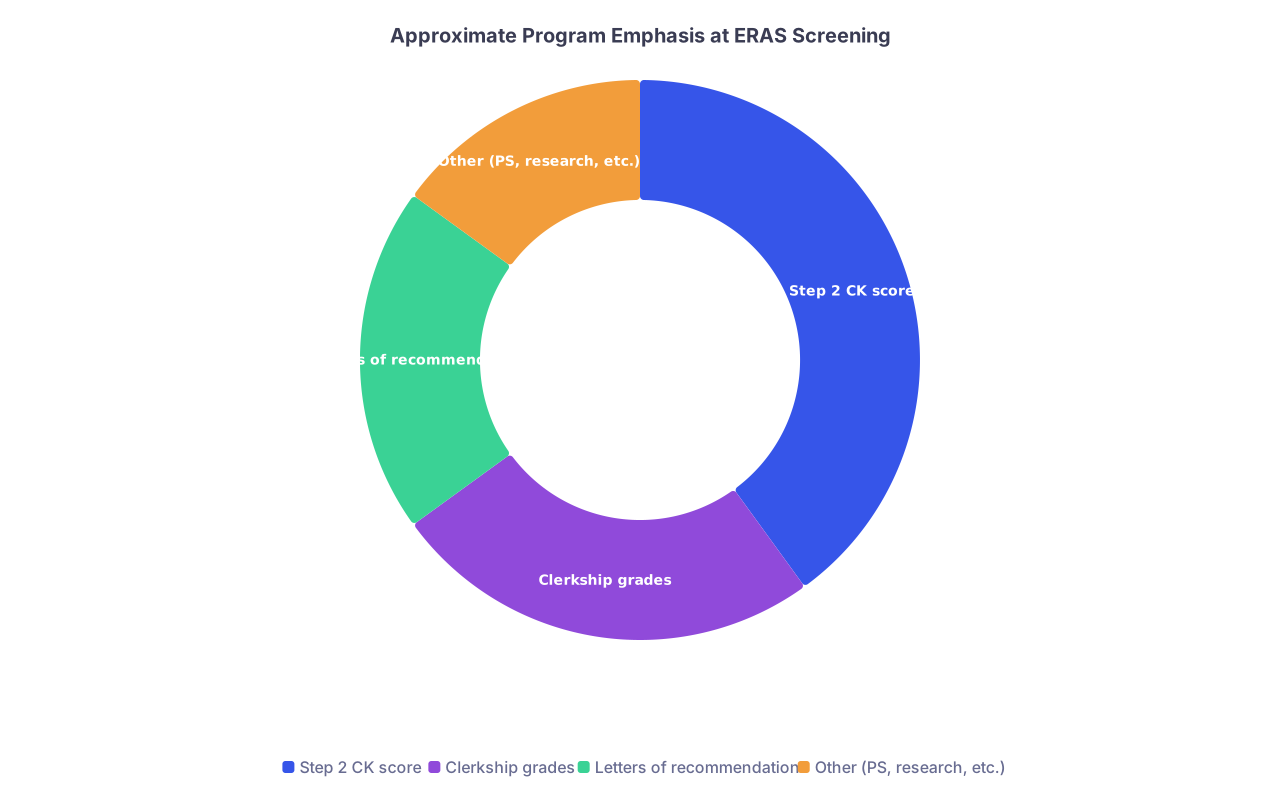
| Category | Value |
|---|---|
| Step 2 CK score | 40 |
| Clerkship grades | 25 |
| Letters of recommendation | 20 |
| Other (PS, research, etc.) | 15 |
That “Step 2 CK score” slice is the gatekeeper. You might have charming letters and decent grades, but if your score is late or mediocre for your specialty, you fall into the maybe‑later pile.
What You Should Have Accomplished By ERAS Month
On the day you submit ERAS, your Step 2 CK situation should look like this:
- Exam taken 4–8 weeks prior.
- Score available and:
- At or above the target for your specialty tier.
- Clearly stronger than your Step 1 performance if Step 1 was mediocre.
- Documented improvement trend:
- Shelf exams improved over time.
- Step 2 CK confirms that upward trajectory.
If any of these are not true, you must adjust your ERAS strategy:
- Add more mid‑tier or community programs.
- Consider a slightly less competitive specialty if your heart was never fully in the ultra‑competitive one.
- Use your personal statement and letters to frame any score improvement narrative (e.g., “initial adjustment to med school, then steady improvement culminating in strong Step 2 CK performance”).
Final Snapshot: The Non‑Negotiable Milestones
Condensed down, here are the three Step 2 CK milestones you absolutely must hit six months before ERAS:
By 4 months before ERAS
- Exam month chosen, rotation schedule adjusted.
- 40–50% of UWorld completed, 1–2 NBMEs taken, clear target score confirmed as realistic.
By 2 months before ERAS
- 100% of UWorld completed once, targeted second pass started.
- At least 3 self‑assessments done, trending within 10 points of your goal.
By ERAS submission
- Step 2 CK taken at least 4 weeks prior, score back and visible in ERAS.
- Score aligned with or above your specialty’s expectations, especially if Step 1 was weak.
Hit those on time, and Step 2 CK becomes your strongest ally in the match, not the silent reason your interview invites never arrive.