
The way most students sequence Sub‑Is, Step 2 CK, and ERAS is backwards—and it costs them interviews.
You do not maximize your application by “fitting Step 2 in somewhere” and sprinkling Sub‑Is randomly. You win by treating MS3 spring through Match Day as a single, integrated project with a ruthless timeline.
I am going to walk you through that project. Month by month. Then, when it gets tight, week by week.
The goal:
- Strong Step 2 CK score reported early
- High-impact Sub‑I evaluations in hand
- Letters uploaded before programs start seriously screening
Not “done eventually.” Done on time, in the right order, to move you up rank lists.
Big Picture: Your 12‑Month Strategy
Before we break it down, you need the macro view. Think of the year from March MS3 to March of Match as one long Gantt chart.
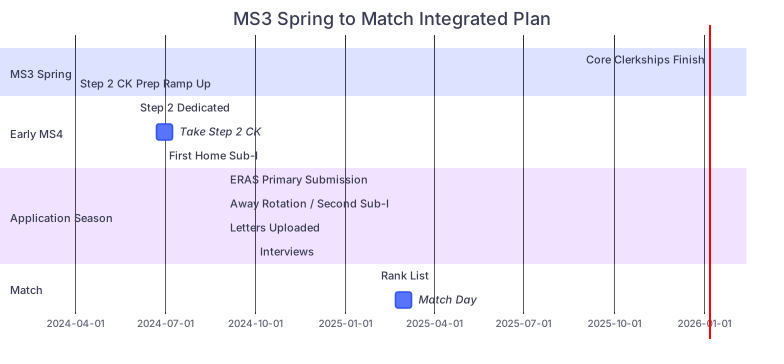
| Task | Details |
|---|---|
| MS3 Spring: Core Clerkships Finish | a1, 2024-03, 3m |
| MS3 Spring: Step 2 CK Prep Ramp Up | a2, 2024-04, 2m |
| Early MS4: Step 2 Dedicated | b1, 2024-06, 1m |
| Early MS4: Take Step 2 CK | milestone, b2, 2024-07, 1d |
| Early MS4: First Home Sub-I | b3, 2024-07, 1m |
| Application Season: ERAS Primary Submission | c1, 2024-09, 0.1m |
| Application Season: Away Rotation / Second Sub-I | c2, 2024-09, 1m |
| Application Season: Letters Uploaded | c3, 2024-09, 0.5m |
| Application Season: Interviews | c4, 2024-10, 4m |
| Match: Rank List | d1, 2025-02, 0.5m |
| Match: Match Day | milestone, d2, 2025-03, 1d |
Core rules of the game:
- Step 2 CK should not be an afterthought. It is your last big, clean, numeric signal.
- Your first Sub‑I in your chosen specialty should land after you have taken Step 2 but before ERAS letters are due.
- At least two high‑quality letters (ideally one from Sub‑I, one from core clerkship or research PI) should be uploaded within 2–3 weeks of ERAS opening.
Here is why timing matters:
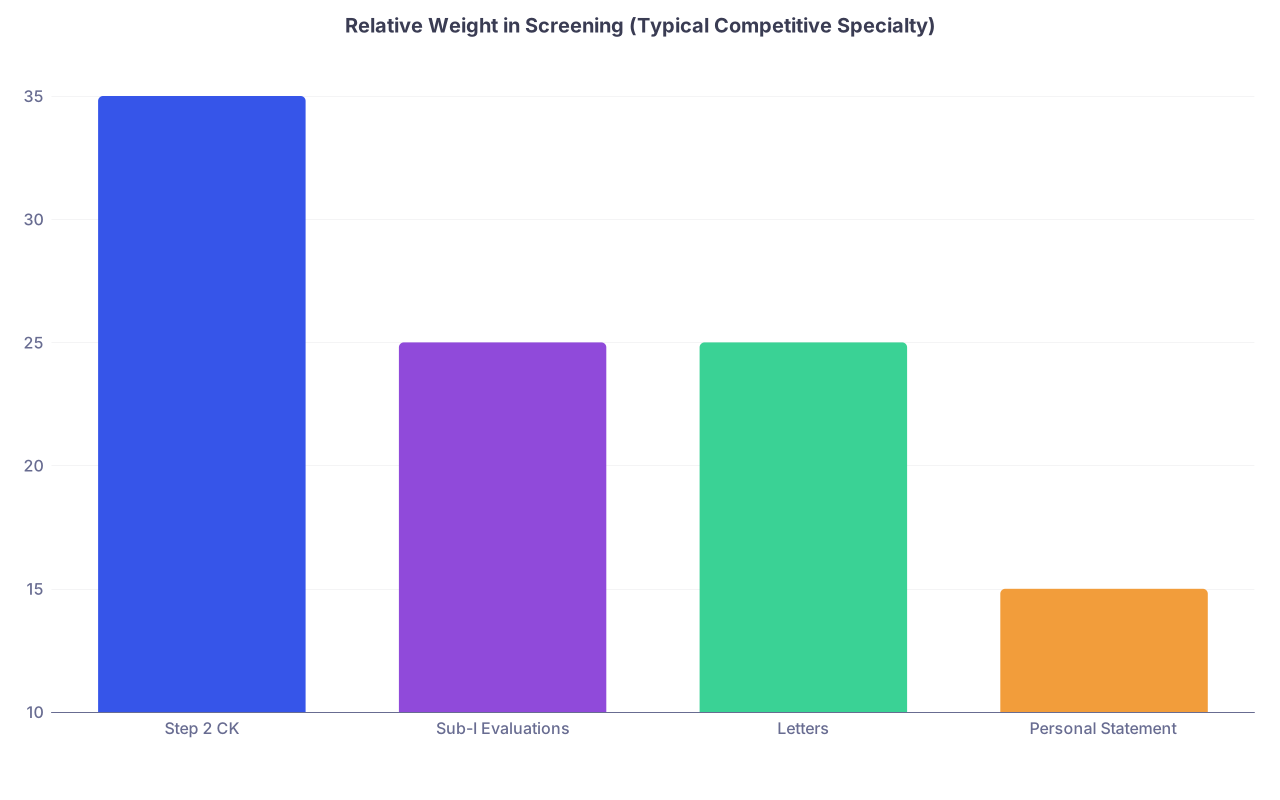
| Category | Value |
|---|---|
| Step 2 CK | 35 |
| Sub-I Evaluations | 25 |
| Letters | 25 |
| Personal Statement | 15 |
Programs say they are “holistic.” Some actually are. Many are not. You must respect the numbers and the first-glance filters.
MS3 Spring (March–May): Lay the Foundation
At this point you should stop thinking of Step 2, Sub‑Is, and applications as separate tasks. They are now one intertwined timeline.
March: Reality Check and Specialty Decision
Pull up:
- Your Step 1 (if you have it)
- Shelf scores
- Class rank / quartile if available
Decide your probable specialty by the end of March. You do not need 100% certainty, but you do need a working plan.
If you are choosing between two fields, rank them A and B. Plan your early Sub‑I and letters for A. You can still keep B alive with one letter and a decent explanation later.
At this point you should:
- Meet with:
- Specialty advisor for your target field
- Dean / advising office
- Ask blunt questions:
- “Given my scores, what Step 2 target score keeps me competitive for [X]?”
- “How many Sub‑Is in this field do your matched students usually have, and when?”
You are building score targets and a Sub‑I count now, not in July when slots are gone.
April–May: Step 2 Infrastructure While You Finish Cores
You cannot go “zero to Step 2 dedicated” in two weeks. That fantasy is why people underperform.
By April you should:
- Lock in your test window: usually late June to late July.
- Reserve a Prometric spot in your preferred week. Yes, this early. The good dates vanish.
- Start a light but consistent Step 2 routine:
- 40 questions/day, 5–6 days/week (UWorld or Amboss)
- Timed, random blocks mixing topics
- Start tracking your percent correct and weak systems
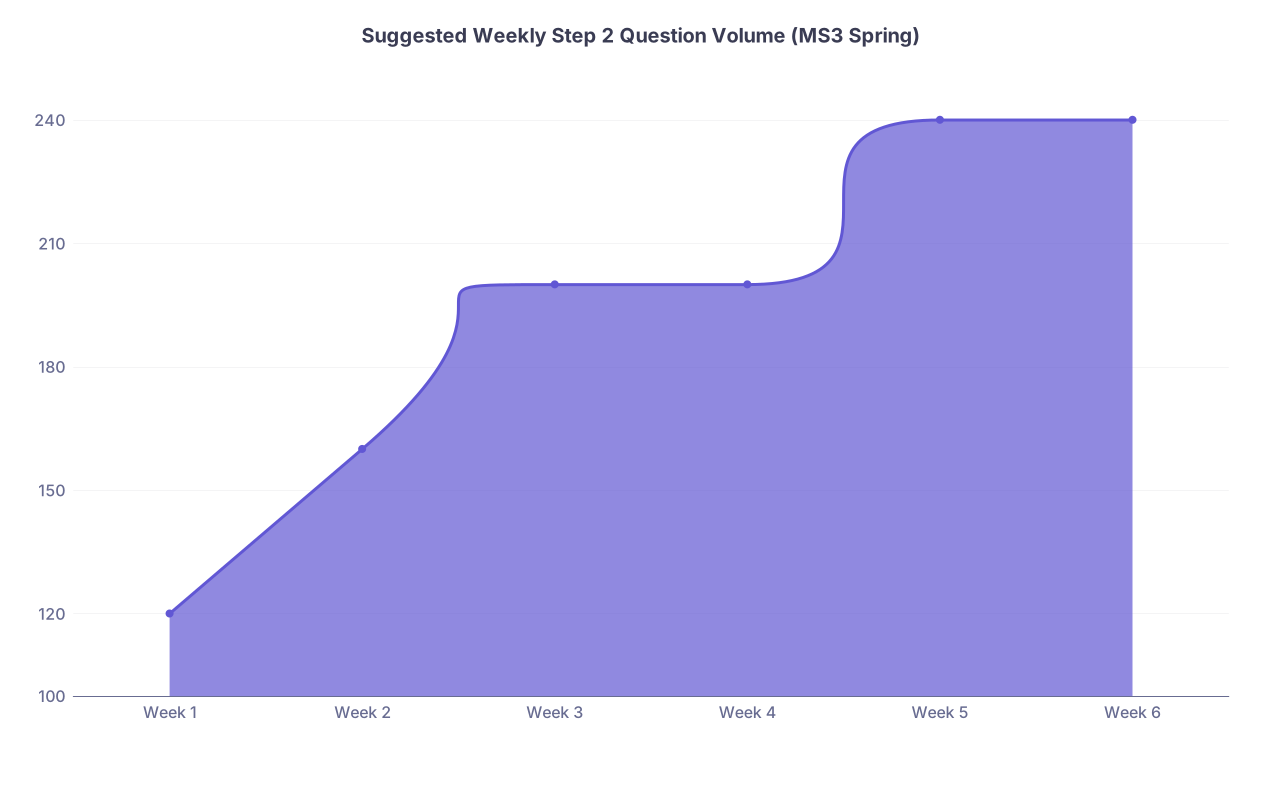
| Category | Value |
|---|---|
| Week 1 | 120 |
| Week 2 | 160 |
| Week 3 | 200 |
| Week 4 | 200 |
| Week 5 | 240 |
| Week 6 | 240 |
You are not “studying for Step 2” yet in a full sense. You are:
- Getting your brain used to the style and pacing
- Building a weaknesses list
- Making sure nothing from early MS3 has fully evaporated
This is also when you should request your first letters from strong core rotations (IM, Surgery, etc.). You want those banked.
Early MS4 Planning (May–June): Lock the Sequence
This is where most people screw it up. They:
- Schedule a Sub‑I in July
- Realize they cannot do Sub‑I and Step 2 at the same time
- Push Step 2 to September
- And now programs see “No Step 2 yet” or a rushed, mediocre score
Do not be that person.
End of May: Build Your Exact Sequence
Your anchor points:
- Step 2 CK date
- First Sub‑I in your chosen specialty
- ERAS opening and key letter upload dates
At this point you should sit with a calendar and sketch:
- Step 2 CK: late June or early July
- First Sub‑I: immediately after Step 2, ideally July or early August
- Second Sub‑I or away: August–September
For most students aiming at competitive or moderately competitive specialties, the sequence should look like this:
| Month | Priority 1 | Priority 2 |
|---|---|---|
| June | Step 2 dedicated | Light clinic/elective |
| July | Take Step 2 | Start home Sub-I |
| August | Finish home Sub-I | Draft ERAS materials |
| September | Away/second Sub-I | ERAS submission, letters |
If your school pushes Sub‑Is earlier (June) and you cannot move them, you have two realistic options:
- Take Step 2 before the Sub‑I (May/early June), with a shorter dedicated
- Or, if you are a very strong test taker and your practice scores are already high by April/May, take Step 2 right after the June Sub‑I, using that Sub‑I as part of your medicine review
But here is the rule: Step 2 should be taken no later than mid‑August unless you have unusually strong reasons not to. Later than that and the score may not help you in early screening or may not be available when programs start sorting.
Step 2 Dedicated: 4–6 Weeks Before Your First Sub‑I
Assume you choose a mid‑to‑late June Step 2 date. Here is how the weeks should run.
6 Weeks Out: Ramp to Full Study Mode
At this point you should:
- Clear your schedule of heavy rotations. If your school forces a core in May/June, trade call shifts, compress, do whatever you can to protect evenings and weekends.
- Hit:
- 60–80 questions/day (UWorld or mix)
- System-based review tied to your weakest areas
Target: By 4 weeks out, you should have:
- Completed at least 50–60% of your question bank
- One NBME or UWSA baseline score
If that baseline is substantially below your target (say, 15+ points under what you need for your specialty band), you have a decision: move the exam date earlier is not the solution. More often, you either:
- Push the date back 1–2 weeks if possible, and
- Carve out more protected time
4 Weeks Out: Full Dedicated
Now your life is Step 2.
Daily structure (example):
- Morning: 2 blocks of 40 questions, timed, full‑length
- Midday: Review questions in detail (not just right/wrong; why did you think what you thought?)
- Afternoon: Targeted content review (OnlineMedEd, Boards & Beyond, or similar)
- Evening: Light anki / quick facts, maybe another 20–40 questions if your stamina allows
By the final 10 days:
- At least one, ideally two, NBME/UWSA practice tests
- You want them to bracket your target. Example: 244 then 252 for someone aiming around 245–250
If your scores are still dangerously low 7–10 days before the exam, delaying may be correct. But do not reflexively push. I have seen plenty of students “delay until ready” and then burn out, doing worse later.
The Week of Step 2 and Transition to Sub‑I
You take Step 2 on, say, June 28.
At this point you should:
- Take the next day fully off. You will feel weird and empty and a bit sick. That is normal.
- Then spend 2–3 days doing:
- Light review of internal medicine topics
- Reading your institution’s Sub‑I expectations and typical evaluation forms
- Logistics: EMR access, pager, schedules, etc.
You are not “done” now. You are shifting from test performance to clinical performance that will be graded and narrated.
July–August: First Sub‑I for Maximum Impact
Your July Sub‑I is your audition for your own home program and for letter writers. It is also the freshest narrative content for your MSPE and letters when ERAS opens.
At this point you should:
Identify 1–2 potential letter writers in the first week of the Sub‑I. People who:
- See you frequently
- Have a reputation for strong letters
- Are respected in your field
Make sure they actually see you shine:
- Ask for feedback at the end of week 2 and week 3
- Volunteer for presentations and procedures
- Show up early, leave late, and document well (yes, it matters more than you think)
Be clear: your goal is one killer Sub‑I letter from this month that can be requested and drafted by the end of August.
Aligning Step 2 Score Release With ERAS
Step 2 scores usually release about 2–3 weeks after the test date. So:
- Late June exam → mid‑July score
- Early July exam → late July score
You want that number before you finalize your application list.
Here is the key decision point:
- If Step 2 is stronger than Step 1 or your profile, you absolutely want it in ERAS early.
- If Step 2 is weaker than expected, you may need to:
- Expand your application list
- Emphasize strengths in Sub‑Is, letters, and personal statement
- De‑emphasize extremely competitive reaches
Programs will see your Step 2 as soon as it is released and transmitted. There is no secret hiding period once it is reported and you have selected “release.”
Late August–September: Second Sub‑I / Away + ERAS Launch
At this point you should be juggling three overlapping tracks:
- Second Sub‑I or away rotation
- Finalizing ERAS
- Herding letters
Sub‑I / Away in August or September
This rotation has three jobs:
- Solidify another strong letter, especially if you are at a big‑name program or your top‑choice institution
- Demonstrate that your July performance was not a fluke
- Give you interview material and home‑program advocates
Do not underestimate the political part: faculty talk. If you are excellent on an away Sub‑I in August, that story is circulating before rank list meetings.
ERAS Timing and Content
ERAS typically opens for applicants to start entering data in June, and you can submit in early September for programs to start downloading later that month.
At this point you should:
- Have your experiences, personal statement, and program list essentially done by late August
- Start pestering letter writers who promised letters during or right after your July Sub‑I
Ideal timeline:
By August 25:
- Personal statement final
- CV and experiences entered
- Program list 90% finalized
By September 1–5:
- At least 3 letters uploaded, including your strongest Sub‑I letter
- ERAS submitted on the first possible submission day
Are you dead if a Sub‑I letter comes later in September? No. But you will miss that extra edge in the very first waves of screening.
Specialty‑Specific Adjustments
Not all fields handle this the same way. Quick reality check:
| Specialty | Step 2 Timing Sensitivity | Sub-I Timing Sensitivity |
|---|---|---|
| Derm / Plastics | Very High | Very High |
| Ortho / ENT | High | Very High |
| IM / Peds | Moderate | High |
| FM / Psych | Moderate | Moderate |
| EM | High (SLOEs) | Very High |
A few notes:
- EM: Your “Sub‑I” is effectively EM rotations with SLOEs. These are time‑critical. Programs want SLOEs by October. That pushes you to do at least one EM month July–August.
- Surgical subspecialties: Away Sub‑Is in July–September are often expected. Your Step 2 should be done before these if at all possible so you are not split‑focus.
- Less competitive fields: You have more flexibility to push Step 2 into early August, but earlier is still better because it can rescue a modest Step 1.
October–February: Interviews and Damage Control (If Needed)
If you followed the above:
- Step 2 was early and strong
- Sub‑I letters hit ERAS on time
- You look polished on paper when invites go out
If things did not go so cleanly—late Step 2, mediocre score, thin Sub‑Is—this is where you manage the fallout.
At this point you should:
- Use any additional Sub‑Is in October/November as leverage for:
- Extra letters
- Advocates who will email PDs directly
- Consider a brief update letter to programs if you:
- Got a very strong new letter
- Earned an honor in a Sub‑I at a respected institution
- Completed substantial new research or presentations
Do not spam every program with “update” emails. Target programs where:
- You have a real connection (home, away rotation, geographic tie)
- You are on the bubble (few signals, but not obviously rejected)
If You Are Already “Off Schedule”
You might be reading this with a Step 2 scheduled in late September and a Sub‑I already in June. Not ideal, but fixable.
At this point you should:
Decide whether moving Step 2 earlier (to August) with an intense push will realistically raise your score, or whether you are better off:
- Doing Sub‑Is June–July
- Taking 3–4 weeks in August for a hard Step 2 push
- Testing late August / early September
If you must test in September:
- Submit ERAS on time anyway
- Add a brief sentence in your personal statement or a supplemental:
- “I am scheduled to take Step 2 CK on [date], and my practice scores are in the [range].”
- Then let the actual score speak when it posts
Prioritize at least one strong Sub‑I letter before September, even if the rotation is in June or July.
I have seen students match well even with later Step 2 scores. But they compensated with:
- Outstanding Sub‑I performance
- Aggressive, targeted letter strategies
- Realistic program lists
The One Thing You Should Do Today
Do not just nod along and go back to scrolling.
Open your calendar for the next 12 months and block three anchors right now:
- A Step 2 CK date that lands no later than mid‑July
- A first Sub‑I month in your chosen specialty immediately after that
- A second Sub‑I / away in August or September
Then email your specialty advisor tonight with a screenshot of that draft sequence and a simple question:
“Does this timeline maximize my Step 2 impact and Sub‑I letters for [your specialty], or what would you change?”