
It is Wednesday night. You just refreshed the NBME portal for the tenth time, and the Step 2 CK score finally appeared. Your stomach dropped. Whether it is higher than you dared to hope or lower than you wanted, the same question hits you immediately:
Now what do I do with residency programs?
This is where most applicants stall. People either spam every program with a generic “my Step 2 is back” email, or they freeze and send nothing because they “do not want to bother PDs.” Both are wrong.
You need a tight, time-based plan from the week before score release through late interview season. I will walk you through it.
Big Picture: When Step 2 CK Actually Matters in Your Timeline
Before we go hour-by-hour, you need the frame.
There are three critical windows where Step 2 CK updates change your fate:
- Pre-interview screening window – from ERAS opening through about mid–October
- Active interview offer window – roughly mid–October through early December
- Post-interview / pre–rank list window – December through late February
How aggressively you push your new score depends on:
- Whether Step 2 helps or hurts you relative to Step 1 / your app
- When in that cycle it hits
- How competitive your specialty is
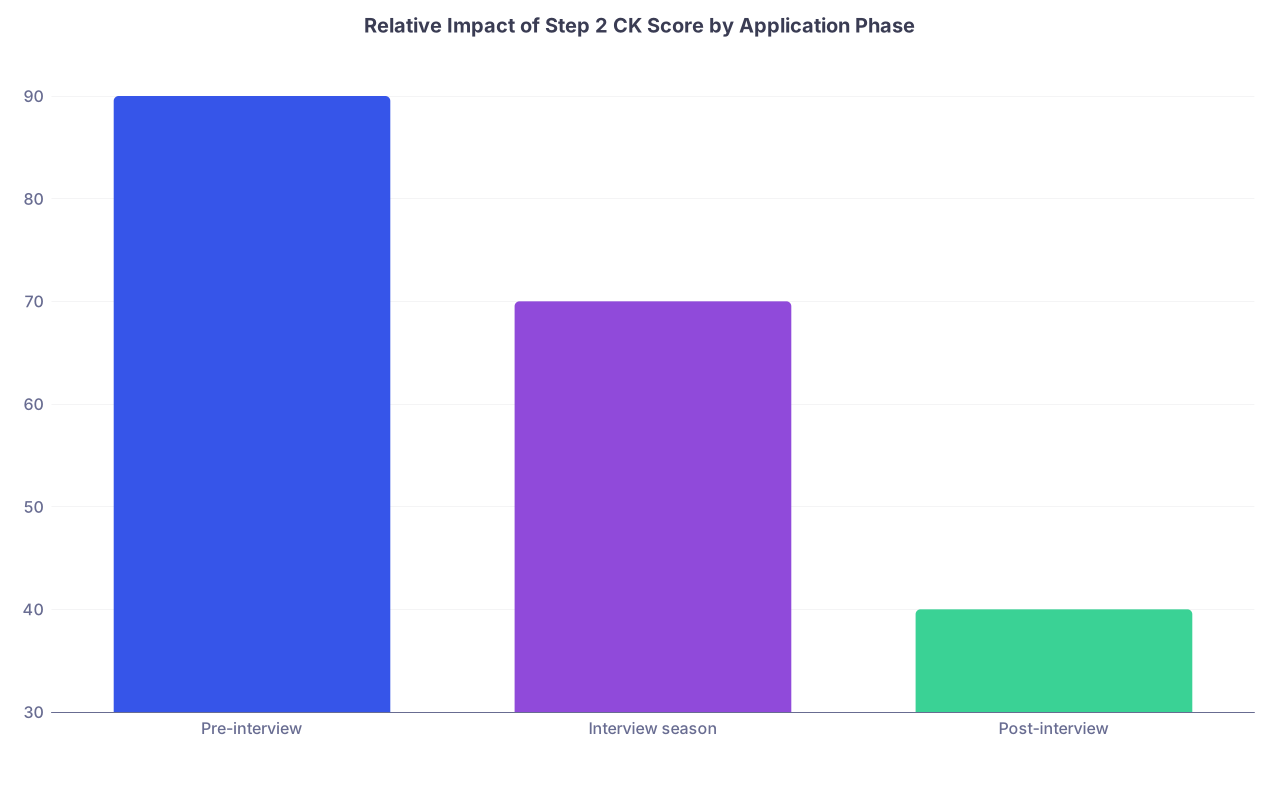
| Category | Value |
|---|---|
| Pre-interview | 90 |
| Interview season | 70 |
| Post-interview | 40 |
Interpretation: Step 2 CK has maximum leverage before most invites go out. It still matters mid-season. After interviews, it rarely rescues a weak file but can reassure programs if there were concerns.
1–2 Weeks Before Score Release: Set the Trap, Not the Panic
You are 7–10 days from the expected Wednesday score release (NBME calendar is public; check it). This is your prep window.
At this point you should…
1. Know which bucket you are probably in
Be honest with yourself based on UWorld percentages and NBMEs:
If your practice tests were stronger than your Step 1
→ Step 2 is likely an asset. You will want to push it early and often.If your practice tests were similar to a high Step 1
→ Step 2 is mostly a confirmation. You update, but you do not need a PR campaign.If your practice tests were lower than Step 1 or borderline passing
→ Step 2 may be neutral or a liability. You will be conservative about who you tell and when.
2. Build your target program tiers
You need a priority map before emotions kick in. Break your list into:
- Tier 1 – Reach / Dream (e.g., MGH IM, UCSF Neuro)
- Tier 2 – Realistic
- Tier 3 – Safety / Backups
Then label programs by behavior so far (once invites start):
- Already invited
- No response yet
- Pre-interview rejection
This will control what you do on score day.
3. Draft your email templates now
You want to be editing a template on score day. Not starting from scratch at 2 a.m.
Create at least three versions:
- Strong score / Clear asset template
- Solid but not game-changing score template
- Disappointing score (or “damage control”) template
Keep them short. PDs do not read essays.
Example – Strong score template (Step 1 pass/low, Step 2 strong):
Subject: Step 2 CK score update – [Your Name], [Specialty] applicant
Dear Dr [PD Last Name],
I am writing to share that my USMLE Step 2 CK score was released this week: [###]. Given my [Step 1 pass/previous score of ###], I wanted to provide objective evidence of my current clinical knowledge and readiness for residency.
I remain very interested in [Program Name], particularly because of [1 specific, real reason – e.g., your clinician-educator track, strong HIV clinic, etc.].
Thank you for your time and consideration.
Sincerely,
[Full Name]
AAMC ID: XXXXXXXX
Have the file names, subject lines, and basic body text ready in a document.
4. Decide your documentation strategy
You will need a PDF of your official score report once available.
- Plan to save it immediately on release day
- Name it something sane:
Lastname_Firstname_USMLE_Step2CK.pdf - Decide if you will:
- Upload to ERAS (when allowed)
- Attach to emails (only when appropriate)
- Or just reference the score numerically
Score Release Day: The First 24 Hours
You wake up, see the score. Whether you are thrilled or upset, do nothing for the first 30–60 minutes except verify and document.
Hour 0–1: Verify, record, calm down
At this point you should:
Confirm the score and status
- Make sure it is actually reported and not “withheld” or some weird status
- Screenshot and download the PDF
Write down the number and a one-sentence interpretation for yourself:
- “Step 2 CK 254 – clearly stronger than Step 1 226, should help for IM.”
- “Step 2 CK 233 – about the same as Step 1 232, neutral.”
- “Step 2 CK 219 – lower than Step 1 235, concerning for some competitive programs.”
You need to see it in plain language.
Hour 1–3: Decide your global strategy
This is where most people lose the plot. You have three basic scenarios.
Scenario A: Step 2 CK is significantly better than your Step 1
Examples:
- Step 1 pass / 21x → Step 2 240+
- Step 1 220–230 → Step 2 245+
- Step 1 230–240 → Step 2 255+
This is an asset. Use it.
Same-day priorities (within 3–6 hours):
Update ERAS (if still early in the cycle and scores can be reported):
- Make sure USMLE transcript release is active
- Request an updated transcript transmission if necessary
- Programs that automatically pull new transcripts will see it
Email targeted programs:
a. Highest priority: Programs that have not invited or rejected you yet, especially in:
- Your home region
- Programs where you have a connection (away rotation, mentor, etc.)
- Programs known to be score-sensitive for your specialty
b. Secondary priority: Programs that have already invited you
- For fields like Derm, Ortho, ENT, a big Step 2 jump can move you up their internal rank list. A short update email helps.
Align your templates:
- Use your “strong score” template
- For top-choice programs, customize 1–2 sentences specific to them
Scenario B: Step 2 CK is roughly similar to your Step 1
Examples:
- Step 1 230 → Step 2 232
- Step 1 245 → Step 2 243
This is confirmation, not a plot twist.
Same-day priorities:
Update ERAS / USMLE transcript as soon as practical. Let the automated system do most of the work.
Email selectively:
- Programs that explicitly asked for Step 2 before ranking
- Programs where you are on a waitlist for an interview (sometimes your dean or mentor will hint at this)
- Programs where your application had a known weakness Step 2 addresses (e.g., a weak medicine clerkship grade and now a solid Step 2)
For everyone else, the automated transcript update is enough.
Scenario C: Step 2 CK is lower than expected or clearly weak
Examples:
- Step 1 240 → Step 2 223
- Step 1 230 → Step 2 215
- Borderline passing score in a competitive specialty (Derm, Ortho, Plastics, ENT, etc.)
You do not hide it. But you do not advertise it either.
Same-day priorities:
Make sure the transcript is still being sent.
Some applicants panic and try to stop transmission. That usually looks worse than a low score.Delay broadcast emails.
- Do not send mass “update” emails highlighting a low score
- You can still update select programs if:
- They explicitly requested Step 2
- You passed after a Step 1 fail or USMLE struggles (in that case, passing Step 2 is still a win)
Talk to your dean’s office or advisor fast.
- Especially in competitive specialties, you may need parallel planning (adding prelim medicine, TY, or backup specialties)
First Week After Release: Structured Outreach
The emotional surge has passed. This week is about disciplined, tiered updates.
Day 1–2: Top-Tier, High-Yield Targets
At this point you should focus on:
- Your top 10–15 programs that:
- Have not rejected you
- Have not yet invited you
- You would rank highly if they invited you
For each, send a brief, individualized email. Same template shell, but tweak:
- One line about why this specific program
- One name-drop if you have a connection (“I greatly enjoyed working with Dr X on my sub-I in September…”)
You are not writing a personal statement. Think 6–8 sentences max.
- These are high-yield for interviews and rank list impact.
- Your new score can sway internal discussions.
Day 3–5: Broader but Still Targeted Outreach
Now you move to:
- The rest of your realistic Tier 2 programs without responses yet
- Any programs that previously said, “We are waiting for Step 2” (yes, people get that email)
You can be slightly more generic now, but still keep emails short.
Who should you not email yet?
- Programs that have already formally rejected you – Step 2 rarely resurrects those unless it is a massive jump and a mentor intervenes directly.
- Programs that are clear safeties where your Step 2 does not change much. No need to flood them.
End of Week 1: Clean-Up and Tracking
By the end of this week you should have:
- A tracker with columns like:
| Program | Tier | Status | Invited? | Step 2 Email Sent? | Reply? |
|---|---|---|---|---|---|
| MGH IM | 1 | No response | No | Yes (9/21) | None |
| State Univ IM | 2 | No response | No | Yes (9/22) | Hold |
| Local Comm IM | 3 | Invite | Yes | No | N/A |
This is how you avoid double-emailing the same PD at midnight from two different accounts. I have seen it. It is not a good look.
Weeks 2–4 After Release: Riding the Interview Wave
By now, most competitive specialties are in active invite season. For IM, Peds, FM, invites may stretch later, but the pattern is similar.
At this point you should…
1. Watch your invite response pattern
After 10–14 days post–Step 2 updates, you can often see:
- Programs that responded positively (interview offered, waitlist, “we will review your file again”)
- Programs that remained silent → likely not moving
Do not keep pestering the same non-responsive programs every week. One good update email plus your updated transcript is usually enough.
2. Use Step 2 inside your interviews
If your Step 2 is a strength, you should:
Mention it briefly when asked about academics:
“My Step 1 was a pass, and I really focused on clinical knowledge. I was happy to score a 245 on Step 2 CK which I think reflects that shift.”Tie it to your clinical competence, not just “I am good at tests.”
If your Step 2 is weaker:
- Have a concise, honest explanation ready.
Not a 5-minute monologue. One or two sentences, then pivot to your strengths.
Mid-Season (Late October–December): Second Wave Updates
By now, two things are usually true:
- You know if you are under-interviewed for your specialty.
- Programs are starting to talk about rank lists internally.
For under-interviewed applicants
If you are clearly behind (for example, 3–4 interviews total in a moderately competitive specialty), at this point you should:
- Send one final, concise Step 2–anchored interest email to:
- Programs in locations you would strongly consider
- Programs where your Step 2 is above their usual average
Something like:
Dear Dr [PD],
I wanted to briefly reiterate my strong interest in [Program]. Since submitting my ERAS application, my Step 2 CK score has been released (###). I remain particularly drawn to [specific feature].
If there is an opportunity for my application to be reconsidered for an interview, I would be very grateful.
Sincerely,
[Name]
No drama. No “you are my number one.” Just clear, polite interest.
- Loop in mentors
This is when a well-placed phone call or email from your chair or a faculty mentor referencing your Step 2 can actually move the needle. Especially for mid-tier academic programs.
Post-Interview / Pre–Rank List: December–February
By late December or January, most interviews are done. Step 2 still plays a role, but the tactics change.
At this point you should…
1. Stop mass Step 2 email blasts
If a program interviewed you, they already have:
- Your USMLE transcript
- Your new score
- Your interview impressions
Endless “update” emails are annoying. You are not lobbying Congress.
2. Use Step 2 as supporting evidence in genuine interest letters
If you are sending a true “I will rank you highly” or “You are my #1” type letter (careful with that), Step 2 can show stability:
“Since we met, my Step 2 CK score was released (###), which I hope further reflects my readiness to contribute as an intern in your program.”
That is enough. No need to re-attach the score report again.
Special Situations: When Step 2 CK Changes the Game
1. Step 1 fail → Step 2 pass
Here, Step 2 is not optional. It is central.
Timeline:
Day 0–3 after release:
- Update ERAS transcript
- Email all programs that have not rejected you yet
- Ask your dean’s office to send a short institutional letter highlighting your remediation and success
Week 1–2:
- Aggressively involve mentors to advocate, especially at community and mid-tier academic programs
- Consider expanding your application list (if timing and finances allow)
2. Applying without Step 1 numeric, Step 2 is your first real number
Common for newer grads with Step 1 pass/fail only.
- Programs will look hard at Step 2.
- You should treat a strong score like a marketing asset and follow the Scenario A timeline above.
- For borderline scores, you lean on clinical grades, letters, and fit instead of drawing too much attention to the number.
Visual Timeline: From Score Release to Rank Lists
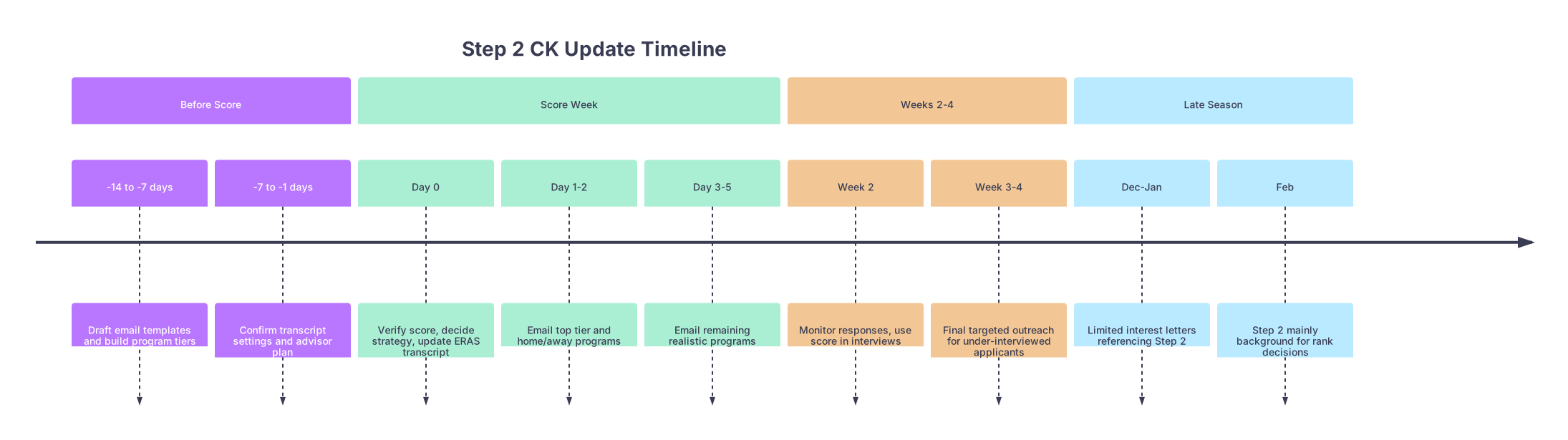
| Period | Event |
|---|---|
| Before Score - -14 to -7 days | Draft email templates and build program tiers |
| Before Score - -7 to -1 days | Confirm transcript settings and advisor plan |
| Score Week - Day 0 | Verify score, decide strategy, update ERAS transcript |
| Score Week - Day 1-2 | Email top tier and home/away programs |
| Score Week - Day 3-5 | Email remaining realistic programs |
| Weeks 2-4 - Week 2 | Monitor responses, use score in interviews |
| Weeks 2-4 - Week 3-4 | Final targeted outreach for under-interviewed applicants |
| Late Season - Dec-Jan | Limited interest letters referencing Step 2 |
| Late Season - Feb | Step 2 mainly background for rank decisions |
When To Attach vs Just Mention Your Score
Stop overthinking this. Basic rule:
Most of the time:
- Just mention the numeric score in the email body.
- Let ERAS / transcripts do the official work.
Attach the PDF only when:
- A program explicitly asks for the official report
- You are dealing with a prelim/TY or off-cycle spot outside ERAS
- An international or non-ERAS pathway requires it
What Not To Do (I have seen all of these)
- Email the same PD three times in one week “just bumping this up.”
- Apologize for a 240 in Internal Medicine like you committed a crime.
- Write a two-page Step 2 reflection essay explaining every incorrect question.
- Pretend a clearly low score is “great for your program” because of “resilience.” That framing fools nobody.
- Copy-paste the same generic paragraph to 60 programs and forget to change the program name in half of them.
Quick Comparison: When Aggressive Updates Make Sense
| Scenario | Step 2 vs Step 1 | Specialty Competitiveness | Recommended Aggressiveness |
|---|---|---|---|
| A | Much higher | Any | High – broad outreach |
| B | Similar / slightly better | Low–moderate (FM, Peds) | Low–moderate |
| C | Similar / slightly better | High (Derm, Ortho) | Moderate, targeted |
| D | Lower | Any | Low, selective updates |
| E | Pass after fail | Any | High, with dean/mentor help |
Final Check: One Page, One Plan
If you are overwhelmed, compress this into a one-page plan:
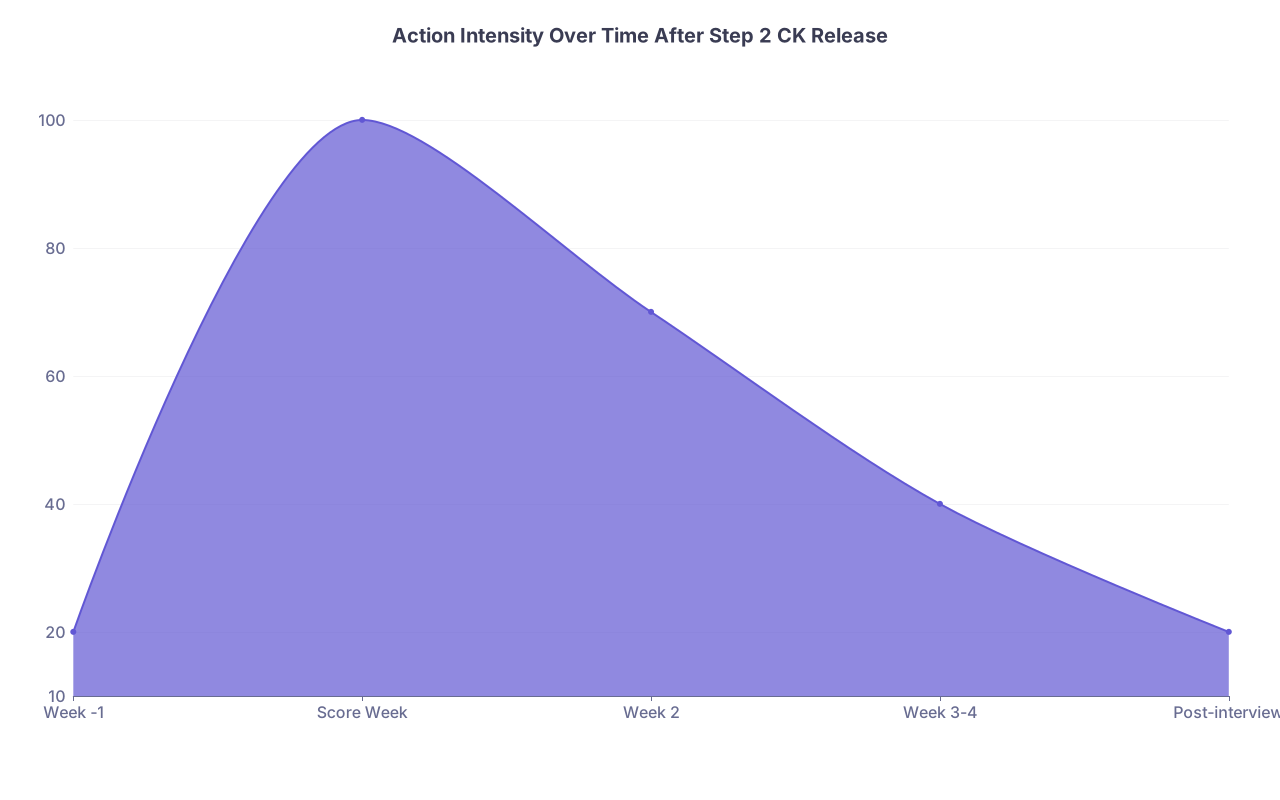
| Category | Value |
|---|---|
| Week -1 | 20 |
| Score Week | 100 |
| Week 2 | 70 |
| Week 3-4 | 40 |
| Post-interview | 20 |
- Peak effort: score week and the week after.
- Then taper, not spam.
Three Things to Remember
React with a plan, not with emotion.
Score day is for verification and strategy. Serious outreach starts once you know which scenario you are in.Use Step 2 where it actually moves the needle.
Big jump from Step 1? Push it hard in the first 1–2 weeks to unresponsive and reach programs. Neutral/weak score? Let the transcript speak, and be selective with emails.One good, concise, well-aimed email beats five desperate ones.
Programs care about your score, but they also care how you handle news, pressure, and communication. Your Step 2 update is their preview.