
The panic about a “late” Step 2 CK score is massively overblown—and badly timed.
If your Step 2 CK score will post after September 15, you are not sunk. But you do lose the luxury of sloppy planning. At this point, timing becomes strategy, not background noise.
I am going to walk you, chronologically, through exactly what to do—from 3 months before Sept 15 until rank list certification—so your delayed Step 2 CK becomes a manageable variable, not a quiet disaster.
Big Picture: What A Late Step 2 CK Score Really Means
First, level-set.
Programs fall into three rough categories when it comes to Step 2 CK timing:
| Program Type | View of Late Step 2 CK | Risk Level |
|---|---|---|
| Score-Required Before Rank | Must see score to rank | High |
| Strongly Prefer Early Score | Will interview but may hesitate to rank highly | Moderate |
| Flexible / Holistic | Okay with late score, especially if Step 1 pass | Lower |
Is it ideal to have Step 2 CK in ERAS on Sept 15? No. But:
- Many programs do not filter applicants by Step 2 CK at initial screen.
- A strong application can absolutely carry you into interview invites before your score drops.
- Communication strategy can partly offset timing issues.
The mistake I see every year: students freeze in August–September, obsessing about the score date instead of optimizing what they can control.
So let us stop doing that.
Timeline Overview
Before we go into week-by-week details, here is the rough structure.
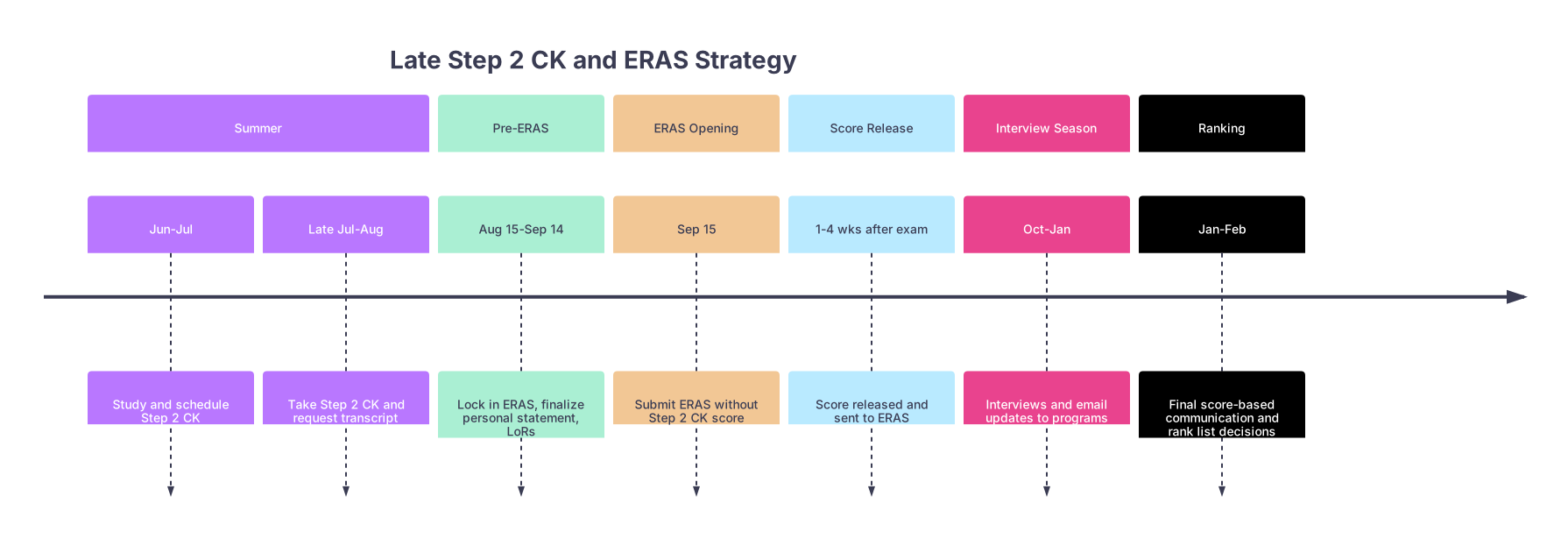
| Period | Event |
|---|---|
| Summer - Jun-Jul | Study and schedule Step 2 CK |
| Summer - Late Jul-Aug | Take Step 2 CK and request transcript |
| Pre-ERAS - Aug 15-Sep 14 | Lock in ERAS, finalize personal statement, LoRs |
| ERAS Opening - Sep 15 | Submit ERAS without Step 2 CK score |
| Score Release - 1-4 wks after exam | Score released and sent to ERAS |
| Interview Season - Oct-Jan | Interviews and email updates to programs |
| Ranking - Jan-Feb | Final score-based communication and rank list decisions |
Now let us go phase by phase.
2–3 Months Before Sept 15: Set Up Your Score Timing Intentionally
This is late June through mid-July for most applicants.
At this point you should be:
Running a brutally honest Step 2 CK calendar.
- Look up your exact testing date and NBME/USMLE’s typical 2–3 week score release window.
- Map that window onto the ERAS timeline:
- If you test before late August, your score probably lands late September.
- If you test early September, your score may not appear until early October.
Deciding your priority: earlier score vs. more prep.
Here is the tradeoff no one likes to state clearly:- Take Step 2 CK earlier →
Less prep time, higher chance of a score that is “fine but not flashy,” but score appears closer to Sept 15. - Take Step 2 CK later →
More prep, better chance at a strong score, but programs may review your app without it.
If you are in any of these groups, I usually recommend prioritizing the score quality over the date, even if that means release after Sept 15:
- Step 1 was pass with borderline performance or low percentile.
- You are applying to competitive specialties (derm, ortho, ophtho, ENT, plastics, rad onc, gas in some regions).
- You are switching specialties and need to “prove” yourself.
- Take Step 2 CK earlier →
Making the score-requirement reality check.
At this point you should build a quick target program list and label them:- “Step 2 Required to Rank”
- “Step 2 Recommended”
- “No explicit timing requirement”
You do not need perfection—just a sense of how many programs must see the score by January.
If your Step 2 CK is already scheduled such that the score will clearly post after Sept 15, stop fantasizing about changing the past. You are now playing a different game: late score optimization.
4–6 Weeks Before Sept 15: Lock In ERAS While You Study
This is mid-August to early September.
You are probably deep in UWorld and practice exams. Fine. But if you wait until your test is over to fix your ERAS, you will sabotage yourself.
At this point you should:
Treat ERAS as a second job.
Block 60–90 minutes per day for:- Finalizing your personal statement.
- Cleaning up experience descriptions (no vague “did research” nonsense—use outcome-focused bullets).
- Double-checking contact info, degree dates, and USMLE ID.
Set your USMLE transcript preference now.
Inside ERAS, you will:- Authorize the release of your USMLE transcript.
- Decide whether you want Step 2 CK automatically added when available.
Ninety-nine percent of you should choose automatic release. If you try to “wait and see” the score before sending, you delay it even further and create more administrative chaos.
Inform your letter writers you are submitting Sept 15 regardless.
Not when the score posts. Not when “everything is perfect.”
Sept 15. Period.That gives them a clear deadline and prevents the common fiasco: late letters plus late score plus late submission.
Step 2 CK Test Week: Messaging and Damage Control
You are now within 0–3 weeks of Sept 15 and taking the exam. During this time, the worst thing you can do is ignore the application side completely.
At this point you should:
Decide your “Step 2 story” in a single line.
You need one clear sentence you can reuse in emails, interviews, and personal conversations:- “My Step 2 CK score is pending and is expected to be released in late September.”
Or, if you already know the date window: - “I took Step 2 CK on September 1; my score is expected in early October and will be automatically released to ERAS.”
No drama. No apology tour.
- “My Step 2 CK score is pending and is expected to be released in late September.”
Finish ERAS content to 95–100% before exam day.
So that after your test, you are doing small tweaks, not writing major sections from scratch.Double-check USMLE/ERAS linkage.
Make sure:- Your USMLE ID is correctly entered in ERAS.
- You have authorized transcript release.
I have seen people lose 2–3 extra weeks of score posting because of a typo in the USMLE ID.
September 10–15: Submitting ERAS Without a Step 2 Score
You are approaching the ERAS opening and your Step 2 CK score is not in. Fine. Do not wait.
September 10–14: Final Prep
At this point you should:
Have:
- Personal statement locked.
- Experiences proofread.
- Photo uploaded.
- Programs list mostly built.
Decide on one of two status lines for your ERAS experiences or personal statement, if relevant:
- If Step 2 CK was a deliberate “prove myself” move after a weak Step 1:
“I registered early for Step 2 CK to demonstrate stronger performance in clinical material; my score will be released later in the application season.” - If Step 1 was fine and this is just scheduling:
You do not need to mention it in the personal statement at all. Save it for emails if asked.
- If Step 2 CK was a deliberate “prove myself” move after a weak Step 1:
You are not required to explain a routine timing issue in your main documents.
Sept 15: Submission Day
Submit on day one. Yes—with no Step 2 CK score.
This matters because program directors often batch review early submissions. A timely, complete-looking application without Step 2 CK is far better than a “perfect” one that shows up in the third or fourth wave.
At this point you should:
- Submit ERAS. Do not wait for the score.
- Confirm that your USMLE transcript (with Step 1) is attached.
- Send zero Step 2–related emails on this exact day.
Do not spam programs with “Just so you know, my Step 2 is coming.” They know. Thousands of applicants are in the same boat.
1–4 Weeks After Sept 15: Waiting for the Score and Smart Outreach
Your score window is coming up. Programs are starting to screen and send early invites.
This is where most people either overshare or disappear. You will do neither.
As Soon As the Score Posts
The day your Step 2 CK score posts (usually Wednesday), at this point you should:
Verify it is in ERAS.
Usually automatic within 24–48 hours if you set automatic release.
If it is not there:- Log in to ERAS and re-request transcript.
- Confirm payment and that your USMLE ID matches.
Classify the score into three buckets:
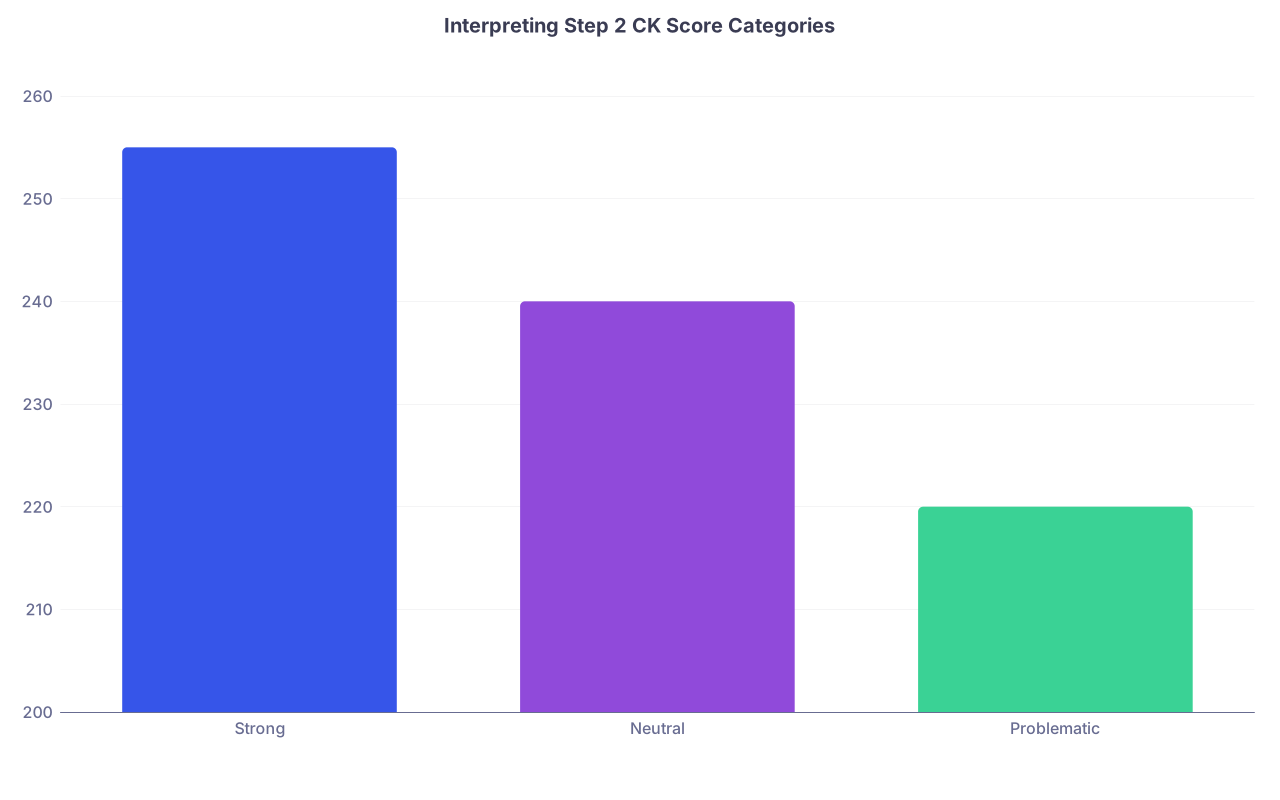
| Category | Value |
|---|---|
| Strong | 255 |
| Neutral | 240 |
| Problematic | 220 |
These are rough, specialty-agnostic mental models, not formal cutoffs:
- Strong: ≥ 250 for most fields, ≥ 245 for primary care / less competitive fields.
- You gained leverage.
- Neutral: Around 235–249, or similar to your Step 1 percentile if you had a 3-digit or strong pass.
- Not game-changing, but safe.
- Problematic: Below ~230 for competitive specialties, or clearly below expectations compared to your Step 1 performance.
- You must manage expectations and program targeting.
- Adjust program list only if necessary.
- Strong score: You may add a few more reach programs if deadlines are still open.
- Neutral: Stay the course.
- Problematic: Consider shifting applications toward more mid-tier or community programs, if still early enough that they are open and reading new apps.
Email Strategy After Score Release
Within 3–5 days of your score posting, at this point you should:
If score is Strong:
Send short, targeted emails to priority programs that:- Are particularly competitive for you.
- Have not yet offered an interview.
- Emphasize the new score as a positive data point.
Sample structure:
Subject: Update to ERAS Application – [Your Name], [Specialty]
Dear Dr. [PD Last Name],
I am writing to share an update to my ERAS application for the [Program Name] [Specialty] residency. My Step 2 CK score (recently released and now visible in ERAS) is [###], which I believe more accurately reflects my clinical knowledge and performance on core clerkships.
I remain very interested in your program because of [1 specific, non-generic reason]. Thank you for your consideration.
Sincerely,
[Name], AAMC ID [XXXXXXX]If score is Neutral:
I usually recommend no mass email. Programs can see the score. Save communication for:- Programs you rotate at.
- Home institution.
- Places where you have strong ties.
If score is Problematic:
Do not highlight the score in broad emails. Focus instead on:- Clinical grades.
- Strong letters.
- Research or unique experiences.
You address the score only if asked directly.
October–January: Interview Season With a Later Score
By now, your Step 2 CK is posted in ERAS. Some programs reviewed your file pre-score. Others looked after.
At this point you should:
In interviews, use a consistent, concise Step 2 narrative.
- If the score was stronger than Step 1:
“I felt my Step 2 CK better captured how I was performing on the wards, and I am glad it aligned with my clinical momentum.” - If it is about the same:
You do not need to bring it up unless you are asked. - If the score is weaker:
“I was disappointed that my Step 2 CK did not fully reflect my clinical abilities, particularly in [specific rotation where you performed well], but I have consistently demonstrated strong performance on the wards and in [other objective metrics—sub-I evaluations, shelf exams, etc.].”
- If the score was stronger than Step 1:
Use updates selectively.
Later in the season (November–December), consider one short update to top-choice programs, combining:- New publications, posters, or rotations.
- A one-line mention that your Step 2 CK score is now available in ERAS (if it posted late and they likely reviewed before it was there).
Track invite patterns.
Use a simple spreadsheet:
| Program | Date Applied | Date Score Posted | II? (Y/N) | Notes |
|---|---|---|---|---|
| Program A | 9/15 | 9/28 | Y | Strong regional ties |
| Program B | 9/15 | 9/28 | N | Competitive, no ties |
| Program C | 9/20 | 10/5 | Y | Community program |
If you notice that community or mid-tier programs are consistently offering interviews while top-heavy academic places stay silent, consider shifting your energy and expectations rather than waiting for miracles.
January–February: Ranking With a Late-Posted Step 2 CK
By the time you are building your rank list, every program that cares about Step 2 CK timing has your score.
At this point you should:
Assume all programs have reviewed your score.
Do not waste energy trying to “fix” it this late with explanations. Your priorities now:- Final communications.
- Honest self-assessment.
- Intelligent ranking, not wish-casting.
Send a single, clear “#1” email if the specialty culture supports it.
In many fields (IM, peds, FM, some others) you can ethically signal your top choice:- Keep it short.
- Do not mention the Step 2 timing unless it was exceptionally late and you know they ranked after it was visible.
- Focus on program fit, not numbers.
Build your rank list based on programs that showed you real interest.
The real impact of a late Step 2 CK score shows up here:- If you had fewer interviews than expected, you must rank every program where you could realistically train.
- Do not over-penalize community or smaller programs that gave you a shot when ultra-competitive ones did not.
Specialty-Specific Reality Check (Quick Hits)
Different specialties care about Step 2 CK timing and score intensity to very different degrees.
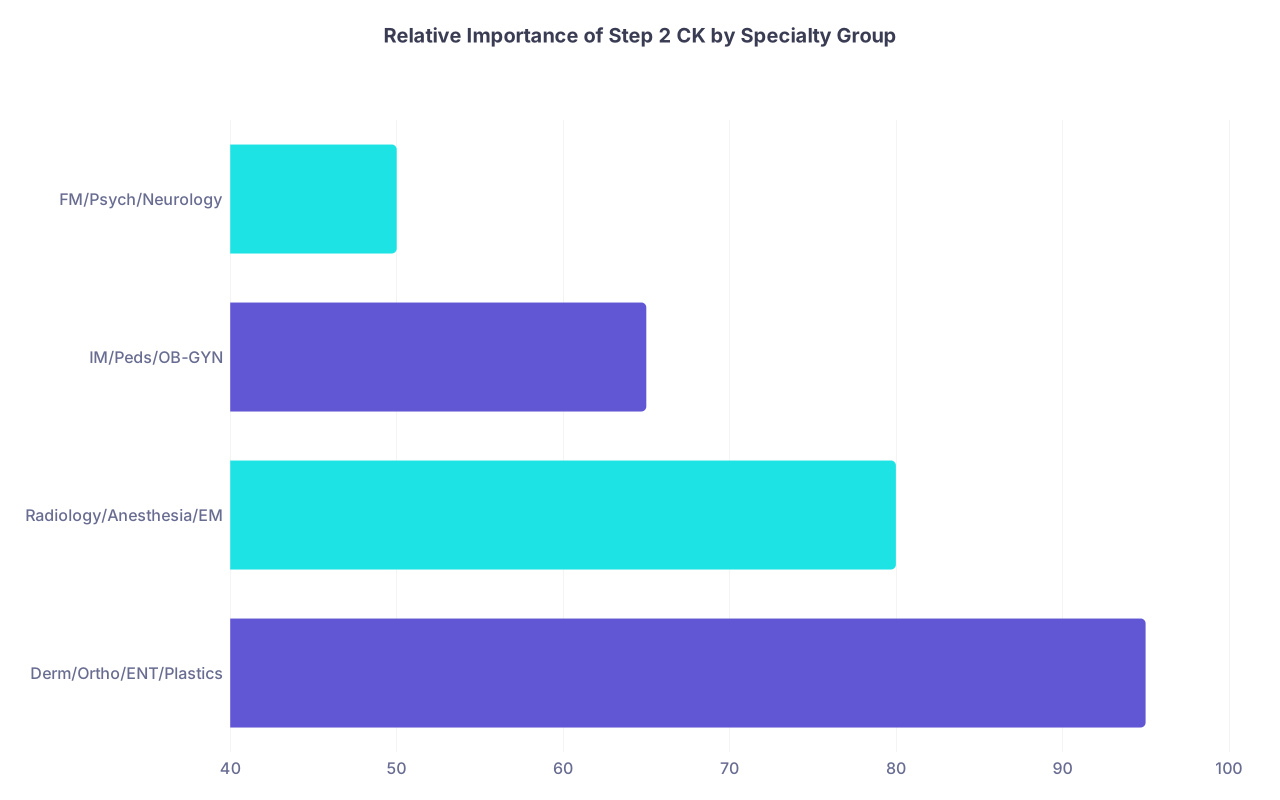
| Category | Value |
|---|---|
| Derm/Ortho/ENT/Plastics | 95 |
| Radiology/Anesthesia/EM | 80 |
| IM/Peds/OB-GYN | 65 |
| FM/Psych/Neurology | 50 |
Derm, Ortho, ENT, Plastics, Ophtho:
Late Step 2 CK with a mediocre score is rough. If you are in this group and your score posts after Sept 15, your:- Research depth
- Letters from well-known faculty
- Home and away rotations
matter even more. You cannot rely on Step 2 to “rescue” a weak Step 1 at the last second if it posts late.
Radiology, Anesthesia, EM:
Programs like to see Step 2 CK, but many will still interview you based on overall profile once they know it is coming. Use your score (when it posts) as targeted ammo for emails if it is strong.IM, Peds, OB-GYN:
A late but solid Step 2 CK generally helps, even if it shows up in October. Especially if your Step 1 was just a pass.FM, Psych, Neurology:
Broadly more forgiving. Holistic review is real here in many regions. A delayed Step 2 CK is rarely fatal.
What To Do Today
You do not fix Step 2 CK timing by worrying about it. You fix it by removing uncertainty and structuring your next moves.
Here is your immediate, concrete step:
Open your calendar right now and mark three dates:
- Your actual Step 2 CK test date.
- The expected score release window (2–3 Wednesdays after).
- September 15 (ERAS submission).
Then, for each date, write one short action sentence:
- “By this date, my ERAS content will be 95% complete.”
- “On this Wednesday, I will check that my score is in ERAS and decide my email strategy.”
- “On Sept 15, I will submit ERAS even if my Step 2 score is not yet posted.”
Once those are written down, you have a timeline. Follow it. The timing will not be perfect, but your process will be—and that is what actually moves the needle.