
The single biggest unspoken rule of Step 2 CK timing is this: your score date matters more than your test date. Programs rank you based on what is in ERAS by late October. Not what you “plan to take soon.”
You’re choosing between three realities:
- Early Step 2 CK: You’re on offense.
- On-time Step 2 CK: You’re neutral.
- Late Step 2 CK: You’re playing catch-up—and you’d better do it strategically.
I’m going to walk you through all three timelines—month by month—so you know exactly what “at this point you should…” looks like.
We’ll assume a “normal” 4th year schedule with:
- ERAS opens: early June
- You can submit ERAS: early September
- MSPE release: October 1
- Most interview offers: October–December
Adjust by a few weeks if your school’s calendar is weird, but the logic stands.
Scenario 1: The Early Step 2 CK Taker (Offense Mode)
This is the student who tests by late June / early July with a score back before ERAS submission. Strong move if:
- You need to compensate for a mediocre Step 1 (Pass with concerns, honors borderline, etc.)
- You’re aiming at competitive specialties (Derm, ENT, Ortho, Rad Onc, some IM subspecialty tracks)
- You want your Step 2 to drive your application narrative
January–February (MS3) – Laying the Foundation
At this point you should:
- Be in the thick of core rotations (IM, Surgery, Peds, OB, Psych).
- Start tracking your NBME shelf scores. They are early Step 2 practice.
- Pick a target test window: late June or early July.
Concrete actions:
- Create a running list of weak systems/topics from every shelf.
- Decide on resources now: UWorld Step 2 QBank, maybe AMBOSS, maybe one main text (Step Up to Medicine or similar).
- If your Step 1 performance was shaky, plan to treat Step 2 as your redemption arc.
March–April – Quiet Build-Up
At this point you should:
- Have a rough study structure around clerkships, nothing crazy yet.
Weekly baseline:
- 80–120 UWorld questions/week in tutor or timed mode.
- 1 focused content block per week on your worst rotation topic (e.g., cardiology, OB, psych).
Schedule:
- Identify a 2–3 week dedicated block after your last key rotation (often after IM or Surgery).
- Reserve family events and travel after that block, not in the middle of it.
May – Locking in the Date
By early May you should:
- Register and book your Step 2 CK date in late June/early July.
- Have finished at least 30–40% of UWorld.
This is where people screw up:
- They “plan” to test early but never book, then end up in August with no slots.
- They cram UWorld into a 3-week fire drill. Scores suffer.
Target progression:
- Two NBME forms between May and early June, even if scores aren’t pretty.
- You want trend data, not perfection.
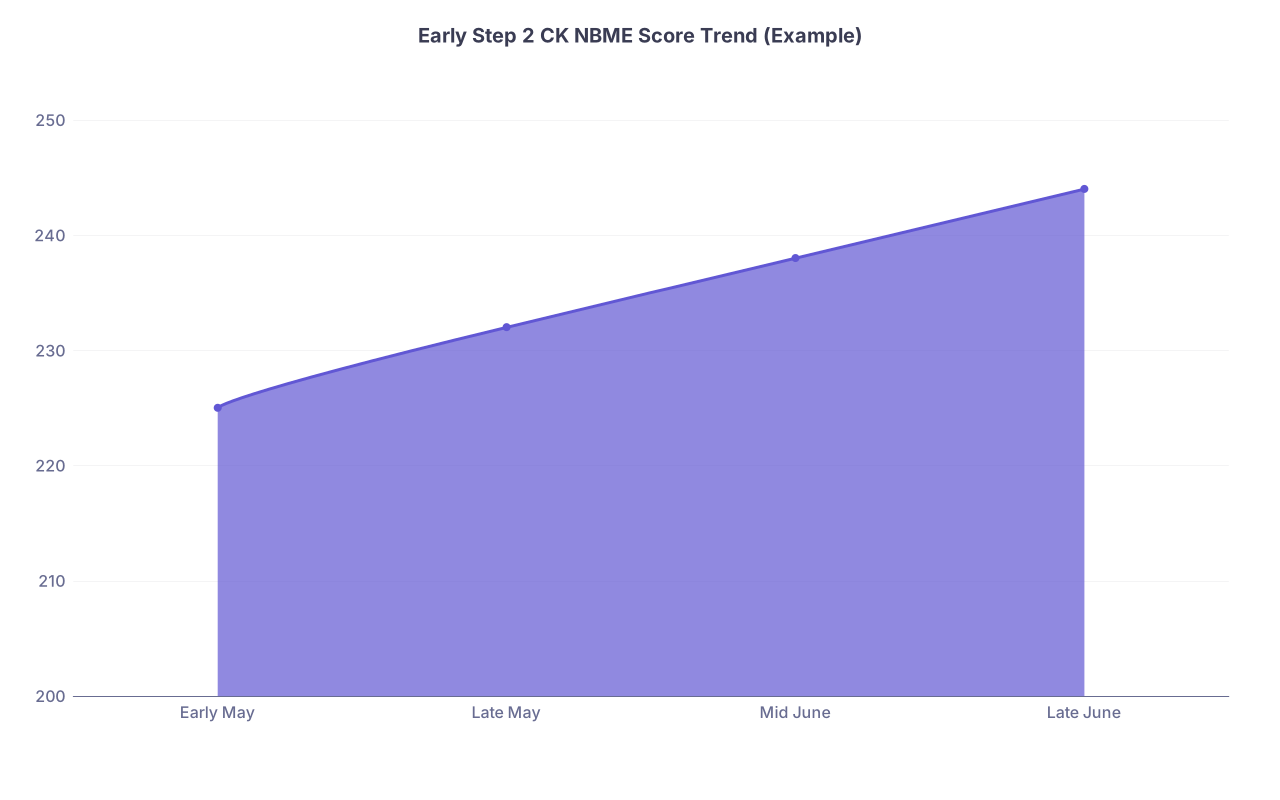
| Category | Value |
|---|---|
| Early May | 225 |
| Late May | 232 |
| Mid June | 238 |
| Late June | 244 |
June – Dedicated and Done
If you’re taking the exam late June:
First 2 weeks of June:
- You should be:
- At 70–80% of UWorld completed.
- Doing 2–3 blocks/day on most days of dedicated.
- Reviewing every explanation like it’s your job (because right now, it is).
Last 2 weeks pre-exam:
- Take:
- 1–2 more NBMEs
- UWorld self-assessment if you want extra data
- Aim to be at or slightly above your target specialty’s competitiveness band.
You test in late June / early July. Score returns in 3–4 weeks, usually before or right around ERAS opens.
July–August – Early Taker Advantage
At this point you should:
- Have a real Step 2 CK score to:
- Share with your letter writers.
- Use in your personal statement narrative (“My Step 2 performance reflects…”).
- Filter your final program list.
Practical benefits:
- If Step 1 is pass-only: programs now see a clear metric.
- If Step 1 is weak: a strong Step 2 is visible before they screen you out.
ERAS strategy for early takers:
- Do NOT schedule Step 2 in ERAS as “planned.” You already have your score. You simply enter the score when it arrives.
- Update your CV bullets with “Shelf scores above 75th percentile” if true, using Step 2 to reinforce that story.
This is the most “offensive” position you can be in: programs know exactly who you are academically when they decide to invite you.
Scenario 2: The On-Time Step 2 CK Taker (Neutral, Default Path)
This is the most common pattern:
- Step 2 CK taken in late July, August, or early September
- Score shows up mid-September to early October, after ERAS submission but before many interviews are offered
Works well if:
- Step 1 was pass or solid enough.
- You’re aiming for mid-range competitiveness specialties.
- Your application strength is broader than just test scores (great clinical grades, strong narrative, research).
February–April (MS3) – Same as Early, But with Less Pressure
At this point you should:
- Be collecting clinical strengths: honors, strong evaluations, early letters.
- Start Step 2 light prep with:
- UWorld questions tied to your rotations.
- Occasional NBMEs once you’re through most core rotations.
No need to rush booking yet, but:
- You should decide if you’re an August or early September tester by April.
May–June – Book and Back-Plan
By early June you should:
- Book a Step 2 CK date in late July, August, or very early September.
- Know your dedicated study block:
- Many schools give 2–4 weeks between core rotations and 4th year electives.
- On-time takers often use this as their main push.
Your June checklist:
- 40–60% of UWorld done.
- At least 1 NBME completed to get a baseline.
- A clear plan for July/August:
- Which rotation will be “lighter” while you ramp up (Sub-I or away rotation is a terrible time to cram).
July – Balancing Rotation + Step 2
If you’re testing mid/late August, then in July you should:
- Increase your UWorld load to 120–160 questions/week.
- Start weekend “mini-dedicated” days:
- 2 blocks + focused review on Saturday.
- 1 block + quick content pass on Sunday.
Key risk:
- You let the rotation completely eat your time and show up to dedicated basically starting Step 2 prep from scratch. That’s how “on-time” becomes “late and underprepared.”

August – Test, Then Submit ERAS
If you test early/mid August:
- Your score usually returns before or right after ERAS submission in early September.
- You’ll be able to update ERAS with your Step 2 score within the first few weeks of screening.
At this point you should:
- Submit ERAS on time regardless of whether the Step 2 score is in that minute.
- Make sure ERAS knows your test is “taken” (not just “planned”), so programs expect a score soon.
If you test late August / early September:
- Your score may not arrive until late September or early October.
- That’s still okay. Many programs send their main wave of invites after October 1 when the MSPE drops.
September–October – How Programs Actually Use Your Score
Reality check:
- Most program directors skim applications quickly:
- Step 1 (if numeric) or Pass
- Step 2 (if present)
- Class standing / clerkship performance
- Letters / school name / red flags
For on-time takers:
- Some invites will go out before your Step 2 appears.
- A good score that posts in late September/early October can:
- Trigger more invites from programs that “held” your app.
- Strengthen your position for ranking later, especially for prelim/TY programs that care about board pass rates.
You should:
- Check that ERAS automatically updates your score (it usually does once transmitted).
- Consider a short, polite update email to key programs if Step 2 is a major jump from Step 1.
On-time takers aren’t maximizing offense, but they’re not handicapping themselves either—assuming they’re prepared and don’t drift into the next category.
Scenario 3: The Late Step 2 CK Taker (Catch-Up or Strategic Delay)
“Late” here means:
- Test after mid-September
- Score not available when programs are doing their main invite wave (late Sept–October)
This can still be defensible—if you’re honest with yourself about why you’re doing it.
Common (valid) reasons:
- Step 1 was strong and you’re not dependent on Step 2.
- You have brutal rotations, away rotations, or personal issues that would tank your score if you rushed.
- You’re changing specialties late and need more time to prep.
Bad reasons:
- “I’m scared so I’ll just push it.”
- “I’ll study after ERAS once things calm down” (they don’t).
March–June – Decide Early if You’ll Be Late
The worst thing you can do is accidentally become a late taker.
By June you should:
- Have made an intentional choice:
- Either test by early September (on-time)
- Or accept that you’re taking it late and adjust your application strategy.
If you’re going late:
- You must understand:
- Many programs will review your file with no Step 2.
- Some competitive specialties and academic programs won’t touch apps without both scores.
| Program Type | No Step 2 by October | Strong Late Score Impact |
|---|---|---|
| Highly competitive | Often disadvantage | Limited, case-by-case |
| Mid-tier academic | Mixed, specialty-based | Can boost mid-season |
| Community programs | More flexible | Can secure more interviews |
July–September – Application Strategy While Studying
At this point you should:
- Be brutally honest in ERAS:
- Mark Step 2 CK as “scheduled” with an actual date.
- Make sure your personal statement and MSPE don’t promise miracles:
- Do not say “I plan to demonstrate my clinical excellence on Step 2 soon” unless you’re confident and early enough for it to matter.
Study-wise:
- You’re probably juggling early 4th year rotations, interviews starting, and Step 2 prep.
- You must carve out:
- 1–2 hours most weekdays
- Longer blocks on weekends
Common failure pattern I’ve seen:
- Student delays exam to “study more.”
- Then uses that extra time to go on trips, do electives that are essentially vacations, or obsess over ERAS formatting.
- Step 2 still ends up underprepared and now also late. Worst of both worlds.
| Category | Value |
|---|---|
| Early May | 225 |
| Late May | 232 |
| Mid June | 238 |
| Late June | 244 |
(Values are illustrative risk levels, not exact percentages, but the pattern is real.)
October–December – Score Drops Mid-Interview Season
If you test in:
- Late September / early October → score drops late October / early November
- Late October / November → score drops late November / December
At this point you should:
- Think like a program director:
- They’ve already sent many invites.
- They may or may not revisit applicants when new scores appear.
Good late Step 2 scenarios:
- You had a strong Step 1 and now a solid Step 2 arrives mid-season:
- Helps mainly for ranking and for a few extra invite decisions.
- You’re applying mostly to community or less competitive programs:
- Many are more flexible and will consider updates.
Risky scenarios:
- Step 1 was marginal and you waited on Step 2.
- If Step 2 is not a clear improvement, it won’t rescue anything—and might hurt.
You should:
- Send targeted updates:
- Short email to select programs:
- 2–3 sentences, include score and brief line about how it reflects your clinical growth.
- Short email to select programs:
- Avoid spamming every program you applied to. That annoys people.
Quick Specialty-Specific Reality Check
Some specialties are much less forgiving about late Step 2 CK, especially post–Step 1 pass/fail.
Here’s a rough sense:
| Specialty | Early Score Helpful | Late Score Risky |
|---|---|---|
| Derm, ENT, Ortho | Very | Very |
| EM, Anes, Rad | High | High |
| IM, Peds, Neuro | Moderate | Moderate |
| FM, Psych | Helpful but flexible | Lower |
If you’re targeting a high-stakes field and Step 1 is pass-only or weak, you should lean early or at worst on-time. Late is a gamble.
Visual Timeline: All Three Scenarios Side-by-Side
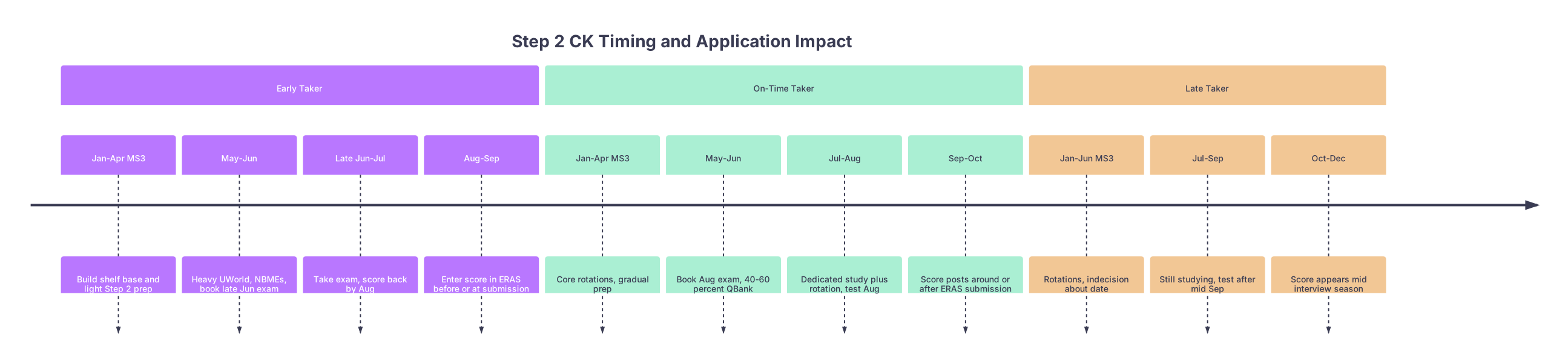
| Period | Event |
|---|---|
| Early Taker - Jan-Apr MS3 | Build shelf base and light Step 2 prep |
| Early Taker - May-Jun | Heavy UWorld, NBMEs, book late Jun exam |
| Early Taker - Late Jun-Jul | Take exam, score back by Aug |
| Early Taker - Aug-Sep | Enter score in ERAS before or at submission |
| On-Time Taker - Jan-Apr MS3 | Core rotations, gradual prep |
| On-Time Taker - May-Jun | Book Aug exam, 40-60 percent QBank |
| On-Time Taker - Jul-Aug | Dedicated study plus rotation, test Aug |
| On-Time Taker - Sep-Oct | Score posts around or after ERAS submission |
| Late Taker - Jan-Jun MS3 | Rotations, indecision about date |
| Late Taker - Jul-Sep | Still studying, test after mid Sep |
| Late Taker - Oct-Dec | Score appears mid interview season |
How to Choose Your Scenario Intelligently
At this point—wherever you are—you should decide deliberately, not reactively.
If you should be an Early Taker:
- Your Step 1 is a weak point.
- You’re eyeing competitive specialties.
- You can secure a 2–4 week dedicated block by June/July.
- Then:
- Book now.
- Build UWorld early.
- Accept that your summer belongs to Step 2.
If On-Time fits you best:
- Your Step 1 is passable or strong.
- You want more clinical experience baked in before testing.
- You can realistically ramp in July and take it August/early September.
- Then:
- Guard your dedicated time like it’s sacred.
- Avoid stacking a brutal Sub-I with your heaviest study period.
If you’re leaning Late:
- Be honest:
- Are you delaying because of legitimate schedule/health/academic reasons?
- Or just fear and procrastination?
- If legitimate:
- Plan a rigorous, realistic study schedule woven into your interview season.
- Accept that Step 2 will be less central to getting interviews and more about board eligibility and ranking.
- If it’s fear:
- Pick an earlier date.
- Commit to the grind. Fear-driven delays usually backfire.
Core Takeaways
- Your score availability date is what programs care about. Early and on-time takers let Step 2 actually influence invites; late takers often don’t.
- Accidentally becoming a late taker is the worst-case scenario. Choose your path by June, book the date, and back-plan your studying and rotations.
- Align timing with your Step 1 story and specialty goals. Weak Step 1 or competitive specialty? You should be early or at worst solidly on-time, not drifting into “I’ll figure it out later” territory.