
The worst Step 2 CK test-day disasters can be salvaged. But only if you document them correctly and early.
Most people blow this. They vent in GroupMe, send a one-line email to NBME or Prometric, then hope the score “works out.” Then six months later, during ERAS, they are scrambling to explain a 214 after an “I was scoring 250s on UWorld NBMEs” story with zero proof.
You are not doing that.
You are going to build a clean, tight documentation trail that:
- Protects you if you need a score invalidation, retest, or appeal
- Gives you credible material for a Step 2 CK explanation in ERAS and during residency interviews
- Shows programs you are organized, honest, and not making excuses
Here is exactly how.
1. First Decision: Score Acceptance vs. Incident Claim
Before you write a single sentence, you need to be clear on what you are trying to accomplish.
There are only three realistic outcomes after a test-day disaster:
- You accept the score as is, do nothing formal, and move on.
- You file an official incident/irregularity but still keep the score.
- You push for retest/score invalidation because you believe your score will be seriously compromised.
If you are reading this, you probably fall into #2 or #3.
When you should strongly consider formal documentation
You should build a formal documentation plan if any of these occurred:
- Technical issues
- Multiple freezes or crashes during blocks
- Test center power outage or server failure
- Time lost due to system reboot or software malfunction
- Environment problems
- Loud, continuous noise (construction, alarms, staff talking) that persisted despite complaints
- Major temperature issues (extremely cold/hot) despite reporting
- Serious interruptions (someone repeatedly entering your cubicle, proctor talking to you mid-block)
- Administrative errors
- Incorrect scheduling, delayed start of >30–45 minutes without compensatory break
- Wrong exam loaded initially
- Proctor gave incorrect instructions about break time or navigation that affected your timing
- Personal acute medical emergency
- Sudden severe illness during the exam (vomiting, fainting, chest pain, panic attack with functional impairment)
- You reported it to staff or left the center early
- Security or misconduct by others that affected you
- Another examinee shouting, arguing with staff, being removed, etc.
If your “disaster” is pretty normal test-day misery—poor sleep, anxiety, feeling “off,” a tough form—that is not documentation material. You can mention it briefly later if you absolutely must, but there is no formal case to build.
You only build a documentation case when an objective third party could reasonably say, “Yes, that situation could affect performance, and it should have been reported.”
2. Timeline: What To Do in the First 7 Days
You have two clocks running:
- The NBME/USMLE incident reporting window (you want to be early and detailed)
- The ERAS/match clock (you need coherent documentation ready long before applications open)
Here is the timeline.
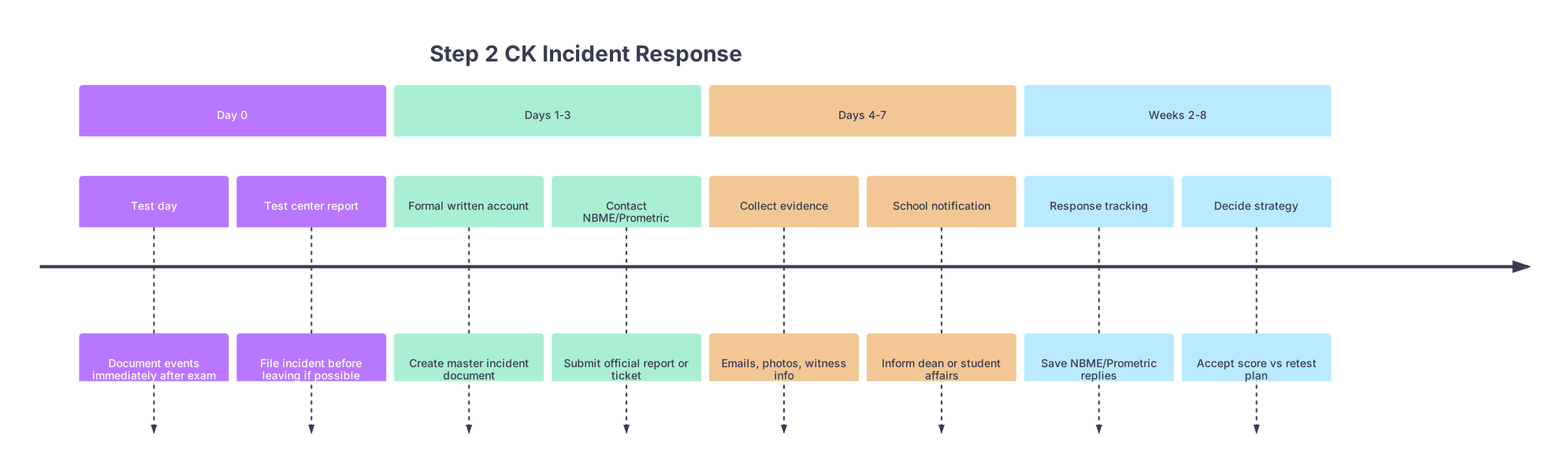
| Period | Event |
|---|---|
| Day 0 - Test day | Document events immediately after exam |
| Day 0 - Test center report | File incident before leaving if possible |
| Days 1-3 - Formal written account | Create master incident document |
| Days 1-3 - Contact NBME/Prometric | Submit official report or ticket |
| Days 4-7 - Collect evidence | Emails, photos, witness info |
| Days 4-7 - School notification | Inform dean or student affairs |
| Weeks 2-8 - Response tracking | Save NBME/Prometric replies |
| Weeks 2-8 - Decide strategy | Accept score vs retest plan |
The more exact your documentation in that first 72 hours, the stronger your position later. Memory fades. Details blur. You want hard timestamps and specifics.
3. Step-by-Step: How To Document the Incident Properly
You are going to create a documentation package. Think of it like a mini legal file, not a venting diary.
That package will contain:
- A master narrative document
- Incident reports (test center, NBME, school)
- Evidence (if any)
- A summary page for ERAS use later
Step 1: Write a Master Narrative (Same Day if Possible)
Open a blank document. Title it:
Step 2 CK – Test Day Incident – [Your Full Name] – [Test Date] – [Test Center City, State]
Then structure it with clear headings. Use this template:
- Basic Exam Details
- Pre-exam Status
- Incident Description (Chronological)
- Actions Taken During Exam
- Actions Taken After Exam
- Estimated Impact on Performance
- Witnesses / Staff Names (if known)
Now fill it out. Be specific and clinical. You are a historian in an H&P, not writing a personal essay.
1. Basic Exam Details
- Full name
- USMLE ID
- Exam: Step 2 CK
- Date and local time of exam
- Test center address and center ID if you have it
2. Pre-exam Status
Brief and factual:
- Sleep (e.g., “Slept from 11 pm to 4 am, woke up multiple times”)
- Baseline health (e.g., “No acute illness, mild baseline anxiety”)
- Baseline performance (e.g., “Last two practice NBMEs: 247, 251”)
You are not building a sob story. You are establishing that you were appropriately prepared and not already falling apart before the test.
3. Incident Description (Chronological)
This is the core. Break it into time blocks. For example:
7:45–8:30 AM – Check-in Issues
- Arrived at 7:45 AM for 8:00 AM check-in
- System failure at center; staff informed all candidates that “the server is down, we are calling tech support”
- Exam start delayed until 8:35 AM
Block 2 – 9:50–10:30 AM – Computer Freezes
- At question 22, screen froze for ~3 minutes
- Raised hand, proctor came at ~2 minutes, restarted workstation
- Lost on-screen timer position; resumed under time pressure
You want:
- Exact or approximate clock times
- Block numbers affected
- Actions you took (raising hand, asking for quiet, etc.)
- Staff responses and exact phrases when relevant (e.g., “The proctor said, ‘There is nothing we can do about the noise, construction is scheduled all day.’”)
Do not interpret. Do not speculate. Just describe.
4. Actions Taken During Exam
List what you actually did to mitigate:
- Reported to staff at X times
- Used or did not use extra breaks to recover
- Asked for earplugs, moved seats, etc.
- Any forms signed or incident logs completed
5. Actions Taken After Exam
This section matters when you want credibility later.
- Did you speak to the front desk before leaving?
- Did they give you an incident number or case ID?
- Did you email or submit a ticket to NBME/Prometric that day?
If you did nothing, write that too. But then fix it now by catching up on reports.
6. Estimated Impact on Performance
Do not write, “This ruined my score; I was a sure 260.” That will get rolled eyes.
Write in concrete terms:
- “During Block 3, I was distracted by repeated loud hammering sounds and proctor conversations behind me. I reread many questions and felt unable to focus. I marked 20+ items, which is considerably more than on any practice exam.”
- “Due to the unexpected 10-minute interruption and confusion with the timer, I had ~8 questions left with 3 minutes remaining in Block 4. I guessed on the last 5 items without reading.”
Translate “disaster” into observable behavior: guessing, rushing, rereading, losing track of time.
7. Witnesses / Staff Names
If you remember:
- Staff: “Front desk: middle-aged female staff, name tag ‘K. Johnson’.”
- Other examinees: “Two other examinees in the room requested earplugs due to construction noise.”
You are building corroboration potential, even if you never contact these people.
4. Formal Reporting: NBME, Prometric, and Your School
Your master document is your base. Now you turn it into official reports.
Step 2: File an Incident with the Test Center / Prometric
If you did not file something before leaving the center, you are already behind. Fix it.
- Check your exam confirmation email for the appropriate contact link (Prometric or vendor equivalent).
- Use their “Test Experience” or “Incident” form or email channel.
- Paste a condensed version of your narrative, not the entire 3-page document.
Key rules:
- Lead with exam details and the main issue in the first 2–3 sentences.
- Bullet your key incidents (timestamps, blocks, what went wrong).
- End with a clear request: documentation only, or investigation and possible remedy.
Example opening:
I am writing to report significant disruptions during my USMLE Step 2 CK exam on [date] at [center]. These included repeated computer freezes requiring restarts, a prolonged exam start delay, and continuous construction noise during multiple blocks despite raising these concerns with staff.
Then you list the 2–4 major events with times and blocks. That is it.
Save:
- The email you send (PDF it).
- Any auto-replies with ticket or incident numbers.
- Any substantive responses.
Put them all in a “Step 2 CK Incident” folder.
Step 3: Notify NBME / USMLE
Most Step 2 CK registration is through NBME/USMLE. You use their “Test Day Issues” or “Irregular Conditions” contact process (exact wording may change, but there is always a channel).
Again:
- Use your master document.
- Summarize, do not dump.
- Attach only what is necessary (you do not need 10 screenshots of your practice NBMEs).
Your structure:
- Brief intro + exam details
- Short summary of the problem
- Clear statement of what you want:
- Documentation only and record of incident
- Formal irregular conditions review
- Consideration for retest / score invalidation
You must decide whether you are asking for:
- Just documentation: “I want this incident documented in case my score is significantly below expectation and I need to explain it to residency programs.”
- Possible retest / invalidation: “Given the extent of the disruptions, I am requesting a review to determine if a retest or score invalidation would be appropriate.”
Be aware:
If you push for invalidation and they agree, you may lose the score entirely. That is not a free roll. Think before you ask.
Step 4: Inform Your School (Student Affairs / Dean’s Office)
Most schools have seen this movie before. Some are helpful; some are useless. You do not know until you loop them in.
Send a polite, concise email:
- To: Student affairs dean or the person who handles licensing exams
- Subject: “Step 2 CK – Test Day Incident – [Your Name, Class Year]”
Attach your master narrative or a slightly trimmed version. Ask for:
- Advice on next steps
- Whether they can document this in your student record
- Whether they have seen similar cases and outcomes
Sometimes, later, you need a support letter. Schools are much more likely to write one if you informed them immediately, not nine months later when you are scrambling for damage control.
5. Evidence: What To Collect (and What Not To Bother With)
You do not need to go full detective. But you do want clean supporting material.
Useful evidence:
- Emails from Prometric/NBME acknowledging issues
- Photos:
- If there was a visible issue (e.g., ceiling leak, broken thermostat showing 58°F), photos can help
- Do not take photos inside the actual test room (security violation). Only general facility/common areas if appropriate and non-prohibited
- Medical documentation:
- If you had an acute panic attack, syncope, or other episode, and saw a clinician the same or next day, keep that note
- If you were on new medication with side effects documented
- Practice exam record:
- A short list of your last 3–4 NBMEs and their dates/scores; do not send them all now, but have them ready
What is useless:
- Screenshots of GroupMe classmates saying the center is “trash”
- Long text threads with friends complaining about the day
- Emotional rants on social media (delete those, honestly)
You want evidence that a reasonable outsider would consider relevant and credible.
6. Turning Documentation into an ERAS-Ready Explanation
Fast forward: You get your Step 2 CK score, and it is significantly below your practice range. Or you had to retake due to invalidation. Now this is a residency application problem.
If you documented correctly, you now have:
- A precise narrative of what happened
- Third-party acknowledgment (center, Prometric, NBME, school)
- Clear contrast between baseline performance and the affected score
Here is how to use it.
Decide Where (and Whether) To Explain
You have a few common slots:
- Personal statement – rarely the best place, unless it is central to your narrative
- ERAS “Additional Information” or “Impactful Experiences”
- A brief note that your dean’s letter (MSPE) may include
- Interview-day responses when asked about Step scores
If your score is marginally lower than your target but still reasonable for your specialty, you may not need a long explanation. Do not overplay it.
If your score is clearly out of line with the rest of your application (e.g., strong clinical grades, high Step 1 if reported, strong practice tests) and it constrains your specialty options, a concise, documented explanation helps.
How To Frame the Incident for Programs
Your tone matters more than the drama of the story.
Do:
- Take responsibility for decisions you controlled (e.g., you chose to continue instead of cancel)
- Focus on facts, not feelings
- End with what you did afterward (studied more, retook, excelled on rotations, etc.)
Do not:
- Blame everyone else for everything
- Claim you “definitely would have scored 260+”
- Spend a full paragraph on your emotions
Here is a rough template for an ERAS-style explanation paragraph:
During my Step 2 CK exam on [date], there were several significant test-day disruptions at the testing center, including [brief list: e.g., repeated computer freezes requiring restarts and continuous loud construction noise despite multiple reports to staff]. I filed an incident report with the center and NBME on the same day, and my medical school’s student affairs office documented the event. While I chose to complete the exam, I believe these irregular conditions contributed to a score that does not fully reflect my clinical knowledge or my performance on practice exams and clerkships. Since that time, I have demonstrated my capabilities through [strong clerkship evaluations, high subject exam scores, improved performance on subsequent standardized testing, etc.].
You are not begging for sympathy. You are giving context with receipts.
7. Retake Strategy and Match Positioning
Sometimes the best move after a disaster is a retake. Sometimes it is accepting the imperfect score and playing the match game strategically.
Your documentation plan informs that decision.
Use a Simple Decision Grid
Ask yourself:
- Did NBME / USMLE acknowledge any part of your claim in writing?
- Is your current score below typical cutoffs for your target specialty?
- Do you have time to retake before ERAS and still get results back?
| Situation | Recommended Path |
|---|---|
| Score slightly below target, no strong documentation | Keep score, do not overexplain |
| Score significantly below target, strong documentation, little time before ERAS | Keep score, explain briefly, adjust specialty/program list |
| Score significantly below target, strong documentation, time for retake | Schedule retake, build improvement narrative |
| Score invalidated or exam voided by NBME | Retake as soon as allowed, document extensively |
Here is the rule:
If you retake, your documentation plus a strong second score becomes a resilience story, not a weakness.
Talk like this in interviews:
- “My original Step 2 CK was taken under irregular conditions that I formally documented with NBME and my school. I was not satisfied that it reflected my ability, so I retook the exam under standard conditions and scored [X], which aligns better with my consistent performance on clerkships and practice assessments.”
Programs are not stupid. They know test centers can be a mess. What they care about is whether:
- You tell the truth without dramatizing
- You take ownership and fix problems
- You can recover and perform under pressure
Your documentation proves you did not invent this story after the fact.
8. Common Mistakes That Kill Your Credibility
I have seen applicants torpedo themselves more with the explanation than with the score.
Avoid these:
Reporting late with vague memory
- “I think there was some noise and maybe my computer froze at some point.”
- Translation for committees: “This person is exaggerating or misremembering.”
Never reporting anything formally, then telling a huge story on ERAS
- If it was really that bad, why is there zero contemporaneous record?
- This inconsistency hurts you badly.
Over-claiming the disaster
- Saying “I was on track for 260+” with practice NBMEs in the 230s.
- Committees check for internal logic.
Making the whole application about this one exam
- You want this to be a small, footnoted part of your story, not the headline.
Blaming everyone except yourself
- Not owning the decision to continue the exam.
- A more adult version: “Given the situation, I chose to complete the exam, but in retrospect I might have considered stopping or voiding.”
9. Quick Implementation Checklist
If you just had a bad Step 2 CK day, here is your punch list:
- Today (Day 0):
- Write your master narrative with times, blocks, events
- File an incident at the test center if possible
- Within 72 hours:
- Submit a detailed report to NBME/USMLE using your narrative
- Email your school’s student affairs with the same
- Create a folder and save all emails / tickets
- Next 2–4 weeks:
- Decide: accept score, consider retake, or pursue invalidation
- If you retake, start a structured study schedule based on your weak content areas, not just vibes
- ERAS season:
- Draft a short, factual explanation paragraph based on your original documentation
- Decide which programs actually need to hear this vs where you let your file speak for itself
10. The Bottom Line
Three things matter most when you are recovering from a Step 2 CK test-day disaster:
- Early, precise documentation. Times, blocks, events, actions you took. No drama. Just facts.
- Formal reporting to the right entities. Test center, NBME/USMLE, and your medical school, with everything saved and organized.
- Controlled, concise explanation later. Use the documentation to support your ERAS narrative and interview answers, not to build an excuse.
Do those three, and you turn a chaotic exam day into a manageable, documented hiccup in your record—not the defining feature of your residency application.