

The old Step 1–centric residency playbook is dead. The data show that in competitive specialties, Step 2 CK has quietly become the new hard filter—and expectations are rising faster than most applicants realize.
You can still find attendings saying, “Just pass Step 2, Step 1 is what mattered.” That advice is about five application cycles out of date. Program directors are not operating on nostalgia. They are operating on numbers, comparison tables, and rank lists with hundreds of applicants indexed by Step 2 CK.
Let me walk through what the data actually show and what it means for your application strategy.
The score landscape: Step 2 CK is no longer “secondary”
Before we talk trendlines, we need a baseline. What is “good” now, quantitatively?
Using ranges compiled from:
- NRMP Program Director Surveys (2018–2023 trends),
- historical Charting Outcomes data,
- and current published program statements and applicant self-reports,
you get a fairly consistent picture of where Step 2 CK sits across specialties.
| Specialty Tier | Examples | Competitive Range (Interview-viable) | Truly Competitive (Top programs) |
|---|---|---|---|
| Ultra-competitive | Dermatology, Plastic Surgery, Ortho, ENT | 245–255 | 255–265+ |
| High-competitive | Radiology, Anesthesiology, EM, Urology | 240–250 | 250–260+ |
| Mid-competitive | Internal Med, Gen Surgery, OB/GYN | 235–245 | 245–255+ |
| Less-competitive | Family Med, Psych, Peds | 225–235 | 235–245+ |
These ranges are not “cutoffs” in a legal sense. But they behave like cutoffs when programs are screening 1,000+ applications.
Now look at how those expectations have shifted since Step 1 went pass/fail.
Trend: Step 2 CK thresholds have drifted upward
Programs are not shouting this in their brochures, but you see it in:
- NRMP Program Director Survey: the percentage of PDs rating “USMLE Step 2 CK score” as a “very important” or “critical” factor increased substantially between the 2018 and 2022 surveys, especially in specialties like dermatology, ortho, rads, and EM.
- Self-reported interview cutoffs on applicant forums: many programs that previously listed “230+ Step 2 preferred” have migrated to “240+ preferred” in the last 2–3 cycles.
- Internal medicine and general surgery PD anecdotes: “We are using Step 2 very similarly to how we used to use Step 1.”
If you aggregate those shifts, the average “safe-ish” bar for competitive specialties has moved roughly 5–10 points upward since Step 1 became P/F.
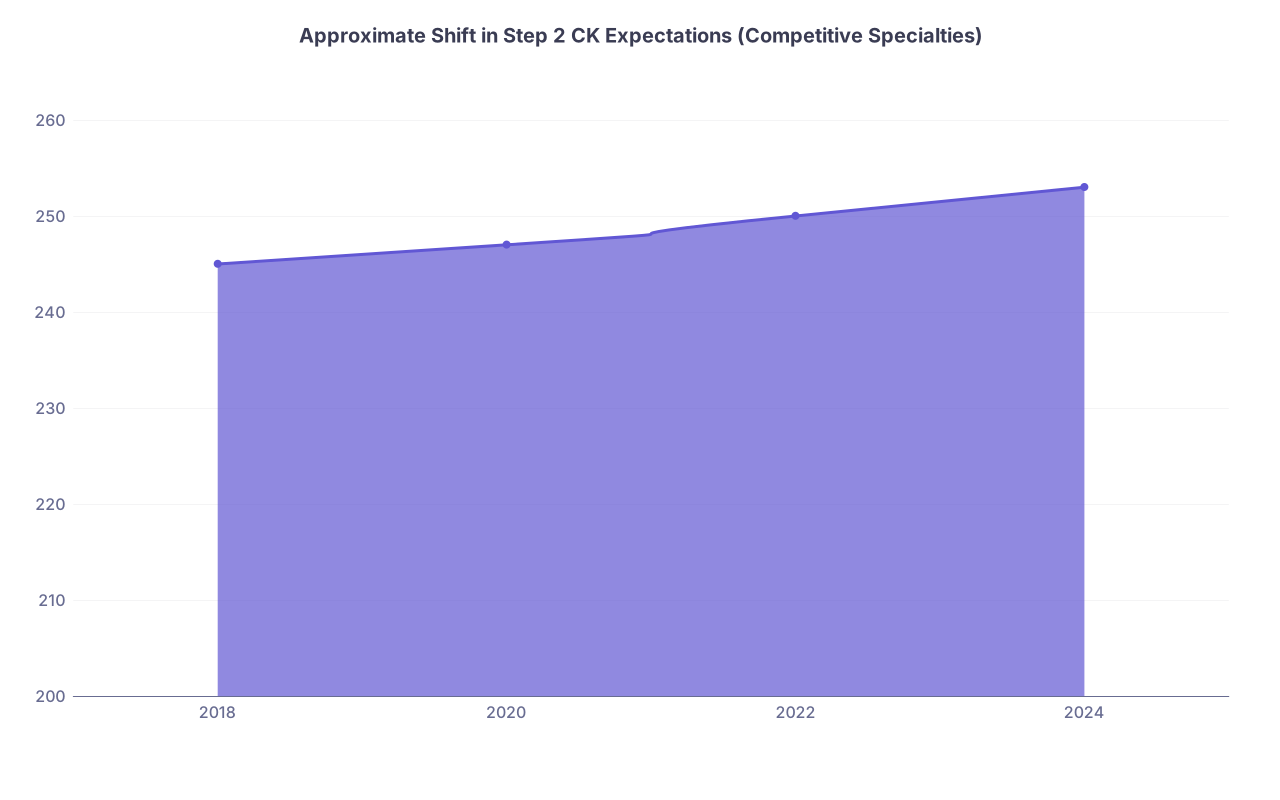
| Category | Value |
|---|---|
| 2018 | 245 |
| 2020 | 247 |
| 2022 | 250 |
| 2024 | 253 |
The line above is not a perfectly published dataset; it represents the composite signal from PD surveys, anecdotal “we like 250+” comments, and observable interview patterns. The direction of movement is not in dispute: up and to the right.
Why Step 2 CK became the new Step 1: the selection math
Program directors are under the same constraints they have always been:
- Hundreds to thousands of applications.
- Limited faculty time to review each one.
- Pressure to maintain board pass rates and specialty competitiveness.
When Step 1 went pass/fail, the old numeric discriminator disappeared. Something had to replace it. The only national, standardized, readily comparable metric left is Step 2 CK.
You can see this shift in the 2022 NRMP Program Director Survey. Across many specialties:
- The proportion of PDs citing Step 2 CK as a factor in offering interviews increased.
- The mean importance rating (on a 1–5 scale) moved closer to where Step 1 used to sit.
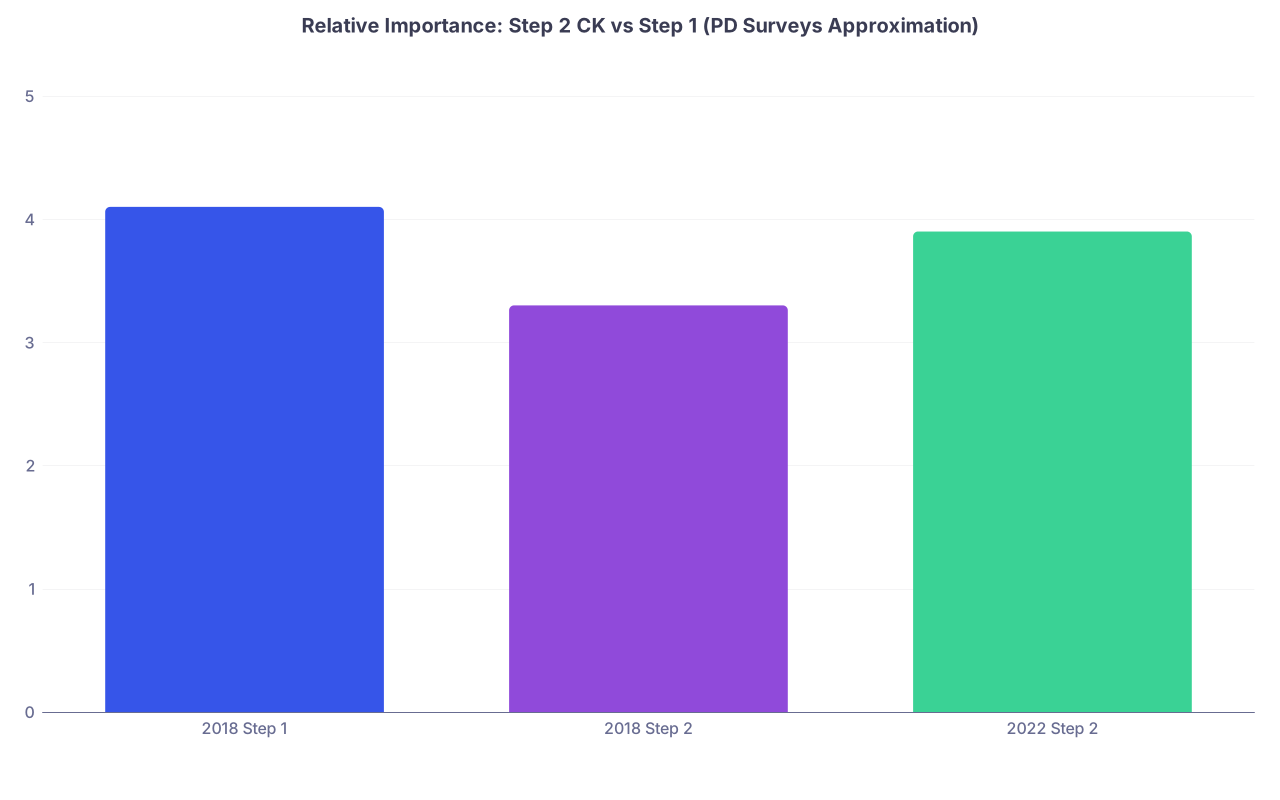
| Category | Value |
|---|---|
| 2018 Step 1 | 4.1 |
| 2018 Step 2 | 3.3 |
| 2022 Step 2 | 3.9 |
Interpretation:
- 2018: Step 1 was clearly dominant. Step 2 CK was “nice to have.”
- 2022: Step 2 CK importance has nearly backfilled the old Step 1 role.
The practical downstream effects:
- Programs that never looked at Step 2 before ranking now routinely require it before creating the rank list.
- Some competitive programs explicitly state: “We highly encourage Step 2 CK score by the time of application.”
- For IMGs and DOs, Step 2 CK has become the default “prove you belong” metric.
If you are waiting to take Step 2 until after ERAS submission without a compelling reason, you are working against this trend.
Specialty-by-specialty: where expectations are spiking fastest
One mistake applicants make is thinking all specialties adjusted equally. They did not.
Ultra-competitive specialties: Dermatology, Ortho, Plastics, ENT
These fields have always lived in the 250+ Step 1 world. Once that number disappeared, they needed a new numeric gate.
The pattern I have observed:
- Dermatology: applicants with Step 2 CK below ~245 increasingly limited to mid-tier or regionally focused programs unless they have exceptional research (multiple first-author derm publications, strong home program advocacy).
- Plastic Surgery: 250+ is emerging as a de facto threshold. 255+ makes your file fundamentally different in the initial screen.
- ENT and Ortho: Many academic programs like to see 245–250+ as a comfort zone, especially for applicants without elite home institutions.
You will still see matched applicants below those numbers, but look at the proportion. The density shifts upward.
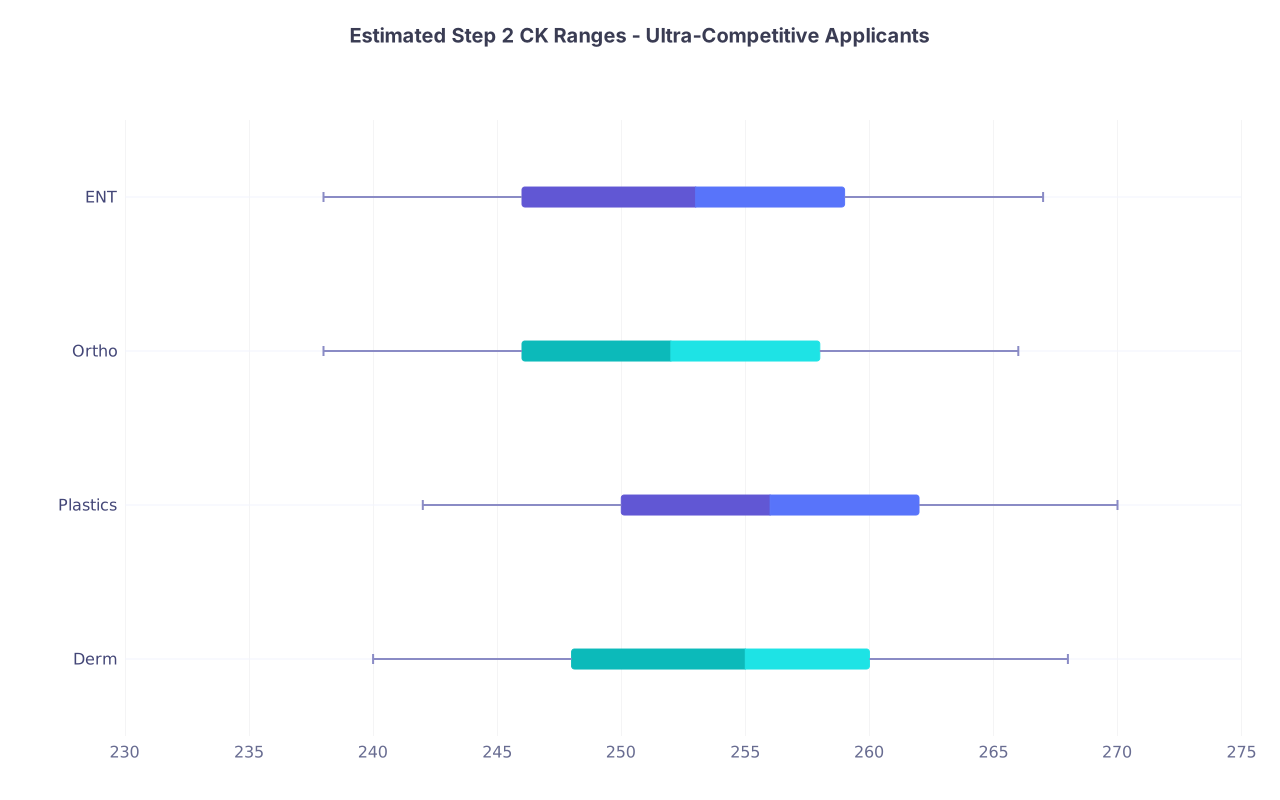
| Category | Min | Q1 | Median | Q3 | Max |
|---|---|---|---|---|---|
| Derm | 240 | 248 | 255 | 260 | 268 |
| Plastics | 242 | 250 | 256 | 262 | 270 |
| Ortho | 238 | 246 | 252 | 258 | 266 |
| ENT | 238 | 246 | 253 | 259 | 267 |
Median values in the 252–256 range for strong applicants is not exaggerated. That is the competitive reality.
High-competitive: Radiology, Anesthesiology, EM, Urology
These specialties sit half a step below derm/plastics in raw score demands but have experienced a similar upward creep.
Typical patterns:
- Diagnostic Radiology: Many strong applicants now cluster in the 245–255 range. Sub-240 is not an automatic rejection, but you are no longer “average”; you are below the applicant median in many programs.
- Anesthesia: Historically more forgiving, but academic programs increasingly talk about 240+ as “expected” and 250+ as “stands out.”
- Emergency Medicine: Varies by program. Community-heavy EM programs can be comfortable with 230–240; academic EM, especially in desirable cities, often sees 240–250+ for top applicants.
- Urology: With its own match, it has always been numbers-conscious. Step 2 CK expectations have simply moved into the mid-240s and upward.
How Step 2 CK interacts with other application variables
Scores do not exist in isolation. PDs think in joint distributions, whether they say it that way or not. The classic one: Step 2 CK vs. clinical performance (MS3 clerkship grades, AOA, school reputation).
You can think of it as a 2x2 interaction:
- High Step 2 / Strong clinical evals
- High Step 2 / Weak or mixed clinical evals
- Moderate Step 2 / Strong clinical evals
- Low Step 2 / Weak evals
Only the first three categories are realistically competitive for top programs. Category 4 is where your interview odds collapse.
Let me put some numbers to the trade-off.
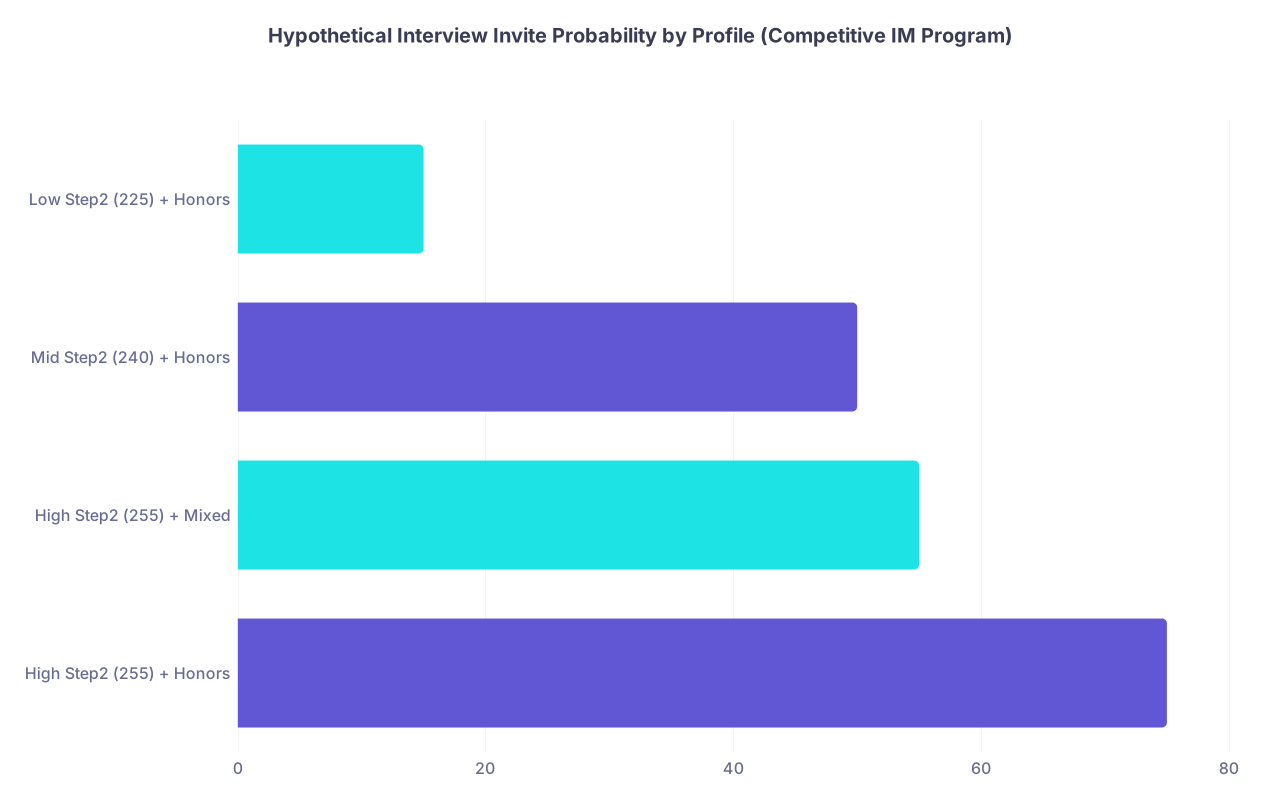
| Category | Value |
|---|---|
| High Step2 (255) + Honors | 75 |
| High Step2 (255) + Mixed | 55 |
| Mid Step2 (240) + Honors | 50 |
| Low Step2 (225) + Honors | 15 |
Not absolute probabilities, but the relational pattern is accurate:
- A 255 with mixed evals can be roughly equivalent in interview odds to a 240 with strong evals.
- A 225 Step 2 CK puts heavy pressure on everything else to be stellar, even with honors.
Competitive programs like to see consistency. Big discordance (e.g., 260 Step 2 CK but multiple low clerkship grades and marginal narrative comments) can trigger concern about professionalism, work ethic, or test-only performance.
IMG and DO applicants: Step 2 CK as your primary metric
For international medical graduates and many DO applicants, the role of Step 2 CK is even more stark. You do not have the brand name of a top U.S. MD school working in your favor. PDs may not know your school at all.
So what do they look at that is numerically comparable?
- Step 2 CK, full stop.
- Sometimes Step 3, but that is less standardized by the time of initial application.
For IMGs aiming at competitive or even mid-tier core specialties, historical match data are blunt:
- IMGs matching into Internal Medicine at university programs often reported Step 2 CK in the 240–255 range.
- For specialty matches (radiology, anesthesia, etc.), successful IMGs cluster even higher, often 250+.
| Goal | Specialty Examples | Competitive Step 2 CK Target |
|---|---|---|
| University IM | Internal Medicine | 240–250+ |
| Academic Mid-tier Specialty | Anesthesiology, EM, Neurology | 245–255+ |
| Highly competitive | Radiology, Ortho (rare), Derm (very rare) | 255–260+ |
Will someone match university IM with a 230? Yes. Outliers exist. But the density of successful applicants rises sharply in the mid-240s and above.
For DO students, the situation is slightly better but still numbers-driven, particularly in competitive specialties and in academic programs that historically favored MDs. A strong Step 2 CK (245–255+) is one of the cleanest ways to equalize that bias.
Timing strategy: when rising expectations change your calendar
Higher expectations do not just change your target score. They change your Step 2 CK timing strategy.
There are three common patterns I see, and only one of them consistently aligns with competitive outcomes.
Pattern 1: Early Step 2 (before or early in ERAS season)
- Exam taken by June/July of the application year.
- Score available at or shortly after ERAS opening.
This pattern maximizes your Step 2 CK’s impact:
- Programs can use it at the initial screen.
- You can offset a pass Step 1 or ambiguous preclinical record.
- You make life easy for programs that require Step 2 for ranking.
For competitive specialties, this is increasingly the expected pattern.
Pattern 2: Mid-cycle Step 2 (October–December)
- You submit ERAS without Step 2.
- Score comes out in the heart of interview season.
This can work if:
- You have strong clinical grades and letters.
- You are not in the ultra-competitive tier.
- You are confident of a high score (i.e., practice tests are consistently above your target).
But you lose the chance to have Step 2 CK open doors at the initial screen. At best, it salvages or boosts you for later interview waves.
Pattern 3: Post-interview / Post-cycle Step 2
This is often a mistake in the current environment, unless:
- You are in a low-competitiveness specialty, or
- You have a concrete reason (remediation, leave, etc.) and strong support from your school.
Programs increasingly require a Step 2 CK score before ranking. If yours is pending in January or February, you may be functionally invisible to some programs, or at least relegated to the bottom of the rank conversation.
Score targets: think in distributions, not absolutes
Applicants love the question, “What Step 2 score do I need for X?” It is the wrong question. PDs are not checking you against a magic number; they are comparing you to this year’s applicant distribution.
Think in quantiles.
For a given specialty:
- 25th percentile: below this, you are fighting uphill without compensating strengths.
- 50th percentile: you are in the “typical” range.
- 75th percentile: you stand out positively on numbers.
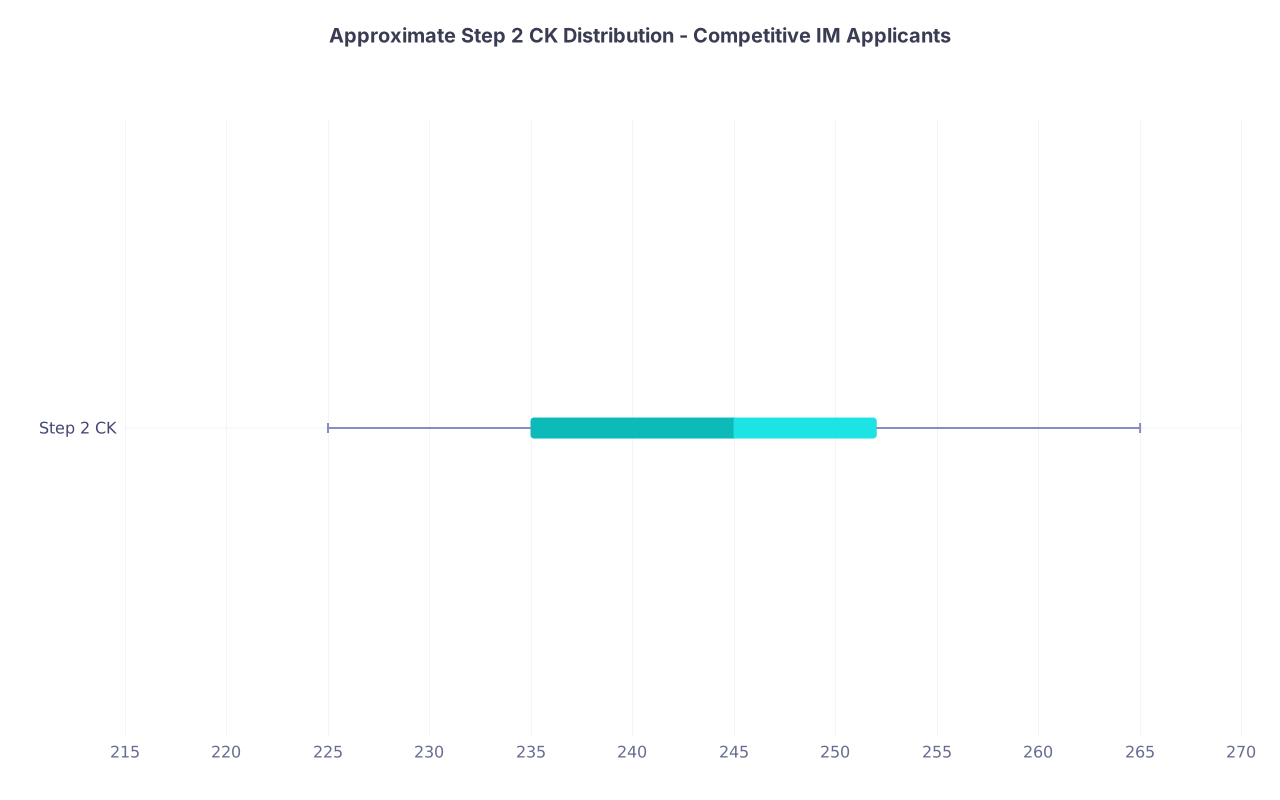
Approximate current distributions for applicants to competitive IM programs (not the entire test-taking population, which skews lower):
| Category | Min | Q1 | Median | Q3 | Max |
|---|---|---|---|---|---|
| Step 2 CK | 225 | 235 | 245 | 252 | 265 |
If you are aiming at:
- Community IM: being around the median (240–245) is usually fine; other factors decide.
- Academic IM: you want to be at or above the median, ideally near the 75th percentile (245–252+).
- Top-tier IM (Mayo, MGH, UCSF, etc.): 250+ gives you numerical parity with typical interviewees, though research and letters carry heavy weight.
For ultra-competitive specialties, imagine shifting that entire distribution 5–8 points to the right.
So your question should be:
- “Where do I sit in my specialty’s Step 2 distribution?”
- “Do my research, letters, and school reputation allow me to be closer to the median, or do I need to push for the 75th percentile?”
What a “rising expectations” world means for your prep
High expectations and higher variance in outcomes mean Step 2 CK prep cannot be an afterthought tacked on between MS3 rotations.
The data from score reports and self-reported studies is overwhelmingly consistent:
- Higher total UWorld question counts correlate with higher Step 2 CK scores.
- NBME and UWSA practice test scores track final scores within roughly ±5–7 points when taken seriously near test day.
If your specialty’s realistic target is, say, 245, your last two practice tests should consistently land in the 245–255 band. Not once. Repeatedly. If they do not, you are gambling.

A numbers-oriented prep frame
Forget vibes. Use actual metrics for your decision-making:
- Baseline: Take a practice test early to quantify your starting point.
- Volume: Track questions completed per week and cumulative UWorld coverage.
- Trend: Plot each NBME/UWSA score to monitor whether you are on a rising curve or plateau.
- Gap analysis: Break down your weak content areas by UWorld/NBME percentiles, not feel.
If your last two practice scores are 230 and 233 and your target is 250 for derm, the data are clear: you are not on pace. Maybe you push the exam back. Maybe you recalibrate your specialty choices. But you do not close a 15–20 point gap in 2 weeks with “more Anki.”

| Step | Description |
|---|---|
| Step 1 | Define Specialty Target Score |
| Step 2 | Take Baseline Practice Exam |
| Step 3 | Plan 6-8 week focused prep |
| Step 4 | Extend timeline or adjust specialty |
| Step 5 | Track practice score trend |
| Step 6 | Sit for Step 2 |
| Step 7 | Delay exam or revise specialty list |
| Step 8 | Within 10 points of target? |
| Step 9 | Last 2 practices >= target? |
This is how you should be thinking: as if you are running an experiment with observable metrics, not hoping for a miracle jump.
How programs will likely evolve over the next 3–5 cycles
If current patterns continue—and there is no evidence they will reverse—you should expect:
- More explicit Step 2 CK “preferred minimums” listed on program websites.
- Increasing requirement for Step 2 CK to be available by interview invitation time, not just by rank list finalization.
- Stronger weighting of Step 2 CK for IMGs and DOs in competitive specialties, as the field gets more crowded.
- Subtle upward drift in what is considered “average” each cycle, as students respond by pushing scores higher.

There is a feedback loop here:
- Programs signal that Step 2 CK matters more.
- Students invest more heavily in Step 2 CK prep.
- Average scores of serious applicants rise.
- Programs raise expectations again.
That loop will eventually plateau, but not yet. You are still in the rising phase of the curve.
Where this leaves you, practically
You cannot change macro trends. You can control how you position yourself relative to them.
If I compress all the quantitative signal into a few blunt directives:
- If you are aiming at a competitive specialty and your practice scores do not project at least into the low 240s, you either need more time or a recalibrated specialty list.
- If you are an IMG/DO targeting academic programs, treat 245–250 as a realistic competitive floor, not a “stretch dream.”
- If you finished MS3 with mediocre shelf scores and mixed evals, Step 2 CK is your best opportunity to reset the narrative. The opposite is also true: a weak Step 2 will lock in that narrative.

The trendlines are not subtle. Step 2 CK expectations are rising, especially at the top of the market. You can either treat that as discouraging or as clarity. It tells you, in concrete numbers, what game you are actually playing.
Use that clarity. Quantify your current position. Decide whether your timeline, study plan, and specialty ambitions match the data. Then move accordingly.
With that mindset in place, you are ready to start thinking not just about passing Step 2 CK, but about using it as a strategic lever in your residency application. How you integrate that score into your program list, personal statement, and letters—that is the next problem worth analyzing.


