
The biggest mistake clinicians make when they pivot to business is underselling what they already do every single day.
You are not “just a doctor.” You are a walking operations lab, risk manager, communicator, and product strategist. The problem is that you are speaking in case presentations, and the business world is listening for metrics, levers, and outcomes.
Let me show you exactly how to translate clinical cases into marketable business skills—step by step, no fluff.
Step 1: Stop Telling Stories, Start Telling Systems

When you describe your experience like this:
“I managed complex ICU patients and coordinated with multidisciplinary teams.”
…you sound like every other clinician. Recruiters glaze over.
You need to reframe that same experience as a business problem, a process, and a measurable result.
Use this simple translation framework for any clinical case:
Context (Business framing, not medical drama)
- Instead of: “62-year-old male with sepsis…”
- Use: “High-risk, unstable situation with incomplete data, multiple stakeholders, and time pressure.”
Constraints
- Time (e.g., “decision needed within 5 minutes”)
- Resources (limited staff, limited OR time, no MRI overnight)
- Policy (hospital protocols, payer constraints, regulations)
Actions (Your levers)
- What exactly you did in business language:
- Prioritized scarce resources
- Coordinated cross-functional team
- Implemented a rapid triage workflow
- Negotiated conflicting priorities
- What exactly you did in business language:
Outcome (Quantified)
- Clinical result → Business result:
- Decreased time to treatment
- Reduced length of stay
- Avoided unnecessary testing
- Improved patient throughput
- Increased adherence to guidelines
- Clinical result → Business result:
Now your “case presentation” sounds like this:
“I led rapid decision-making in high-risk, time-critical situations with incomplete data. On a typical ICU shift I prioritized care across 12–18 complex patients, coordinated a multidisciplinary team under resource constraints, and consistently reduced time to critical interventions by 30–60 minutes compared to baseline workflows.”
Same work. Different language. Vastly different impact.
Step 2: Map Clinical Activities to Business Functions
You are doing core business functions already. You just do them in scrubs instead of a blazer.
Here is a direct mapping you can use to rewrite your CV, LinkedIn, and interview stories:
| Clinical Activity | Business Function |
|---|---|
| Running morning rounds | Operations management |
| Triage in ED/clinic | Prioritization & resource allocation |
| Multidisciplinary huddles | Cross-functional collaboration |
| Explaining risks to patients | Stakeholder communication & risk framing |
| Implementing new protocol | Change management & process improvement |
| Quality or M&M meetings | Quality assurance & root cause analysis |
Let’s go granular.
1. Diagnosis → Analytical and Product Thinking
Clinical reality: You synthesize scattered data (history, lab results, imaging, exam) to arrive at a working diagnosis, weigh differentials, and update your plan as new data arrives.
Translated:
- Hypothesis-driven analysis
- Data synthesis from multiple noisy sources
- Iterative decision-making under uncertainty
How you would say it in business terms:
“I am trained to form and test hypotheses using incomplete, noisy data. On a daily basis I combine qualitative inputs (patient narrative, team feedback) with quantitative data (labs, imaging, vitals trends) to identify root causes, prioritize risks, and adjust strategy in real time.”
2. Rounds and Lists → Operations and Workflow Design
Those “patient lists” you manage? That is operations in its rawest form.
You:
- Prioritize tasks for the day
- Sequence work to avoid bottlenecks
- Anticipate downstream problems (discharge needs, social issues)
- Coordinate multiple team members
Business interpretation:
“I routinely managed dynamic, high-volume workflows. Each day I organized and sequenced 20–30 interdependent tasks across a team of nurses, therapists, and consultants, balancing urgent needs with long-term goals to minimize delays in care and reduce bottlenecks in patient flow.”
3. Breaking Bad News → Stakeholder Management and Communication
If you can tell a family their loved one is dying, you can manage a misaligned stakeholder group.
Clinical reality:
- You tailor communication to different literacy levels
- You handle emotional reactions without losing the plan
- You align people to a shared decision despite conflicting preferences
Business framing:
“I specialize in high-stakes communication with emotionally invested stakeholders. I am able to explain complex, technical information in plain language, align expectations, and guide groups toward decisions when incentives and preferences are not fully aligned.”
Step 3: Turn Cases into Bullet-Proof “Business Stories”
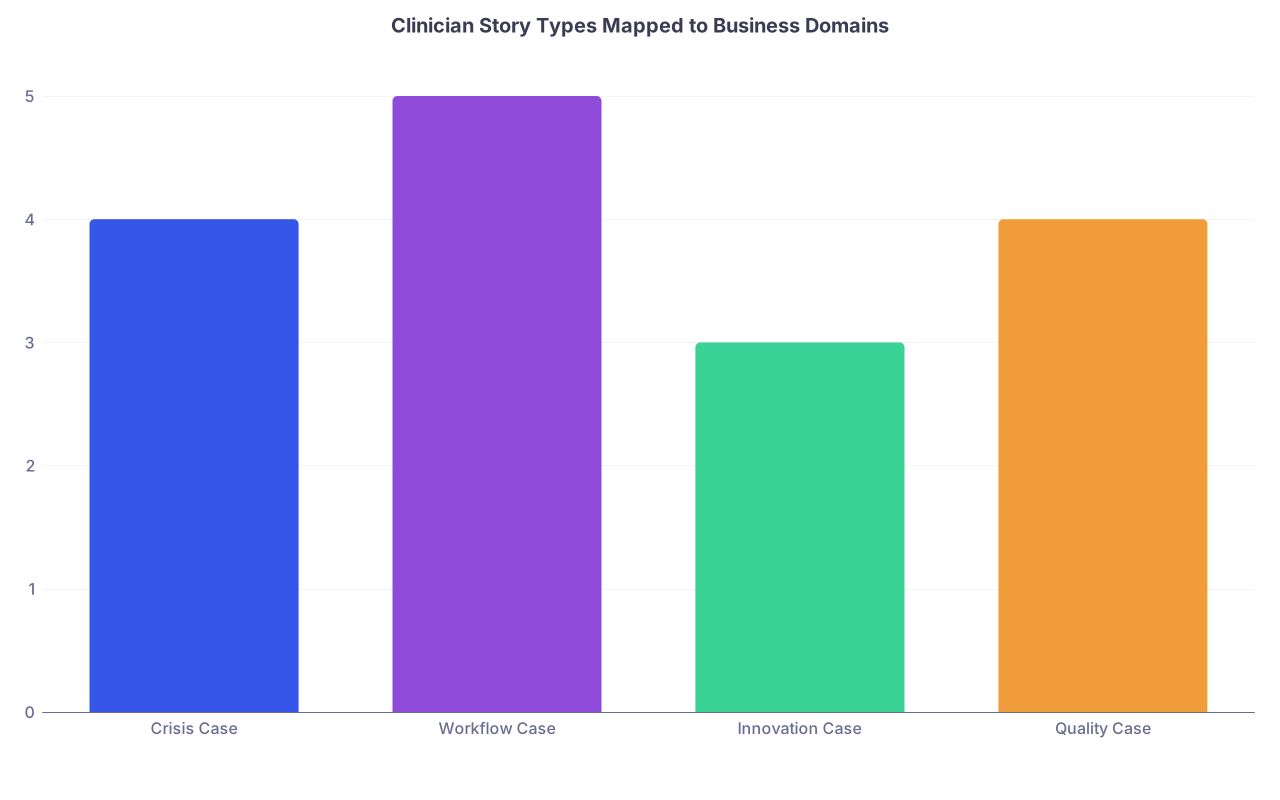
| Category | Value |
|---|---|
| Crisis Case | 4 |
| Workflow Case | 5 |
| Innovation Case | 3 |
| Quality Case | 4 |
You need 6–8 reusable “anchor stories” drawn from your clinical life that you can adapt to interviews, networking, and applications.
Each story should hit 4 checkpoints:
- Business Problem
- Constraints / Complexity
- Your Specific Actions
- Quantified or Concrete Results
Let’s build a few.
Story Type 1: Crisis Management → “Leadership Under Uncertainty”
Clinical case: Massive GI bleed rolling into the ED.
Bad version:
“We had a patient with a massive GI bleed and I managed the resuscitation.”
Good, marketable version:
- Business problem: “An unexpected critical event threatened both safety and flow.”
- Constraints: Limited staff, no immediate endoscopy, full ED.
- Actions:
- Quickly reassigned tasks and restructured roles
- Escalated to ICU and GI early with clear expectations
- Created a temporary workflow to preserve throughput for other patients
- Outcomes:
- Stabilized patient
- Avoided shutting down the whole ED for one patient
- Preserved core metrics (door-to-provider time, overall wait times)
Business translation:
“During an unplanned critical incident, I reorganized a 6-person ED team on the fly, reallocated resources to stabilize a high-risk patient while preserving throughput for 20+ other patients, and coordinated with ICU and GI to avoid service shutdown. The team maintained door-to-provider and disposition times within target ranges despite the disruption.”
Now this reads like crisis leadership and ops management, not “I hung blood and called GI.”
Story Type 2: Chronic Disease → “Longitudinal Customer Success”
Clinical case: Difficult diabetic patient with poor control, frequent admissions.
Transformed:
“I managed a high-risk, high-utilization patient population. For one particularly complex patient with recurrent admissions, I redesigned their care plan by involving a pharmacist, social worker, and diabetes educator, shifting from reactive, hospital-based care to proactive outpatient management. Over 12 months, this reduced their hospital admissions from 6 to 1 and improved treatment adherence, demonstrating the impact of coordinated, multidisciplinary care on cost and outcomes.”
This is essentially a customer success and lifecycle management story.
Step 4: Quantify What You Already Do
If you cannot put numbers on your impact, you will be ignored in business conversations.
You do not need randomized trials. You need reasonable, defensible estimates.
Think in these buckets:
- Volume
- Patients per day/week/year
- Procedures per month
- Team size
- Time
- Time to decision
- Time from consult to action
- Length of stay
- Quality / Outcomes
- Readmission rate changes
- Complication rates
- Protocol adherence
- Efficiency / Cost Proxies
- Reduced unnecessary tests
- Avoided admissions
- Fewer duplicate consults
Example:
“Implemented a new pre-op checklist for our ortho cases.”
Weak. Now quantify:
“I co-led implementation of a standardized pre-op checklist for elective orthopedic procedures. Within 6 months, we reduced day-of-surgery cancellations by approximately 25% (from roughly 8 per month to 6), saving multiple OR blocks and associated staffing hours.”
Nobody will audit your exact numbers. But they must be credible and linked to a clear mechanism.
Step 5: Match Skills to Specific Alternative Careers
“Alternative medical careers” is too vague. The translation depends on where you aim.
Here is a snapshot to orient you:
| Target Role | Core Clinical Skill to Highlight |
|---|---|
| Pharma/Medtech MSL | Communication, clinical reasoning |
| Clinical operations | Rounds, throughput, workflow design |
| Health tech/product | Problem framing, user insight, MVP thinking |
| Management consulting | Analytical reasoning, structured thinking |
| Insurance/Utilization Mgmt | Guideline-based decision making, cost-benefit judgment |
1. Pharma / Medtech / MSL
You are now the bridge between trial data and reality.
Translate cases into:
- “How this therapy impacts real-world adherence”
- “Barriers to uptake at the front line”
- “Which patients actually benefit vs look good on paper”
Example:
“In managing patients with biologics for inflammatory bowel disease, I routinely balanced guideline recommendations with real-world access, adherence challenges, and comorbidities. I can articulate the clinical nuance behind treatment selection and explain why certain therapies succeed or fail in actual practice, beyond trial populations.”
2. Clinical Operations / Hospital Administration
You already live in operations.
Show:
- How you improved discharge efficiency
- How you reduced delays in imaging, transport, consultations
- How you smoothed transitions between ED–floor–ICU–OR
Example:
“I led a small initiative to streamline discharge planning on our general medicine service by starting disposition planning on day 1, flagging anticipated barriers during morning rounds, and establishing a daily 5-minute touchpoint with case management. Informally tracking for 3 months, we saw typical discharge order times move up by 2–3 hours, opening beds sooner and decreasing length of stay for select patients.”
Not fancy. Very operational.
3. Health Tech/Product Management
Product teams are desperate for people who actually know what happens in clinics.
From your cases, extract:
- Workarounds clinicians use with current systems
- Failure points in current workflows
- Where tech helps vs slows things down
Clinical case:
“We kept missing subtle early sepsis cases on the floor.”
Product framing:
“On the wards I repeatedly saw failure points in early sepsis recognition: scattered data across EHR tabs, alert fatigue from non-specific prompts, and inconsistent escalation thresholds. I helped our unit trial a simple, one-page sepsis checklist and a revised escalation protocol. This kind of front-line workflow redesign is exactly what digital tools must support rather than disrupt.”
Now you sound like a product thinker who understands user pain.
Step 6: Build a “Skill Translation Sheet” for Yourself
Do this once and you will use it for the next 10 years.
Take a blank page (or spreadsheet) and create three columns:
- Clinical scenario
- What I actually did (specific behaviors)
- Business skill name + metric
Example entries:
Clinical: “Night float cross-cover on 40+ patients”
- Did: Rapid triage, prioritized pages, created mental queue, escalated only when necessary
- Business skill: “Prioritization at scale under time pressure; managed a queue of 30–40 concurrent issues per night and maintained safe care with minimal escalation”
Clinical: “Implemented new anticoagulation bridging protocol”
- Did: Reviewed evidence, aligned surgeons/hospitalists/pharmacy, educated residents, tracked early outcomes
- Business skill: “Change management and stakeholder alignment across three departments, resulting in reduced perioperative delays and more predictable scheduling”
Once you have 10–15 of these, you can plug them directly into:
- Resume bullet points
- LinkedIn About section
- Interview answers (“Tell me about a time…”)
Step 7: Rewrite Your CV in Market Language

Your academic CV is almost useless outside academia.
You need a business resume that:
- Leads with targeted skills, not degrees
- Uses impact bullets, not job descriptions
- Strips out jargon that only clinicians understand
Bad bullet:
- “Managed inpatient and outpatient care of cardiac patients.”
Good bullet:
- “Led longitudinal management of a high-risk cardiac population (20–25 patients per clinic day), coordinating multidisciplinary care and optimizing treatment plans to reduce unplanned admissions and improve adherence.”
Bad bullet:
- “Participated in quality improvement project on hand hygiene.”
Good bullet:
- “Co-led a unit-based quality improvement project that increased observed hand hygiene compliance from ~70% to ~90% over 4 months through targeted education, visual cues, and simple auditing, decreasing hospital-acquired infections on the unit.”
Every bullet should follow a pattern:
Action verb + business skill + scope + result (ideally with numbers)
Step 8: Practice Saying This Out Loud Without Slipping Back into “Doctor Mode”
On paper is one thing. In conversation, most clinicians regress and start presenting like they are on rounds.
You need to rehearse your new language.
Take 3–5 clinical stories and practice telling them:
- In 30 seconds
- In 2 minutes
- In 5 minutes (for deeper interviews)
Rules:
- No ICD codes. No detailed labs. No “the CT showed…”
- Lead with the business problem, not the medical label:
- “We had a major workflow bottleneck…”
- “We were seeing a high failure rate in…”
- “We needed to redesign how…”
Example 30-second version:
“On our medicine service we were frequently missing anticipated discharge dates, which led to bed shortages and backup in the ED. I introduced a simple habit: explicitly setting and revisiting a target discharge date for each patient during rounds, and flagging barriers for early action by case management. Over a couple of months, more patients left earlier in the day and ED boarding noticeably decreased on our primary unit.”
Notice: no disease names. Clear business framing.
Step 9: Use Visual and Process Thinking
Business people love processes and frameworks.
Take a classic clinical experience and draw it as a process. Then you can talk through the diagram in an interview or networking chat.
Example: Admitting a patient from ED to floor.

| Step | Description |
|---|---|
| Step 1 | ED identifies admit |
| Step 2 | Initial assessment and orders |
| Step 3 | Bed request placed |
| Step 4 | Waitlist and prioritization |
| Step 5 | Handoff to floor team |
| Step 6 | Medication reconciliation |
| Step 7 | Day 1 plan and discharge target |
| Step 8 | Bed available |
Now you can say:
“I know this workflow end-to-end and can quickly identify where digital tools or process changes would reduce delays—typically at bed assignment, handoff quality, and early discharge planning.”
That sounds like operations and product thinking, not “I admit patients.”
Step 10: Anchor Everything to One Simple Identity Statement
You need a one-sentence answer to: “So what do you do?”—even if you are still clinical.
Something like:
- “I am a clinician who specializes in turning messy frontline workflows into clear, efficient processes.”
- “I use my clinical background to bridge the gap between real-world care and scalable health solutions.”
- “I am a physician-operator focused on improving how care actually gets delivered.”
Then every case you share is evidence supporting that identity.
Quick Reality Check: What Business People Actually Care About
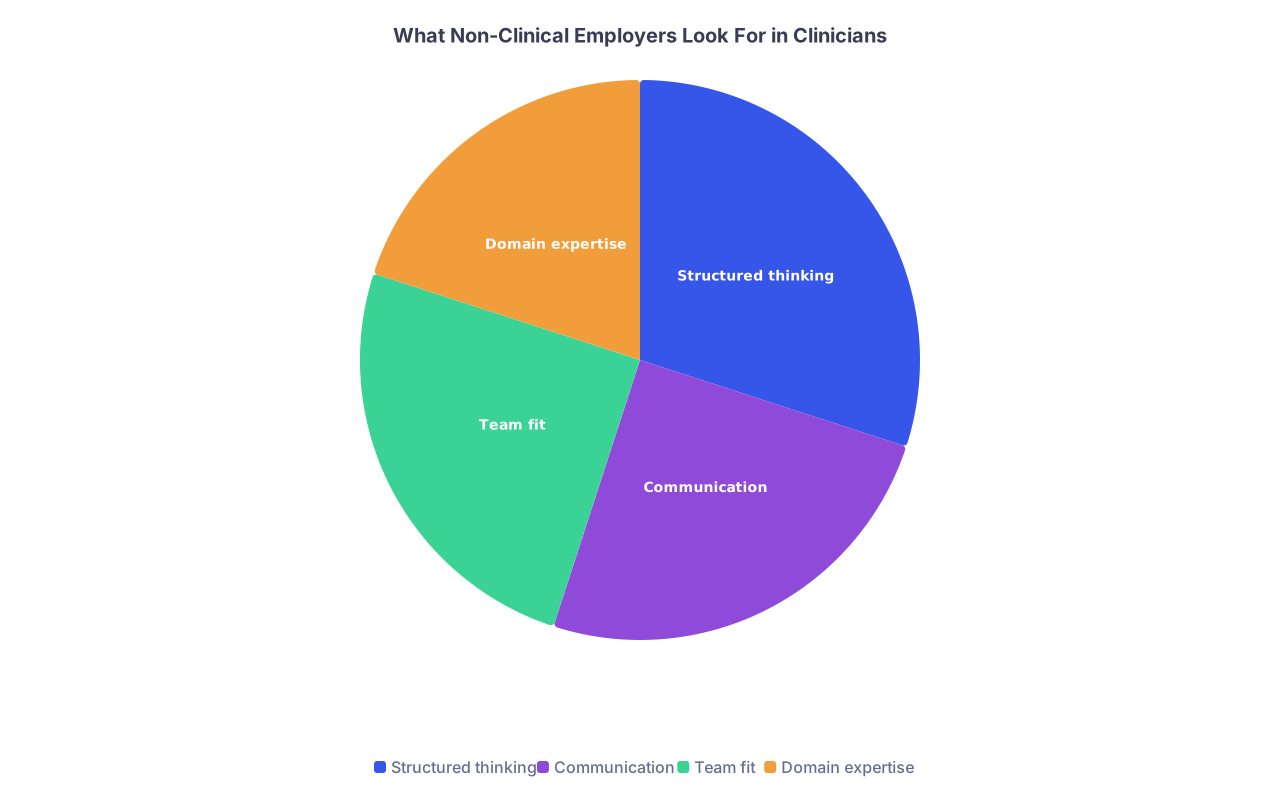
| Category | Value |
|---|---|
| Structured thinking | 30 |
| Communication | 25 |
| Team fit | 25 |
| Domain expertise | 20 |
You think your board scores matter. They do not.
Here is what actually gets you hired outside traditional medicine:
- Can you talk clearly about problems and solutions without jargon?
- Do you understand trade-offs and constraints, not just ideal guidelines?
- Have you led change, or did you just “participate”?
- Do you show you can learn business concepts quickly?
Every clinical case you describe should be proof of one of these.
If your story ends with “…and then the patient got better,” you missed the point.
If it ends with “…and we reduced delays / improved adoption / prevented waste / aligned the team,” you are on the right track.
Final Moves: Put This Into Action in the Next 7 Days
Do not read this and go back to clinic the same way.
Here is a concrete, one-week protocol:
Day 1–2: Build your translation sheet
- List 15–20 memorable clinical cases.
- For each, write:
- Problem (in business language)
- Constraints
- Your actions
- Outcome (with at least one approximate number)
Day 3–4: Rewrite your resume bullets
- Replace all disease names with process/impact language.
- Force every bullet to have a measurable or observable outcome.
Day 5–6: Practice 3 anchor stories out loud
- One “crisis / acute” story
- One “process improvement / operations” story
- One “communication / stakeholder” story
- Record yourself. Eliminate medical jargon.
Day 7: Update LinkedIn headline and About section
- Headline example:
- “Physician | Clinical Operations and Workflow Optimization | Translating Frontline Care into Scalable Solutions”
- About section: 3–5 short paragraphs using your new language and 2–3 of your strongest quantified impacts.
- Headline example:
Do this, and suddenly your “years of clinical experience” stop being an abstract line and become a portfolio of marketable business skills.
The Short Version
- Your clinical cases are already business stories—you just have to rewrite them in the language of problems, constraints, actions, and measurable outcomes.
- Map everything you do to clear business functions like operations, product, risk management, and stakeholder communication, then quantify your impact with credible numbers.
- Build reusable, well-practiced stories that you can deploy in resumes, LinkedIn, and interviews, so you stop sounding like “a doctor exploring options” and start sounding like a valuable operator in any alternative medical career.