
The biggest reason smart clinicians never land their first freelance medical writing client is simple: they hide behind portfolios and LinkedIn instead of sending a sharp, targeted cold email.
You do not need a website. You do not need a logo. You do not need a 20-piece portfolio.
You need one thing: a systematized outreach script that you actually use.
This is that system.
Step 1: Get Clear On Exactly Who You Are Pitching
“Anyone who needs medical content” is not a client profile. It is a stall tactic.
Your cold outreach works only if it is painfully specific. You are writing to one human with one job at one type of company.
Pick one lane to start:
- Health tech / digital health startups
- CME / education companies
- Healthcare marketing agencies
- Pharmaceutical / med device marketing teams
- Patient education platforms or large health systems
- Health blogs that pay (not content mills for $20/article)
Then narrow to a role. The actual human who can say “yes” is usually:
- Director / VP of Marketing
- Content Marketing Manager
- Medical Director (at agencies)
- Managing Editor / Editorial Director
- Founder / CEO (for early-stage startups)
Stop overthinking. Pick one segment and one role and commit for 4 weeks.
| Target Type | Best Contact Role | Why Good For Beginners |
|---|---|---|
| Health tech startup | Marketing Manager / Founder | Need authority, move fast |
| CME company | Medical Editor | Value clinician writers |
| Healthcare agency | Medical Director | Constant need for freelancers |
| Hospital/health system | Patient Education Lead | Ongoing patient-facing content |
| Health blog (funded) | Managing Editor | Structured process, clear pay |
If you are a clinician, you already have a niche. Do not pretend you are “general medical writer.” Sell what you already know best:
- Hospitalist? Care transitions, inpatient pathways, chronic disease content
- EM? Urgent care, triage tools, symptom checkers, patient education
- Primary care? Prevention, screening, chronic disease management
- Specialist? Own that specialty for B2B and CME content
Your first 5–10 clients will not hire you for being a “writer.” They will hire you for being the clinician who understands their exact space.
Step 2: Build a Minimum Viable Proof Packet (1–2 Days)
You do not need a fancy portfolio. You do need to remove doubt that you can write.
Your goal is simple: when they click one link, they think, “Yes, this person can clearly explain medical stuff.”
Here is the minimum viable setup:
A clean LinkedIn profile (or simple one-page Google Doc “bio”)
- Headline: “Physician & Freelance Medical Writer – [Your Specialty / Focus]”
- About: 3–4 short bullets:
- X years clinical in [field]
- Types of writing: e.g., patient education, blog posts, white papers, CME
- Topics: e.g., cardiometabolic disease, digital health, health systems
- One line on availability: “Available for freelance and consulting projects.”
2–3 writing samples (you can create them yourself)
Create them in a Google Doc or simple PDF. No one cares that they were not “published” yet if the quality is high.Aim for:
- 1 patient-facing article (800–1200 words)
- 1 professional-facing or B2B-style piece (1000–1500 words)
- Optional: 1 short “explainer” or FAQ sheet
Make them:
- On topics you actually want to be hired for
- Clear, structured, with headings and plain language
- Light on citations but obviously evidence-based
One simple landing doc
A 1-page Google Doc you can link that says:- Who you are (2–3 lines)
- What you write (bullet list)
- 2–3 sample links
- Contact info
This is your “trust packet.” Good enough beats perfect. You can upgrade later.
Step 3: Find Real Humans To Email (Not Generic Inboxes)
Mass emailing “[email protected]” is how you burn time.
You are going to spend 60–70% of your effort just finding good targets. That is normal. That is the job.
Here’s a lean process that works.
A. Use LinkedIn as your primary radar
For each target type you picked:
Search:
- “healthcare content marketing manager”
- “medical education editor”
- “CME managing editor”
- “digital health content lead”
Filter by:
- Industry: “Hospital & Health Care,” “E-Learning,” “Pharmaceuticals,” “Marketing & Advertising,” “Information Technology & Services”
- Geography: start with your country or time zone for easier calls
Open each interesting profile:
- Check their company website: do they have a blog, resources, education section, or “Insights” page?
- If yes, they probably use freelancers even if they don’t say it.
B. Extract the email (without going insane)
You have a few options:
Guess based on pattern on their site (often visible on press releases):
- [first].[last]@company.com
- [first]@company.com
- [first_initial][last]@company.com
Use tools (Hunter.io, Apollo, Lusha, etc.) for a few free lookups.
Worst case: if you cannot find direct email but the person is clearly the right contact, send a very short LinkedIn message using a modified version of the script below.
C. Track your leads in something dumb and simple
Spreadsheet. Notion. Whatever. Columns:
- Company
- Contact name
- Role
- Date 1st email
- Date follow-up 1
- Date follow-up 2
- Status (No reply / Warm / Call booked / Client)
If you do not track, you will quit early because it “feels” like you emailed dozens of places when you actually emailed 7.
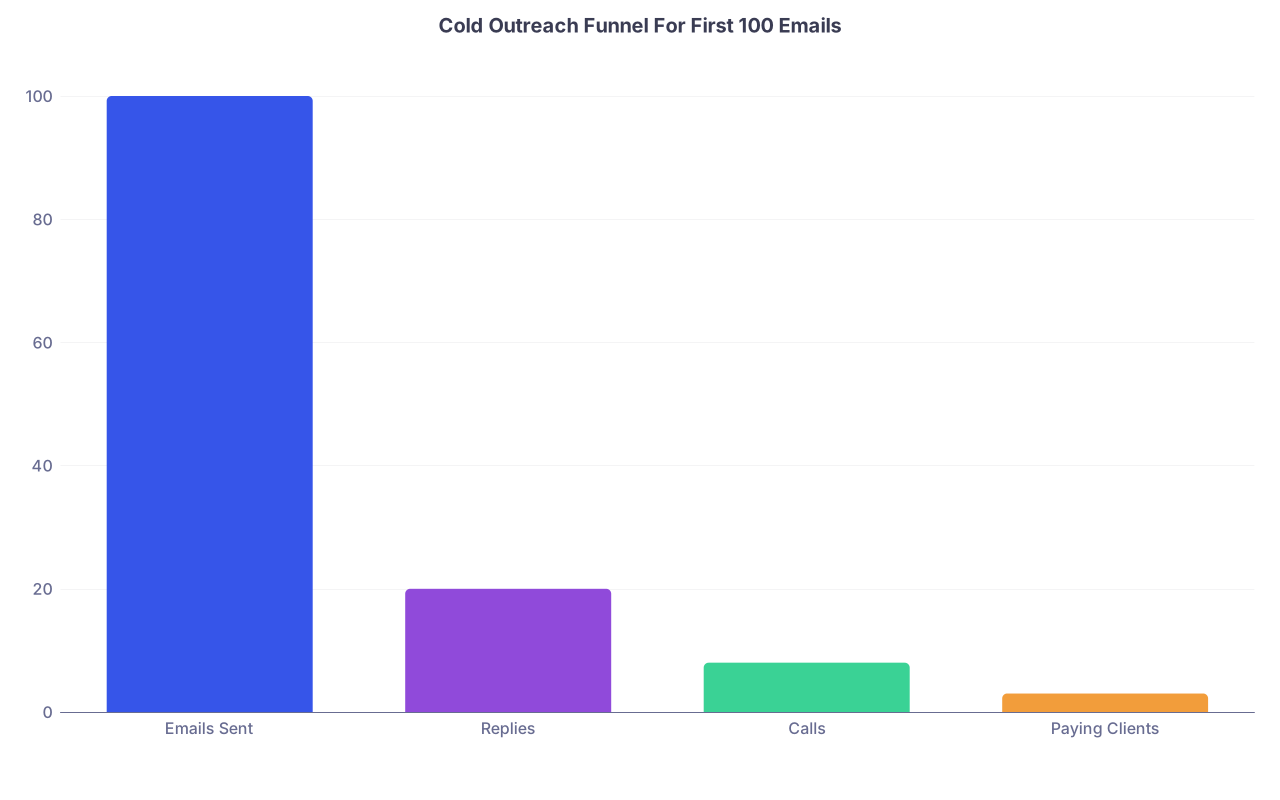
| Category | Value |
|---|---|
| Emails Sent | 100 |
| Replies | 20 |
| Calls | 8 |
| Paying Clients | 3 |
Those numbers are realistic if your targeting and script are tight.
Step 4: Use This Cold Outreach Script (And Actually Send It)
Here is the core email template. Then I will break down how to adapt it.
The Script – Base Version
Subject options (pick one, do not overthink):
- “Clinician writer for your [X] content”
- “Support for your [specialty] content production”
- “[Role] at [Company] – quick question”
Email body:
Hi [First Name],
I am a [your role – e.g., internal medicine physician / PA / pharmacist] with [X] years of clinical experience in [your focus, e.g., hospital medicine and chronic disease management]. I now also work as a freelance medical writer.
I saw that [Company] is producing [specific type of content – e.g., patient education on cardiometabolic disease / CME modules in oncology / blog content for primary care clinicians]. This is very close to my clinical background and the writing work I do.
I help teams like yours with:
– [Deliverable 1 – e.g., evidence-based patient education articles]
– [Deliverable 2 – e.g., clinician-focused blog posts and explainers]
– [Deliverable 3 – e.g., white papers and clinical summaries for product pages]Here are a couple of brief samples of my writing:
– [Title – 1 line description] – [link]
– [Title – 1 line description] – [link]Do you ever work with clinician-writers on a freelance basis for this type of content? If it would be helpful, I can send a short writing sample tailored to one of your upcoming topics or hop on a quick call to see if there is a fit.
Best,
[Your Name], [Degrees]
[Role, e.g., Board-certified in …]
[LinkedIn or simple website link]
[City, Time zone – optional but useful]
That email does three things right:
- Signals clinical authority without bragging.
- Shows you actually looked at their content.
- Makes a specific, low-friction ask.
Now let’s tune it.
How To Customize For Different Targets
For a health tech startup (patient-facing app):
- Show you understand their product and language.
- Emphasize patient education, UX-friendly content, and accuracy.
Middle paragraph can become:
I saw that [App/Product] includes educational content on [condition / behavior]. In my practice, I have spent many years explaining [these topics] to patients, and I now help digital health teams create clear, accurate copy for in-app education, blogs, and onboarding sequences.
For a CME or education company:
- Emphasize guideline familiarity and nuance.
- Mention any teaching, precepting, or academic work.
Add a line:
I have [X] years of experience teaching residents/med students and staying current with [relevant guidelines – e.g., ADA, ACC/AHA]. I enjoy turning dense guideline updates into practical, case-based content for clinicians.
For a healthcare marketing agency:
- Emphasize reliability, deadlines, and being low-drama.
- Show you know pharma/med device has guardrails (compliance, fair balance).
Add:
I have worked with teams that need clinically accurate content that stays within regulatory and brand guidelines, and I am comfortable working with briefs, reference packs, and tight deadlines.
Step 5: Follow-Up Protocol (Where Most People Fail)
Most “no’s” are actually “not yet” or “I forgot you exist.”
You need a ruthless, boring follow-up system. Here is one that works without being annoying:
Timeline
- Day 0: Initial email
- Day 5–7: Follow-up #1
- Day 14: Follow-up #2
- Day 30: Follow-up #3 (if they were a high-priority target)
Then stop unless they engage.
Follow-Up Scripts
Follow-up #1 – “polite bump”
Subject: “Re: [original subject]”
Hi [First Name],
Just circling back on my note below in case it slipped your inbox.
I am a [role] with experience in [their area], and would be glad to support [Company] with [2–3 deliverables again].
If you occasionally work with freelance clinician-writers, I would be happy to send a short custom sample on one of your upcoming topics or jump on a quick call.
Best,
[Name]
Follow-up #2 – add value
Here, you show you actually understand their world. You do not send a textbook, just a small, relevant thing.
Hi [First Name],
I know you are busy, so I will keep this brief.
I recently wrote a short piece on [topic closely related to their content – e.g., “Explaining GLP-1 therapy to patients in plain language”] that might be relevant to your audience. Here is the link: [link].
This is the type of clinician-reviewed content I can create for [Company]. If you have upcoming topics in [X/Y area], I would be glad to draft a brief sample tailored to your style.
Either way, thanks for taking a look.
Best,
[Name]
You are not asking them to “review your portfolio.” You are dropping something useful and reminding them what you do.
Follow-up #3 – graceful close
Hi [First Name],
Last quick follow-up from me.
If you do decide you need freelance support from a clinician-writer for [their content type], I would be glad to help. My background is [1-line clinical summary], and my work now focuses on [their topic area].
You can always reach me at this email or via LinkedIn here: [link].
Wishing you and your team all the best with [Company/Project].
Best,
[Name]
This keeps the door open without pestering.
Step 6: Handle Replies Without Sounding Like A Newbie
You will get four main types of replies:
- “We do not use freelancers / we are fully covered.”
- “Send your rates and portfolio.”
- “We will keep you on file.”
- “Let us schedule a call.”
Here is how to handle each.
1. Flat “No”
Still useful. You turn it into intel and maybe a future lead.
Thanks for letting me know, [First Name].
If things change in the future or you need a clinician perspective on a project in [your niche], I would be glad to help.
Out of curiosity, do you know if any other teams or companies in [their space] ever use freelance clinician-writers? Happy to reach out to them directly.
Sometimes they will refer you to another contact. I have seen this happen often with agencies.
2. “Send your rates and samples”
Do not send a huge rate sheet. Give a range and show flexibility.
Thanks for your note, [First Name].
Here are a few representative ranges for typical projects:
– Short patient education article (800–1200 words): [$X–Y]
– Clinician-focused article or blog post (1200–1800 words): [$X–Y]
– Longer white paper or report: typically scoped individually based on length and research depth.I am happy to work on a per-project basis initially. For ongoing work, we can also discuss a retainer or package structure that fits your volume.
Here are 2 additional samples relevant to your audience:
– [Title – link]
– [Title – link]If you would like, I can also draft a short (500-word) sample on one of your upcoming topics so you can see fit and style before a larger engagement.
You do not lock yourself into cheap work. You demonstrate you are flexible but not desperate.
3. “We will keep you on file”
Half of these are polite dismissals. The other half mean it. You reply once, then move on.
Thanks, [First Name].
I appreciate you keeping me in mind. I will check back in a few months in case your needs change.
Best,
[Name]
Set a reminder for 3–4 months out.
4. “Let’s schedule a call”
This is where many clinicians ramble themselves out of gigs.
Here is a simple 15–20 minute call structure that keeps it professional:
Brief intro (1–2 minutes)
- “I am [Name], [role], clinically in [field], and now I split my time between [current clinical work] and freelance writing focused on [their area].”
Their needs (5–10 minutes)
- “Can you tell me a bit about the types of content you are producing and where you feel the most pressure or backlog right now?”
- “Do you have existing writers or subject matter experts, or are you looking to add clinician voices?”
- “What does your ideal freelance relationship look like? Ad-hoc pieces, or ongoing support?”
Your offer (5–7 minutes)
- Reflect back what you heard.
- “Based on what you said about [X], I can help with [A, B, C]. For example, I can take briefs from your team and turn them into [deliverables] on a [timeline].”
Logistics (3–5 minutes)
- “Do you have an existing budget/rate structure for freelancers, or would you like me to send a simple rate range and a sample scope after this call?”
- Discuss timelines, communication (email, Slack), and typical review cycles.
End with:
“I will send you a brief email recapping what we discussed along with suggested next steps and a small test-project idea. Does that work for you?”
Then actually send it that day.
Step 7: Volume And Consistency (The Boring Part That Works)
Here is what almost no one wants to hear: your first paying client usually lands somewhere between email 30 and email 100.
That is not failure. That is normal.
Your job is not to “write one perfect email.” Your job is to:
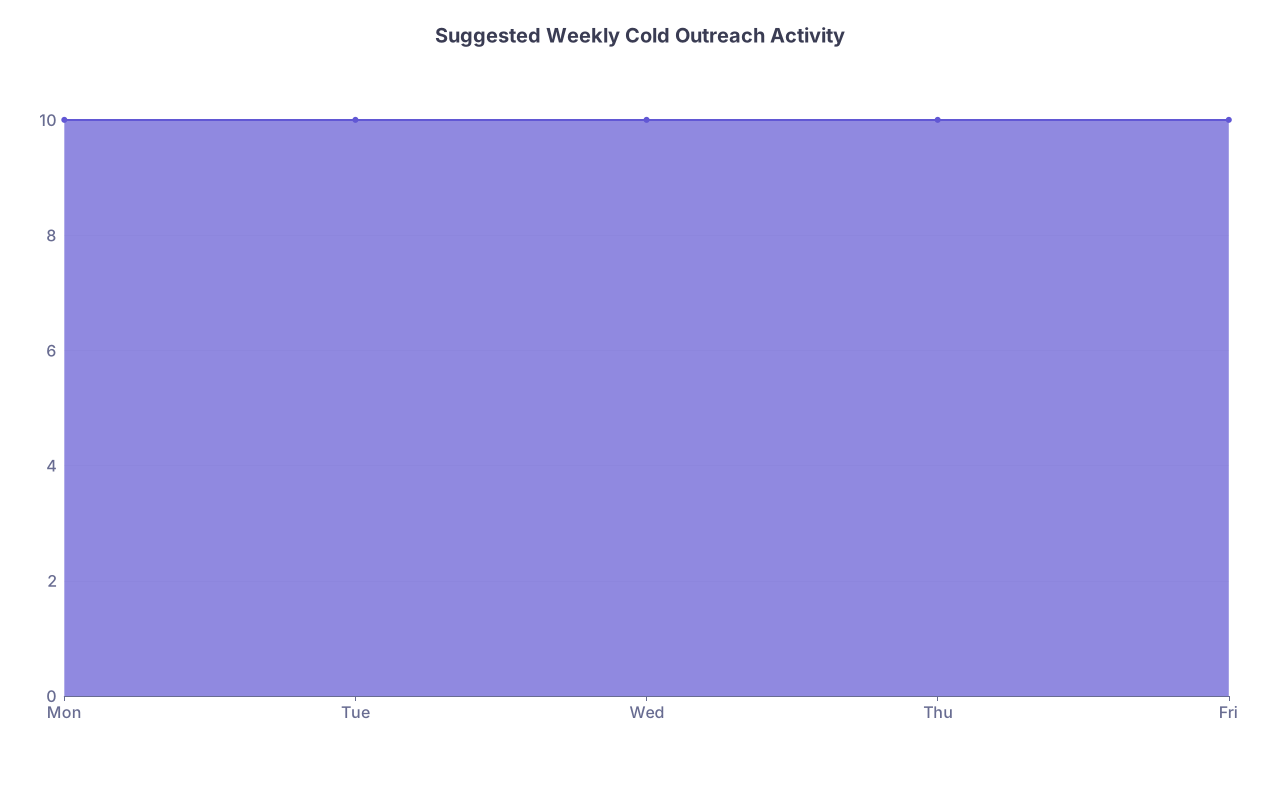
- Send 5–10 targeted emails per weekday for 3–4 weeks
- Follow up on every single one that does not reply
- Improve your targeting and subject lines based on actual replies
| Category | Value |
|---|---|
| Mon | 10 |
| Tue | 10 |
| Wed | 10 |
| Thu | 10 |
| Fri | 10 |
That is 50 outreach attempts per week. In a month, you are at ~200. If your targeting is competent and your script is decent, you will not need 200 before something hits.
You want numbers like:
- Response rate: 15–30%
- “Interested” responses: 5–10%
- Calls: 3–8%
- Clients: 1–3%
If your response rate is under 10%, your problem is one of these:
- You are emailing generic inboxes, not humans
- Your subject line looks spammy or vague
- Your first line is generic and clearly copy-pasted
- You are targeting companies that are too big or totally irrelevant
Fix those, not your confidence.
A Concrete 7-Day Action Plan
If you want this to actually result in your first client, here is a one-week protocol.

| Step | Description |
|---|---|
| Step 1 | Day 1 - Choose Niche |
| Step 2 | Day 2 - Build Samples |
| Step 3 | Day 3 - Optimize LinkedIn/Bio |
| Step 4 | Day 4 - Build Lead List 30 Contacts |
| Step 5 | Day 5 - Send 15 Emails |
| Step 6 | Day 6 - Send 15 Emails |
| Step 7 | Day 7 - Follow Up, Review, Adjust |
Day 1 – Decide
- Choose 1–2 target sectors (e.g., CME + health tech)
- Choose your top 3 clinical topic areas
Day 2 – Create 2–3 samples
- One patient article
- One clinician/B2B article
- Polish enough that you would not be embarrassed if it went on JAMA’s blog tomorrow
Day 3 – Clean your digital presence
- LinkedIn headline + About
- Create 1-page Google Doc “About & Samples” and grab share link
Day 4 – Build a mini lead list (30 names)
- 15 in your first sector, 15 in the second
- Find contact names and emails, log in your spreadsheet
Day 5 – Send 15 emails
- Use the script, customize the middle paragraph for each company
- Do not tweak the template endlessly; send
Day 6 – Send 15 more
- Now you have 30 out. You are in the game.
Day 7 – Check replies + schedule follow-ups
- Reply to anyone who wrote back
- Set follow-up reminders for the rest (Day 12 and Day 19)
- Adjust subject lines if your open/reply rates are terrible

Repeat that weekly for a month and you will not be asking, “How do I find my first client?” anymore. You will be asking, “How do I price this so I am not undercharging?”
Common Mistakes You Will Avoid (Because I Am Telling You Now)
You can still ignore this and learn the hard way. Your call. Here are the landmines:
Writing 5,000-word “about me” emails
No one cares about your entire residency origin story. They care if you can solve their content problem.Leading with diplomas, not outcomes
“Board-certified XYZ” is good. “I help teams produce accurate, clinician-vetted content on [topic]” is better.Sounding like a job applicant, not a consultant
Do not write like you are begging for a job. You are offering a service. Different posture.Obsessing over prices before you have leads
If you have zero clients, your problem is not whether you should charge 50 or 60 cents per word. Your problem is that not enough people know you exist.Stopping after 10 emails because “it is not working”
Ten emails is a warm-up. The effect is visible around 50. It compounds at 100.

Quick Recap: What Actually Gets You Your First Client
Keep this simple:
- Pick a narrow target and own your clinical niche.
- Build a minimal but solid “proof packet” (LinkedIn + 2–3 samples).
- Send a focused, human cold email to real decision-makers. Then follow up.
Do that consistently for 3–4 weeks and you will not be guessing how freelancers land work. You will be on a call with your first client, negotiating scope and start date.