
The fantasy that KOL relationships are “scientific collaborations” is only half true. Once you join pharma, you find out they’re also carefully engineered business assets with guardrails, politics, and a lot of theater.
Let me walk you through how it actually works on the inside.
What “KOL” Really Means Inside Pharma
In med school and residency, you think “KOL” just means: big name, lots of publications, speaks at conferences.
Inside pharma, KOL is a business category.
You’ll hear people behind closed doors say things like:
- “We need five Tier 1s to anchor this launch.”
- “She’s scientifically strong but commercially difficult.”
- “He’s overexposed with the competitor; we’ll never move him.”
A KOL is not just an expert. They’re a node in the influence network around your product: guidelines committees, podium speakers, major trial PIs, social media voices, society leadership, those “everyone in the field calls this person” types.
Internally, they’re graded. Literally.
| Tier | Reach/Influence | Typical Engagement |
|---|---|---|
| Tier 1 | National/Global | Steering committees, advisory boards, major congress talks |
| Tier 2 | Regional | Speaker programs, trial sites, working groups |
| Tier 3 | Local/Community | Small dinners, peer-to-peer education, trial referrals |
Nobody shows this table to KOLs, obviously. But this is how resourcing and access get decided.
If you join medical affairs, you’ll see slide decks with your top 20 KOLs mapped against things like:
- Academic footprint
- Guideline involvement
- Trials run for competitors
- Social media presence
- “Degree of alignment with our data” (yes, that’s a real line)
You are not “just” building relationships. You’re managing strategic assets with a budget attached.
How a KOL Relationship Actually Starts (From the Inside)
On the outside, it looks organic: “We invited Dr. X to speak based on their expertise.” Inside, the initiation looks more like this.
First, marketing and medical sit in a room and someone says:
“We need 10 solid KOLs in [specialty] in the Midwest who are not locked in with Competitor Y, and who see at least 30 of [disease] a month.”
Then:
- Commercial pulls claims data and field intel.
- Medical combs publication databases, guideline committees, trial registries.
- MSLs (Medical Science Liaisons) are asked: “Who actually drives opinion in your territory? Not just the big names.”
A list appears. It’s not random. It’s built around influence and business need.
Then the dance begins.
Typical sequence:
Scientific reconnaissance
An MSL “just happens” to be at a conference where that KOL is speaking, introduces themselves:
“I really liked your talk on X; we’re working on some data that might interest you.”
That’s not accidental. They were told to be there.First 1:1 scientific exchange
They set up a meeting: often branded as a “scientific discussion” or “pipeline overview.”
Officially: fair-balanced data exchange.
Unofficially: capability assessment.
The MSL reports internally:- Does this person understand the mechanism?
- Are they skeptical or hostile?
- Do they have reach?
- Do they trash competitors or stay neutral?
Internal decision
The medical team reviews: “Is this someone we invest in?”
They check conflicts, trial history with competitors, reputation.
Someone usually asks the blunt question: “Will they ever be on our side?”First formal engagement
If the answer is yes, they’re invited to something “light”: an advisory board, an authorship review, a consult on patient pathways, maybe a small symposium.
Once money hits their bank account for the first time as a consultant or speaker, the relationship changes. Not necessarily corrupt. But absolutely different.
Money, Compliance, and the Invisible Fence
Let me be absolutely clear: modern pharma is terrified of violating compliance. There are more lawyers and compliance people than you’d believe.
You’ll see phrases drilled into you:
- “No quid pro quo.”
- “No pay-for-prescribe.”
- “Compensation for fair market value of time and expertise.”
And they mean it. There are audits, training modules, and real consequences.
But here’s the nuance nobody tells you:
They don’t buy prescriptions.
They buy access, attention, and option value on future influence.
You’ll see internal thinking like:
- “If we invest in her early, she may join future steering committees.”
- “He’s on three guideline panels; having him understand our data is critical.”
- “We want her neutral at worst, positive at best, once we launch.”
Money is framed (and structured) as:
- Hourly consulting fees for advisory boards and scientific consults
- Honoraria for speaking on approved, pre-reviewed slides
- Investigator fees and per-patient payments for clinical trials (through institutions)
Everything flows through process. You’ll do FMV (fair market value) checks for every engagement. You’ll fill out forms with painful detail: topic, duration, expertise level, rate bands.
The invisible fence is this:
- You may not say: “We’ll support your trial if you prescribe more.”
- You may absolutely say: “We’d value your insights on how our data fits into real-world practice.”
And yet everyone understands the subtext: long-term alignment matters.
What Your Job Really Is With KOLs (If You Join Pharma)
If you land in medical affairs (and that’s where most physicians start), you sit at the fault line.
Official description:
You build peer-to-peer scientific relationships with external experts.
Unofficial reality:
You are the translator between the company’s strategic needs and the KOL’s ego, curiosity, and career ambitions.
Your core jobs:
Feed them oxygen
They want early data. They want to be in the know. They want access to slides nobody else has seen.
You become the person who can legally and appropriately share that within guardrails.Protect the company from them
The “difficult” KOL who rants off-label on stage? Marketing loves them until compliance freaks out.
You’re the one who has to say, “We’re not engaging them again,” or “We need to be careful with what they see.”Shape how they think, without selling
You can’t say “Use our drug.” You can walk them through your trial design, subgroup analyses, and limitations.
You show them data in a way that lets them reach their own conclusions… that conveniently align with your label.Surface their insights internally
When a Tier 1 KOL says, “Your inclusion criteria are useless for real-world Type 2 diabetics,” that gets quoted—verbatim—in internal decks.
The CMO hears their name more than yours.
Done right, you become the quiet power broker: you know who’s aligned, who’s drifting, who’s going to flame you on Twitter after the next NEJM paper.
The Different “Types” of KOLs You’ll Encounter
Once you’ve been in pharma a few years, you can predict KOL behavior on sight. The archetypes repeat.
You’ll see:
The Pure Academic
Deeply data-driven, less interested in money, more in trials and authorship.
They’ll say no to speaker gigs but yes to steering committees.
If you try to “spin” anything at them, they’ll shut down and you’re done.The Professional Speaker
They love podium time, travel, being the face of a new therapy.
Comfortable with branded decks, love Q&A, know how far they can push without going fully off-label.
When marketing says “We need a closer,” this is who they mean.The Network Builder
Maybe mid-career faculty, ambitious. Wants to join boards, be seen as “the person to call” for your disease area.
You can build a long, fruitful relationship here if you actually support their research and visibility.The Mercenary
They’ll speak for every company in the space. Competing symposiums, back-to-back.
They’re not loyal; they’re transactional.
Sometimes you use them early, then quietly phase them out when you need more credibility.The Political Player
Society positions, guideline chairs, editorial board seats.
They may not publish the most, but they control rooms where your drug is voted into or out of recommendations.
Their leverage is enormous. They know it.
You manage all of them differently. You also learn quickly: the “biggest name” is not always the most useful ally.
Speaker Programs, Advisory Boards, and What’s Really Going On
From the outside, a company-sponsored dinner talk just looks like… a dinner talk. But internally, those programs sit inside a very specific strategy.
Think about 3 main tools:
Speaker Programs
These are controlled by commercial but medically “approved.” Every slide, every word, pre-cleared.
On the record, purpose:
Educate clinicians on the approved label and data.
Off the record, internal expectation:
Move prescribing behavior within legal boundaries.
Your KOL in this context is a polished mouthpiece. They’re not freelancing; they’re operating in a box you’ve built.
You, as a medical person, are often in the room. You listen:
- Do they stick to on-label?
- Do they overpromise?
- How do community docs react? Sceptical? Excited?
And afterward, you debrief with the rep and sometimes with the KOL. That feedback shapes future content and even future invite lists.
Advisory Boards
Ad boards are where KOLs feel like “true consultants.” And to be fair, at a good ad board, they are.
Inside, these things are engineered like experiments:
- Carefully balanced mix of friendly, neutral, and skeptical voices
- Pre-set list of questions: “How do you treat X today?” “What did you think of this endpoint?”
- Pre-work: reading packets, draft concepts
Your job is to extract honest thinking without overtly steering. Marketing sits there listening, often not allowed to speak freely.
What pharma really gets from these sessions:
- The language KOLs use around the disease
- Real-world barriers to adoption
- Landmines: safety fears, payer objections, comparator complaints
- Soundbites that will echo in internal decks for months
The dirty secret: there’s often a “shadow ad board” outcome—an internal read: “Who’s worth further investment? Who’s a problem? Who’s a star?”
Clinical Trial Roles
Being a PI or on a steering committee is the highest level of engagement.
For KOLs, this equals prestige and publications. For pharma, it’s deeper than that:
- They now have skin in the game.
- They’re emotionally and professionally tied to your asset.
- They’re the ones presenting your data at ESC, ASH, ASCO.
You will hear people say internally: “We need to get Dr. X onto a trial if we ever want them off competitor Y.”
They can’t be “bought” into changing guidelines. But their mindset changes once they’ve shepherded a molecule from Phase 2 to Phase 3 success.
Social Media KOLs and the New Reality
Ten years ago, KOL basically meant senior professor.
Now? The 38-year-old associate professor with 100k followers on X and a Substack can move opinion faster than the guy chairing the guideline committee.
Pharma’s adjusting, clumsily.
You’ll sit in meetings where:
- Marketing loves the social media KOL who “gets engagement.”
- Medical and compliance panic because this same person freelances hot takes, off-label riffs, and memes.
You’ll find odd constraints:
- You often can’t pay them because of the risk they’ll talk about you in an uncontrolled way.
- Or you can only engage them in very narrow roles—like advisory boards without public attribution.
Internally, the mindset is shifting from “KOLs” to “DOLs” – Digital Opinion Leaders.
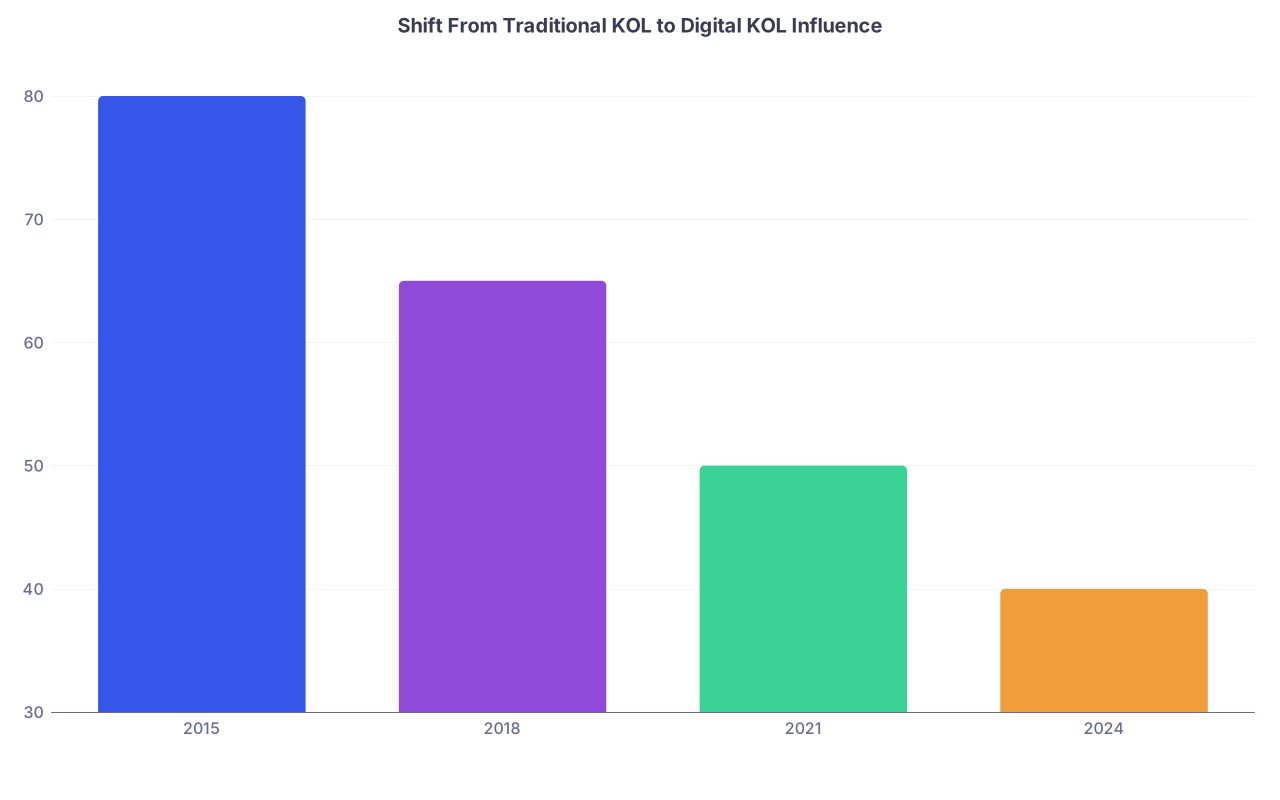
| Category | Value |
|---|---|
| 2015 | 80 |
| 2018 | 65 |
| 2021 | 50 |
| 2024 | 40 |
(Think of those numbers as the percentage weight placed on traditional KOL influence. Digital is eating into that.)
You, as an insider, will have to split your attention:
- The gray-haired titan on the guideline panel.
- The mid-career doc running the trials.
- The younger voice shaping Twitter consensus after every major trial drops.
They’re all KOLs now. Different flavors, different risks.
How KOLs See You Once You’re in Pharma
Physicians crossing into pharma underestimate this part. You used to be “one of them.” Now you’re on the other side of the table.
Here’s how many KOLs see you:
- Either as “the intelligent insider I can actually talk science with”
- Or as “the corporate mouthpiece I have to tolerate”
Your behavior determines which bucket you land in.
They can smell selling. Instantly. Even when you’re technically not selling.
If you:
- Dodge questions about limitations
- Overemphasize marginal endpoints
- Trash competitors unfairly
- Or lean too hard on talking points
…you’ll be written off. And trust me, that gets fed back into your company. Your name becomes “that one medical person who just spins.” You lose access.
If you’re straight with them:
- “Our trial excluded X; we really don’t know what happens there.”
- “Yes, that safety signal bothers us too; we’re watching it.”
- “Honestly, competitor Y’s data are strong in that subgroup; where we think we’re different is…”
Then you become valuable. To them and to your own team.
I’ve watched KOLs do this: praise a specific med affairs person at a congress to a senior VP. That person’s internal stock shoots up overnight.
KOLs can make or break your career internally if you’re in a visible role.
Time, Travel, and What Your Calendar Actually Looks Like
Let’s get concrete about lifestyle. Because people romanticize this.
If you’re in a field-based medical role (MSL, field medical director) supporting a high-science product:
- You’re on the road 40–70% of the time.
- Your weeks cluster around major meetings and KOL availabilities.
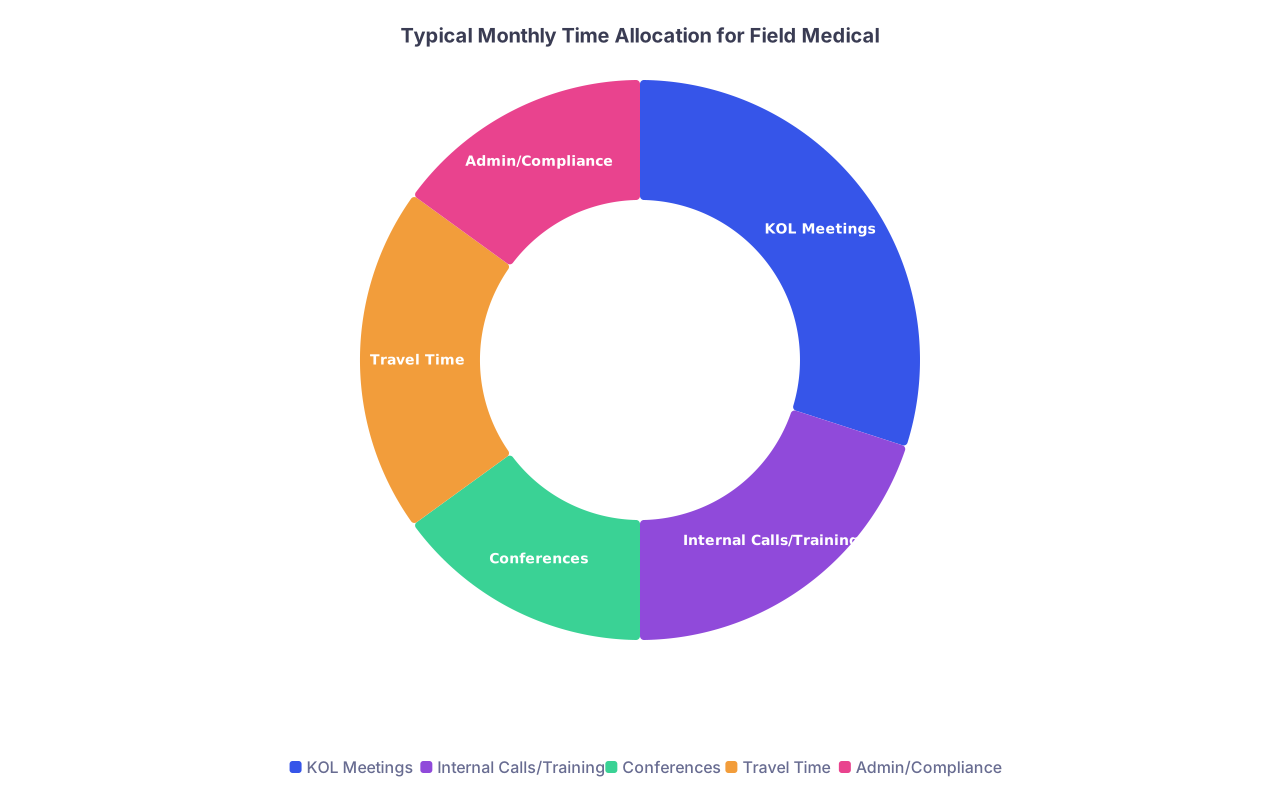
| Category | Value |
|---|---|
| KOL Meetings | 30 |
| Internal Calls/Training | 20 |
| Conferences | 15 |
| Travel Time | 20 |
| Admin/Compliance | 15 |
You’re:
- Flying to meet two Tier 1s at a major academic center.
- Sitting in dark conference halls at ASCO, ESC, ATS, hearing your own data presented—then sprinting to the KOL you care about for a 30-minute debrief.
- On endless internal calls debriefing: “What did Dr. Z say? Any red flags?”
If you’re home-office medical (medical director, medical strategy):
- You see KOLs mostly at advisory boards and large congresses.
- You spend more time in slide decks, protocols, and strategy files.
- KOL names are all over your emails, even when you don’t see them in person.
And always, always, KOL engagement is tracked. In systems. With metrics.
You’ll get questions like:
- “How many meaningful scientific interactions did we have with Tier 1 KOLs this quarter?”
- “Which KOLs are at risk of being ‘captured’ by competitor Z?”
You may hate this language. But it’s the language.
Ethical Lines: Where Things Actually Get Uncomfortable
Everyone wants the KOL relationship to feel clean: just science, just patient benefit.
Reality: a few pressure points always exist.
You’ll see:
- Senior marketing people pushing hard: “We need Dr. X as a speaker. Their numbers are huge in this region.”
- A med affairs person resisting because Dr. X is off-label-happy and unmanageable.
- Legal/compliance people shutting down entire ideas overnight.
And then there’s the gray zone:
- The KOL who hints they want support for a registry “unrelated” to your product… right before guideline votes.
- The PI who expects special treatment in publication authorship because “I’ve been with you since Phase 2.”
- The person on a guideline panel who wants to see “all your subgroup data” that you’re not ready to publish.
Your integrity is tested in tiny interactions, not big dramatic moments.
You won’t be asked to bribe. But you will be tempted to be… selectively transparent.
If you want to sleep at night and keep your license, you draw your own lines and you stick to them. People notice that, too.
Where This Is All Headed
KOL relationships aren’t going away. They’re morphing.
Expect:
- Less pure “dinner talk” style programs. Too much scrutiny, too little impact.
- More integrated engagements: KOLs as trialists, digital educators, advisory partners, content co-creators (within limits).
- Heavier compliance oversight of social media-linked clinicians.
- Greater reliance on data to identify influence: network graphs, prescribing patterns, congress interactions.
You, as a physician in pharma, become part diplomat, part scientist, part strategist.
If you like complex human dynamics, high-level science, and seeing how the sausage of guidelines and practice patterns actually gets made, KOL work can be incredibly satisfying.
If you want purity and clean lines with no politics, you’ll struggle. Because this entire space lives in the gray.

| Step | Description |
|---|---|
| Step 1 | Identify Potential KOL |
| Step 2 | Initial Scientific Meeting |
| Step 3 | Light Monitoring Only |
| Step 4 | Early Engagement |
| Step 5 | Ad Boards or Trial Involvement |
| Step 6 | Speaker or Steering Role |
| Step 7 | Long Term Partnership |
| Step 8 | Monitor Alignment and Risk |
| Step 9 | Reduce Engagement |
| Step 10 | Strategic Fit? |




FAQ: How KOL Relationships Really Work Once You Join Pharma
1. Do KOLs actually change their practice because of pharma relationships?
Sometimes. Not from a single dinner or honorarium, despite what cynics say. But long-term, sustained engagement—seeing early data, being on steering committees, presenting results—shapes how they interpret evidence and weigh options. The relationship doesn’t override data, but it colors how that data is perceived and how quickly it’s adopted.
2. How much of my time in pharma will be spent on “relationship management” versus real science?
If you’re in field medical, the split is heavily weighted toward external interaction—scientific but still relational. Maybe 60–70% direct KOL-facing work, 30–40% internal and scientific. In home-office medical roles, it’s flipped: maybe 20–30% direct KOL time, the rest on strategy, content, trials, and internal firefighting.
3. Can I push back if marketing wants to use a KOL in a way I think is wrong?
You can, and you should. Strong medical leaders do this constantly. You won’t win every battle, but compliance usually sits on your side of the table. If a KOL is unsafe, sloppy with off-label talking, or scientifically weak, you have every right to recommend against using them as a speaker or face of the brand.
4. Will working closely with KOLs hurt my credibility if I ever go back to academia or clinical practice?
If you behave like a sales proxy, yes. If you maintain scientific rigor and are transparent about your role, less so. Many physicians go back and forth—academic to pharma and back again—especially in oncology, cardiology, and immunology. Your personal reputation will hinge on how you handled conflict of interest and whether you were seen as a serious scientific partner or a corporate puppet.
5. How do I know if I’m actually good at KOL work—or if I’ll hate it?
If you enjoy high-level journal club-style conversations, can tolerate politics, and don’t mind that influence is often indirect and slow, you’ll probably thrive. If you’re allergic to ambiguity, hate repeated conversations, or bristle at the idea that smart people’s opinions can be “strategically managed,” you’ll find this frustrating. The best way to know is to talk to current medical affairs physicians off the record and, if you join, see how you feel after your first major congress cycle.
Key takeaways:
KOL relationships in pharma are not pure science and not pure sales—they’re a structured, strategic, and heavily policed gray zone. Your job inside is to keep the science honest while understanding the business stakes. If you can live with that tension—and work it to your advantage—you’ll see a side of medicine that most clinicians never even realize exists.