
The biggest threat to your industry salary is not the company. It is you walking into the negotiation acting like a resident asking for vacation days.
Physicians moving into pharma, medtech, health tech, or consulting routinely undercut themselves. Not because they lack value. Because they drag a clinical mindset into a corporate game with completely different rules. I have watched MDs leave $50,000–$150,000 on the table in a single offer cycle, then complain later that “industry just pays less than I expected.”
No. Industry often pays better than you expect. You just negotiated like a fellowship applicant instead of a revenue-driving specialist.
Let us walk through how physicians sabotage their own salary negotiations in industry—and how to stop doing it before you lock yourself into a weak offer for years.
Mistake #1: Treating the First Offer Like a Sacred Final Answer
Physicians are trained in hierarchical systems. Attendings decide. Institutions dictate. Schedules come top‑down. That conditioning kills you in corporate negotiations.
The most common self‑sabotage: treating the initial offer as if it were a non‑negotiable residency contract.
“I did not want to seem ungrateful.” “They said this was standard.” “They told me they rarely negotiate with physicians.”
I have heard variations of those three lines more times than I can count. Every time, the physician left money, equity, or title on the table.
What you do wrong
You:
- Accept the first offer within 24 hours “to show enthusiasm.”
- Ask, “Is there any flexibility?” instead of stating a counter number.
- Believe “this is our standard package” means “this is our only package.”
- Confuse HR scripts with actual constraints.
The company expects negotiation. HR literally has ranges and scenario sheets ready. When you fold immediately, you send two messages:
- You do not understand your market value.
- You are easy to please.
That combination does not earn respect later when you ask for promotions, budget, or headcount.
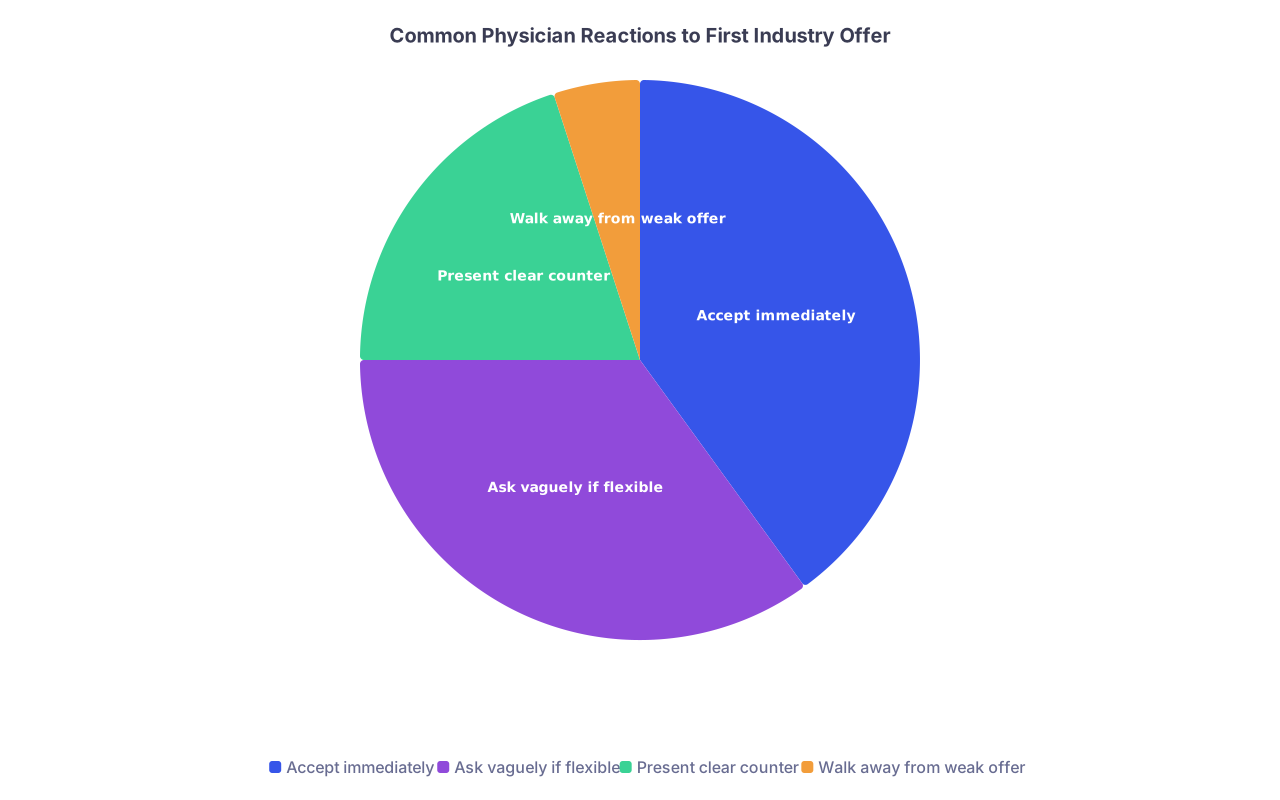
| Category | Value |
|---|---|
| Accept immediately | 40 |
| Ask vaguely if flexible | 35 |
| Present clear counter | 20 |
| Walk away from weak offer | 5 |
How to avoid this
Stop asking if the offer is flexible. Assume it is.
You say something like:
“I am very interested in the role. Based on my background and market data for similar positions, I was targeting a base closer to $X with a total compensation in the $Y range. Can we get closer to that?”
Specific. Calm. Professional. Not apologetic.
If they genuinely cannot move, they will tell you. But they almost always have more room than the first number suggests.
Mistake #2: Importing RVU Thinking Into a P&L World
You are used to income based on RVUs, call, procedural volume, or academic rank. Industry does not care about your RVUs. It cares about:
- Market access.
- Product strategy.
- Regulatory risk.
- Trial design and timelines.
- Revenue growth and cost containment.
Physicians sabotage themselves by anchoring to clinical pay structures that are irrelevant in industry.
Typical errors:
“I made $320k as a hospitalist, so if I can get close to that, I am happy.” “I would take a pay cut for better lifestyle.” “I do not know what industry roles at my level pay, so I just used my current salary as a reference.”
You negotiate relative to your hospital job instead of relative to the company’s value drivers and internal banding. That is how senior medical directors end up earning like mid‑level product managers.

How to avoid this
You must think like they think.
Before you talk numbers, understand:
- What revenue or cost impact is tied to your function (e.g., avoiding trial delays, enabling launches, de‑risking regulatory submissions).
- The level bands: associate director vs director vs senior director vs VP. Each has different salary and equity ranges.
- Benchmarks from multiple sources: friends in similar roles, salary reports, recruiter intel, and public data from sites like Levels.fyi, Glassdoor, and Blind (filtered carefully, obviously).
Then negotiate based on role value, not your last W‑2.
A better frame: “For a director-level medical affairs role at a large pharma company in Boston, total cash comp is typically in the $X–$Y range, excluding equity. Given my [specific experience], I would expect to be toward the upper half of that.”
If you speak their comp language, you stop sounding like someone begging for a lifestyle upgrade and start sounding like someone who understands the business.
Mistake #3: Over‑indexing on Base Salary and Ignoring the Rest
Another way physicians sabotage themselves: obsessing over a $10,000 bump in base salary while casually ignoring $100,000+ swings in bonus and equity.
You know who understands equity? Tech workers with no professional degrees. You know who routinely says, “I do not really get equity; I am just focusing on base”? Physicians.
That is malpractice on your own finances.
Common self‑sabotaging statements:
“I am risk‑averse, so I do not care about equity.” “I just want a stable salary.” “I do not understand vesting; it is confusing.”
That confusion costs you. A lot.
The compensation pieces you underuse
Most industry packages have:
- Base salary
- Annual bonus (often 10–30%+ of base)
- Sign‑on bonus
- Equity (RSUs, stock options, or both)
- Long‑term incentive plans
- Relocation, education, and other benefits
| Role Level | Base ($) | Target Bonus (% base) | Annual Equity Value ($) |
|---|---|---|---|
| Associate Director | 210000 | 15 | 30000 |
| Director | 250000 | 20 | 60000 |
| Senior Director | 290000 | 25 | 100000 |
| VP Medical | 340000 | 35 | 200000 |
You argue over $5,000 in base while ignoring that a modest adjustment to equity and bonus structure could outstrip that by 5–10x annually.
How to avoid this
You do not need to become a Wall Street analyst, but you must stop acting allergic to basic comp structure.
At minimum, push on:
- Target bonus percentage (moving from 15% to 20% of a $250k base is $12,500 a year).
- Sign‑on bonus (especially if you are walking away from a clinical bonus or payout).
- Equity refresh and vesting cadence (annual refresh vs one‑time grant).
- Leveling up the title (which often auto‑raises base, bonus target, and equity band).
When HR says, “We have very limited flexibility on base; we are at the top of our band,” the inexperienced physician hears “Game over.” The experienced one says:
“Understood. In that case, can we look at increasing the sign‑on bonus or equity grant, or possibly adjusting the level to Director to align with my responsibilities?”
That is how you rebuild value when one lever is “closed.”
Mistake #4: Negotiating Like a Caregiver, Not a Peer
You have been rewarded for collegiality, agreeableness, and not rocking the boat. In a hospital, that keeps things moving. In corporate negotiation, excessive deference is read as weakness.
The physician mistakes I keep seeing:
- Over‑explaining personal reasons (“daycare costs,” “student loans”) instead of business reasons.
- Apologizing for negotiating: “Sorry to ask this, but…”
- Asking for permission instead of setting expectations.
You are not asking the program director for an exception to the block schedule. You are a domain expert with scarce skills. The negotiation is a business conversation between equals.
How to avoid this
Drop the apology language entirely.
No:
“I know I am new to industry, so I totally understand if this is not possible…”
Try:
“Based on my experience and the scope of this role, I would be comfortable accepting at $X base with a Y% bonus target. If we can meet that, I am ready to sign.”
Notice the difference. One sounds like a resident asking for an extra weekend off. The other sounds like someone who knows they are bringing serious value.
Being firm is not being difficult. The company can always say no. Your job is to give them something worth saying yes to—and to state your terms clearly.
Mistake #5: Underselling Transferable Value From Clinical Work
This one frustrates me the most.
Physicians walk into industry interviews and essentially argue against their own value:
“I know I do not have much industry experience.” “I am just a clinician, so I am happy to learn.” “I am probably not as qualified as some of the other candidates from industry.”
You know what the hiring manager hears? “Pay me at the bottom of your range.”
You spend years making high‑stakes decisions, explaining complex science to patients, and functioning under regulatory and legal pressure. Then you sit in front of pharma or a startup and act like an undergrad intern.
What you do wrong
- You talk about “seeing patients” but do not translate that into insight generation, market understanding, or design input.
- You omit concrete impact: guideline contributions, protocol development, quality improvement, informatics work.
- You frame your lack of direct industry experience as a liability instead of as fresh, deep market knowledge.
How to avoid this
You must re‑frame your clinical work in business terms. For negotiation to work, the company has to believe your presence increases revenue, de‑risks projects, or accelerates progress.
Example reframes:
- “I led our sepsis QI initiative” becomes “I led a cross‑functional project that cut ICU length of stay, which directly reduced costs and improved throughput.”
- “I helped write our hospital’s anticoagulation protocol” becomes “I developed and implemented evidence‑based protocols with measurable outcome improvements.”
When you do this before talking numbers, you set a higher perceived value baseline. Then your compensation ask sounds proportionate, not aspirational.
Mistake #6: Revealing Your Minimums Too Early
Another classic self‑sabotage move: answering the “What are your compensation expectations?” question like you are being quizzed in morning report.
You supply a detailed, honest answer. As if there is a correct number.
That number then becomes your ceiling. Not your floor.
Common blunders:
“I am currently at $260k, so anything in that range would be fine.” “I would be happy with something around $230–250k.” “I do not want to be greedy; $200k would be more than enough.”
You think you are being transparent and reasonable. HR hears your anchor and adjusts accordingly.
How to avoid this
You are not obligated to provide a specific number early. This is not Step 1; there is no “best possible” answer that scores points.
Early in the process, lean on ranges and deflection:
“I am still learning how compensation is structured for this level in industry. I am more focused on finding the right role and team. I trust that if we both feel it is a good fit, you will make a competitive offer in line with market data for director-level physician roles.”
If they push hard, give a broad range based on your research—and anchor high:
“For a role with this scope in a major biotech, I would expect total compensation somewhere in the $X to $Y range, depending on base, bonus, and equity mix.”
Do not disclose your absolute minimum. That is your internal guardrail, not their negotiation target.
Mistake #7: Failing to Use Time and Silence
Physicians are used to urgency. Codes. Pages. “Come now.” So in negotiation, they respond instantly. Over‑explain. Fill silences. Accept deadlines as gospel.
Companies use time pressure deliberately:
- “We need a decision by Friday.”
- “We are moving quickly with another candidate.”
- “This is our best and final.”
Physicians fold fast because they are uncomfortable sitting with perceived conflict or delay.
How you sabotage yourself
- Accept offers within hours.
- Counter once, get mild resistance, and immediately retreat.
- Talk yourself down during the conversation: “I was thinking X, but I understand if that is too high.”
You renegotiate against yourself.
How to avoid this
You need to get comfortable with two tools you already use with patients: time and silence.
After receiving a written offer:
“Thank you for sending this over. I am excited about the opportunity. I will review the details and get back to you by [specific date].”
Then review it. Ask people. Compare. Prepare your counter. Do not rush because someone in HR wants to check a box this week.
During live negotiation, state your ask and then stop talking. If they are silent, let them be silent. That is not your cue to bargain yourself down.
You already know how to handle 10 seconds of a patient staring at you after you deliver a diagnosis. You can handle 10 seconds of HR silence.
Mistake #8: Ignoring Non‑Salary Levers That Shape Your Future
Physicians often narrow their focus to the paycheck and maybe bonus, then ignore levers that affect:
- Future earning power
- Career trajectory
- Workload and burnout
Errors I see:
- Accepting a lower title “for now” with no path or timeline for promotion.
- Vague roles: “We will figure it out once you start.”
- No written agreement on remote work, travel expectations, or protected time.
You then discover your “Director”‑level work is under an “Associate Director” title with lower comp bands. Or your “hybrid” job is four days a week in airports.
How to avoid this
Use negotiation to shape structure, not just cash.
Areas that are fully negotiable more often than you think:
- Title level (Associate Director vs Director vs Senior Director)
- Reporting line (reporting to VP vs middle manager)
- Scope of responsibility (geography, product lines)
- Remote vs hybrid, travel percentage, on‑call expectations
- Support resources (team size, coordinator or analyst support)
Often, companies cannot break salary bands, but they can adjust level and scope. That has downstream effects on every raise and promotion you will ever get there.
A small title bump now can be worth far more than a one‑time sign‑on check.
Mistake #9: Letting “Gratitude” Suppress Your Ambition
This one is subtle but real. Many physicians moving to industry are burned out, disillusioned, and frankly desperate for a way out of the hospital grind.
So when an offer appears, they feel grateful. Relieved. Emotionally indebted. “They are giving me a chance.”
Then they negotiate like someone who won the lottery, not like someone selling a scarce skill set.
Phrases that give this away:
“I really appreciate you considering me since I am new to industry.” “I do not want to push too hard and lose this opportunity.” “This all seems more than fair, I am just happy to be here.”
Gratitude is fine. But if it bleeds into your negotiation posture, you will undercut yourself.
How to avoid this
Remind yourself:
- Companies hire physicians because they need them, not as charity.
- Your expertise derisks multimillion‑dollar decisions.
- You are not a student begging for a spot. You are a professional with options (even if staying in clinical is your only other one, it is still an option).
Express enthusiasm for the role. Not personal gratitude for being picked.
“I am excited about what we can do together” is very different from “I am so grateful for this chance.”
FAQ: Salary Negotiations for Physicians Moving to Industry
1. Should I get an attorney or compensation consultant to review my industry offer?
Most physicians do not, and that is a mistake for mid‑ to senior‑level roles. For base offers under, say, $250k total comp, a good mentor with industry experience plus careful research may be enough. Once equity, complex bonus structures, or VP‑level titles enter the picture, paying for an attorney familiar with employment contracts and equity plans can prevent you from signing lopsided non‑competes, bad clawback terms, or misleading equity promises. The mistake is assuming the offer is “standard” and therefore safe. It often is not.
2. How many times is it reasonable to counter an offer before I risk burning bridges?
Physicians tend to assume they get one timid counter and then must accept or walk. In reality, two to three rounds of negotiation is normal for senior roles, provided each round is focused and constructive. The red flag is not the number of counters; it is shifting goals or emotional arguments. You can say, “If we can get to X on base and Y on equity, I am comfortable signing.” Then adjust within that framework. What makes you look bad is changing asks without rationale, or dragging on for weeks over tiny amounts.
3. What if the company genuinely cannot meet my compensation expectations, but I really want the role?
Then you have a decision, not a negotiation problem. The mistake here is pretending you negotiated “well enough” when you actually chose to accept less for strategic reasons. Own that choice. If you are taking a below‑market offer for a startup with massive upside, or for a role that perfectly positions you for future leadership, fine—but spell that out for yourself. Then protect against long‑term stagnation: push for a clear review and promotion timeline in writing, with defined criteria. Otherwise, you will wake up three years later still underpaid, with “potential” as your only consolation.
Two points to remember as you step into industry negotiations:
- You are not a trainee asking for a favor. You are a scarce, high‑impact professional entering a business conversation. Act like it.
- Salary is only one lever. Title, bonus, equity, and scope often matter more over time—and physicians routinely sabotage all of them by negotiating like residents instead of executives.