
The idea that “alternative medical careers are just for burned-out doctors” is wrong. And not just a little wrong—it’s backwards.
The doctors who do best in alternative careers usually are not the ones fleeing a disaster. They’re the ones who treated their career like an investment portfolio instead of a single all‑in bet on clinical work. They moved early, deliberately, and with a strategy. The walking-wounded who bail out at the breaking point? They often end up with the fewest options.
Let’s dismantle the myth properly.
What People Think Alternative Medical Careers Are
When residents talk about “nonclinical jobs” in the call room at 2 a.m., the tone is almost always the same:
“I’ll just go do utilization review if this keeps up.” “I’ll quit and do pharma.” “I’ll become a medical director at an insurance company and work from home.”
The implicit story: clinical medicine is the “real” path, and anything else is a consolation prize for the burned-out or the not-good-enough. Alternative medical careers are framed as an exit for failures or casualties.
That narrative is emotionally convenient, but factually garbage.
If you actually look at the physicians in nontraditional roles—policy, health tech, informatics, pharma, venture, consulting, AI, education, quality, entrepreneurship—you see a completely different pattern:
They often left before they were on life support. They built skills on the side, years in advance. They usually had strong clinical credentials, not weak ones.
The “only for burned-out doctors” line is a coping mechanism for people who feel trapped. It’s also how institutions keep you in place: if leaving equals failure, you’re easier to control.
What the Data Actually Shows About Why Doctors Leave
Let’s put numbers to this instead of vibes.
Survey after survey in the US, UK, and Canada shows roughly the same thing: a large minority of physicians plan to reduce hours, switch roles, or leave direct patient care entirely over the next few years. Often 30–50%, depending on specialty and methodology.
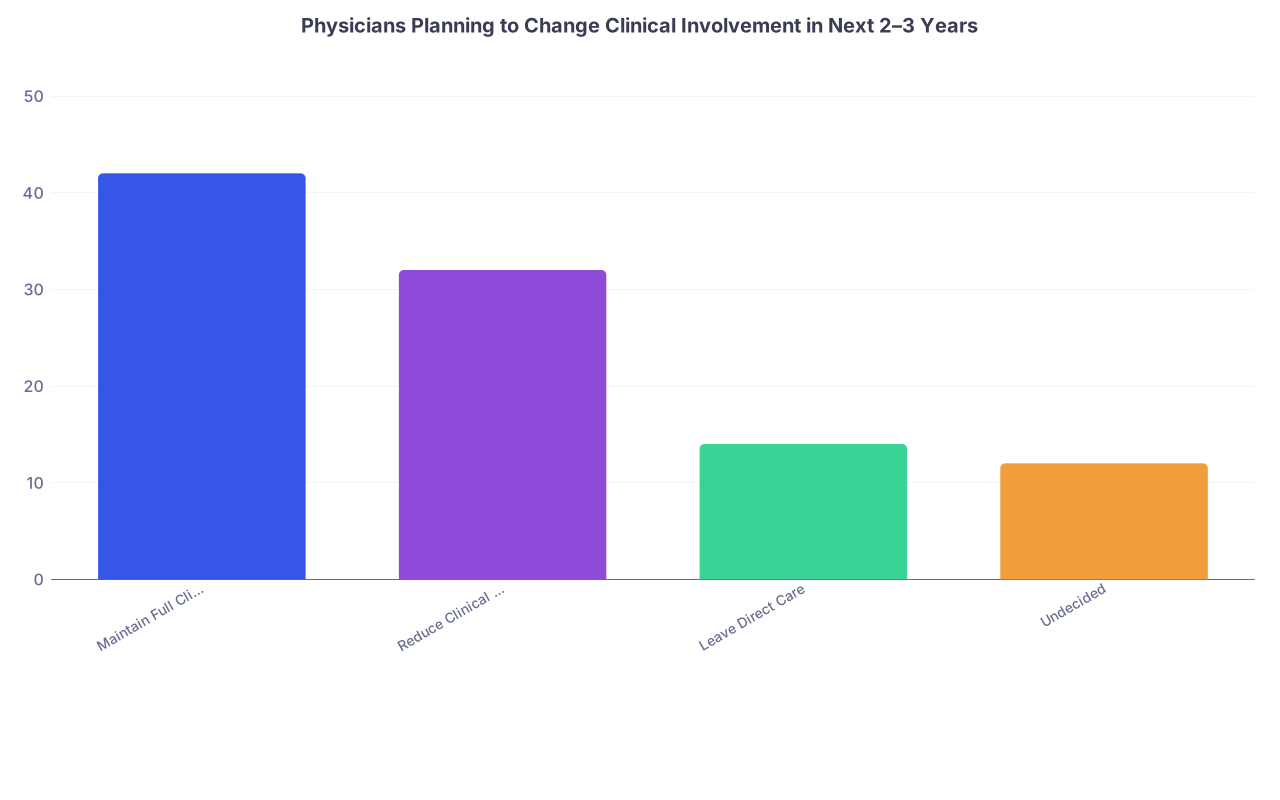
| Category | Value |
|---|---|
| Maintain Full Clinical | 42 |
| Reduce Clinical Time | 32 |
| Leave Direct Care | 14 |
| Undecided | 12 |
Are all of these “burned-out doctors”? No. Are many dissatisfied? Yes. But the primary drivers vary, and they’re not identical to “I’m clinically broken.”
Top factors commonly reported:
- Loss of autonomy and micromanagement by administrators
- EHR and documentation burden exceeding meaningful patient time
- Inadequate staffing and unsafe workloads
- Compensation models that reward volume over value
- Geographic or family priorities that clinical schedules can’t accommodate
- Desire for broader system-level impact (policy, tech, quality)
Burnout is one signal, not the whole story.
Crucially, when you look at who successfully pivots into attractive alternative roles, the pattern doesn’t support the “burnout rescue” myth.
The people landing:
- Medical director roles in health tech
- MSL / medical affairs or safety roles in pharma
- Clinical product leadership in digital health
- Physician executive positions in payers or health systems
…usually have one thing in common: they moved before they were nonfunctional. They had enough energy and clarity to build networks, learn new skills, and articulate value.
The ones who try to move when they’re already at rock bottom? They struggle. They’re competing with people who have a coherent story and demonstrable nonclinical skills, not just a degree and a trauma narrative.
The Bigger Shift: Medicine Is Becoming a Platform, Not a Prison
Here’s the uncomfortable truth hospitals don’t like you to internalize: the MD/DO is one of the most versatile professional credentials on the planet right now.
Not because you’re “special” in some mystical way. Because the training gives you three rare, marketable combinations:
- High domain expertise in a complex, regulated industry
- Decision-making under uncertainty with real-world consequences
- Direct credibility with multiple stakeholders (patients, clinicians, regulators, investors)
That combination is exactly what a lot of growing sectors are desperate for:
- Digital health and AI products that need real clinical sense-making
- Value-based care models and risk-bearing entities
- Pharma and biotech running complex trials and navigating regulation
- Health policy and payment reform
- Quality, patient safety, and outcomes measurement
- Venture and investing in health-related companies
- Education, content, and communication in health
Yet the profession still sells you a 1980s story: pick a specialty, grind for 30 years, retire. Everything else is painted as failure, burnout, or flakiness.
Reality check: health care as an industry is shifting faster than medical training is. Alternative careers are not a fringe movement of burned-out docs; they’re part of the structural evolution of how medicine gets done.
You’re not “leaving medicine” when you go into informatics, policy, pharma or health tech. You’re changing where you sit in the system.
Three Very Different Groups in “Alternative Careers”
Lumping all nonclinical physicians into “burned-out doctors” is lazy. I see roughly three groups.
1. The Crash Landers
These are the folks everyone imagines:
- Severe burnout, sometimes full-blown depression or PTSD
- Malpractice trauma, moral injury, or toxic workplace experiences
- Abrupt exits with little planning: “I quit. I’m done.”
They often wake up at 45 with no clear next step, a high cost-of-living lifestyle, and a CV that screams “clinical only.” The anxiety is palpable.
Can they build fulfilling alternative careers? Yes, many do. But it’s harder, slower, and more chaotic. They’re trying to skill-build, network, and rebrand while recovering. That’s like re-wiring the plane mid-crash.
The burnout narrative fits this group. But they’re not the whole story.
2. The Portfolio Builders
These are the quiet ones who rarely vent on social media. They:
- Start doing QA projects, informatics work, teaching, or research on the side
- Take a part-time role with a digital health startup or local health plan
- Pick up medical writing gigs, consulting, or advisory work
- Gradually reduce clinical FTE while increasing nonclinical work
They might still enjoy patient care. They just refuse to bet their entire professional life on the whims of RVU targets and hospital administrators.
When they eventually jump—say from 0.7 clinical / 0.3 nonclinical to 1.0 nonclinical—people say: “Wow, I didn’t know you were thinking of leaving.” Because they weren’t loudly melting down. They were quietly building options.
These are the people who debunk the “only for burned-out doctors” myth. They’re not escaping; they’re optimizing.
3. The Strategic Shifters
This group never planned to be 100% clinical for decades. Some examples I’ve personally seen:
- The med student who always wanted to do health policy and targeted combined MD/MPH, then went into a think tank and CMS instead of long-term practice.
- The radiologist who loved data and transitioned into AI imaging startup leadership by year 7 of practice.
- The hospitalist who built a reputation as a quality guru, then became a system-level Chief Quality Officer and later moved into a national payer role.
Were these people “burned out”? No. They were clear-eyed about where they could have the impact and life they wanted.
Calling these folks “burned-out” is not just inaccurate; it’s erasing their strategy.
The Ugly Truth: Systemic Problems Are Pushing People Out
Let’s be clear: a massive chunk of alternative-career movement is driven by a broken clinical environment. That doesn’t make the careers “for burned-out doctors,” it makes them rational responses to bad incentives.
You know the list, but let’s stop pretending it’s normal:
- 10–15 minutes per complex patient, with endless “work after work” in the EHR
- Payers second-guessing your decisions constantly
- Loss of control over your schedule, staffing, and clinical policies
- Legal fear and safety concerns
- A compensation model that squeezes you year after year
Burnout isn’t a character flaw. It’s a predictable endpoint of chronic moral and operational stress. When that stress is built into the design of modern clinical practice, of course alternative careers start to look attractive.
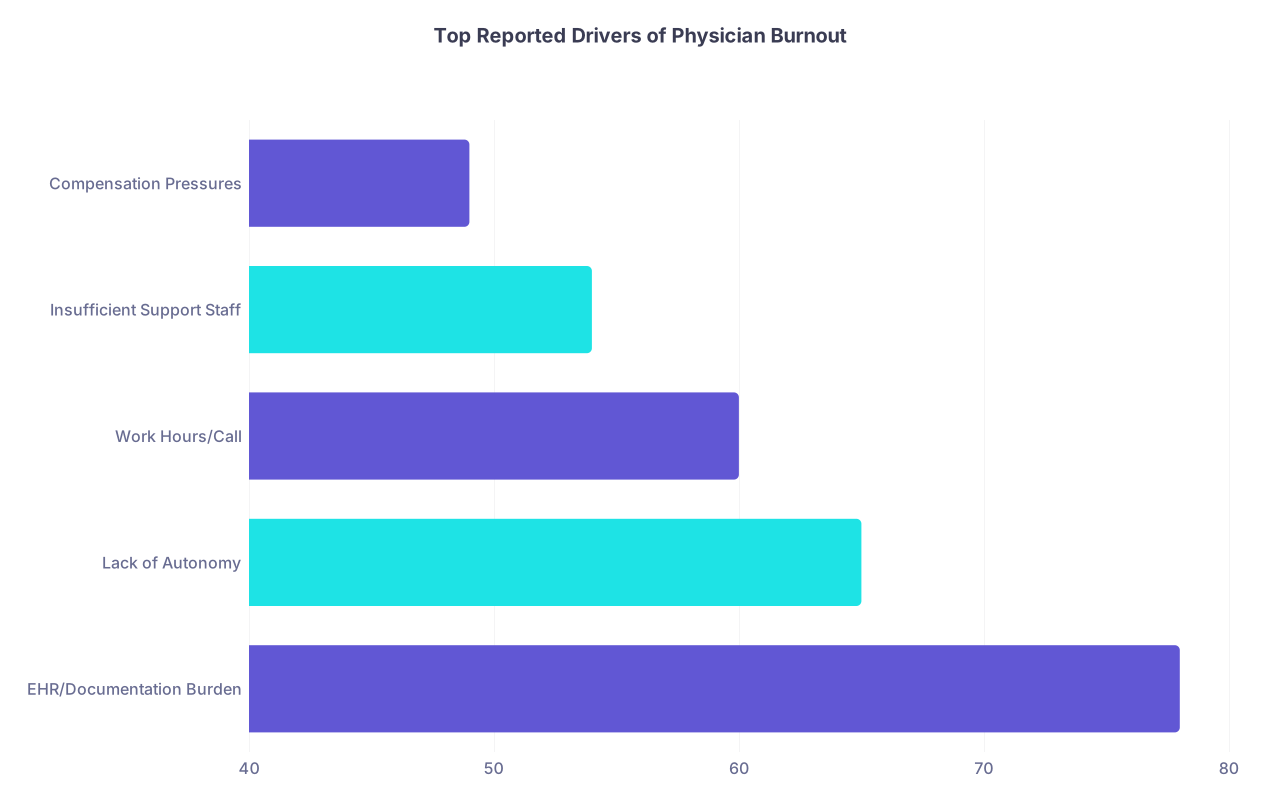
| Category | Value |
|---|---|
| EHR/Documentation Burden | 78 |
| Lack of Autonomy | 65 |
| Work Hours/Call | 60 |
| Insufficient Support Staff | 54 |
| Compensation Pressures | 49 |
So yes, many doctors are leaving primary clinical roles because the system is frying them. But that does not mean the alternative roles are some kind of dumping ground. It means health care is so dysfunctional that bright, trained professionals are reallocating themselves to environments where they can function.
That is not a burnout problem. That is a system design problem.
The Skills Gap No One Talks About
Another reason the “only for burned-out doctors” myth persists: a lot of clinicians have no clue what these jobs actually require. They assume the MD alone is the ticket.
It isn’t.
Whether it’s pharma, tech, consulting, or policy, successful transitions usually involve one or more of these:
- Project management and execution in nonclinical settings
- Real familiarity with data, analytics, and outcomes
- Understanding of product development or regulatory pathways
- Ability to talk with non-physician stakeholders in their language (finance, engineering, operations)
- Writing and communication skills that work outside a note template or journal format
| Domain Skill | Traditional Clinical Role | Alternative Medical Role |
|---|---|---|
| Direct Patient Care | Very High | Low to None |
| Team Leadership | Medium | High |
| Data/Analytics Use | Low to Medium | High |
| Business/Finance | Low | Medium to High |
| Writing for Non-Clinicians | Low | High |
The people who step into alternative careers smoothly are usually the ones who started building this toolkit early—while still clinically functional.
Again, not a burnout narrative. A competence narrative.
Who Actually Struggles the Most to Transition?
Here’s the part people do not like to hear.
The group that struggles most to land good alternative roles tends to be:
- Late in career, clinically exhausted, and
- With minimal documented leadership, project, or nonclinical work, and
- Carrying a “just get me out” energy in interviews
Employers in these spaces aren’t running a rehab facility for overworked clinicians. They want people who can contribute on day one, not just people who “need a break.”
So the myth—“alternative careers are for burned-out doctors”—is not only false, it’s dangerously misleading. If you buy into it and wait until you’re wrecked, you guarantee you’ll be less competitive for the exact roles you’re hoping will save you.
It punishes late, desperate movers and rewards early, strategic ones.
Stop Asking “Am I Burned Out Enough to Leave?”
The better question is: “What mix of work will give me a sustainable, meaningful life and leverage my medical training?”
That might be 100% clinical in a well-run group. Fine.
It might be 80/20 clinical/nonclinical for 10 years, then a gradual pivot.
It might be 0.5 clinical + 0.5 startup for a while, then full-time startup.
It might be no clinical at all after residency because you’d rather design systems than run 20-minute visits all day.
None of those require you to clear some imaginary threshold of suffering before you’re “allowed” to move.
And no, choosing an alternative career does not “waste” your medical training. It repurposes it. The waste is forcing yourself to stay in a role that is misaligned, purely because of stigma or sunk-cost guilt.
The Future: Alternative Careers Won’t Be “Alternative” Much Longer
Look at where money and power are moving in health care:
- Big tech building health and AI products
- Payers and risk-bearing entities controlling dollars and data
- Pharma and biotech using increasingly complex trial designs and real-world evidence
- Governments reforming payment and quality metrics
- Startups attacking every inefficient corner of the system
Every one of these ecosystems is pulling physicians in—not as “burned-out clinicians,” but as domain experts, leaders, and connectors.
It’s not outrageous to say that in 10–20 years, a significant percentage of physicians will spend less than half their career in traditional full-time direct care. Not because they “couldn’t hack it,” but because that’s how the industry is evolving.
Alternative careers will just be… careers. Clinical medicine will be one (important) node in a larger network of roles physicians occupy across the system.
Three Points to Walk Away With
Alternative medical careers are not a dumping ground for burned-out doctors. They’re a rational, growing set of roles at the heart of how modern health care functions.
The physicians who thrive in these paths usually move before they’re on fire. They invest early in nonclinical skills and diverse experiences, instead of waiting for a breaking point.
You do not need to earn your way out of clinical medicine by suffering enough. Treat your MD/DO as a platform, not a prison, and build the career mix that actually fits your brain, your values, and your life.