
It is 7:15 p.m. You just finished clinic, opened your inbox, and there it is again: another angry payer denial for a patient you absolutely managed correctly. You are tired of “please add this modifier” emails and administrators talking about “MSSP performance” and “downside risk” like everyone should have been born knowing what that means.
You do not want to code CPTs for the rest of your life. But the way money flows in healthcare clearly needs people who actually understand patients. And you are starting to wonder: could that be your job?
This is where value-based care (VBC) consulting lives. It is the intersection of medicine, payment models, operations, and data. And clinicians who understand all four do not just “fit” here. They drive the agenda.
Let me break this down specifically.
1. What “Value-Based Care Consulting” Actually Is
Skip the buzzwords. Here is the core.
Value-based care consulting means helping healthcare organizations get paid based on outcomes and cost efficiency instead of just volume. You are redesigning how care is delivered and how money moves, then making the math actually work in real life.
You see this work done for:
- Health systems and academic centers
- Large multi-specialty groups
- Payers (commercial plans, Medicare Advantage, Medicaid MCOs)
- Startups (virtual care, chronic disease platforms, enablement companies)
- Private equity–backed roll-ups and platforms
In practice, a VBC consulting engagement might include:
- Designing or evaluating a risk contract (shared savings, global capitation, narrow networks)
- Building care models to hit quality and utilization targets (e.g., reduce 30‑day readmissions)
- Aligning incentives for clinicians so they do not hate the new payment model
- Creating workflows, pathways, and digital tools that make the model operational instead of hypothetical
- Measuring performance and fixing what is not working
You are not just “doing strategy.” You are translating value-based payment theory into clinic schedules, order sets, staffing models, and actual daily behavior.
2. Where Clinicians Add Non-Replaceable Value
This part is non-negotiable: non-clinicians can do very sophisticated actuarial modeling and contract structure. They are often better at that than you. Where they fail is operational reality and patient nuance.
There are five places where clinicians are the difference between a pretty slide deck and a workable model.
2.1 Designing Payment Models That Do Not Backfire
Non-clinical example: a consultant proposes a big upside for lowering hospital admissions for heart failure by 20%. On paper it looks great. Fewer admissions = lower cost = shared savings.
Clinical reality: the local primary care network has:
- No same-day slots
- No IV diuresis clinic
- No home nursing capacity
- A cardiology group that books out 3 months
You know exactly what will happen. The hospital will eat readmission penalties. Clinicians will get blamed. Morale will tank. Patients will suffer.
A clinician in the room can say:
- “If you want a 20% drop in HF admissions, you need: X visits/week in high-risk clinic, Y home health slots, Z protocol for diuretic titration, and 24–48 hour follow-up post-discharge. Otherwise this is fantasy.”
You are not just complaining. You are specifying the operational stack required for the payment model’s math to hold.
2.2 Translating Contracts Into Clinical Workflows
Most clinicians never actually read the fine print of a risk contract. In consulting, you live there.
Contract language example: “Bonus pool tied to performance on HEDIS and custom quality measures; thresholds at 50th, 75th, and 90th percentile; downside starting at 3% over target total cost of care.”
What this means on the ground if you are clinically literate:
- Chronic disease care: You identify exactly which labs, visits, and documentation matter for diabetes, hypertension, COPD, etc.
- Visit design: You push for longer or differently structured visits for high-risk panels, not just “add another checkbox.”
- Role design: You design MA, RN, pharmacist, and social worker workflows around specific quality metrics and care gaps.
You convert vague “we need to do better” into “for a panel of 1,000 Medicare lives, we need X care gap closures/month and Y outreach touches.”
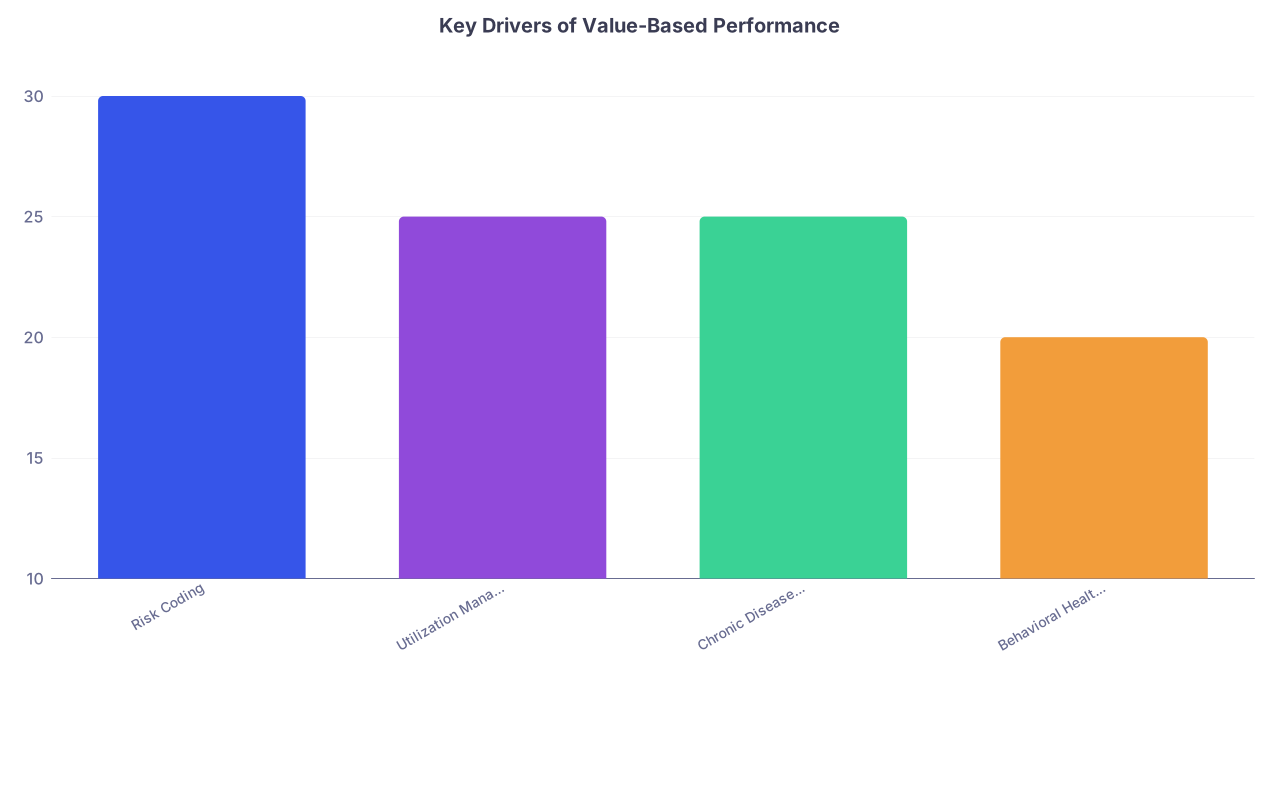
| Category | Value |
|---|---|
| Risk Coding | 30 |
| Utilization Management | 25 |
| Chronic Disease Control | 25 |
| Behavioral Health Integration | 20 |
That rough breakdown is actually how a lot of value-based contracts behave. If your risk coding and chronic disease control are garbage, no clever contract will save you.
2.3 Stopping Dangerous or Stupid Ideas Early
I have seen all of these proposed by bright people who had never written a single discharge summary:
- “Let’s cap ED use by charging patients dynamic co-pays after visit number X.” For a duals-heavy safety-net population.
- “Push all follow-ups to telehealth to save cost.” For a mostly geriatric population with sensory deficits and no devices.
- “Tie 50% of physician comp to VBC metrics next year.” In a group that cannot even produce reliable, physician-level performance dashboards.
A clinician consultant can kill these ideas before they waste 12 months and seven figures.
You say, very directly:
- “If you do this, your heart failure mortality will go up.”
- “Your access-to-care bottleneck is upstream, not in the ED.”
- “You will trigger a mass exodus of senior clinicians and be left with locums.”
That is value. Brutal pattern recognition backed by real inpatient and outpatient experience.
2.4 Building Clinician Trust in the Payment Model
A value-based care model that clinicians do not trust will fail. Period.
Clinician consultants are often used as:
- Translators: “Here is what this risk score actually means and how it affects your daily work.”
- Validators: “No, this metric is garbage. Yes, this one is fair if we adjust it this way.”
- Ambassadors: “I have been on both sides. This comp plan is aggressive but not predatory.”
You can sit in a room with 50 skeptical physicians and say:
“I have read the full contract, I have checked how they are calculating total cost of care and attribution, and I would or would not sign this myself. Here is why.”
You will be listened to in a way a pure MBA never will.
3. The Main Value-Based Payment Models (And Where Consultants Fit)
You cannot work in this space without being fluent in the models. Let’s keep it tight.

3.1 Shared Savings / Shared Risk
Core idea: You start with normal fee-for-service, then layer on a bonus if you keep total cost of care below a benchmark. Shared risk adds penalties if you overshoot.
Consulting levers:
Attribution analysis: Who “owns” the patient in the model?
Benchmarking: Is the target even remotely realistic given this population?
Utilization: Where are the avoidable costs (SNFs, ED, post-acute, imaging)?
Clinical programs: You recommend things like:
- High-risk care management teams
- 24/7 nurse lines and after-hours clinics
- SNFist programs and tight post-acute oversight
3.2 Bundled Payments / Episodes of Care
One price for an episode (e.g., 90 days around a joint replacement).
Clinician consulting work:
- Episode design: What is included or excluded? Complications? Readmissions?
- Pathway standardization: Pre-op optimization, PACU criteria, rehab plans.
- Site of care shifts: Inpatient vs outpatient surgery, home vs SNF rehab.
- Gainsharing structure: How surgeons and teams participate in savings.
If you are an orthopod or anesthesiologist who understands both length of stay and post-acute cost, you are gold here.
3.3 Capitation / Global Payments
Fixed per-member-per-month (PMPM) payment to cover a defined scope of care. Ranges from modest primary care capitation to full global risk.
Where you come in:
- Panel management: Safe panel sizes, risk adjustment awareness.
- Access redesign: Same-day, virtual, home-based capacity for high-risk groups.
- Care team clustering: Who does what, at what license level, in what setting.
- Clinical governance: When to escalate to specialty or hospital-level care.
This is where “population health” stops being a slogan and becomes math plus scheduling plus triage.
| Model Type | Typical Clinical Levers |
|---|---|
| Shared Savings | Care management, SNF oversight, ED diversion |
| Bundled Payments | Pathways, pre-op optimization, post-acute care |
| Capitation | Panel design, access, risk stratification |
| Pay-for-Performance | Documentation, chronic disease management, screening |
4. What Clinician VBC Consultants Actually Do Day to Day
Let’s make this tangible. Titles and employers differ, but the work tends to cluster into a few themes.
4.1 Clinical Model Design
You might be asked to:
- Design a heart failure program for a system that just signed a downside MSSP contract.
- Build an integrated behavioral health model inside primary care for a Medicaid population.
- Stand up a “hospital at home” program to pull admits out of the inpatient setting.
Your tasks:
- Specify inclusion criteria, staffing, workflows, and escalation triggers.
- Tie each element back to specific quality and cost metrics.
- Work with finance and actuaries to prove the ROI.
This is not theoretical pathway work. You are designing programs that need to be live in 6–12 months.
4.2 Clinical Input on Data and Reporting
Most “physician performance dashboards” are junk without clinical review.
You will:
- Review metric definitions and push back on flawed ones (e.g., not excluding hospice patients from certain measures).
- Define meaningful clinical segments: high-risk vs rising-risk vs stable; acute vs chronic episodes.
- Help build actionable reports: things a clinician can use tomorrow, not just pretty population graphs.
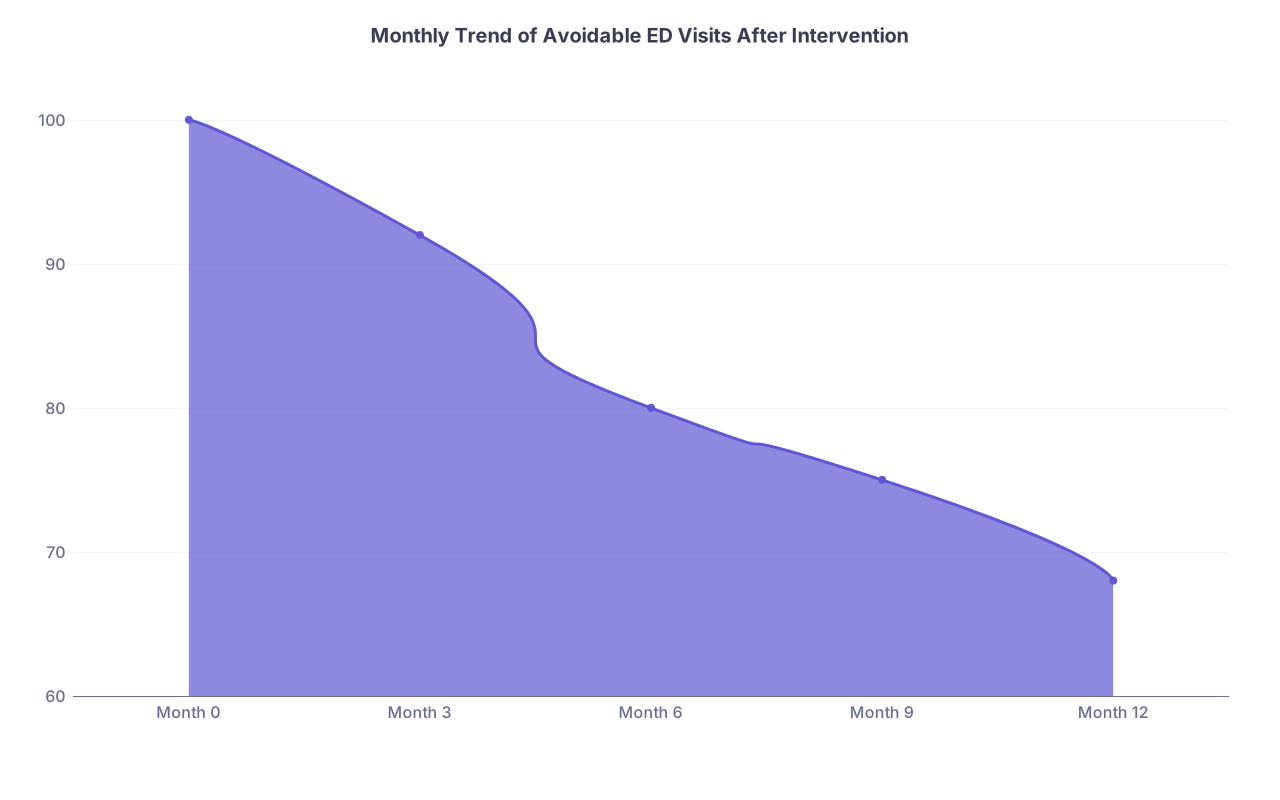
| Category | Value |
|---|---|
| Month 0 | 100 |
| Month 3 | 92 |
| Month 6 | 80 |
| Month 9 | 75 |
| Month 12 | 68 |
A chart like that is what you want to see once your intervention goes live. And if the line is flat or going up, you are the one who interprets why.
4.3 Contract and Compensation Design with Clinical Sanity
You may sit across from:
- Payers, working out contract language and performance metrics.
- Health system finance teams, structuring internal gainsharing and comp plans.
- Physician groups, trying to not revolt when shown the new “VBC-heavy” comp model.
You will:
- Translate actuarial risk into clinical reality: “This MLR target is incompatible with your current specialty mix and post-acute spend.”
- Flag perverse incentives: metrics that push under-use or over-simplify complex care.
- Design ramp-up and guardrails: floors, caps, grace periods, stabilization for high-risk changes.
5. Career Paths: How Clinicians Enter VBC Consulting
There is no one clean pipeline. But there are a few common paths.

| Step | Description |
|---|---|
| Step 1 | Clinical Practice |
| Step 2 | Internal VBC Role |
| Step 3 | Formal Training - MBA MHA |
| Step 4 | Health System VBC Leadership |
| Step 5 | Consulting Firm - Healthcare |
| Step 6 | Independent Consultant |
5.1 Starting Inside Your Own Organization
Honestly the best entry point.
You might:
- Join a “population health” or “care transformation” committee.
- Lead a pilot project (e.g., reduce readmissions for a specific diagnosis).
- Become the physician lead for a quality metric initiative tied to a payer contract.
From there, common titles:
- Medical Director, Population Health
- Clinical Lead, Value-Based Care
- Physician Champion, ACO Programs
You get real experience and a story that external employers understand.
5.2 Going Directly into a Consulting Firm
Big names: McKinsey, BCG, Bain, Deloitte, PwC, L.E.K., plus healthcare-specific boutique firms.
Reality:
- They like physicians, especially if you are early-career and willing to travel.
- You will do more general healthcare work (strategy, operations) but VBC will be a recurring theme.
- You will pair with non-clinical consultants who expect you to bring credibility on anything touching care delivery.
Do you need an MBA? Helpful but not mandatory. What you absolutely must have:
- Comfort with Excel and PowerPoint
- Ability to speak both clinical and business language
- Willingness to sit in a room for 10 hours and grind through contract details
5.3 Pivoting to Payors, Enablement Companies, and PE-Backed Platforms
Some clinicians jump straight into:
- Medicare Advantage plans
- Risk-bearing PCP platforms (e.g., ChenMed-style, Oak Street–style)
- Care management or tech-enabled VBC startups
- Private equity–backed multi-specialty or single-specialty groups going at-risk
Roles:
- Medical Director, Value-Based Programs
- VP Clinical Strategy
- Chief Medical Officer for a VBC business line
Here you are half internal operator, half consultant. The “client” is your own company.
5.4 Independent / Boutique Consulting
This is not step one. This is step three or four.
Once you have:
- Operated in at least one real risk arrangement
- Sat through contract negotiations
- Built and run at least one program with measurable impact
Then you can credibly sell your brain directly:
- To smaller provider groups negotiating their first MA or MSSP deal
- To digital health startups trying to design outcome-based contracts
- To hospitals in markets where VBC is just now heating up
6. Skills Clinicians Must Build to Be Taken Seriously
Clinical credibility gets you in the door. It does not keep you there.
You need to add three buckets of skill.
6.1 Financial and Contract Literacy
You must be fluent in:
- Basic payer math: PMPMs, MLR, total cost of care, risk corridors, withholds.
- Risk adjustment: HCCs, RAF scores, how coding affects revenue and fairness of comparison.
- Contract structure: upside-only vs downside risk, stop-loss, attribution rules.
You do not need to be an actuary. But if someone says, “We are taking 50% of first-dollar risk on Part A/B for 8,000 aligned lives with 5% of revenue at risk for quality,” you should not blink.
6.2 Data and Analytics Comfort
You are not a data scientist. You are a power user and a translator.
You should:
- Read and critique metrics, not just absorb them.
- Know basic statistics well enough to spot nonsense (“this is not risk-adjusted”, “your N is too small”, “this is seasonality, not trend”).
- Work comfortably with dashboards, Excel, and basic query tools.
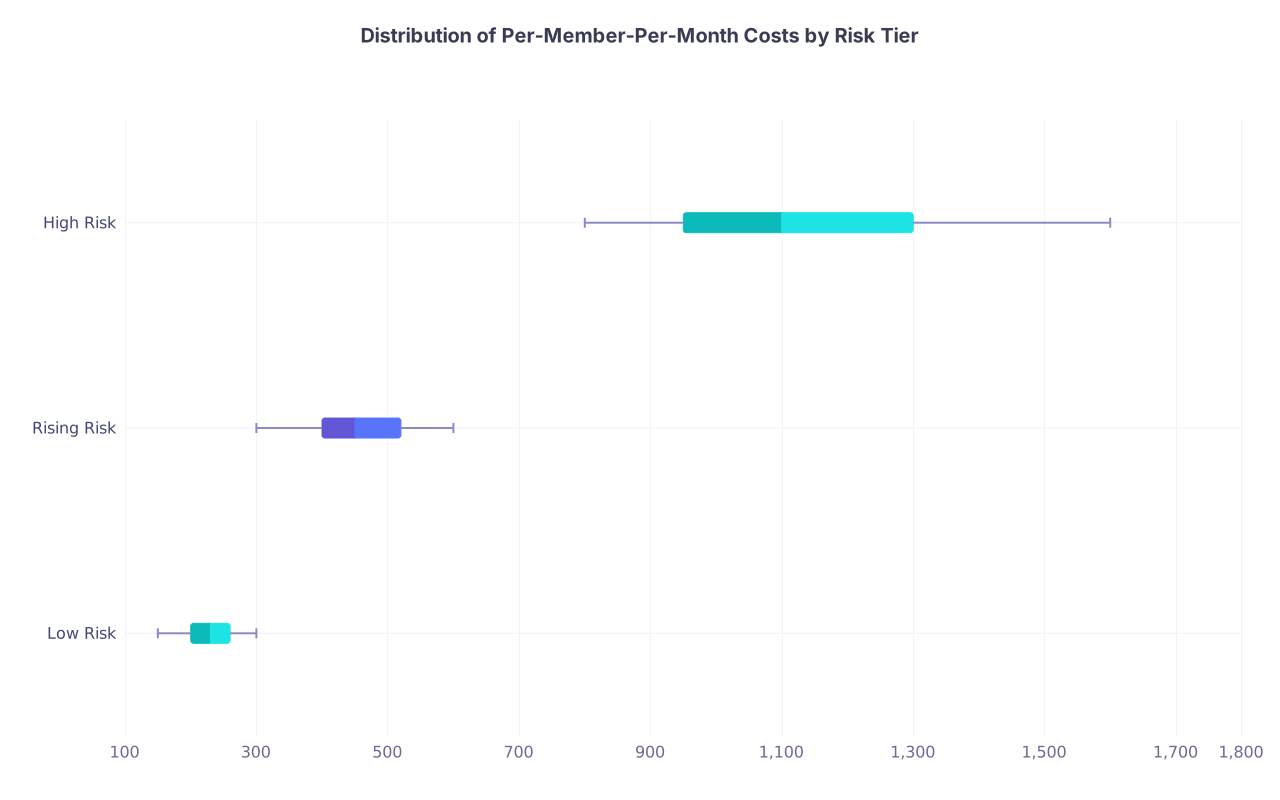
| Category | Min | Q1 | Median | Q3 | Max |
|---|---|---|---|---|---|
| Low Risk | 150 | 200 | 230 | 260 | 300 |
| Rising Risk | 300 | 400 | 450 | 520 | 600 |
| High Risk | 800 | 950 | 1100 | 1300 | 1600 |
Those kinds of distributions show you where to focus your clinical programs. High-risk outliers are where your clinical brain pays off.
6.3 Communication and Influence
If you cannot:
- Explain a complex payment model to a skeptical surgeon in 5 minutes, and
- Explain a complex clinical reality to a CFO in 5 minutes,
you will be background noise.
Consulting is constant translation:
- Payer to provider
- Finance to front-line
- Operations to clinicians
You must be blunt but not alienating, clinical but not jargon-heavy, business-aware but not “sellout.”
7. Pros, Cons, and Who This Path Fits
Some reality checking.
7.1 The Upside
- Impact at scale: You move levers that affect thousands or millions of patients, not a panel of 1,500.
- Diverse problems: No pre-authorization treadmill. Each engagement is a new puzzle.
- Career mobility: From consulting you can go to payers, health systems, startups, PE-backed platforms.
- Respect for clinical perspective: When you are one of few clinicians in the room, your words have weight.
7.2 The Downside
- Less direct patient contact: For most VBC roles, patient care is advisory, not direct.
- Travel and hours (especially in big firms): You can be on the road and in slide decks constantly.
- Frustration tolerance: You will see good ideas blocked by politics and bad ideas propelled by money.
- Identity shift: You are no longer “just a doctor.” That sounds nice until you lose the reflexive respect of white coat culture.
7.3 Who Tends To Thrive
You will probably do well here if you:
- Find yourself mentally redesigning your clinic schedule and call system constantly.
- Like “why do we do it this way?” more than “I want to master this one procedure.”
- Can sit through long discussions about contracts and not zone out.
- Are comfortable being the only one in the room who has actually practiced medicine.
8. Concrete First Steps If You Are Interested
Do not quit your job and “become a consultant” tomorrow. Start small and structured.
- Get literate:
- Read CMS materials on ACOs, MSSP, and bundled payments.
- Follow a few serious VBC organizations and think tanks, not just LinkedIn fluff.
- Learn your institution’s reality:
- Ask your leadership which VBC contracts you are already in.
- Find out which metrics drive your bonuses and penalties.
- Volunteer for one real project:
- A readmission reduction project tied to a contract.
- A chronic disease metric improvement effort.
- Consider formal training if you want to fully pivot:
- Short courses in healthcare finance or population health.
- MBA/MHA only if you want broader leadership/strategy roles, not mandatory.
From there, you can decide: internal VBC leadership, external consulting, payer or startup roles, or some hybrid.
FAQ (Exactly 4 Questions)
1. Do I need an MBA to get into value-based care consulting as a clinician?
No. An MBA can help if you want to join a top-tier consulting firm or move into broad executive roles, but it is not a prerequisite. What matters more: demonstrated interest in VBC, basic financial literacy, and evidence that you can work beyond individual patient care (committees, projects, pilots).
2. Can I keep seeing patients if I move into VBC consulting?
Yes, but usually at reduced FTE. Common setups: 0.6–0.8 clinical with 0.2–0.4 VBC leadership internally, or 0.5 consulting with 0.5 outpatient practice. In pure external consulting firms it is harder to maintain clinical time unless the firm explicitly supports it.
3. What specialties translate best into value-based care consulting roles?
Primary care (IM, FM, pediatrics) aligns most directly with population health and risk contracts. Hospitalists, emergency physicians, and geriatricians also translate well given their familiarity with utilization and complex patients. But any specialty with heavy chronic disease and coordination issues (cardiology, oncology, nephrology) has real value if you understand system-level dynamics.
4. How do I know if my experience is “enough” to apply for a VBC consulting role?
You are ready to start applying when you can point to at least 1–2 concrete projects where you influenced outcomes tied to cost, quality, or utilization. Examples: leading a readmission reduction initiative, helping implement a new chronic disease pathway, working as a physician lead for an ACO or MA initiative. If you can explain the clinical, operational, and financial sides of those projects coherently, you are ahead of most applicants.
Key points to walk away with:
- Value-based care consulting lives at the intersection of clinical reality, payment models, and operations. Clinicians are uniquely positioned to bridge those worlds.
- Your clinical experience is not a side note; it is the core asset that keeps payment models from becoming dangerous or unworkable.
- You do not need to become an actuary, but you must become fluent in the language of risk, contracts, and data if you want to be taken seriously in this space.