
The worst way to spend a gap year is to “see what comes up.”
The best way is to treat it like a 12‑month launchpad into a specific, non‑clinical career.
You are not drifting. You are building. And the calendar is your main weapon.
Below is a concrete, month‑by‑month blueprint for a 12‑month gap year aimed at non‑clinical careers for people with medical training (med students, residents leaving training, or physicians pivoting). I am assuming you are broadly interested in one or more of these:
- Healthcare consulting
- Pharma / biotech / medtech
- Health tech / startups / product roles
- Health policy / public health / NGOs
- Medical writing / education / communication
- Operations / administration / informatics
If you are totally undecided, that is fine. This plan starts with exploration, then narrows. But you do not get to “stay undecided” past Month 3. After that, you pick a lane and drive.
Big Picture: Your 12‑Month Non‑Clinical Launch Timeline
At this point you should understand the overall arc before we zoom into weeks and days.
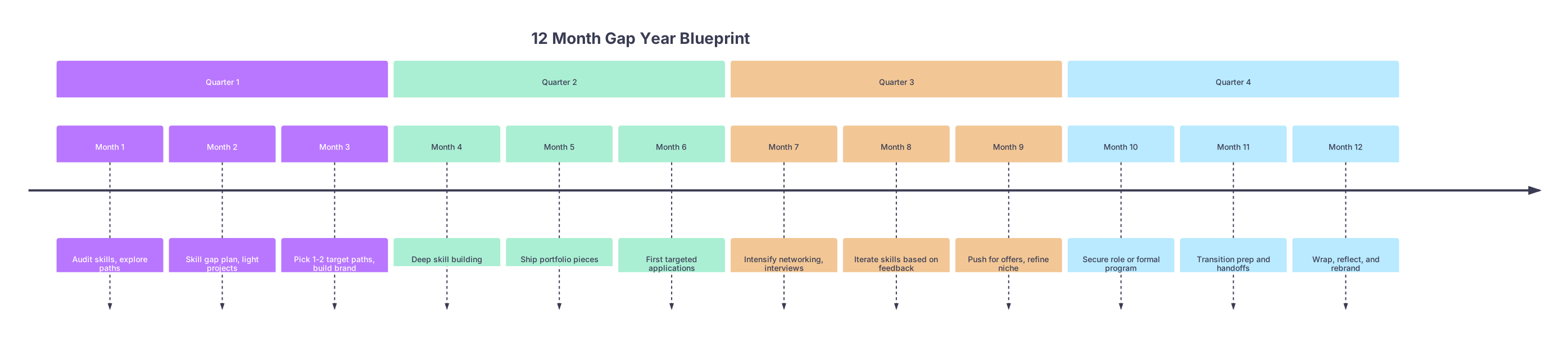
| Period | Event |
|---|---|
| Quarter 1 - Month 1 | Audit skills, explore paths |
| Quarter 1 - Month 2 | Skill gap plan, light projects |
| Quarter 1 - Month 3 | Pick 1-2 target paths, build brand |
| Quarter 2 - Month 4 | Deep skill building |
| Quarter 2 - Month 5 | Ship portfolio pieces |
| Quarter 2 - Month 6 | First targeted applications |
| Quarter 3 - Month 7 | Intensify networking, interviews |
| Quarter 3 - Month 8 | Iterate skills based on feedback |
| Quarter 3 - Month 9 | Push for offers, refine niche |
| Quarter 4 - Month 10 | Secure role or formal program |
| Quarter 4 - Month 11 | Transition prep and handoffs |
| Quarter 4 - Month 12 | Wrap, reflect, and rebrand |
This is not abstract. By Month 9 you should be in active interview cycles. By Month 12 you should have:
- A clear career direction
- A portfolio (projects, products, writing, slide decks, or data work)
- 15–30 real professional contacts who know you by name
- Applications and interviews completed for concrete roles, fellowships, or programs
Let us go quarter by quarter, month by month, then drill down to weekly and daily actions.
Quarter 1 (Months 1–3): Explore, Decide, and Position
Month 1: Audit, Exposure, and Brutal Honesty
At this point you should stop pretending your CV “speaks for itself.” In non‑clinical careers, it usually does not.
Weeks 1–2: Career and skills audit
- Map your starting point:
- Clinical background: med school year, residency level, or attending
- Any non‑clinical experience: research, QI projects, teaching, leadership, startup tinkering
- Concrete skills: Excel, basic stats, coding, slide decks, teaching, writing, etc.
- Shortlist 3–4 target directions:
- Example clusters:
- Consulting / strategy
- Pharma / biotech (medical affairs, safety, clinical development)
- Health tech / product / UX
- Policy / public health
- Writing / communication / education
- Example clusters:
- Do a 2‑column reality check on each path:
- Column 1: What they actually hire for (look at 10 real job postings)
- Column 2: What you actually have
You will see gaps. Good. That is the entire point of Month 1.
Weeks 3–4: Structured exposure
At this point you should be talking to real humans, not just reading blogs.
- Set a target: 4–6 informational calls by end of Month 1
- Sources:
- Alumni databases (med school, undergrad)
- LinkedIn: search “[your school] + ‘consultant’ / ‘medical director’ / ‘product manager’”
- Professional groups: AMWA (writers), HIMSS (informatics), local health tech meetups
- On each call (20–30 min):
- Ask:
- “What does your week actually look like?”
- “What backgrounds transition well into your role?”
- “If I had 12 months, what would you tell me to do?”
- Request: “Is there one junior person you would recommend I speak to?”
- Ask:
End of Month 1 checkpoint:
- You have a 1‑page “Gap Year Intent” document:
- 3–4 possible paths
- Top skill gaps for each
- Initial target companies or orgs
- You have done at least 4 real conversations with people in non‑clinical roles.
Month 2: Skill Gap Plan and Early Projects
Now you stop just “thinking about” options and start building things.
Week 1: Choose 2 primary paths to pursue
At this point you should narrow to 2 main directions, not 4. Example pairs:
- Consulting + health tech
- Pharma + medical writing
- Policy + public health analytics
You are not yet choosing just one, but you are done with unfocused exploration.
Weeks 2–3: Build your skill plan
Break the next 4–6 months into specific upskilling themes. Example:
- If consulting is primary:
- Excel and PowerPoint at a professional level
- Case interview basics
- Simple financial literacy (P&L, margins, market sizing)
- If health tech / product is primary:
- Intro UX / product management course
- Basic SQL or Python
- Understanding Agile / Scrum
- If pharma / med affairs:
- Regulatory basics (FDA, EMA)
- Reading trial protocols and CSR documents as “product”
- Scientific communication (slides, abstracts)
Choose 1–2 courses max per quarter. Do not hoard courses. Finish them.
Weeks 3–4: Start one tangible project
You need something to point to in future interviews. One of:
- For consulting:
- Analyze a public company’s healthcare strategy, build a 10–15 slide deck
- Do a “market sizing” project for a digital health product idea
- For writing:
- Start a Substack or blog and publish 2 short, well‑researched posts
- Write a structured drug monograph and post it as a sample
- For health tech:
- Map a patient journey and propose a digital solution; simple clickable prototype via Figma
- Build a basic data dashboard using public health data
End of Month 2 checkpoint:
- You have a defined skills plan with specific courses / resources and dates
- You have started one project and blocked weekly time to advance it.
Month 3: Decide Your Primary Lane and Build a Public Profile
By now you should stop hedging. You will still apply broadly, but your brand needs focus.
Week 1: Choose 1 primary and 1 secondary path
Examples:
- Primary: Health tech product. Secondary: Consulting.
- Primary: Medical writing. Secondary: Pharma medical affairs.
- Primary: Policy / public health. Secondary: Analytics roles.
This is about messaging, not limiting your applications.
Week 2: Rebuild your CV and LinkedIn for non‑clinical work
At this point you should rewrite your materials from scratch. Not “tweak your old CV.”
- Translate clinical work into outcomes and skills:
- “Managed 15–20 inpatients daily, prioritizing limited resources under time pressure”
- “Led QI initiative that reduced ED LOS by 20% over 6 months”
- “Coordinated a 10‑person interdisciplinary team”
- Remove:
- Excess detail about obscure rotations or niche procedures you will never do again
- Add:
- Keywords matching your primary path (e.g., “stakeholder management,” “data‑driven decision making,” “healthcare operations,” “scientific communication”)
Weeks 3–4: Light personal brand
You do not need to become an influencer. You do need receipts.
Minimum:
- LinkedIn:
- Updated headline: “Physician transitioning to health tech / product roles” (or similar)
- About section: 3 short paragraphs → background, interests, current projects
- 2 short posts: summary of something you are learning or building
- Simple portfolio:
- Google Drive or Notion page with:
- Your project(s) from Month 2
- Slides, writing samples, or prototypes
- Brief descriptions: problem, your role, outcome
- Google Drive or Notion page with:
End of Month 3 checkpoint:
- Your primary and secondary target paths are clear
- Your CV and LinkedIn speak to those paths
- You have at least 1–2 public or shareable artifacts.
Quarter 2 (Months 4–6): Deep Skill Building and First Applications
Now the timeline shifts from “explore” to “execute.”
Month 4: Double Down on Skills and Portfolio
At this point you should be spending 15–25 focused hours per week on your future career, not just “when you have time.”
Weekly structure (example)
- 8–10 hours: Formal learning (course, book, cases)
- 8–10 hours: Project / portfolio work
- 2–3 hours: Networking (1–2 calls, LinkedIn messages, events)
If you are working clinically part‑time, you still need these blocks. Otherwise this “gap year” turns into a vague sabbatical.
Specific actions by path (Month 4 focus)
- Consulting:
- Finish a core consulting skills course (slide design, Excel)
- Do 10–15 practice cases with partners (PrepLounge, peers, alumni)
- Health tech / product:
- Complete an intro product management or UX course
- Draft a PRD (product requirements document) for your Month 2 idea
- Pharma / med affairs:
- Read 3–5 published CSRs or pivotal trial manuscripts, write 1–2 structured summaries
- Build a sample conference slide deck for a landmark trial
- Writing / comms:
- Commit to 1 piece/week
- Pitch 1 article to a small outlet or blog
Month 5: Ship Something Real
At this point you should “ship” something with an external audience. Not just private Google Docs.
Examples by path:
- Health tech:
- Publish your clickable prototype and share it with 5 people for feedback
- Contribute to an open‑source project or hackathon
- Policy / public health:
- Analyze a local health policy issue and publish a short policy brief online
- Use a public dataset (CDC, WHO) to create a concise report with charts
- Writing:
- Guest post on a niche site
- Apply to 2–3 paid freelance platforms
- Consulting:
- Present your deck (from Month 2/4) to a mentor actually working in consulting and ask for blunt critique
Your goal this month: have at least one thing you can mention as “recent work” in conversations and cover letters.
Networking target:
- 2–3 new conversations this month, but now with more senior people if possible
- Always end calls with: “If my goal is [role] in 6–12 months, what am I missing from my profile?”
Month 6: Start Targeted Applications and “Soft Searching”
By Month 6 you should not be “waiting until you feel ready.” You start applying.
Week 1–2: Define your target market
Create a simple list:
| Path | Target Type | Example Targets |
|---|---|---|
| Consulting | Big + boutique | McKinsey, LEK, IQVIA |
| Health Tech | Seed to Series C | Local startups, Teladoc |
| Pharma / Med | Large + mid-size | Pfizer, Novartis, Biogen |
| Policy / Public | NGO + Gov + Think | WHO, local DOH, RAND |
Aim for:
- 10–20 organizations where you would realistically fit as an entry‑level or “career switcher” hire
- For each, identify:
- 2–3 relevant roles (current or past postings)
- 1–2 people to contact on LinkedIn
Week 3–4: Start “soft” applications
- Roles you should consider:
- Fellowships (e.g., health policy, digital health, innovation)
- Associate / analyst / coordinator / specialist roles
- Contract / part‑time positions (great for portfolio and references)
- For each application:
- Tailor a short, sharp cover email
- If possible, have someone in the company forward your CV
End of Month 6 checkpoint:
- You have applied to at least 5–10 roles or fellowships
- You have a clear tracking sheet: applications, contacts, status.
Quarter 3 (Months 7–9): Aggressive Outreach, Interviews, and Iteration
This is where the year either turns into a launch or drifts into “maybe next year.” Your actions decide.
Month 7: Professionalize Your Search
At this point you should treat the job search like a job.
Weekly structure (example 20–25 hrs/week)
- 6–8 hours: Applications and customization
- 4–6 hours: Networking and follow‑ups
- 4–6 hours: Continued project work (keeps you sharp)
- 2–3 hours: Interview prep
Concrete goals for Month 7:
- 10–15 new tailored applications
- 5–8 new conversations (mix of warm and cold outreach)
- Begin serious interview prep:
- Consulting: live cases 3x/week
- Product: practice product sense questions
- Pharma / med affairs: practice explaining trials to non‑experts
Month 8: Respond to Market Feedback
The market is giving you feedback, even if it feels like silence.
At this point you should evaluate:
- You are getting:
- No responses → your CV / LinkedIn / targeting is off
- Screens but no interviews → your story is weak
- Interviews but no offers → your interviewing or portfolio is not convincing
Adjust accordingly:
- If no responses:
- Rewrite your summary and top 5 bullet points
- Narrow to a tighter set of roles and mirror their language more precisely
- Ask 2 people in your target field to tear apart your CV
- If interviews but no offers:
- Do 3–5 mock interviews with people actually in the field
- Record yourself; check if you ramble, over‑explain clinical jargon, or never mention business impact
Keep building while applying
Do not stop making things:
- Release version 2 of your project based on earlier feedback
- Add one more portfolio piece if your target path expects it (e.g., second writing sample, second deck)
Month 9: Push Hard for Offers
By Month 9 you should be in at least early‑stage processes for some roles.
Aggressive weekly targets:
- 10+ tailored applications
- 3–5 follow‑up notes to prior contacts
- 2–3 mock interviews
Use your gap year story cleanly:
- “I set aside this year to deliberately transition into [X]. During this time I have [built project Y, taken course Z, published A, etc.]. I am now ready to commit long‑term to this path.”
If you are not in any processes by now, you must:
- Get 1–2 real professionals to review your overall strategy
- Consider widening your target:
- Different geography
- Adjacent roles (e.g., operations instead of pure strategy; MSL instead of med affairs director)
Quarter 4 (Months 10–12): Secure, Transition, and Rebrand
Now you close loops. The goal is not endless searching. The goal is to land.
Month 10: Secure Something Concrete
At this point you should be pushing existing processes to a decision.
- Follow up with every recruiter or hiring manager you have spoken to
- Be explicit: “I am very interested in this role and this team. What is the realistic timeline for next steps?”
If nothing is moving fast enough, add:
- 1–2 targeted, structured internships / fellowships
- Short‑term contracts (consulting projects, writing contracts, research coordination) that give you:
- A supervisor reference
- Something recent and relevant on your CV
Month 11: Prepare for the Next Role
Once you have an offer (or a very likely pathway), shift part of your time to transition.
You should:
- Confirm start dates, expectations, and any onboarding materials
- Ask your future manager:
- “If I want to hit the ground running in Month 1, what should I read or practice now?”
- Wrap up ongoing independent projects:
- Document what you built
- Update your portfolio with final versions and outcomes
Also: clean up your online presence. You want your future colleagues to see a consistent, intentional story.
Month 12: Reflect, Rewrite, and Reset Your Identity
This month is for integration.
At this point you should no longer describe yourself only as “a doctor taking a gap year.” You should sound like someone in (or about to enter) your new field.
Actions for Month 12:
- Rewrite your LinkedIn headline and About section to reflect your new role or path
- Update your CV to front‑load:
- New job / fellowship
- Most relevant projects from the year
- Concrete skills and tools
- Do a 2‑page retrospective for yourself:
- What worked this year
- What you would not do again
- Where you want to be in 2–3 years
This document will guide your next transitions more than any blog post ever will.
Weekly and Daily Structure: How to Actually Live This Plan
Grand timelines fail when your weeks are chaos. Here is what a steady execution rhythm looks like.
Sample Weekly Template (Gap Year, Non‑Clinical Focus)
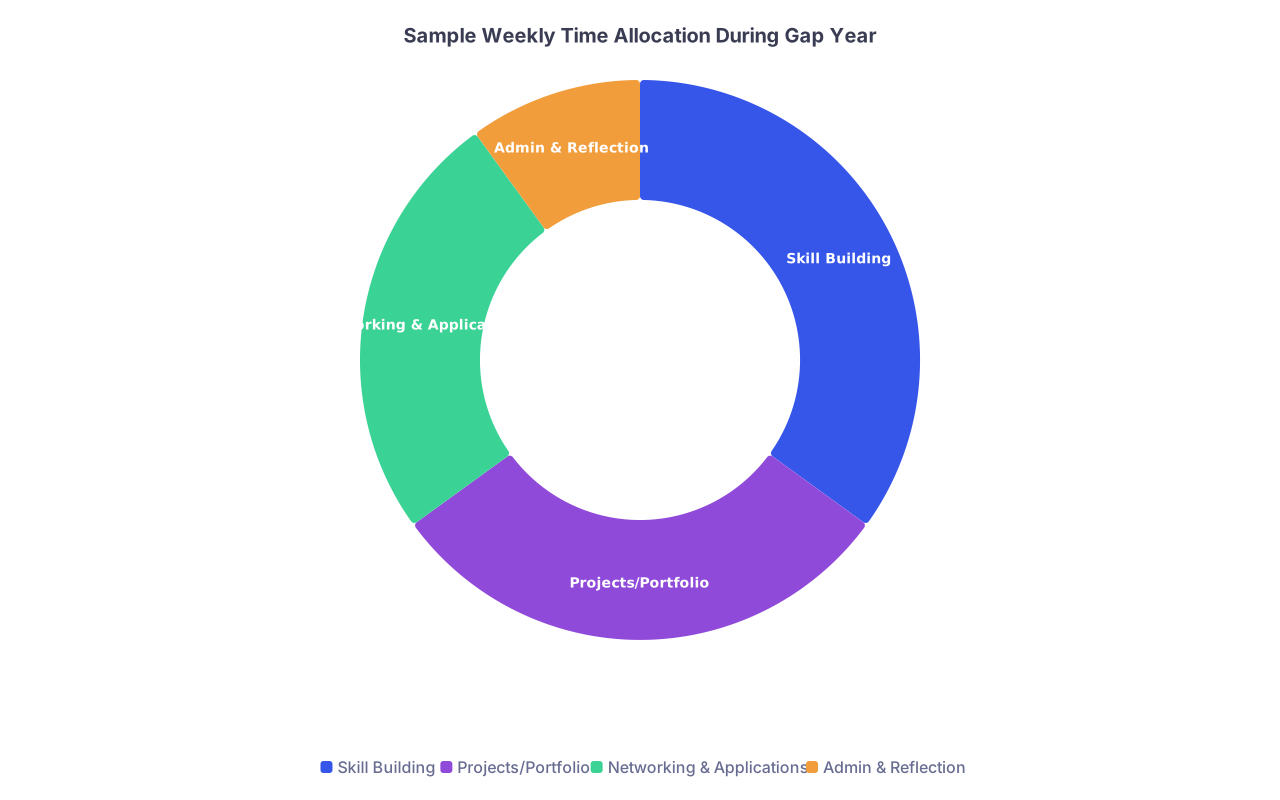
| Category | Value |
|---|---|
| Skill Building | 35 |
| Projects/Portfolio | 30 |
| Networking & Applications | 25 |
| Admin & Reflection | 10 |
For a 30‑hour/week dedicated schedule (adjust if you also work clinically):
- 10–12 hours: Skill building (courses, reading, practice problems)
- 8–10 hours: Project work / portfolio building
- 6–8 hours: Networking and job search
- 2–4 hours: Admin, planning, and reflection
Sample Day (Focused Block)
- 09:00–11:00 – Deep work: course or hard skill (no phone, no email)
- 11:15–12:30 – Project work: write, design, code, analyze
- 14:00–15:00 – Networking: 1 call + 2 LinkedIn messages
- 15:15–16:00 – Job search: 1 tailored application
- 16:00–16:15 – Quick journal: what moved the needle today?
If you do that 4 days a week, for 9–12 months, you will not be in the same place next year.
Common Pitfalls (And When in the Timeline They Hit)
I have watched smart people waste these 12 months. The pattern is predictable.
- Months 1–3 pitfall: Endless “research” and zero decisions
- Fix: Force the Month 3 checkpoint → pick 1 primary, 1 secondary path
- Months 4–6 pitfall: Course hoarding without shipping
- Fix: Every 6 weeks you must have something finished you can show
- Months 7–9 pitfall: Weak story in interviews (“I just wanted to explore options…”)
- Fix: Rewrite a clear, confident narrative of why you are choosing this path now
- Months 10–12 pitfall: Drifting into a second gap year
- Fix: Set a hard decision date for yourself in Month 10 (accept something viable, even if not perfect; you can pivot again later)
If You Are Starting Late
If you are already halfway through a “gap year” and you just realized you have been drifting, compress the plan:
- Months 1–2 tasks → Do them in 2 weeks
- Months 3–6 tasks → Spread across the next 6–8 weeks
- Months 7–9 tasks → Run aggressively for 2–3 months
You lose the luxury of meandering, but the structure is the same.
You do not need to solve your entire career in 12 months. You do need to move decisively toward a non‑clinical identity, skill set, and network.
Start today with one concrete step:
Open your calendar and block the next four weeks with specific 2‑hour blocks labeled “Skill,” “Project,” and “Networking”—then, in the next 24 hours, schedule one informational call for that networking slot.