
Most physicians waste their first 100 days in industry trying to “learn the business” instead of building power. That is a mistake.
You are not onboarding. You are positioning. The clock is running from day one.
This is your chronological, no-fluff roadmap for the first 100 days in an industry role (pharma, medtech, payer, health tech, consulting, anything non-clinical). Follow it and you integrate fast, avoid the classic MD missteps, and set yourself up for promotion instead of “token doctor” status.
Big Picture: The 100-Day Timeline
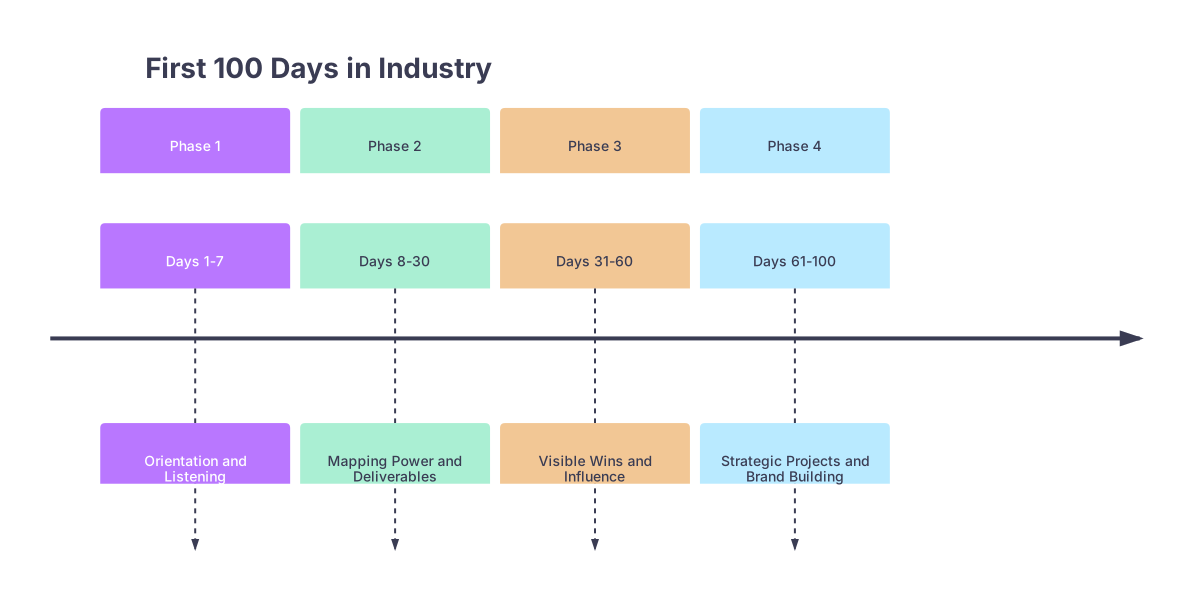
| Period | Event |
|---|---|
| Phase 1 - Days 1-7 | Orientation and Listening |
| Phase 2 - Days 8-30 | Mapping Power and Deliverables |
| Phase 3 - Days 31-60 | Visible Wins and Influence |
| Phase 4 - Days 61-100 | Strategic Projects and Brand Building |
At each phase, your priorities shift:
- Days 1–7: Decode the culture, map expectations, avoid rookie MD errors
- Days 8–30: Clarify your value, define deliverables, identify decision-makers
- Days 31–60: Deliver visible wins, build cross-functional credibility
- Days 61–100: Anchor a strategic niche, secure sponsorship, plan your next 6–12 months
Let’s walk it chronologically.
Days 1–7: Orientation, Listening, and Avoiding Physician Traps
Your only job this week: understand the game you just entered. Not fix it.
Day 1: Set the tone
On day 1, you should:
Have a 30–45 minute 1:1 with your manager
- Ask: “What does success look like at 30, 60, 100 days for you?”
- Ask: “If I do nothing else, what three things matter most this quarter?”
- Ask: “Who are the 5–7 people I must build strong relationships with now?”
Clarify basic logistics:
- Core working hours
- Meeting cadence (1:1 with manager, team standups, key recurring meetings)
- Tools: Slack/Teams, project management, CRM, document repositories
Get explicit about decision rights:
- Where you can decide alone
- Where you must seek input
- Where you must get approval
Do not start pitching ideas. Do not compare everything to hospital life. Just collect data.
Days 2–3: Stakeholder intake
At this point you should book short intros with key people:
- Your immediate team colleagues
- Cross-functional partners:
- Product / R&D
- Commercial / sales
- Regulatory / legal
- Data / analytics
- Operations / implementation
Use a tight script:
- “What are you working on in the next 90 days that really matters?”
- “Where does medical/clinical input help you most?”
- “How have physicians in this role been most helpful… or unhelpful… in the past?”
Listen for phrases like:
- “Last doc we had always slowed things down…”
- “We really need someone who understands the field and can translate to customers.”
This tells you the biases you must either fight or leverage.
Days 4–5: Culture and language decoding
Corporate culture is a foreign country. If you act “too clinical,” you get sidelined.
By the end of week 1 you should:
- Know the top 3–5 metrics that matter to your team (revenue, adoption, NPS, trial milestones, etc.)
- Learn the internal jargon:
- “QBR”, “OKRs”, “MVP”, “HCP engagement”, “launch readiness”, etc.
- Identify how decisions are actually made:
- Formal: committees, governance, RACI charts
- Informal: the two people everyone checks with before moving
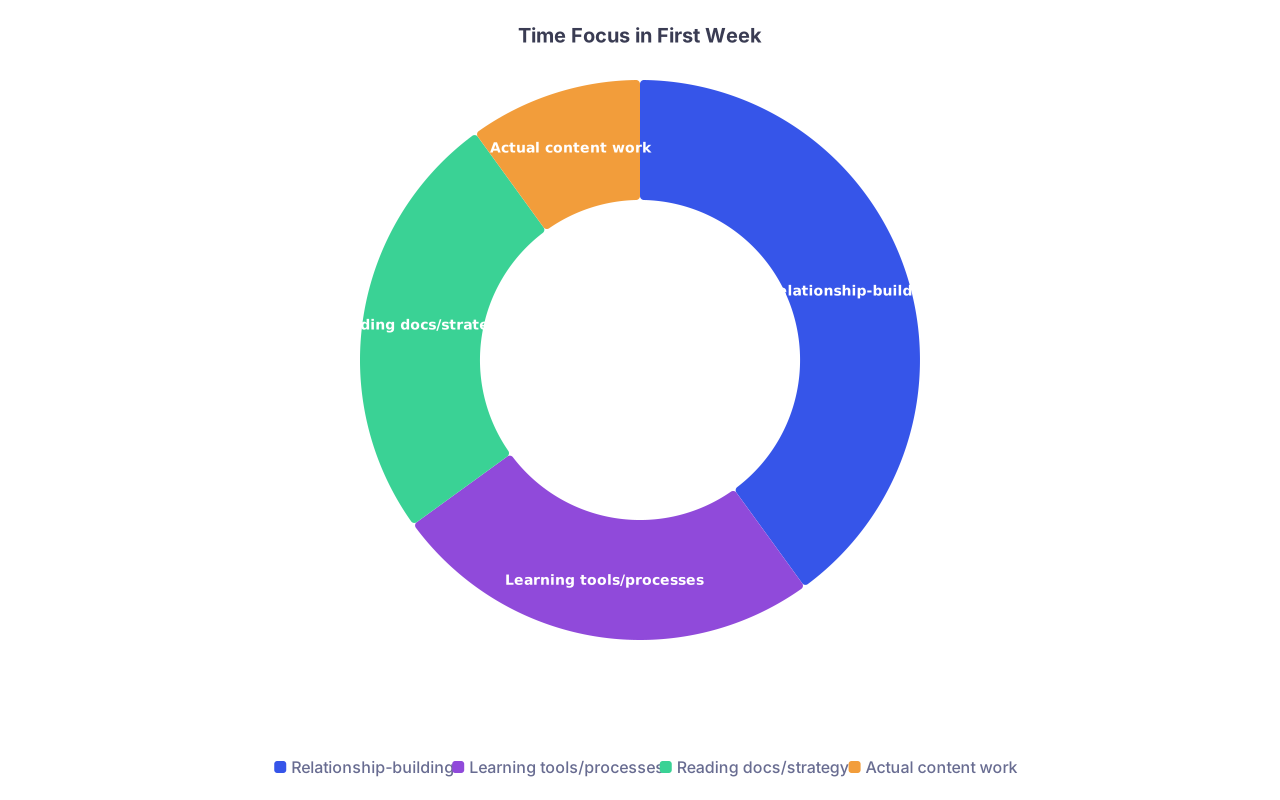
| Category | Value |
|---|---|
| Relationship-building | 40 |
| Learning tools/processes | 25 |
| Reading docs/strategy | 25 |
| Actual content work | 10 |
If you are spending more time “doing work” than observing and asking questions in week 1, you are doing it wrong.
Days 6–7: Draft your initial integration map
Before week 2 starts, create a one-page personal integration plan:
- Top 5 relationships to deepen in next 30 days
- 2–3 quick ways you can add value based on what you heard
- Known gaps (e.g., regulatory pathways, product architecture, payer landscape) and how you will close them
Share a trimmed version with your manager: “Here is how I am thinking about my first 30 days—anything missing or mis-prioritized?”
You are signaling: I plan, I prioritize, I am coachable.
Days 8–30: Mapping Power, Clarifying Deliverables, Choosing Your Wins
Now you move from “tourist” to “operator.”
Week 2 (Days 8–14): Get crystal clear on your role
Too many physicians float for months with a vague job description. That kills careers.
During week 2, you should:
Turn your JD into real work:
- Take the official job description
- Translate each bullet into:
- Concrete outputs (documents, decisions, meetings led)
- Stakeholders affected
- Time expectation per week / month
With your manager, define:
- Top 3 deliverables for the next quarter
- What “excellent” vs “fine” looks like for each
- Where you are owner vs contributor
Confirm KPIs where possible:
- Number of KOL interactions per month
- Turnaround time for medical review
- On-time delivery of specific milestones
- Quality measures (feedback from cross-functional partners, error rates, etc.)
| Area | Example KPI |
|---|---|
| External work | 6–10 KOL interactions/month |
| Internal input | Respond to content review in 48–72 hours |
| Strategy | Lead 1–2 medical strategy docs |
| Collaboration | Positive feedback from 3+ key stakeholders |
Week 3 (Days 15–21): Power mapping and allies
Industry runs on relationships and politics. Pretending it does not is naive.
This week you should:
Draw a simple power map:
- Core decision-makers for your area
- Influencers who shape those decisions
- Blockers who can slow you down
Identify:
- 1–2 potential mentors (in or outside your function)
- 1–2 potential sponsors (people with real power who could speak for you in rooms you are not in—this may take longer to confirm, but start thinking now)
Ask colleagues:
- “Whose opinion really matters on this topic?”
- “Who do you always run things by before going to leadership?”
You are not gaming the system. You are understanding the system you already entered.
Week 4 (Days 22–30): Select your first visible wins
You want 1–2 “they moved the needle” stories by Day 60. That means picking them now.
Types of good early wins for physicians:
Cleaning up confusion:
- Clarify a messy clinical slide deck going to customers
- Fix a misguided medical claim before it becomes a problem
Speeding up a stuck process:
- Streamline clinical review of marketing content
- Create a simple FAQ that reduces ad hoc questions to you
Translating field reality:
- Summarize what frontline clinicians actually care about for the product team
- Debunk a flawed assumption baked into a roadmap
At this point you should:
- Agree with your manager on 1–3 specific “early win” items
- Put them on a simple timeline with owners and milestones
- Confirm how success will be measured and who will see it
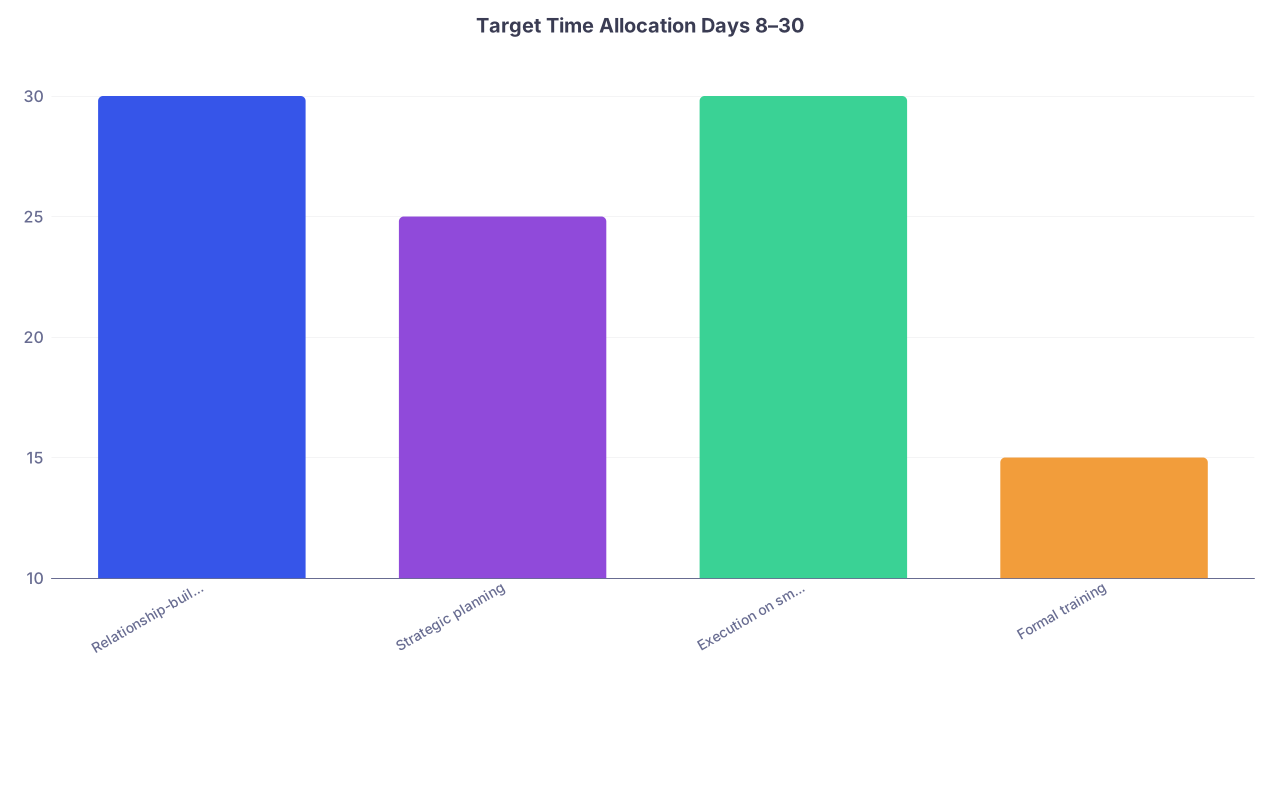
| Category | Value |
|---|---|
| Relationship-building | 30 |
| Strategic planning | 25 |
| Execution on small tasks | 30 |
| Formal training | 15 |
Days 31–60: Deliver Wins, Build Credibility, Expand Your Radius
This is where many physicians either lock in credibility or get quietly sidelined.
Week 5–6 (Days 31–42): Execute and communicate
You should now be in delivery mode on your early wins.
Focus on:
Reliability over brilliance
- Hit deadlines.
- Communicate early when something will slip.
- Dependable > genius in corporate life.
Translating, not lecturing
- When you give clinical input, anchor it in business impact:
- “If we phrase it this way, we risk X regulatory issue and Y loss of clinician trust.”
- “These trial endpoints will make adoption easier because…”
- When you give clinical input, anchor it in business impact:
Structured communication
- Execs want the TL;DR first, then rationale:
- “Recommendation: Do X. Rationale: 3 bullets. Attach: details.”
- Execs want the TL;DR first, then rationale:
At this point you should have:
- Delivered at least one concrete artifact:
- Revised deck, medical brief, strategy memo, playbook, etc.
- Presented or explained something in at least one cross-functional setting
- Started to be the “go-to” for at least one narrow topic
Week 7–8 (Days 43–60): Feedback and course correction
Do not wait for a formal review. Pull feedback early.
By Day 60 you should:
Have a 45–60 minute check-in with your manager focused solely on:
- “What is working well so far?”
- “Where am I missing expectations or norms?”
- “Compared with others in this role at 2–3 months, am I on track, ahead, or behind?”
Ask 2–3 close collaborators:
- “Is there anything I am doing that makes your work harder?”
- “Where can I be more useful next month?”
Write down patterns. Then adjust.

Common mid-course corrections I have seen physicians need:
- Talking for 10 minutes when 2 will do
- Sending “textbook” explanations instead of decisive recommendations
- Ignoring non-medical constraints (budget, timeline, legal risk)
You fix this now, or it becomes your brand.
Days 61–100: Strategic Positioning, Deeper Ownership, and Future-Proofing
You are past the “new” phase. Now you either become essential or interchangeable.
Weeks 9–10 (Days 61–75): Claim a strategic niche
By this point you should understand:
- Where your background gives unusual leverage
- Where there is a gap the team quietly knows about but has not solved
Examples of niches physicians carve out:
- “The person who understands how this will actually play on the ward or in clinic.”
- “The MD who can talk to data science and clinicians without either side glazing over.”
- “The one who can face regulators / payers and defend our clinical story convincingly.”
Pick 1–2 themes where you will go deeper:
- A specific product line or indication
- A particular customer segment (hospital systems, payers, specialists)
- An internal process (medical review, evidence generation strategy, real-world data)
Then:
- Propose a small, concrete initiative aligned with that niche:
- Example: a structured KOL feedback program; a clinical evidence gap analysis; a playbook for field medical teams.
Get explicit sign-off from your manager: “Yes, this is worth your time.”

Weeks 11–12 (Days 76–90): Build sponsorship and visibility
Integration is not just what you do. It is who knows what you do.
By Day 90, you should:
Present or co-present in at least one meeting where senior leaders are present
- Keep it tight, outcome-focused, and visually clean
- Position yourself as a partner, not “the doctor who came to talk about guidelines”
Have at least one senior non-physician who:
- Knows your name
- Has seen your work
- Can describe your value in a sentence
You can engineer this. Ask your manager:
- “Where could I add value in upcoming leadership touchpoints?”
- “Is there a forum where my recent work would be useful to share?”
Do not wait for organic exposure. That is a slow career.
Days 91–100: Codify your brand and the next 6–12 months
The last 10 days of this window are for consolidation and planning.
By Day 100 you should have:
A clear personal brand statement (even if you never say it out loud):
- “I am the physician here who _______ in order to help the company _______.”
- Example: “I am the physician here who translates frontline cardiology practice into product and evidence strategy so we build tools cardiologists actually adopt.”
A written 6–12 month development plan including:
- Skills to build (regulatory science, HEOR, product management basics, data literacy, influencing)
- Projects that will stretch you
- People to learn from (inside and outside the company)
A brief 100-day reflection with your manager:
- 1–2 pages or a short deck:
- What you have done
- Impact so far
- Where you want to focus next
- What support you need
- 1–2 pages or a short deck:
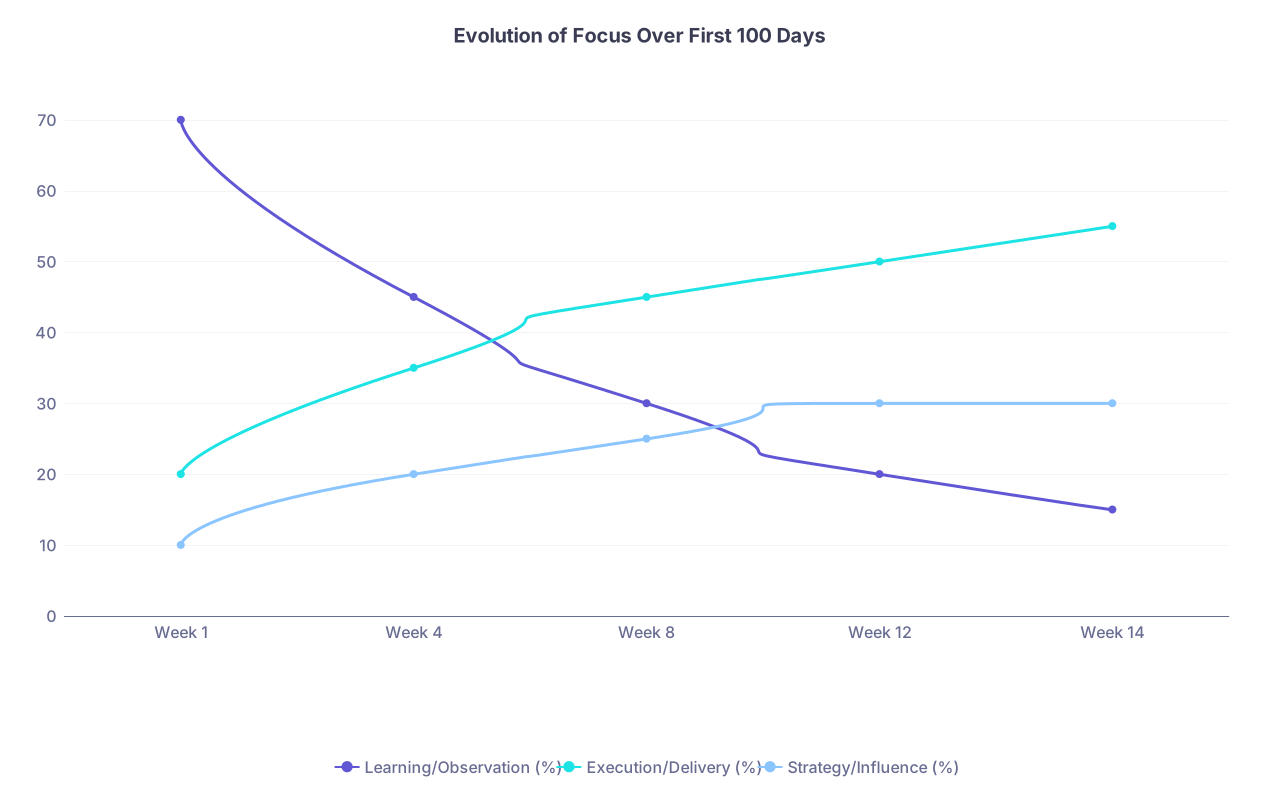
| Category | Learning/Observation (%) | Execution/Delivery (%) | Strategy/Influence (%) |
|---|---|---|---|
| Week 1 | 70 | 20 | 10 |
| Week 4 | 45 | 35 | 20 |
| Week 8 | 30 | 45 | 25 |
| Week 12 | 20 | 50 | 30 |
| Week 14 | 15 | 55 | 30 |
You are signaling you are not just here to perform tasks. You are here to grow and to drive.
Quick 100-Day Checklist
Use this as a brutal, yes/no scorecard.
By Day 7, have you:
- Met 1:1 with your manager and clarified expectations?
- Identified at least 5 key stakeholders and booked intros?
- Understood the top 3 metrics your team actually cares about?
- Created a one-page integration plan?
By Day 30, have you:
- Translated your job description into specific deliverables?
- Identified 1–3 early-win projects and started on them?
- Mapped decision-makers, influencers, and blockers?
- Started to see where your unique leverage is?
By Day 60, have you:
- Delivered at least one clear, visible contribution?
- Gotten direct feedback from your manager and 2–3 peers?
- Been invited (or invited yourself) into cross-functional work?
- Reduced your “I’m new here” card to almost zero?
By Day 100, have you:
- Claimed a specific niche where you provide outsized value?
- Presented your work in a setting with senior leaders?
- Identified at least one informal sponsor and one mentor?
- Written a 6–12 month development and impact plan?
If you are missing several of these, you are integrated socially but not strategically. Fix that.
Common Physician Mistakes in the First 100 Days

You will see colleagues fall into these. Do not join them.
Staying in “expert mode”
- Talking like a consultant hired for an opinion rather than an owner accountable for outcomes.
Over-identifying with the “doctor” label
- Constantly saying “In the hospital we…” turns you into a caricature, not a peer.
Underestimating non-medical constraints
- Pushing for the theoretically ideal clinical answer without regard to budget, timeline, or regulatory realities.
Trying to fix everything
- You see 100 broken processes. Choose 1–2. You are not here to redesign the universe in quarter one.
Staying only with fellow clinicians
- It feels safe. It also caps your influence. Your future allies are in product, commercial, and strategy.
FAQ (Exactly 3 Questions)
1. How much should I push back on decisions I think are clinically wrong in the first 100 days?
You push on anything that is unsafe, non-compliant, or clearly misleading from day one. That is non-negotiable. For everything else, calibrate. In your first 100 days, your goal is to understand the context behind a decision before you try to overturn it. Ask, “What constraints are we optimizing around here?” Then propose alternatives that respect those constraints. If you argue every clinical nuance like a morbidity conference, you will be labeled difficult rather than helpful.
2. Do I need a formal mentor immediately, or can that wait?
You do not need a formal mentorship program in the first 100 days. You do need people you can ask “dumb” questions safely. Start informally: find someone 1–2 levels above you, ideally non-physician, who has a reputation for being effective and approachable. Ask for a 30-minute chat. If it goes well, ask, “Could we do this monthly for a few months while I ramp up?” Formal titles can come later. The relationship is what matters.
3. What if my role is poorly defined and my manager is vague about expectations?
That happens a lot with first-time physician hires. Treat the ambiguity as your first project. Draft your own role definition based on what you see the team needing, plus what the business is targeting this year. Bring it to your manager as a proposal: “Here is how I am thinking about my scope and deliverables for the next quarter—what would you change?” If they still stay vague, start aligning yourself with concrete projects and leaders who do have clarity. Make yourself useful where the work is real, not theoretical.
Key points, stripped down:
- In the first 30 days, your job is to learn the power structure, language, and expectations—not to fix the company.
- Days 31–60 are about delivering 1–2 visible, business-relevant wins and correcting course based on direct feedback.
- By Day 100, you should own a clear niche, have visible impact, and a written plan for how you will grow and contribute in the next 6–12 months.