
Most physicians who “jump to pharma” have no idea what they’re really signing up for.
You’ve heard the polite version: bridge between science and medicine, external facing role, strategic partner to commercial. That’s brochure language. Inside medical affairs, the question people actually ask is: “Can this MD help us move the needle without breaking compliance?”
Let me walk you through what actually happens behind the glass conference rooms, in Teams calls at 8:00 pm, and in those “quick touch base” chats the MSLs keep putting on your calendar.
First, understand the power structure: you’re not the star
Everyone assumes: “I’m the MD, I’ll be the center of the MSL universe.”
Wrong.
In medical affairs, the hierarchy is not based on your clinical seniority. It’s based on your utility.
Here’s the unspoken map:
- MSLs = the field engine
- Medical directors / TA leads (often MD or PhD) = strategy and escalation
- You, as an MD (either MSL or in-office) = clinical credibility, decision filter, and shield
The commercial side would sell oxygen to fish if legal allowed it. Medical affairs is the governor on that engine. And MDs are the most defensible justification for “we made a balanced, evidence-informed decision.”
That’s why programs keep hiring MDs even when finance complains about the salary line.
How MSL teams actually “use” MDs: the daily reality
Let’s get specific. Day to day, here’s how your MD gets leveraged behind closed doors.
1. Clinical validator and excuse-maker
An MSL will ping you on Teams:
“Hey, can I run something by you real quick?”
Translation: they’re about to show you an HCP slide or an email they already plan to send and want you to bless it.
You’ll see:
- A slide set for a KOL discussion.
- A proposed response to an off-label question.
- A “scientific exchange” deck that’s basically 90% pushing a particular outcome.
Your actual function here:
- You sanity check the content:
“Would I have said this to a peer as a practicing physician?” - You calibrate the aggressiveness:
“Is this science-forward or disguised marketing?” - You become the institutional memory:
“Last time we did something like this, legal tore us apart.”
You sign off—or you don’t.
Inside conversations later will sound like:
“Med reviewed this. Dr. X was fine with the framing.”
“Our MD said this is aligned with current clinical practice.”
Your name becomes a compliance shield—whether you love that or not.
2. KOL triage and ranking: who’s actually worth the flight and hotel?
MSL teams spend an insane amount of time figuring out who to talk to, not just what to say.
This is where you become the KOL filter.
You’ll get spreadsheets (they call it “rosters,” “priority lists,” “mapping”) with:
- Local academic heavyweights
- Community volume monsters
- Guideline committee members
- That one private practice doc who’s running half the trials in your region
And they’ll ask you variations of:
- “Is Dr. S a real thought leader or just loud?”
- “Does Dr. K actually influence referrals or just publish?”
- “This guy does huge volume but is kind of wild—worth engaging?”
Your clinical background and bullshit radar matter here. MSLs know who’s nice, who’s accessible. You know who’s actually respected in the physician community.
What you’re really doing: steering finite field resources toward HCPs who will translate to:
- Trial enrollment
- Guideline shaping
- Real-world adoption
Nobody admits this out loud, but the underlying question is always: “If we educate this person, will it move practice patterns?”
3. Off-label and gray-zone referee
This is one of the big reasons companies like MDs around. They need someone who has lived the gray.
MSLs get peppered with:
- “So… if I used this in [unapproved indication], any data?”
- “We’ve got this 85-year-old with X, Y, Z comorbidities—any dosing guidance?”
- “Anyone tried this in combination with [competitor product]?”
MSLs are supposed to be strictly on-label and evidence-based. But reality is messy. Guidelines lag. Patients do not fit inclusion criteria.
So what happens?
The MSL calls you:
“Doc, walk me through how you would think about this patient scenario, without me overstepping label.”
Behind closed doors, you help:
- Distinguish standard of care vs. what you’d actually do at 2 am on call
- Phrase nuanced answers in scientific, non-promotional language
- Decide when the right answer is: “You need to say we don’t have data”
You’ll say things like:
“You can acknowledge mechanistic rationale, but you cannot recommend the approach.”
“Talk about ongoing trials. Don’t imply clinical endorsement.”
“Frame it as ‘in the literature, X has been described,’ not ‘you should consider.’”
The MSL will then script something—verbally or via approved response documents—that’s technically compliant but practically useful. You’re the one making sure that line is real, not imaginary.
The unglamorous backbone: review, review, and more review
Here’s what no one wants to put on LinkedIn: a huge chunk of how MSL teams use their MD is content review and governance.
Slides. FAQs. Response letters. Field narratives. Training decks. More slides.
You’re the clinical adult in the room.
4. Medical review committee: the slow, painful heart of everything
Most mid-to-large pharma has some version of MRC / PRC / MLR (Medical-Legal-Regulatory) review.
Picture the room (or Zoom):
- Regulatory lead: “We can’t say that; it’s not in the PI.”
- Legal: “What’s the risk if this screenshot ends up in court?”
- Commercial: “If we can’t say that, what’s the point of this slide?”
- MSL/Medical: “This is what the field actually needs to discuss with HCPs.”
- You (MD): sitting between science and reality, trying not to die inside.
Day to day, they use you to:
- Justify why a particular graph, subgroup, or exploratory endpoint is clinically meaningful
- Push back when legal/reg try to neuter content into meaningless mush
- Rephrase and reframe claims to sound like a physician, not a marketer
Example: You might say,
“Clinicians don’t care about this post-hoc p value. They care that in high-risk patients, hospitalization went down. We need that subgroup data visible, even if we over-label it as exploratory.”
You’re not there just to rubber-stamp. You’re expected to argue from a clinician’s point of view. The smart teams listen to you a lot. The dumb ones just want your signature.
Internally, this is where MDs earn their paycheck.
Inside the field: how MSLs pull on MDs before and after every big interaction
Let’s get into the rhythm of real MSL life, because that’s exactly where your MD brain gets mined.

| Step | Description |
|---|---|
| Step 1 | Upcoming KOL meeting |
| Step 2 | MSL drafts plan |
| Step 3 | MSL pings MD |
| Step 4 | Discuss clinical angle |
| Step 5 | Refine questions and slides |
| Step 6 | MSL meets KOL |
| Step 7 | Debrief with MD |
| Step 8 | Feed insights to strategy |
5. Pre-call war rooms: “What the hell should I actually ask this KOL?”
The best MSLs don’t just show up with a slide deck and vibes. They set up “pre-call” discussions with you.
You’ll hear:
- “This KOL is on the guideline panel. What’s the right depth to go into on the secondary endpoints?”
- “They’re very skeptical about our safety signal—help me frame a balanced, non-defensive discussion.”
- “They love competitor X, hate our class. Where would you start the conversation?”
Together, you’ll:
- Identify 2–3 real questions that a serious clinician would want to debate
- Kill fluffy slides and keep the ones that actually add value
- Predict which parts of the data will trigger pushback
Your job isn’t to script them word-for-word. It’s to get them thinking like a specialist in that disease space, not like a company representative.
MSLs remember those calls. They replay your phrasing in their heads when they’re in the room.
6. Post-call debriefs: turning anecdotes into strategy
After a major KOL engagement, the MSL will log their notes in Veeva or whatever CRM they use. That’s the official version.
The real version happens when they debrief with you.
“Dr. R said he’s seeing way more [specific patient subtype] than the trial reflected.”
“Dr. T thinks our endpoint is clinically irrelevant for sick patients.”
“Dr. Y asked about sequencing with this combo—clearly everyone’s doing it, even if it’s not labeled.”
You help them translate:
- “Is this one KOL’s quirk, or a pattern emerging in the field?”
- “Is that criticism actually valid from a clinician lens?”
- “Is this a signal that needs to reach global strategy, or just local noise?”
Then, behind closed doors with medical leadership, those “MSL insights” get filtered, aggregated, and weaponized:
- Input to label expansion discussions
- Justification for new Phase IV or RWE studies
- Rationale for new medical education initiatives
And yes, your commentary gets paraphrased up the chain:
“Our MDs are hearing consistent concerns about X; this is not just an isolated complaint.”
Internal education: how MSLs milk your clinical brain for training
If you think you’re leaving teaching behind by moving to pharma, you’re wrong. You just changed students.
Now your students are:
- MSLs with PhDs, PharmDs, PAs, NPs, RNs
- Brand managers who barely remember Step 1 biochem
- Leadership teams who haven’t touched a patient in 15 years
7. Field training: turning smart people into pseudo-subspecialists
Behind the scenes, MSL leadership leans on MDs to:
- Run case-based sessions: “Here’s a typical patient path, here’s where our drug realistically appears in the decision tree.”
- Break down guideline nuances: “Nobody actually follows that algorithm linearly; this is what happens in clinic.”
- Clarify comorbidity and polypharmacy complexity: “You cannot just say ‘use this first-line’ without acknowledging X, Y, Z constraints.”
You’ll get asked things like:
- “How would a hospitalist versus an outpatient doc think about this?”
- “What’s the difference between an NCCN category 1 and what people actually do?”
- “What would make you roll your eyes if an MSL said it?”
You often become the unofficial voice of “Here’s how a real doc hears that talking point.” MSLs remember your irritation points and avoid them in the field.
8. Internal “clinic translator” for non-clinical colleagues
You will routinely get pulled into conversations that look like this:
Brand:
“We want to say this will reduce ICU admissions.”
You:
“Based on what? You have zero ICU-specific data, and clinicians will know that. That’s how you lose credibility.”
Market access:
“Can we imply cost savings for hospital systems?”
You:
“You can model it, but do not pretend anyone discharges earlier based on a hazard ratio alone. That’s fantasy.”
You become the anti-delusion mechanism. The person who punctures wishful thinking with:
“No clinician will buy that,” or,
“That’s the kind of oversell that gets you mentally blacklisted.”
How MDs get used politically: credibility and optics
This part nobody tells you in the interview.
Your presence is not just functional; it’s political capital.
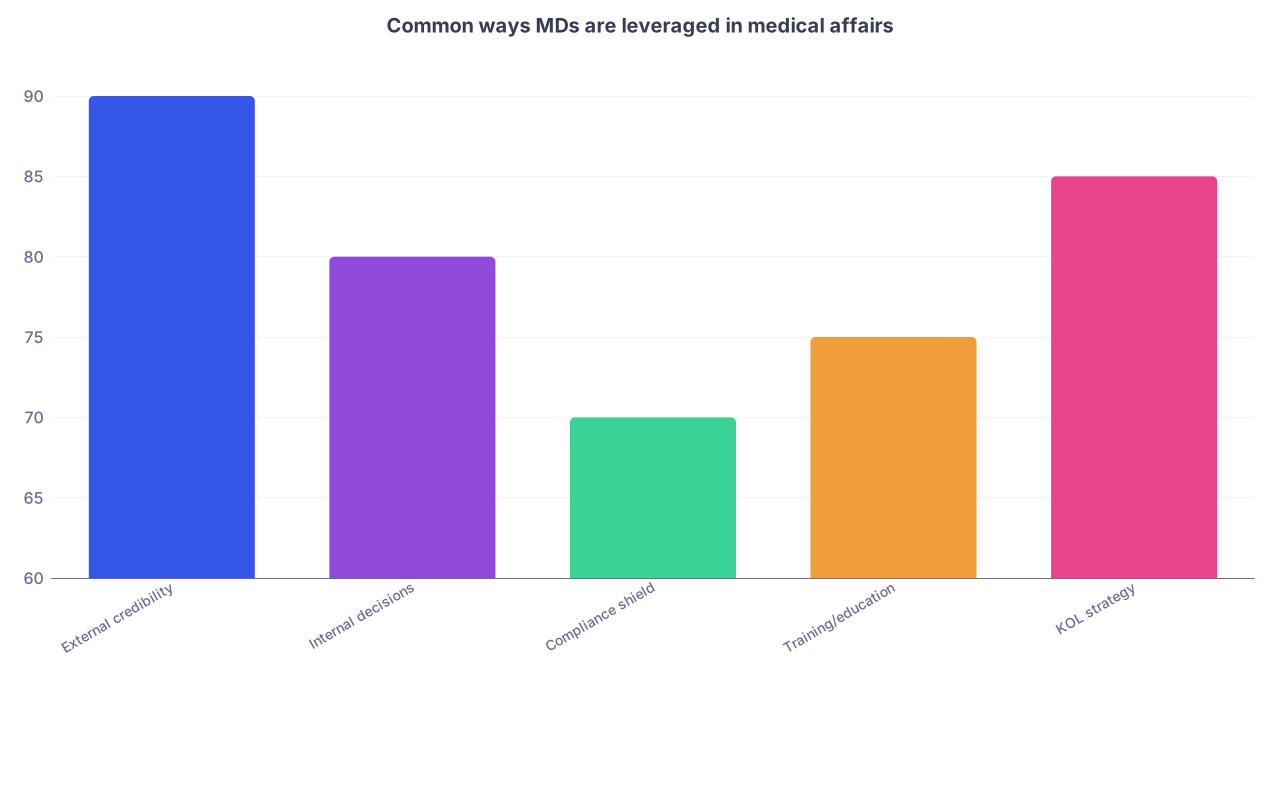
| Category | Value |
|---|---|
| External credibility | 90 |
| Internal decisions | 80 |
| Compliance shield | 70 |
| Training/education | 75 |
| KOL strategy | 85 |
9. The “we have real doctors on this” card
Executives love parading MDs when stakes are high:
- Advisory boards with global KOLs
- Investigator meetings
- Cross-functional “war rooms” before big launches
- Internal town halls when results are controversial
You’re the symbol that “we’re considering real-world medicine.” Whether or not they always listen to you is another story.
Behind closed doors, your name gets dropped:
“Our medical director—he practiced at [recognizable institution]—is comfortable with this approach.”
“We’ve had multiple MDs review this scenario; consensus is X.”
Sometimes that’s true. Sometimes that’s overinterpreting your offhand comment during a rushed call. You have to be very deliberate about what you actually endorse, because your title will be used as leverage.
10. The escalation endpoint for field frustration
MSLs use you as their escalation point when they feel torn between:
- What commercial wants
- What medical allows
- What they believe is right for patients and KOLs
You’ll get venting like:
- “This slide is useless, but brand is forcing it.”
- “KOLs are asking reasonable questions, and our approved answer sounds evasive.”
- “We’re getting hammered on this safety issue, and we don’t have a coherent story.”
You decide how much you’re willing to rock the boat.
Strong MDs push back upstream and shape strategy. Weak MDs just shrug and tell MSLs to “stay on label” and “use the approved text.” That’s how you lose field trust, by the way.
The quiet truth: MSLs judge you hard. If they feel you get real-world medicine and will go to bat for them, they’ll move mountains for you. If they think you’re just there for the paycheck and title, they’ll bypass you and survive without your input.
The good, the bad, and the parts you should think about before jumping
Let me be candid.
What’s genuinely satisfying about this role
You:
- Use your clinical brain without 2 am pages.
- Influence care across thousands of patients instead of one at a time.
- See the inside of how data becomes guidelines, not just how it’s applied.
- Get to shape how good science is communicated—or protected—from commercial overreach.
The best days:
- A KOL emails the MSL: “That was actually helpful. Not promotional. Thank you.”
- You kill a misleading slide that would have subtly distorted practice.
- You help design or refine a study question that actually matters to clinicians.
What might drive you insane
- Endless meetings where everybody is terrified of breaking a rule they only half understand.
- Commercial pressure leaking into “scientific” discussions, even when people swear it doesn’t.
- Reading the same study 25 times because every deck, letter, and FAQ is basically the same four endpoints in different colors.
- Watching leadership rationalize decisions based more on market share than medicine—then writing a scientific story around it.
If you need direct patient impact and immediate feedback, this will feel abstract. If you enjoy systems, nuance, and long games, it makes sense.
Where this is heading: the future of MD use in MSL and medical affairs
You’re not irreplaceable. Let’s be clear.
Companies are experimenting aggressively with:
- Non-MD MSLs: PharmD, PhD, NP, PA, who often know the data better than most MDs
- Centralized medical information systems: standardized, pre-approved answers
- AI-assisted literature monitoring and response drafting
So where do MDs still have a durable edge?
- Nuanced clinical judgment in weird, messy, multi-morbid cases
- Understanding how guidelines, payers, and workflow collide in real clinic life
- Reading the “tone” and subtext of KOL feedback in a way that’s not purely textual
- Standing in front of a skeptical room of senior physicians and not blinking
The future MD in medical affairs will be less about being a “walking textbook” and more about being:
- A clinical strategist
- A credibility anchor
- A translator between messy reality and rigid systems
The companies that understand that keep their MDs close to MSLs and in the room for big calls. The ones that don’t slowly sideline MDs into symbolic roles while the real work happens elsewhere.
You want to be in the first group.

If you’re considering this path, here’s what you should really ask
Forget the recruiter fluff. In interviews, ask:
- “How often do your MSLs pull in MDs for pre-call planning or post-call debrief?”
- “What percent of your time do MDs spend in MLR versus in strategic field-facing work?”
- “Can you give an example where MD input changed a medical strategy or field guidance?”
- “Who actually owns KOL segmentation—medical, commercial, or a mix? And where do MDs fit?”
Their answers will tell you everything about how you’ll be used:
As a signature and title.
Or as a partner and force multiplier.
You want the latter. Or you’ll be bored and frustrated in 6 months.
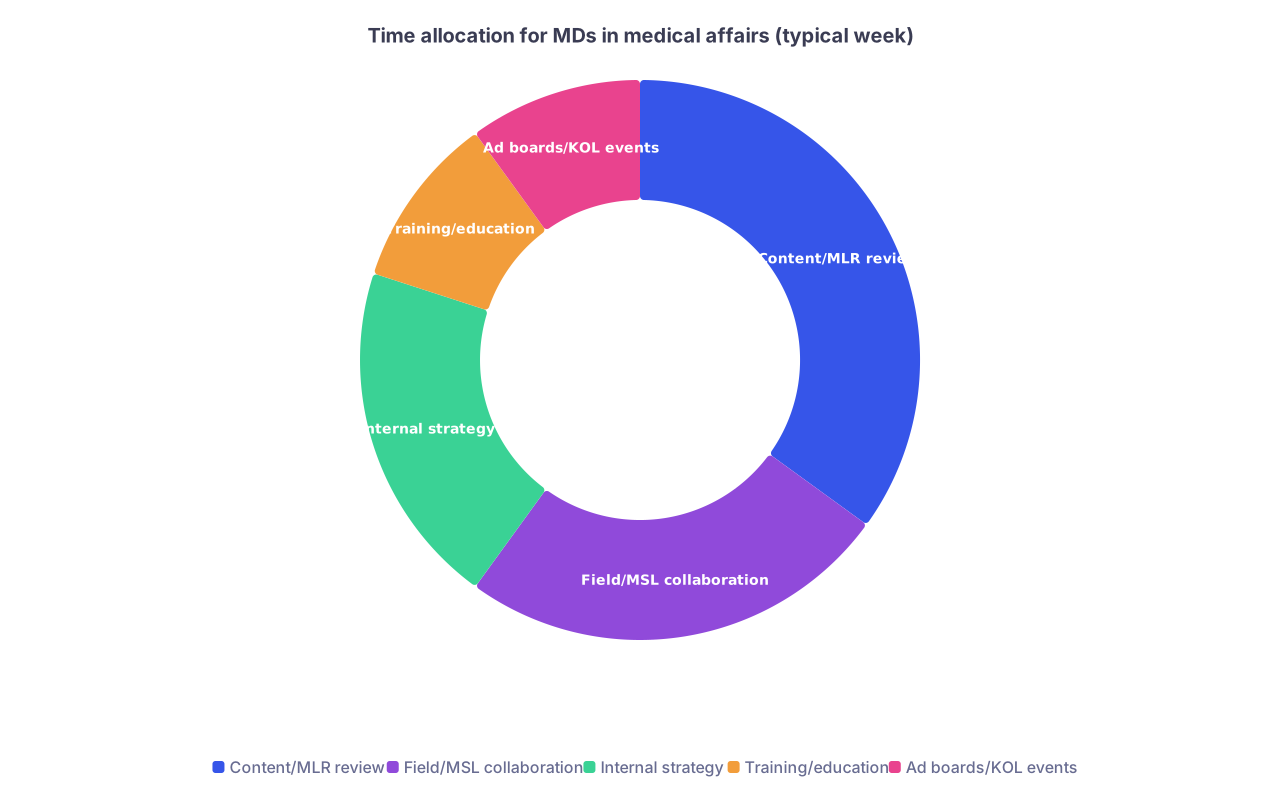
| Category | Value |
|---|---|
| Content/MLR review | 35 |
| Field/MSL collaboration | 25 |
| Internal strategy | 20 |
| Training/education | 10 |
| Ad boards/KOL events | 10 |