
The day a mid‑career clinician joins industry, their status in medicine silently resets to intern-level. Nobody tells you that in the recruiting call. I will.
You’re not “Dr Big Name from Major Academic Center” anymore. Inside pharma, medtech, or digital health, you’re “the new medical person who doesn’t understand how anything actually gets built or sold.” That’s the starting point. No matter how many RVUs or R01s you left behind.
Let me walk you through what really happens when you cross that line.
The First Shock: Your Old Resume Stops Working
The moment your hospital badge becomes a visitor pass, something shifts. In academia and clinical practice, you’ve spent 10–20 years accumulating a kind of currency: titles, committee roles, impact factors, step scores, national talks. In industry, that currency converts at a brutal exchange rate.
I’ve sat in hiring debriefs where a VP of Product looks at a candidate’s CV and says, “Nice CV. But have they ever shipped anything?”
The candidate was a full professor. 150+ publications. NIH funding. On the ACGME committee for their specialty. The product VP didn’t care. Not out of disrespect—out of priorities.
In industry, three things matter more than almost anything on your academic CV:
- Can you help us de‑risk decisions?
- Can you help us move faster without getting sued or shut down?
- Can you talk so non‑clinical people actually understand you?
Everything else is decorative.
So your first shock:
- Your epic clinical volume? Interesting, but only as evidence you understand real-world workflows.
- Your landmark paper? Good only if you can translate it into strategy: market positioning, evidence roadmap, differentiation.
- Your associate professorship? A credibility booster for external optics. Intern-level for internal power.
You’ll feel this the first time you’re in a meeting where a 29-year-old product manager says, “I don’t think that’s the main user problem,” after you just described a patient safety issue. And the room listens to them as much as you.
That’s industry. Get used to it—or you’ll be miserable.
How Your Role Is Actually Seen On The Inside
There are two parallel versions of your job when you join industry mid-career:
- The version you tell your former colleagues (“I’m leading medical strategy for X”)
- The version written between the lines internally (“We hired this doc to keep us out of trouble and make our slides look credible”)

Let me translate the typical “Medical Director” or “Clinical Strategist” job into what it actually means day-to-day.
You become:
- The reality check: “Is this actually how care works, or did we invent a fantasy workflow on this whiteboard?”
- The liability radar: “If we say this in our marketing, will FDA/EMA/regulators tear us apart? Will a plaintiff attorney use this slide in a deposition?”
- The internal interpreter: Turning ‘EF 15% with NYHA III–IV and recurrent admissions’ into ‘this is the person who can’t walk to their bathroom without gasping.’
You think you’re there to be “the medical decision-maker.” You are not. You’re there to shape decisions made by people whose incentives you don’t yet understand.
Let me be blunt: The core business stakeholders—product, commercial, regulatory, finance—often see “medical” as both essential and inconvenient. Essential because without you, things can fail catastrophically. Inconvenient because you slow them down and say “no” a lot.
Your power doesn’t come from your title. It comes from becoming the rare clinician who understands what they care about: timelines, risk, revenue, share price, competitive landscape. When you start speaking in those terms, you stop being “the roadblock doc” and start being “the partner who keeps us from wasting $50M.”
The First Year: Identity Crisis and Imposter Syndrome
Here’s the part almost nobody talks about honestly: the emotional whiplash.
You go from being the senior attending whose notes people quote on rounds to the person who doesn’t know how to use the project management software. You’re suddenly asking a 26-year-old associate, “Where do I find the version‑controlled deck?” while they explain Slack etiquette to you.
I’ve watched superb clinicians melt internally in that first year because of a few recurring hits:
Loss of instant impact.
In the hospital, you adjust a drip and watch someone’s blood pressure stabilize minute by minute. In industry, your work may not hit the real world for 18–36 months. Sometimes longer. That delay can feel suffocating if you’re used to immediate feedback loops.Loss of clear metrics.
No more RVUs, patient volumes, or relative ranking on billable procedures. Now you have OKRs, KPIs, and deliverables like “support evidence strategy” or “enable launch readiness.” It feels vague. Because it is, at first.Loss of social status in your old world.
Your old colleagues will say “That’s great, congrats!” but there’s often an undertone:- “Couldn’t hack clinical?”
- “Sold out?”
- “Gave up on academic medicine?”
I’ve heard PDs dismissively say, “Yeah, he went to pharma” like it’s early retirement.
You need to be prepared for that. The people congratulating you on LinkedIn are not the ones you’ll be thinking about at 11 PM when you’re wondering if you just threw away your identity as a “real doctor.”
Here’s the quiet reality: A good chunk of mid-career clinicians in industry seriously think about going back in the first 12 months. Not because the work is bad. Because they didn’t anticipate the psychological hit of walking away from something they were undeniably good at into a world where they’re a beginner again.
How the Work Actually Feels Day-to-Day
Forget the glossy job descriptions. Let me sketch a week of a mid‑career clinician in a medical affairs / clinical strategy type role at a mid-to-large pharma or digital health company.
Monday:
You’re on a 7:30 AM cross‑functional call with commercial, regulatory, and market access discussing a new indication. They want to claim “best-in-class outcomes.” You’re the one saying, “Show me the head‑to‑head data or tone that down.” You argue about a single word in a tagline for 25 minutes. It feels absurd. It isn’t. One word can alter risk.
Tuesday:
You spend half the day answering “quick medical questions” from marketing, sales training, and regional teams. Some are high level—trial interpretation, clinical relevance. Some are shockingly basic—“What’s the difference between MI and unstable angina?” because a junior marketer is drafting email copy.
Wednesday:
You’re in a three‑hour evidence planning meeting. Biostats, clinical development, HEOR, real world evidence. They’re planning which subanalyses to run, which endpoints are worth publishing, how to position results for payers. Your role: steer them toward what will matter to practicing clinicians versus what just looks fancy in a journal.
Thursday:
You’re meeting with external KOLs (some of whom were your peers, others your former attendings). You’re now on the other side of the table asking, “How would this change your practice?” They’re privately more candid with you than with non-clinical colleagues. You become the internal translator for what those KOLs really meant.
Friday:
Internal review hell. You’re going slide by slide through a 90‑deck sales training presentation making sure clinical claims, images, and phrasing are accurate and not misleading. You die a little inside every time you fight over whether an arrow implies causality.
Is it intellectually rich? Often, yes. Is it glamorous? Almost never.
For digital health or medtech, swap in user testing sessions, product roadmap reviews, and endless debates about what data is “good enough” to launch version 1.0.
The Hidden Power Shift: Money, Time, And Autonomy
Now the part that does feel radically different—and for many people, liberating.
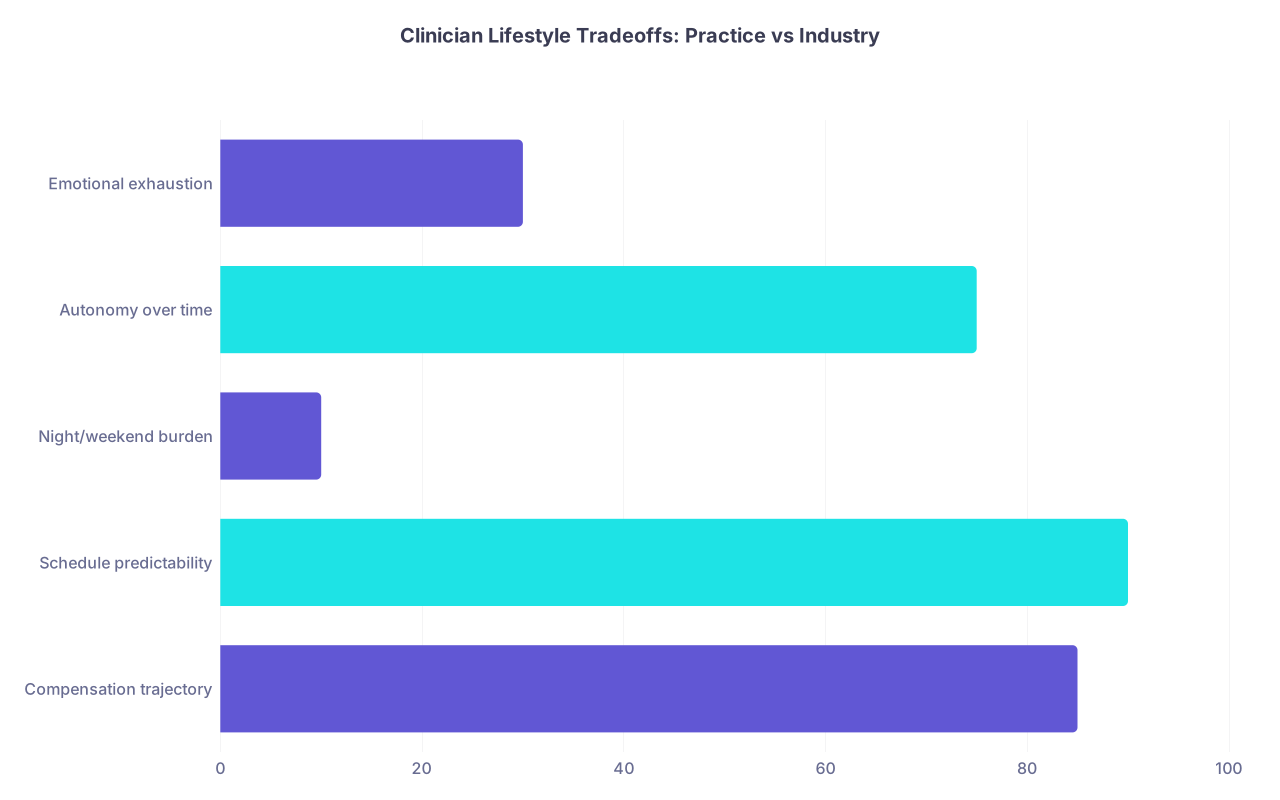
| Category | Value |
|---|---|
| Compensation trajectory | 85 |
| Schedule predictability | 90 |
| Night/weekend burden | 10 |
| Autonomy over time | 75 |
| Emotional exhaustion | 30 |
Interpretation: Higher numbers favor industry compared to traditional practice.
Let’s talk bluntly.
Compensation
If you’re a primary care physician, hospitalist, pediatrician, or lower-paid cognitive specialist, a mid-career move to industry can be financially transformative over 3–5 years. Your base may not immediately double, but:
- You’re suddenly in a world of bonuses, stock, equity refreshers, and promotion bands.
- You no longer cap out at one RVU conversion factor.
For proceduralists and high-earning private practice specialists, the math can go the other way. Yes, your base may be high, but bonus + equity usually won’t match top-decile specialist income. What you receive instead is time, sanity, and a lower wear‑and‑tear lifestyle.
I’ve seen hospitalists double comp within 5–7 years in industry. I’ve seen private practice orthopods take 30–40% pay cuts and still say, “I’d do it again tomorrow because I got my life back.”
Time And Schedule
No nights. No 3 AM pages. No 14‑hour OR days that bleed into post‑op notes.
That’s not a small thing. And it’s not just “better hours.” It’s predictability. You’ll have late nights in industry, especially around major deliverables or launches. But those late nights can often be planned. You can go to your kid’s game. You can reliably take a week off without 200 MyChart messages.

| Stage | Activity | Score |
|---|---|---|
| Clinical Practice | Full time clinical work | 2 |
| Clinical Practice | Burnout and frustration | 4 |
| Exploration | Talk to industry contacts | 3 |
| Exploration | Interview and offers | 3 |
| Transition | First 6 months in role | 3 |
| Transition | Learn corporate culture | 4 |
| New Normal | Regain work life balance | 5 |
| New Normal | Redefine professional identity | 4 |
Autonomy
This one surprises people.
You lose day‑to‑day autonomy in the sense that you’re embedded in project teams, roadmaps, and corporate priorities. But you regain autonomy over your life.
You can plan long weekends. Go to conferences because they’re interesting, not because you need CME to maintain hospital privileges. Say “I’m unavailable after 6 PM” and not have that sound insane.
For many mid‑career clinicians, that trade—less control over micro decisions, more control over macro life—is more than worth it.
How Programs And Departments Quietly React To Your Exit
Let me tell you what’s said in the closed-door meetings you’re not invited to once you announce you’re leaving.
In academic departments:
- The chair does a subtle calculus: losing a senior clinician hurts coverage and reputation, but your salary line may now be used to hire two junior people or a researcher.
- Program directors whisper, “We’re going to lose that teaching bandwidth. Who’s going to run the M&M now?”
- Some younger faculty and fellows will quietly ask to “pick your brain about non-clinical options” because your exit gave them permission to imagine leaving.
In private practice groups:
- Partners may be annoyed that your departure destabilizes call schedules.
- There’s often a bit of “they couldn’t handle the grind” talk to protect the group’s self‑image.
- Within six months, at least one other person will start quietly browsing LinkedIn for “Medical Director” roles.
You don’t see this directly. You just notice a strange mix of admiration, distancing, and occasionally, resentment. People project their own fears onto your decision.
Here’s the uncomfortable truth: your move to industry is a walking indictment of the system they’re still in. Some will resent you for highlighting that. That’s not your problem.
The Unwritten Skills You Need To Survive (And Advance)
If you join industry mid‑career and try to operate exactly like you did as an attending, you’ll hit a ceiling fast. You need to build a set of skills almost no residency program teaches—and frankly, many academic centers actively de‑value.
The high-yield ones:
Concise communication to non-experts.
Your 20‑minute teaching monologue is now a 90‑second slot on a slide review. If you can’t explain something to a smart non‑clinical person without jargon and without condescension, you will be sidelined.Understanding incentives.
You must know what your product lead, your regulatory lead, and your commercial VP are each optimizing for. They’re not bad people when they push for speed or bold claims; they’re doing their jobs. Your influence depends on speaking to their incentives, not lecturing about “standard of care” like you’re on rounds.Asking “what problem are we actually solving?” relentlessly.
This is where your clinical experience is gold—if you use it. You’ve seen what actually makes clinicians change practice and what they ignore. You’re the one who can say, “No intern is going to click through three extra screens for this feature. You’re dreaming.”Internal relationship-building.
In the hospital, people are forced to work with you. In industry, they can route around you. If commercial decides “medical is impossible,” they’ll find someone more pliable, or they’ll minimize your involvement. Make yourself the person they want in the room because you help them win without crossing lines.Comfort with ambiguity and incomplete data.
You will launch things with less evidence than you’d like. You will make calls with imperfect information. If you demand RCT-level certainty for every decision, you’ll be ignored. Your job is to define “acceptable uncertainty,” not eliminate it entirely.
What It Does To Your Sense Of Being A “Real Doctor”
This one runs deeper than most people admit.
You stop wearing a white coat. Your badge no longer unlocks the ICU. Nurses don’t call you by your first name while asking for orders. Residents don’t present to you. Nobody cares about your step scores, your board certification, or how slick your bedside ultrasound skills are.
If your entire identity is anchored in direct patient care, this can feel like a death.
But here’s the part you only really grasp later:
Your radius of influence changes shape.
As a clinician, you profoundly affected tens, maybe hundreds of patients per month. As an industry physician working on a major therapy or technology, your decisions quietly influence care for tens of thousands, sometimes millions.
The tradeoff: you lose the intimacy and immediacy. You gain scale and leverage.
I’ve seen mid-career physicians who were drowning in burnout rediscover meaning when they realized, “That label change I fought for altered how 50,000 clinicians will prescribe this drug over the next decade.” That doesn’t hit like saving a crashing patient in real time. But it’s not nothing. And it’s not theoretical.
You also get to choose how “clinical” you remain:
- Some keep a half‑day clinic once a week for sanity and identity.
- Some keep their license and boards but stop seeing patients.
- Some retool entirely, lean all-in on the business side, and never look back.
There’s no one right answer. The only wrong answer is pretending you’ll feel nothing about the shift.
Where This Is All Heading: The Future Of Mid-Career Moves
Here’s the meta-truth program directors and deans talk about privately but won’t say in public: the traditional linear “residency → junior attending → senior attending → retire” model is already dead for a significant fraction of physicians. They just haven’t updated the brochure.
Over the next decade, three things are going to normalize mid-career transitions into industry:
The sheer volume of clinician-founded or clinician-led startups.
Digital health, AI diagnostics, remote monitoring, biotech platforms—the smartest of these companies want clinicians at the center of product decisions. Not as advisory-board window dressing, but as operators.Residency and fellowship alumni who expect non-linear careers.
Your generation of trainees has watched attendings burn out in real time. They’re not going to stay in one lane for 30 years out of inertia. Mid-career will increasingly be seen as a pivot point, not a fixed track.Industry itself recognizing the cost of building in a clinical vacuum.
Too many products have failed because they ignored workflow, ignored patient behavior, ignored regulatory nuance. Companies are learning—often the hard way—that they need deep clinical DNA in-house, not just rented for 3 hours of “KOL input.”
| Role Title | Typical Background |
|---|---|
| Medical Director (Medical Affairs) | IM, Onc, Cards, Neuro |
| Clinical Development Lead | Subspecialists, researchers |
| Safety/Pharmacovigilance Physician | Any specialty with strong clinical judgment |
| Digital Health Clinical Lead | EM, FM, Hospitalist, IM |
| Health Economics/Outcomes Liaison | IM, Cards, EM with policy interest |
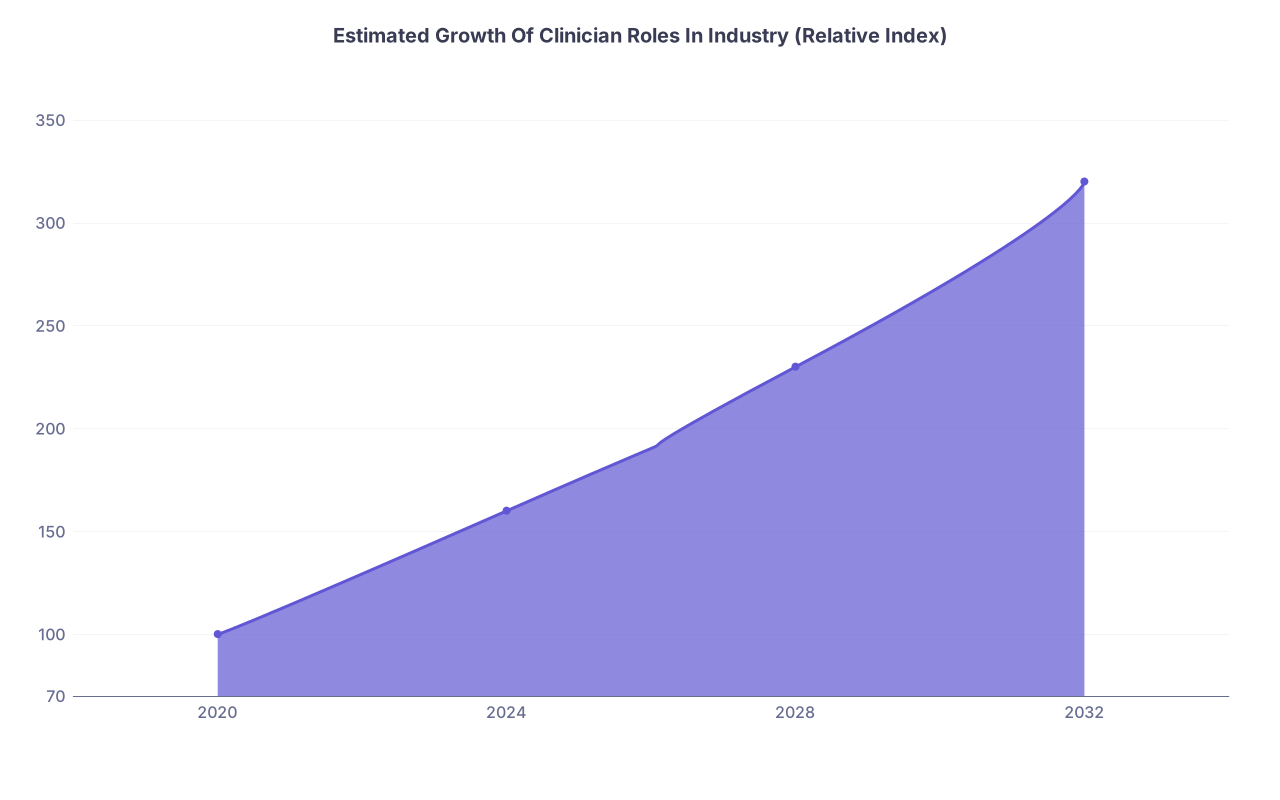
| Category | Value |
|---|---|
| 2020 | 100 |
| 2024 | 160 |
| 2028 | 230 |
| 2032 | 320 |
The outcome? Joining industry mid‑career will stop being seen as “leaving medicine” and start being recognized as one of several legitimate medical careers. Different path, same core mission—just with more acronyms and fewer night shifts.
How To Decide If This Is Actually For You
The question you need to ask yourself isn’t “Is industry good or bad?” That’s shallow.
The real questions:
- Do you still get a charge out of direct patient care that makes the chaos worth it?
- Or do you mostly feel drained, boxed in, and underutilized intellectually?
- Are you willing to be a beginner again after spending a decade earning seniority?
- Can you stomach adding “business considerations” to your mental model without seeing that as selling out?
If your honest answers tilt toward wanting leverage, predictability, and new intellectual challenges—and you’re willing to eat some humble pie for 12–18 months while you retool—then a mid-career jump can be one of the best moves you ever make.
If the idea of stepping back from the bedside feels like a loss you’d never really accept, tread very carefully. A partial pivot (consulting, advisory roles, part-time industry while staying clinical) might be a better starting point.

Years from now, you won’t remember the titles you traded or the LinkedIn posts you crafted to justify the move. You’ll remember whether you kept growing, whether you got your life back, and whether you found work that made sense for the person you actually became—not the one your training assumed you’d stay forever.