
The biggest mistake clinicians make when moving into consulting is treating it like a career change instead of a market repositioning problem.
You are not “starting over.” You already have assets: clinical judgment, domain expertise, credibility, and a sickening amount of time spent in broken systems. The problem is simple: the consulting market does not understand your value in its own language. Your job is to translate, package, and place that value where decision-makers can pay for it.
This playbook will walk you through that translation. Step by step. No fluff, no “follow your passion” nonsense. Just a clear path from “I’m a clinician who might want out” to “I’m a paid consultant with a defined niche.”
Step 1: Decide Which Consulting Game You’re Actually Playing
“Consulting” is useless as a career goal. It covers too many different realities. You need to pick a lane.
Here are the main buckets clinicians usually end up in:
| Path Type | Typical Employer | Travel Level | Time to Break In |
|---|---|---|---|
| Big 3 / Big 4 Strategy | MBB, Deloitte, PwC | High | 6–18 months |
| Healthcare-focused Firms | LEK, ZS, Chartis etc. | Moderate | 3–12 months |
| Boutique / Niche Consultancies | Small specialist shops | Low–Mod | 1–9 months |
| Independent / Freelance | Direct clients | Low–High | 1–6 months |
| Industry Internal Consulting | Payers, pharma, health systems | Low–Mod | 3–12 months |
If you say “I’ll take anything,” you are already behind. Firms can smell lack of focus. Pick one primary path and a backup:
- Path A (example): Healthcare-focused consulting firm (e.g., Chartis, ECG, ClearView)
- Path B (example): Internal consulting at payer / health system
Some blunt realities:
- Big 3 (McKinsey, BCG, Bain)
Possible from clinical practice. Harder mid-career. They care about:- Brand-name schools
- Clear analytics horsepower
- Leadership and impact stories
- Healthcare-specific firms
Much more clinically friendly. They like:- Deep domain expertise
- Experience with operations, QI, guidelines, payer interactions
- Boutique / independent
You win by:- Narrow niche
- Clear, painful problem you solve
- Proof you can deliver results, not titles
Pick your target. Then everything else (resume, networking, projects) gets built for that lane, not for “consulting” in general.
Step 2: Translate Your Clinical Background into Consulting Language
Consulting firms do not care that you “saw 25 patients a day.” They care what problems you solved and what numbers you moved.
You need to take your clinical history and reframe it into three buckets:
- Problem-solving and analysis
- Operational impact
- Stakeholder management and communication
Let’s convert clinical into consulting:
“Managed a busy clinic panel of 2,000 patients” →
“Led ongoing management of a 2,000-patient panel, improving annual visit completion from 68% to 81% through redesigned follow-up workflows.”“Served on sepsis committee” →
“Member of hospital sepsis improvement task force; contributed to protocol redesign that reduced door-to-antibiotic time by 35 minutes and improved bundle compliance by 22%.”“Precepted residents” →
“Led weekly structured teaching and case review for 8–10 residents; implemented standard feedback framework that increased resident satisfaction scores from 3.8 to 4.5 / 5 over 12 months.”
You get the idea. Numbers. Directional improvement. Specific impact.
Make a quick inventory:
- Projects where you:
- Cut wait times
- Changed protocols
- Improved metrics (LOS, readmissions, throughput, patient satisfaction, revenue)
- Situations with:
- Cross-functional teams (nursing, admin, IT, pharmacy, quality)
- Conflict and alignment
- New initiatives (pilots, rollouts, EMR changes)
- Any data-heavy work:
- QI dashboards
- Audit projects
- Outcomes reporting
- Research with statistics
You will recycle this inventory everywhere: resume bullets, LinkedIn, networking conversations, interviews.
Step 3: Build a Focused “Consulting Story” (Not a Sob Story)
Nobody hires you so you can escape burnout. They hire you to solve specific business problems.
You need a short, sharp narrative that:
- Explains why you are moving
- Connects your clinical past to a business-valued future
- Signals you are not flailing
Use this three-part structure:
- Origin – “I spent X years doing Y, which exposed me to Z problem.”
- Shift – “I realized the part I was best at / most pulled into was A (operations, strategy, analytics, etc.).”
- Direction – “Now I am focused on consulting in B area, where I can use my clinical foundation to drive C type of results.”
Example:
“I have spent eight years as a hospitalist in a large academic center, and over time I kept getting pulled into projects on patient flow and length of stay. I found I was more excited by redesigning admission pathways and discharge processes than by the daily grind of notes and orders. Now I am moving into healthcare consulting focused on hospital operations and care model redesign, where I can use my frontline perspective and project experience to help systems improve throughput and quality metrics.”
That is tight. Forward-looking. Professional. No trauma dumping about EMR clicks per hour.
Write your version. Two or three sentences. Memorize it.
Step 4: Close Your Skill Gaps Intentionally (Not Randomly)
You do not need an MBA to break into consulting.
You do need to plug a few obvious holes that make clinicians look uncommercial:
- Lack of basic business vocabulary
- Weak exposure to financials
- No portfolio of non-clinical work
Focus on four skill clusters:
- Analytics / quant
- Excel: pivot tables, simple modeling, basic sensitivity analysis
- Data literacy: understanding datasets, confounders, bias, basic stats
- Business fundamentals
- Payer mix, reimbursement, cost vs charge vs margin
- Value-based care, capitation, bundles, risk adjustment
- Market sizing, basic competitive analysis
- Project / stakeholder management
- Scoping a project (goal, constraints, stakeholders)
- Running meetings, capturing actions, driving decisions
- Communication / slide-making
- Structuring an argument (problem → options → recommendation → impact)
- Making clean, readable slides in PowerPoint / Google Slides
You can build this cheaply and pragmatically:
- One solid book on consulting-style problem solving
Example: “Case In Point” or “Case Interview Secrets” for structure, not because you must be a case-interview ninja. - One business fundamentals crash course
Example: Coursera “Healthcare Marketplace” or intro health economics. - Short Excel / PowerPoint course
There are endless options; pick one and finish it in two weeks.
Then, most important: apply these in a small project of your own (more on that in Step 7).
Step 5: Rebuild Your Resume and LinkedIn for Consulting
Your current CV is almost certainly unusable for consulting. It reads like a chronology, not a sales document.
You need a consulting-style resume, 1–2 pages max, built around impact bullets.
Core changes:
- Drop the full research abstract graveyard
- Keep publications that support your niche (e.g., health policy, QI, outcomes)
- For each role, 4–6 bullets that start with a verb and end with a number
Bad bullet:
“Responsible for inpatient care on general medicine service.”
Good bullet:
“Redesigned daily rounding structure for 24-bed medicine unit, reducing average discharge time of day from 3:45 pm to 1:30 pm and increasing bed availability for ED admissions by 18%.”
If you have leadership titles, weaponize them:
- “Medical director” →
What budget? How many FTEs? What metrics did you own? What changed while you held that title?
Update LinkedIn to match:
- Headline: Not “Hospitalist at XYZ.” Try “Physician | Healthcare Operations & Strategy | Transitioning to Consulting.”
- About section: Summarize your consulting story, 6–8 lines, with 3–4 concrete examples of impact.
- Experience: Mirror your resume bullets, not the hospital HR descriptions.
Make sure your location and “Open to Work” settings align with your target roles (consulting hubs: New York, Boston, Chicago, SF, etc., or remote).
Step 6: Pick and Position Your Niche
Trying to be a generic “healthcare consultant” is how you become invisible.
You need a sharp niche that answers this question in a sentence:
“I help [type of client] do [specific thing] better.”
Some physician-relevant consulting niches:
- Hospital / system:
- Care model redesign
- ED throughput / bed management
- Clinical quality and pathways
- Service line strategy (oncology, cardiology, ortho)
- Payer:
- Prior auth and utilization management
- Provider engagement
- Value-based program design
- Pharma / medtech:
- Medical affairs strategy
- KOL engagement
- Clinical trial design / site operations
- Market access, HEOR input
- Digital health:
- Clinical workflow integration
- Product validation with clinicians
- Outcomes design and measurement
You are not locking yourself in forever. You are choosing a doorway that makes it easy for people to see where you fit.
Your positioning sentence might be:
- “I help community hospitals reduce avoidable readmissions and length of stay by redesigning discharge workflows and transitional care.”
- “I help digital health startups design clinically credible, adoption-ready care pathways for primary care and chronic disease management.”
Everything you do publicly—posts, networking conversations, project examples—should reinforce this.
Step 7: Create a Mini “Consulting Portfolio” While You Are Still Clinical
This is where most clinicians fail. They send in a rebranded resume but have zero proof of consulting-type work.
You fix that by deliberately running 2–4 small, well-scoped internal projects that look like consulting engagements.
Here is the playbook:
Identify a painful, measurable problem
- Excessive no-shows in clinic
- Delayed discharge summaries
- High 30-day readmission for CHF
- Low vaccine uptake in a specific population
Define a 6–12 week project
- Scope: very narrow, very clear
- Stakeholders: 3–6 max (e.g., nurse manager, one admin, one IT contact)
- Metrics: 1–3 numbers you want to move (baseline them!)
Run it like a consultant
- Kickoff meeting: confirm problem, goal, constraints
- Data collection: simple Excel, EMR reports, manual sampling
- Hypotheses: 2–3 ideas on what is causing the problem
- Interventions: test simple changes, document outcomes
- Close-out: 4–6 slide summary deck with before/after
Get permission to share de-identified results
- You do not need patient data
- You can describe the problem, actions, and high-level metrics
Now you have:
- A concrete story for interviews
- A small portfolio you can talk through with a hiring manager
- Evidence that you think and act like a consultant, not just a clinician
This is 10x more convincing than another certificate.
Step 8: Network Like an Adult, Not a Student
Sending “Can I pick your brain?” messages to strangers on LinkedIn is amateur hour. You need a targeted, respectful approach.
Here is a simple, repeatable script for outreach to clinicians already in consulting:
Subject: Fellow [specialty] moving into consulting – quick question
Hi [Name],
I am a [X-year] [specialty] physician at [institution] and have been leading several projects around [operations / digital health / quality]. I saw that you moved from clinical practice into [firm / role], and that is the exact direction I am pursuing.If you would be open to a 15–20 minute call, I would really value your perspective on two things:
- Which parts of my background are most relevant for [type of consulting]?
- How you would focus a transition plan over the next 6–12 months.
I know you are busy; I am happy to send a short summary of my background in advance and keep the conversation focused.
Best,
[Name]
Key rules:
- Always be specific about why you chose them
- Make it time-bounded
- Bring 2–3 focused questions, not “tell me everything”
- Follow up once, then stop. Do not badger.
Your goals for each conversation:
- Learn what actually matters for hiring at that firm / role
- Get feedback on how to present your experience
- Ask if (and only if it feels appropriate) they would be comfortable forwarding your resume internally when you are ready to apply
Track this like a project:
- 3–5 new outreach messages per week
- Aim for 1–2 conversations per week
- Update a simple spreadsheet (name, firm, date, notes, follow-ups)
This is your informal apprenticeship. Treat it seriously.
Step 9: Prepare for Consulting Interviews the Right Way
Consulting interviews often have two parts:
- Fit / behavioral (“Tell me about a time you…”)
- Case / technical (more common in strategy firms, less formal in internal roles)
You must be ready on both.
A. Behavioral
Your clinical background is gold here—if you package it well.
Build 6–8 core stories using the STAR pattern (Situation, Task, Action, Result):
- Challenging stakeholder or conflict
- Leading a project with limited authority
- Fixing something broken
- Handling uncertainty or incomplete information
- Teaching / influencing behavior change
Then practice answering:
- “Why consulting and why now?”
- “Why our firm / this role?”
- “Why leave medicine / will you miss patients?”
Your answer to “Why are you leaving?” cannot be: “I am burned out and hate clinical practice.” Even if it’s partially true.
Acceptable frame:
“I have reached the point where the parts of my job I enjoy most are the improvement and strategy work rather than the direct patient volume. I want to spend the majority of my time on those projects, at scale, which is why I am moving into consulting.”
You are moving toward something, not running from something.
B. Case-style / technical
If you are targeting MBB or classic strategy consulting, you will need to practice formal case interviews. There are entire books and communities for that.
For more healthcare-specific or internal roles, the “case” is usually:
- “How would you reduce readmissions in a community hospital?”
- “A payer wants to increase provider adoption of their value-based contracts—what would you look at?”
- “We are launching a new digital tool in primary care; what are the biggest adoption barriers?”
Use a simple structure:
- Clarify the goal (what metric, by how much, by when)
- Lay out a structured approach (2–3 buckets)
- Walk through each bucket with examples
- Summarize with a recommendation and 2–3 tradeoffs / risks
Practice aloud. Not in your head. With another human if possible.
Step 10: Decide How to Leave Clinical Practice (All at Once vs. Gradual)
You have three main exit models:
Hard switch – full-time role in consulting, stop clinical entirely
- Pros: Clear identity shift, full focus, higher income ceiling quickly
- Cons: Big jump, loss of license relevance over time if you never practice
Hybrid phase – part-time consulting, part-time clinical
- Pros: Financial stability, preserves clinical identity, smoother test
- Cons: Fatigue, possible conflict, slower ramp in consulting
Independent consulting alongside clinical
- Pros: Full control, can test niche, build portfolio
- Cons: You must find your own clients, learn sales, unpredictable income
For many mid-career clinicians, a 12–24 month hybrid phase is ideal:
- Drop to 0.5–0.7 FTE clinically if your employer allows it
- Use the freed time for:
- Contract work with smaller firms
- Short-term projects via platforms
- Building your own small client base
If your institution is flexible, you can even position yourself as an “internal consultant” for a year while testing external opportunities. Just make sure someone is paying you for clearly scoped project work, not dumping extra committees on you.
Step 11: If You Go Independent, Treat It as a Business from Day One
Many physicians “dabble” in consulting and then insist there is no work. The reality: they are waiting for work to find them.
If you want to be an independent consultant, treat it like a serious business:
Pick a niche and one ideal client type
Example: “Regional hospitals, 150–400 beds, struggling with ED boarding and throughput.”Define 1–2 clear offers
Example:- 8-week “Rapid Throughput Assessment and Redesign”
- 3-month “Discharge Process Overhaul”
Price on value, not hours
- Fixed-fee projects with a defined scope
- (Yes, you will underprice early. Adjust upward quickly.)
Build simple marketing assets:
- One-page PDF describing your offer, outcomes, and process
- 2–3 slide mini-case or anonymized example
- Basic website or even a strong LinkedIn profile with a clear positioning statement
Use your existing network first:
- Former colleagues now in admin roles
- Medical directors
- Quality and operations leaders
Your pitch is not “Do you have any consulting work?” It is:
“I have put together an 8-week rapid assessment and redesign offer specifically focused on ED throughput and boarding for mid-size hospitals. It can be run mostly remotely, includes staff interviews, data review, and a prioritized implementation plan. Would it be useful to walk you through it for 15 minutes to see if it could fit any of your current priorities?”
Very different energy.
Step 12: Timeline and Milestones – A Realistic 12-Month Plan
To make this concrete, here is a sample 12-month transition plan for a practicing physician aiming at healthcare-focused consulting:
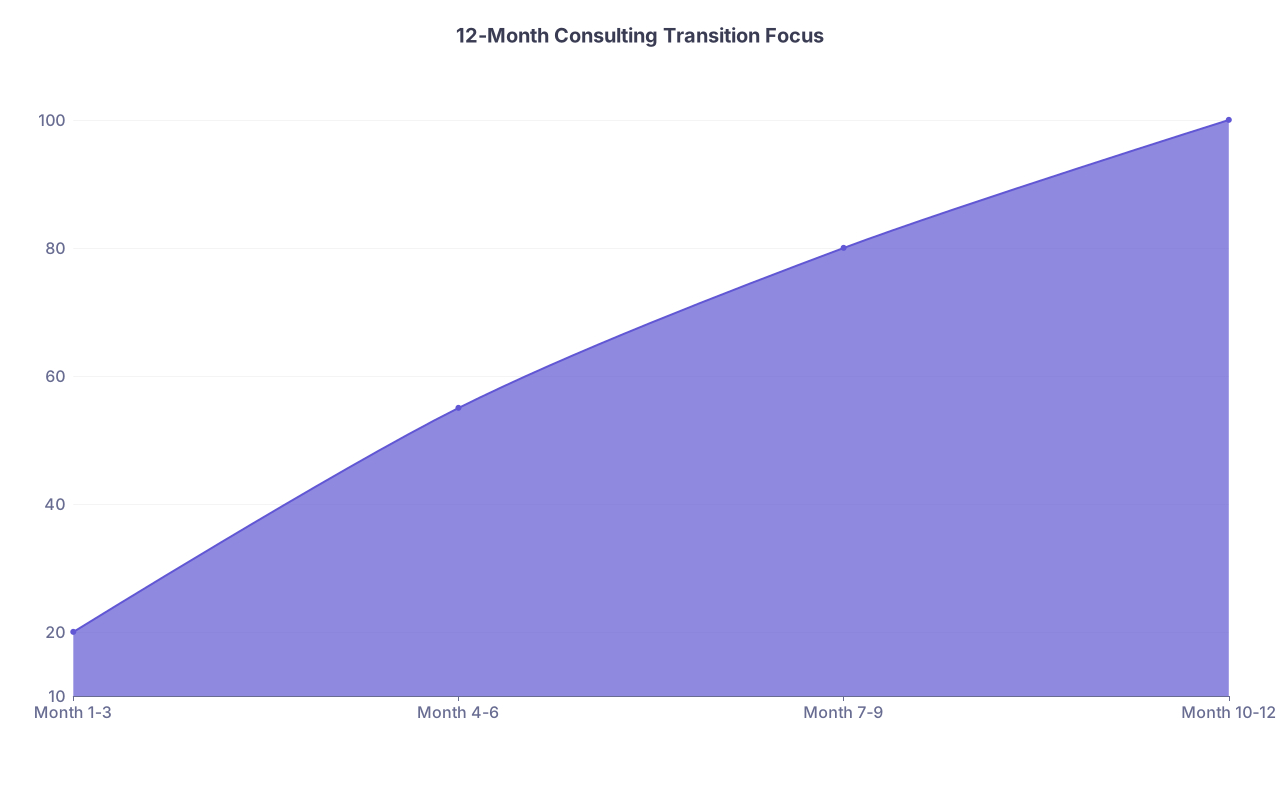
| Category | Value |
|---|---|
| Month 1-3 | 20 |
| Month 4-6 | 55 |
| Month 7-9 | 80 |
| Month 10-12 | 100 |
Months 1–3
- Clarify target path and niche
- Rewrite resume and LinkedIn
- Start basic business / analytics upskilling
- Scope and start one small internal project
Months 4–6
- Finish 1–2 internal “consulting-style” projects
- Begin structured networking (3–5 outreaches / week)
- Practice behavioral and light case interview skills
- Start applying to targeted roles / project opportunities
Months 7–9
- Intensify applications based on feedback
- Leverage warm referrals from your networking
- Consider cutting clinical FTE if serious opportunities emerge
- Explore one small external project (even underpaid) for portfolio
Months 10–12
- Land a full-time role or establish a recurring project pipeline
- Decide on clinical exit vs. hybrid model
- Formalize systems: calendar, income tracking, project templates
It is not instant. But 12 months is absolutely enough to make a serious move if you treat it like a project, not a fantasy.
Visualizing Your Path Options
Here is a simple map of the main transition routes from clinical practice into consulting:

| Step | Description |
|---|---|
| Step 1 | Clinical Practice |
| Step 2 | Full Time Strategy Firm |
| Step 3 | Healthcare Focused Firm |
| Step 4 | Internal Consulting Role |
| Step 5 | Independent Consultant |
| Step 6 | Hybrid Clinical plus Consulting |
You are not stuck on one path. But you should commit to one first, then adjust based on real-world traction.
Example: How a Hospitalist Becomes a Consultant in 9 Months
To make this less theoretical, here is a summarized real pattern I have seen repeatedly:
Background: 7-year hospitalist at mid-size system, some QI work, no MBA.
Month 1–2:
- Reworked resume, highlighted LOS and throughput projects
- Took short course on healthcare finance
- Started Excel / PowerPoint practice
Month 3–4:
- Ran a defined 10-week project: improved discharge-before-noon rate from 18% to 34% on one unit
- Built simple 7-slide deck on project results
- Reached out to 15 physicians now in consulting; got 6 calls
Month 5–6:
- Applied to 8 healthcare consulting firms, 3 payer internal roles
- Got 4 interview processes started
- Practiced case-style problem solving with friends 3x/week
Month 7–8:
- Received offer from healthcare-focused consulting firm with significant pay bump
- Negotiated start date 3 months out to wrap clinical obligations
- Agreed with former hospital to return for 4 weekend shifts/month for 6 months if desired
Month 9:
- Started consulting full-time
- Continued minimal clinical work for 6–12 months as identity and financial buffer
Not magic. Just ruthless focus and consistent effort.
Common Traps to Avoid
Let me be blunt about what kills most transitions:
Collecting certificates instead of projects
Another course is not a portfolio. Results are.Applying cold to 100 “healthcare consultant” jobs
Low-yield. Focused applications with warm connections work better.Leading with your frustration with medicine
It turns off hiring managers. They worry you will hate consulting too.Staying vague about what you want
“Any nonclinical role” advertises low conviction and poor self-awareness.Waiting for perfect clarity
You will not get it. You get clarity by doing small experiments and talking to people actually in the roles.
Your Next Concrete Step (Today)
Do this now, not “when things calm down” (they never do in healthcare):
- Open a blank document.
- Write your 2–3 sentence consulting story using the Origin → Shift → Direction structure.
- Under that, list five times in the last three years you improved a process, changed a metric, or led a non-clinical project. One line each.
That document is the seed of your new career. From there you will build your resume, your networking script, and your first internal consulting projects.
Do not overthink. Start the list today.