
The leap from staff physician to medical director is not a promotion. It is a career change. And most physicians botch it because they treat it like “more of the same, plus meetings.”
If you want to be a medical director within 3 years, you need a plan. Not vague intentions. A real, stepwise transition that builds skills, visibility, and credibility while you are still practicing.
I am going to lay out that plan.
You will see exactly:
- What to do in Years 1, 2, and 3
- Which skills to build and in what order
- What roles to seek, which to avoid, and how to talk to your CMO without sounding naive
- How to pivot your CV and reputation from “good clinician” to “serious leadership candidate”
If you follow this and adjust for your setting, you give yourself a very real shot at a medical director title in roughly 36 months.
Step 0: Get Honest About What a Medical Director Actually Does
Most staff physicians misunderstand the role. They picture:
- Some meetings
- Signing off on protocols
- A bit of quality work
- Slightly less call and more “influence”
Reality is different.
Medical directors:
- Spend most of their time not seeing patients
- Live inside metrics: throughput, LOS, readmissions, utilization, patient experience, safety events
- Negotiate constantly with nursing, administration, payers, and other physicians
- Get judged on system outcomes, not individual patient stories
If that bores you, frustrates you, or feels like a downgrade, good. You just saved yourself a lot of pain. Stay clinical and look for other alternative careers.
If, however, you are genuinely interested in:
- How systems work
- Why good clinicians still produce bad outcomes in broken workflows
- Fixing root causes rather than firefighting every day
…then you are a realistic candidate.
Next, understand the three big gaps between a staff physician and a viable medical director:
- Skill gap – leadership, finance, quality, operations, change management
- Visibility gap – nobody in leadership knows you are serious or sees you in action
- Narrative gap – your CV and reputation say “good doc” not “organizational leader”
Your 3-year plan is about closing these gaps in a structured way.
The 3-Year Roadmap at a Glance
| Year | Primary Focus | Time Allocation (avg) |
|---|---|---|
| 1 | Skill foundation + visibility | 5–7 hrs/week |
| 2 | Formal roles + targeted education | 7–10 hrs/week |
| 3 | Transition + negotiation | 5–8 hrs/week |
| Category | Value |
|---|---|
| Year 1 | 10 |
| Year 2 | 30 |
| Year 3 | 50 |
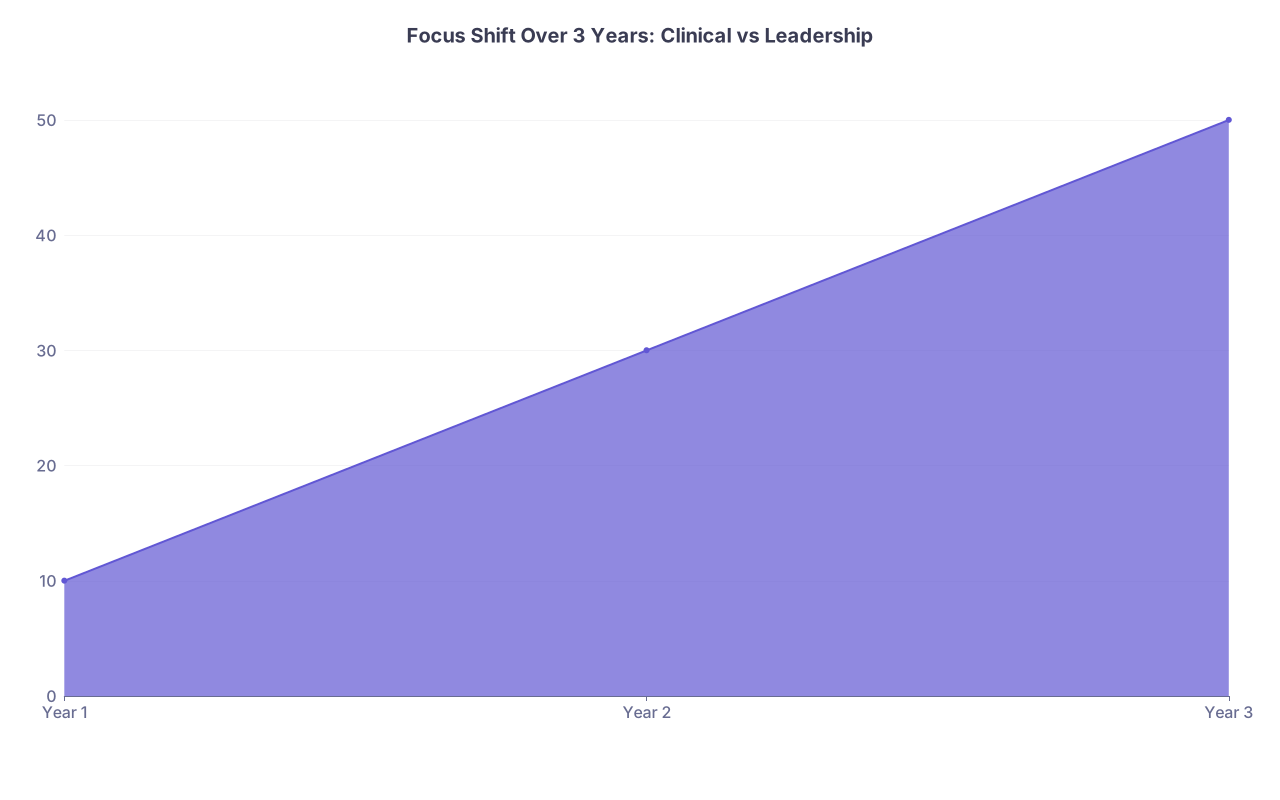
That area chart is conceptual: leadership work ramps from ~10% to ~50% of your professional energy over 3 years. You will still be a clinician, but you stop being just a clinician.
Year 1: Build Leadership Muscles Where You Already Are
Year 1 is about proving you can lead without a title and learning the language of administration.
1. Carve Out a Clear Weekly Leadership Block
Stop telling yourself you will “find time.” You will not.
Pick:
- One weekday evening (2–3 hours)
- One weekend block (2–3 hours)
These are your “leadership development” slots. Non-negotiable. Treat them like call. Everyone in your life adjusts around those.
Use them for:
- Courses
- Reading
- Preparing for committee work
- Informational meetings
If you are not willing to protect 5 hours a week, you are not serious about this transition.
2. Pick One Real Problem and Own It
Leadership is not about titles. It is about repeatedly taking responsibility for problems bigger than your own patient list.
Look around your unit or department. Choose one problem that:
- Affects many people
- Is concrete and measurable
- Has an obvious pain point for clinicians and administration
Examples:
- ED boarding times are insane; throughput is stuck
- Discharge summaries are delayed; length of stay is creeping up
- Opioid prescribing is inconsistent; risk concerns rising
- Sepsis bundle compliance is poor
Now, do the following:
- Collect data
- Pull basic metrics from whatever system you can access
- Get baseline numbers: How big is the problem actually?
- Talk to people in the workflow
- Nurses, unit clerks, case managers, residents, midlevels
- Ask: “What makes this hard?” “Where does this break down?”
- Sketch a small pilot solution
- One unit, one shift, one template, one checklist
- Present it to your existing leadership
- Section chief, department chair, local medical director
- “I have noticed X, here is baseline data, here is what front-line staff say, and here is a small pilot we could try over 30 days. I will run it and track results.”
This does several things at once:
- Shows initiative
- Demonstrates you think like a systems person
- Puts you in front of leadership with something concrete
You are not asking for a role. You are demonstrating value.
3. Start Committee Work — But Be Ruthless About Which Committees
Committee membership can be a complete waste of time if you choose poorly.
Avoid:
- Committees that never touch metrics
- “Talking shops” that produce minutes but no measurable change
- Groups that exist primarily for optics
Seek:
- Quality and Safety committees
- Peer review / chart review
- Utilization management
- Sepsis, stroke, AMI, readmissions, patient flow
Ask your department chair or current medical director:
“If I want to contribute more at the system level, which 1–2 committees would give me the best exposure to quality and operations work?”
Then treat those commitments seriously:
- Show up on time
- Read the packet
- Volunteer for follow-up tasks
- Ask data-driven questions
You want people to start saying in those rooms:
“Dr. X actually gets stuff done.”
4. Begin a Structured Education Plan (But Do Not Run for an MBA Yet)
The most common mistake? Jumping straight into an expensive MBA or MHA before you have even touched real operations or quality projects.
Year 1 should be lightweight but structured:
Core topics to cover:
- Basics of healthcare finance (DRGs, RVUs, payor mix, margin, bundled payments)
- Quality & safety frameworks (LEAN, Six Sigma concepts, root cause analysis, PDSA cycles)
- Fundamentals of leadership (difficult conversations, influencing without authority, negotiation basics)
Practical options:
- Free/low-cost online content from IHI (Institute for Healthcare Improvement)
- Coursera / edX courses: healthcare operations, quality improvement
- A small leadership development course offered by your hospital system
Your goals:
- Learn vocabulary so you stop sounding like “just a clinician” in leadership meetings
- Understand how your hospital actually gets paid and what your C-suite cares about
Do not overcomplicate this. One focused course at a time, plus reading.
5. Reposition Your Reputation Locally
Your leaders have a mental file on you. Right now it probably says:
“Good (or solid) clinician. Reliable. Not a problem.”
You need it to say:
“Serious. Systems thinker. Interested in leadership. Low drama.”
Practical moves:
- Stop complaining in public spaces (nurse’s station, physician lounge). Bring problems with 1–2 proposed solutions.
- When something goes well due to a system improvement, send a short email: “Just wanted to flag that X has noticeably improved workflow on Y shift.”
- Ask your current medical director once a quarter:
“What is one thing I can take off your plate or help you with on a small scale?”
You are not sucking up. You are signaling intent and reliability.
Year 2: Get Formal, Get Measurable, and Get Selective About Education
Year 2 is where you start taking on formal leadership roles and doing work that shows up on dashboards.
You should still be clinically strong, but you are no longer just a workhorse. You are building a visible second identity.
1. Land a Small but Real Leadership Title
You are not jumping to “Medical Director” from nothing. Target stepping-stone roles:
- Assistant/Associate Medical Director
- Site lead for your specialty at a satellite clinic
- Chair or co-chair of a key clinical committee
- Medical lead for a specific program (e.g., sepsis, stroke, CCC, telehealth initiative)
How to position yourself:
Schedule a direct conversation with your current medical director or department chair:
- “I am committed to moving into formal leadership over the next 2–3 years. I have been doing X, Y, and Z. I would like to know what roles you think I could grow into, and what I need to demonstrate to be considered.”
Bring receipts:
- Brief one-page summary of the project you led in Year 1 with before/after data
- Committee contributions (e.g., sub-projects, changes you helped implement)
Be specific about your bandwidth:
- “I can realistically give 6–8 hours per week to leadership work, plus meetings.”
If your local environment has no stepping-stone roles, that is a data point. It tells you that at some point you may need to:
- Switch to a different site/system
- Join a large group where assistant medical director roles are more common
- Look at payor or telehealth organizations that rely heavily on physician leadership
But start where you are.
2. Lead a Project That Hits a Real Metric
In Year 2, you need one or two heavyweight projects:
Examples:
- Reduce 30-day readmissions for CHF by 10–15% on your service
- Improve ED door-to-needle times for stroke by 15–20%
- Decrease average length of stay on a specific unit by 0.3–0.5 days
- Increase same-day discharge rate for a common elective surgery
Structure the work like this:
- Define the metric with clear baseline data
- Get executive sponsorship (your med director or quality lead)
- Form a small cross-functional workgroup (nurses, case managers, etc.)
- Run PDSA cycles – pilot small changes, measure weekly
- Document relentlessly:
- A one-page driver diagram
- Simple run charts before/after
- Brief summary of interventions and obstacles
Then present results:
- At department meeting
- To quality committee
- Possibly at a regional or national conference
This is the kind of concrete story that gets a CMO’s attention later:
“I led a multidisciplinary team that reduced CHF readmissions by 12% over 9 months, saving approximately $X and improving our performance on this core measure.”
That is how medical directors talk.
| Category | Value |
|---|---|
| Baseline | 22 |
| Quarter 1 | 20 |
| Quarter 2 | 18 |
| Quarter 3 | 17 |
| Quarter 4 | 16 |
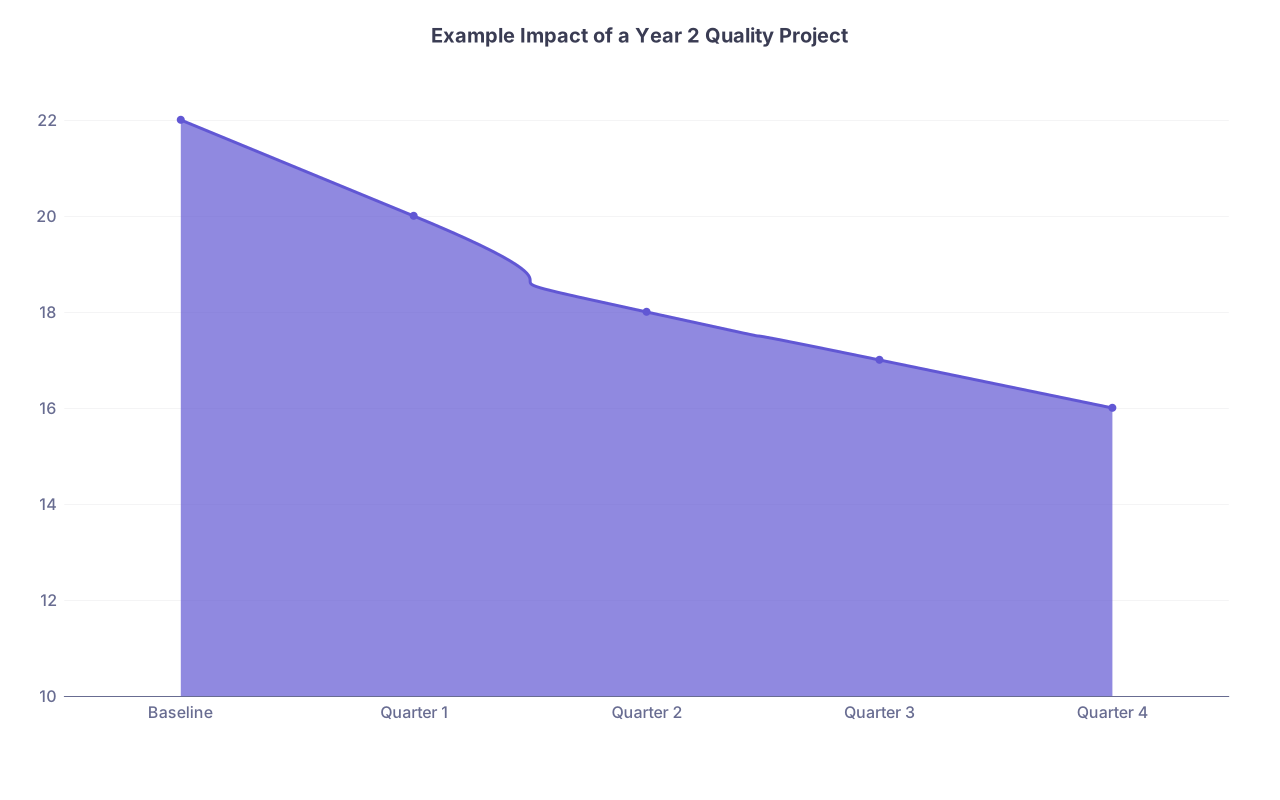
(For instance, CHF readmission dropping from 22% to 16% over a year.)
3. Decide on Formal Education: Yes, No, or Not Yet
By mid-Year 2, you will know if you like this work. If yes, now is the time to consider formal education.
Options:
- Short leadership academies run by your health system or specialty society (CHEST, ACEP, SHM, ACP, etc.)
- Certificate programs in healthcare leadership, quality, or management (6–12 months, part-time)
- MHA, MPH, or MBA (2–3 years, significant time and money)
How to decide:
Ask three questions:
- Do my target roles require a degree, or just prefer it?
- Can I tap tuition support from my institution or group?
- Do I have enough real-world leadership experience that coursework will actually stick and not be abstract?
If you have:
- Genuine leadership roles
- Serious projects under your belt
- Clear signs from leadership that more education would position you better
Then an MHA/MPH/MBA can be worth it. If not, do not use a degree to compensate for lack of experience. That is backward. Employers see through it.
4. Adjust Your Clinical Practice Strategically
You need protected mental bandwidth. That often requires changing your clinical obligations.
In Year 2, consider:
- Reducing night shifts or high-acuity block density if possible
- Trading some extra call for more daytime admin time
- Negotiating for 0.1–0.2 FTE of protected admin time tied to your project or assistant director role
Be explicit:
- “To deliver on X and Y projects, I need 4–8 hours per week during normal business hours, not evenings after a 12-hour shift.”
If your employer wants the benefits of your leadership work, they must pay in either money or time. Ideally both.
Year 3: Position, Negotiate, and Step Into the Medical Director Role
By Year 3, the goal is not “maybe I will do some leadership.” The goal is to be on a short list for medical director positions inside or outside your organization.
1. Build a “Leadership CV,” Not Just a Clinician CV
Your CV must stop looking like an academic promotion packet and start looking like a leadership dossier.
Key structural changes:
Professional Summary at top – 3–5 lines
- “Board-certified internist with 8 years of clinical experience and 3 years of progressive leadership responsibility, including Assistant Medical Director for Hospital Medicine, chair of Sepsis Committee, and leader of LOS-reduction initiative achieving 0.4-day decrease across 2 units.”
Leadership & Administrative Experience section before clinical experience
Each entry should include:- Title, organization, dates
- Scope (number of physicians, sites, programs)
- Key outcomes with metrics
Example bullet:
Led cross-functional team of 14 (physicians, nurses, case managers, pharmacy) to reduce CHF readmissions from 22% to 16% over 12 months, improving CMS quality scores and generating estimated $450K annual margin improvement.
Quality Improvement & Projects section
Education & Leadership Training (including courses, certificates)
Clinical Experience at the bottom unless there is a special reason not to
This is how non-clinical hiring managers (in payors, telehealth, health systems) scan you.

2. Have Explicit Career Path Conversations With Leadership
By early Year 3, you should be scheduling direct conversations with:
- Your current medical director
- Your department chair
- If appropriate, the CMO or VP of Medical Affairs
The script is straightforward and direct:
“Over the last two years, I have taken on X and Y roles and led Z projects with these results. My goal over the next 12–18 months is to step into a formal medical director position, here if possible. What are the upcoming opportunities, and what specific gaps do I still need to close to be a top candidate?”
Listen carefully to the answers. You will often hear one of three things:
“We see you that way. There may be an opening in [X] in 6–12 months.”
- Good. Stay engaged. Ask to be looped into more senior meetings.
“We value you, but there’s nothing here for at least several years.”
- Translation: If you want that title soon, you will likely have to leave.
Vague non-answers, no metrics, lots of “we’ll see.”
- This usually means they like the cheap labor you are providing and have no real intention of promoting you. Time to look outside.
3. Decide: Internal Promotion vs External Move
Some systems are fantastic at promoting internally. Others are political, slow, or lock leadership roles for years.
You need an honest assessment.
Compare:
| Factor | Internal Path | External Path |
|---|---|---|
| Learning curve | Shorter (you know the system) | Steeper (must learn new culture) |
| Perceived value | May be seen as “junior” or “always a staff doc” | Often valued as “new blood” with experience |
| Politics | You know them (for better or worse) | You start without baggage |
| Control over timing | Limited by local openings | Wider set of options |
| Risk | Lower | Higher but often faster payoff |
I have seen many strong assistant directors sit for years waiting for a local med director role that never opens. Meanwhile, a competing health system or telehealth company would have hired them yesterday.
In Year 3, you should be interviewing externally, even if you prefer to stay. It clarifies your market value and gives you leverage.
4. Understand What Medical Director Jobs Actually Require
Most physicians read job descriptions superficially. Do not do that. They are telling you exactly how you will be judged.
Look for:
- FTE split (common: 0.4–0.6 admin, 0.4–0.6 clinical)
- Specific metrics you will own:
- Quality measures (HEDIS, CMS core measures, sepsis, readmissions)
- Operational metrics (throughput, LOS, bed turnaround)
- Financial metrics (productivity, cost per case)
- Size and scope:
- Number of physicians or APPs under you
- Number of sites (single hospital vs multi-site vs regional)
- Reporting structure:
- To whom do you report? CMO? VP? Another med director?
Then map your experience to those requirements. Where there is a gap, be ready with:
- A story from a smaller-scale situation
- A clear plan for how you would approach the larger responsibility
Example: You have led QI projects on one unit, but the role needs system-level work across three hospitals. You say:
“On Unit X I led a team to reduce sepsis delays by 25%. The drivers and resistance we encountered are essentially the same at scale – variation in protocols, documentation, communication. I would start by standardizing sepsis pathways across the three sites, measuring adherence weekly, and building a shared sepsis dashboard with local champions.”
You do not need to have done the exact job already. You need to speak in a way that convinces them you think at the right altitude.

| Step | Description |
|---|---|
| Step 1 | Staff Physician Today |
| Step 2 | Year 1 - Lead Local Project |
| Step 3 | Year 1 - Join Key Committees |
| Step 4 | Year 2 - Assistant Director Role |
| Step 5 | Year 2 - Lead Metric Based Projects |
| Step 6 | Year 2 - Targeted Education |
| Step 7 | Year 3 - Leadership CV + Career Talks |
| Step 8 | Internal Medical Director |
| Step 9 | External Applications |
| Step 10 | External Medical Director |
| Step 11 | Internal Role Open? |
5. Negotiate Sanity: FTE, Support, and Boundaries
The fastest way to burn out as a new medical director is to accept a role with:
- Too much clinical time
- No support staff
- Vague expectations
Non-negotiables you should push for:
Clear FTE breakdown
- If it says 0.3 FTE admin and 0.7 clinical, expect 0.5 admin work again shoved into nights/weekends.
- A healthier ratio for a real med director job is at least 0.4–0.5 FTE admin.
Administrative support
- Who builds the dashboards? Who schedules meetings? Who helps run reports?
- If “you do everything,” that is a red flag.
Defined metrics and review cadence
- “These are the 5–7 metrics you own. This is how we will evaluate your performance at 6 and 12 months.”
Decision authority
- You need actual levers: ability to modify schedules, set expectations, and influence hiring/firing at least indirectly.
- If you are just a “physician liaison” with no teeth, expectations and stress will be high with limited power.
Be willing to walk away from bad offers. There is no shortage of organizations that want cheap leadership labor. There are fewer that structure roles intelligently. Your leverage is highest before you say yes.
Common Mistakes That Delay (or Kill) the Transition
Let me be blunt about the self-inflicted wounds I see most often.
Waiting for someone to “tap you”
If you are just quietly doing your job and hoping someone notices your leadership potential, you will be waiting a long time. Leaders advocate for themselves.Taking on random committees instead of strategic ones
“We need a physician for this committee” is not a reason to say yes. If it does not build skills or visibility tied to operations, quality, or strategy, it is a distraction.Getting the degree first and the experience later
A fresh MBA with no track record of leading people or projects is not compelling. Hiring committees smell “degree as identity patch” quickly.Failing to shift your communication style
Staff physicians think in terms of individual patients and fairness to colleagues. Medical directors speak in data, tradeoffs, and resource constraints. Practice that language now.Staying in obviously stagnant environments
If your system never promotes from within, has entrenched leadership, and treats medical directors as scapegoats, stop waiting for it to change. Move.
What You Should Do This Week
Do not treat this as theory. Treat it as a checklist.
Here is a concrete 7-day assignment:
Block your time
- Put a 2-hour block on your calendar this week for “leadership work.” Not optional.
Identify one problem in your current clinical environment that is:
- Painful
- Measurable
- Fixable at small scale
Collect a baseline dataset
- Even if it is rough – counts over 1–2 weeks, anecdotal logs, etc.
Email your current medical director
- Two paragraphs:
- Paragraph 1: Describe the problem and its impact briefly.
- Paragraph 2: Propose a small pilot and offer to lead it. Ask for 15 minutes to discuss.
- Two paragraphs:
Write a one-page leadership CV draft
- Even if it looks thin. Put every committee, project, and informal leadership activity on it. Seeing the gaps on paper will force you to act.
Do those five things this week. Then build from there.
Open your clinical schedule and your calendar right now. Where is the 2-hour block you are dedicating to becoming a medical director instead of just talking about it?