
The story you’ve been told about physician work–life balance is mostly a PR strategy.
Let me tell you what really happens behind those “wellness town halls” and “flexible schedule” brochures, especially if you’re drifting toward alternative medical careers or thinking about your long game outside traditional clinical work.
The Unspoken Contract: Why Directors Need You Unbalanced
Medical directors rarely say this out loud, but here’s the reality: most systems run on the assumption that physicians will over-give.
Not because anyone sat down and wrote that policy. Because the entire financial structure depends on it.
You are the pressure valve. When volumes spike, when someone quits, when a new service line opens, when flu season hits—leadership assumes the physicians will absorb it. Not the administrators. Not the MBAs. You.
That’s why work–life balance conversations are always framed in a very particular way: “resilience,” “mindfulness,” “time management,” “burnout prevention.” Notice the pattern? All the focus is on you being stronger, more efficient, more “regulated.” Almost none of it is about reducing volume or giving up RVUs or capping patient loads in a way that hurts the bottom line.
Every medical director I’ve seen in those closed-door meetings knows this. They balance two competing realities:
- They need you to believe you can have a sustainable life.
- They need you to produce at a level that is fundamentally unsustainable long-term.
So they split the difference. They sell you “micro-fixes” while preserving “macro-exploitation.”
And that tension is exactly why alternative medical careers are exploding quietly in the background.
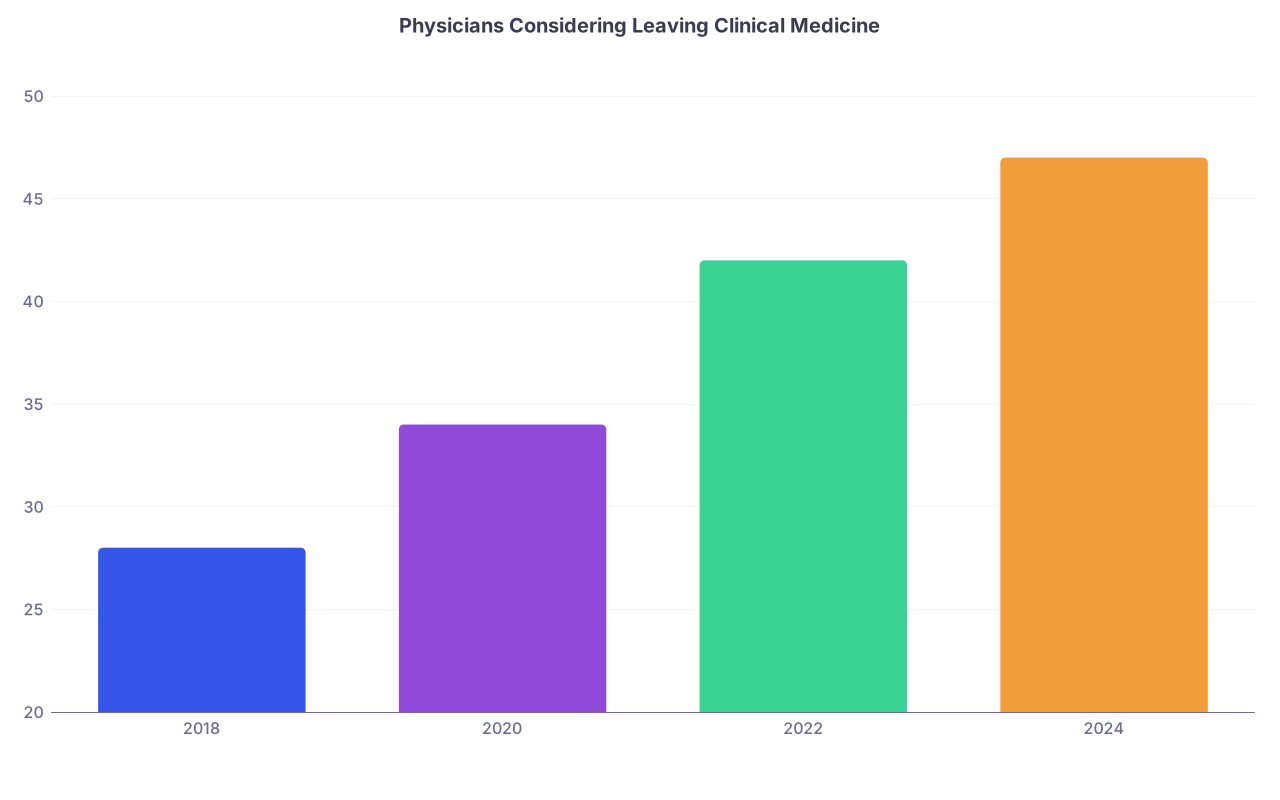
| Category | Value |
|---|---|
| 2018 | 28 |
| 2020 | 34 |
| 2022 | 42 |
| 2024 | 47 |
(Those aren’t abstract numbers directors ignore. I’ve watched PowerPoints in C-suite meetings with data like this in 40-point font. They’re worried about retention. But not enough to cut revenue targets.)
How Work–Life Balance Is Quietly Weaponized
You’ve probably seen this play in real time.
A system launches a new “wellness initiative”: online yoga, burnout webinars, maybe a “wellness champion” role for a half day a week. It photographs well. It looks compassionate.
Behind the scenes, nothing material changes. Panel sizes stay bloated. EMR time stays ridiculous. Call remains brutal. The message is subtle but very clear:
“If you’re still burned out after all this, maybe you’re the problem.”
I’ve sat in meetings where directors review “engagement” survey results that are frankly screaming. Comments like:
- “I’m charting 3 hours a night after my kids go to bed.”
- “I had chest pain driving to work last month.”
- “I haven’t taken a real vacation in three years.”
And I’ve heard leadership respond with:
“Let’s bring in a resilience speaker.”
“Can we do a mindfulness series on Fridays?”
“Can we create a peer support group?”
No one says: “We should cut visit quotas by 15% and accept lower revenue.” That’s off-limits. Untouchable.
This is what I mean when I say work–life balance gets weaponized. It becomes another way to measure how well you endure a broken system, not a genuine effort to fix it.
Why Alternative Careers Suddenly Look Rational, Not Radical
The older attendings who mock alternative careers as “selling out” or “giving up” are often operating from a training-era mindset that no longer exists.
They did medicine in an environment with:
- Less suffocating EMR documentation
- Fewer administrators per physician
- Less consumer-style satisfaction pressure
- Call structures that weren’t 100% malignant
Your generation is playing a different game. You’re being asked to be a clinician, customer-service rep, documentation specialist, coder, and part-time marketer. For the same “honor of the profession” speech.
Medical directors see this generational shift. They may even privately agree the job has become absurd. I’ve had more than one quietly admit: “If I were coming out of residency now, I’d probably do industry.”
They just won’t say that into a microphone.
Because if they validate that narrative, they accelerate the very thing they’re afraid of: mass physician exit from clinical care.
So they talk about “nonclinical leadership opportunities” and “expanded roles,” but rarely walk you through the genuine alternative paths where your quality of life quadruples while your income stays the same or goes up.
Let’s be blunt. For a lot of physicians, work–life balance doesn’t come from tweaks inside the system. It comes from stepping partly—or entirely—outside it.
The Three Versions of Work–Life Balance Directors Won’t Name
There are really three different “balances” in play. Directors only openly endorse one.

1. Cosmetic Balance
This is what you’re usually being sold.
You still work the same number of hours. The same panel. The same call. They just give you:
- A meditation app subscription
- A wellness newsletter
- A “half-day admin time” that you fill with more patient calls and inbox messages
You feel marginally better for a month. Then you’re back where you started, only more cynical.
From a director’s standpoint, cosmetic balance is perfect. It costs little, looks good to the board, and doesn’t touch revenue. You’re more likely to stick it out another year. That’s the goal.
2. Negotiated Balance
This is the one they’ll sometimes support if you push hard and you’re valuable enough.
Negotiated balance is where you say, “I want 0.8 FTE,” or “I’m not doing more than X nights of call,” or “I need protected time to do teaching/research/leadership.”
Directors privately categorize people like you very quickly:
- High producer, politically savvy → they’ll bend
- High producer, poor communicator → they’ll delay
- Average producer, always asking → they’ll label you “difficult”
- Short-timer, already half out mentally → they’ll stall until you leave
I’ve watched two hospitalists with nearly identical schedules ask for reduced FTE. One was the unofficial backbone of the service—took extra shifts, never complained publicly, always civil with admin. She got 0.7 FTE and flexible block scheduling.
The other constantly voiced frustration (valid frustration, to be fair), clashed with nursing leadership, and had mediocre patient satisfaction scores. He was told, “We’ll look at it next fiscal year once we stabilize volumes.” Volumes never stabilized.
Same request. Different politics.
3. Structural Balance
This is the one almost no medical director will suggest to you unprompted:
- Leaving for a nonclinical or hybrid role
- Moving to industry (pharma, medtech, health tech)
- Shifting into consulting, informatics, utilization management, or payer side
- Building portfolio careers (locums + telemed + consulting, for example)
Why won’t they suggest it? Because it doesn’t just rebalance your life. It siphons capacity out of their system. You stop being their safety valve.
So they’ll help you get on a committee. They’ll support you doing a QI project. They’ll back you to be “section chief.”
But will they sit you down and say:
“You’re burning out on this treadmill. Here are three jobs in industry that would cut your hours, pay you the same or more, and let you see your kids while they’re still young”?
No. Because from their vantage point, that’s self-sabotage.
What Directors Really Look At When You Ask for “Balance”
Let’s drop the polite language. Here’s the internal scoring system that’s running in a lot of directors’ heads when you come to them asking for better work–life balance.
| Factor | What They Actually Think |
|---|---|
| Your RVU / productivity | "Can we afford to reduce this person’s volume?" |
| Replaceability | "How hard to recruit someone like this?" |
| Service coverage | "Who picks up the slack if we say yes?" |
| Political capital | "Do they have allies in leadership?" |
| Risk of losing you | "Are they bluffing or really ready to leave?" |
If your director believes you’re:
- High producing
- Hard to replace
- Likely to actually walk away
You suddenly become “a retention priority,” and accommodations magically appear: job sharing, telehealth days, fewer weekends, even partial administrative roles.
If they think you’re bluffing and have nowhere else to go? Expect a lot of sympathetic nodding and very little actual change.
You need to internalize this. The balance conversation isn’t about fairness. It’s about leverage.
How Alternative Careers Secretly Give You Leverage
Directors will never discourage you from becoming more “marketable” inside the system—more procedural, more leadership-focused, more academic.
They get nervous, however, when you become marketable outside the system.
Because as soon as you have genuine options—real alternatives—your tone changes. And they can hear it.
When a physician comes into a meeting and says, calmly, “I’ve got another opportunity I’m exploring that would cut my clinical load in half and keep my income level—I’d like to see what’s possible here before I make that move,” directors listen differently.
Why? Because that sentence signals you’ve broken their most useful illusion: the idea that you’re trapped.
This is why I push physicians, especially burnt-out ones, to start building nonclinical skills before they’re desperate:
- Consulting or advisory work
- Quality and safety expertise that’s legible to payers/industry
- Informatics and EMR optimization skills
- Medical writing, education, or coaching with proof of value
- Experience on tech pilots, AI tools, or workflow redesign
You don’t have to actually leave. The simple fact that you could leave changes the power dynamic.

| Step | Description |
|---|---|
| Step 1 | Clinician feels stuck |
| Step 2 | Explores alternative careers |
| Step 3 | Builds nonclinical skills |
| Step 4 | Creates outside opportunities |
| Step 5 | Negotiates from strength |
| Step 6 | Better schedule or new role |
That’s the part most medical directors will never openly teach you. Because a physician with real leverage is harder to exploit.
The Future: Why Work–Life Balance Will Get Worse Before It Gets Better
You’re not imagining it. The system is shifting under your feet.
The next decade is not going to magically hand you better work–life balance. It’s going to intensify the pressure, then finally break enough things that real change becomes unavoidable.
Here’s what’s coming, and yes, directors are already talking about this in boardrooms:
More metrics, more surveillance.
Productivity dashboards, patient satisfaction scores, documentation audits. “Underperformers” will be pressured to do more in less time. The psychological toll is massive.AI and automation used the wrong way first.
Early versions of AI tools will be sold as “reducing documentation burden,” but in reality they’ll often be used to justify higher volume. “The AI handles your notes, so you can see two more patients per session, right?”Shrinking tolerance for “inefficiency.”
Block schedules, longer visits, cushion in the day—these will get carved away in revenue-driven settings. Directors will call it “optimization.” Clinicians will call it what it is: extraction.More people stepping out. Quietly.
The smartest move will be early, quiet repositioning. Folks who build alternate paths now will leave relatively gracefully. Those who wait to act until they’re in full collapse will find it harder to pivot.
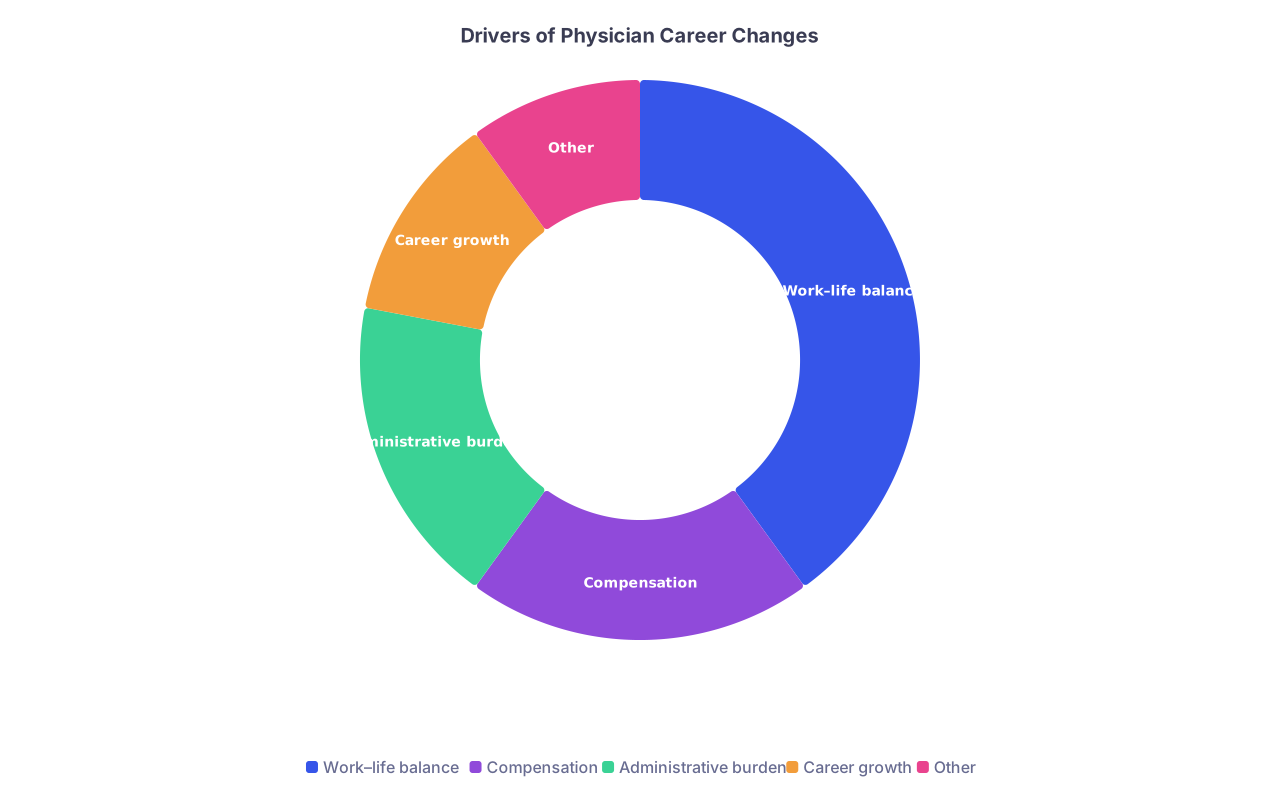
| Category | Value |
|---|---|
| Work–life balance | 40 |
| Compensation | 20 |
| Administrative burden | 18 |
| Career growth | 12 |
| Other | 10 |
The directors who understand all this are privately planning for more part-time physicians, more turnover, more locums, more nontraditional staffing.
They are not planning on systemic, heroic fixes that give you back 15 hours of your week. That fantasy only exists in wellness slide decks.
If You Stay Clinical: The Only Sustainable Play
Staying in direct patient care is not masochism. It just requires strategy most people never learn.
If you’re going to stay clinical in any major capacity, here’s what actually works long term:
You narrow. You specialize your lifestyle, not just your clinical niche.
Physicians who last 20–30 years without becoming either bitter or broken do one or more of these:
- Choose practice settings where control > prestige. A “lesser-known” group with sane schedules beats a name-brand system that works you into the ground. Every time.
- Engineer their FTE early. They lock in 0.7–0.8 FTE before kids, before burnout, before financial creep. They build their life and budget around that, not around maxed-out income.
- Carve out a parallel lane. Teaching, research, consulting, informatics, med-legal work—something that gives them agency and identity outside hamster-wheel clinical productivity.
- Learn how money actually works. They hit financial independence or “work-optional” status earlier than their peers. Then they bluntly renegotiate their job around their new leverage.
A medical director will happily invite you onto a “burnout task force.” They’re far less likely to sit down and walk you through how to build work-optional wealth and shift to 0.5 FTE at 45.
That’s not in their job description. But it needs to be in your plan.

If You Leave Clinical: What Directors Will Never Admit Publicly
Here’s the part people dance around.
I've watched physicians leave for pharma, digital health, payer roles, consulting, or full-time entrepreneurship. I’ve also watched what happens behind closed doors at their old jobs.
Phase one: mild condescension.
“Oh, she went to pharma? Interesting. Guess she was never really a clinician at heart.”
Phase two (6–12 months later): envy.
When your former colleagues realize you’re working 40 predictable hours, no nights, no weekends, making the same or more money, and not grinding yourself into paste—or when they see you at school pick-up at 3 pm on a Tuesday—they start sending you LinkedIn messages.
Medical directors see this too. They’ll never say, “Yeah, honestly, he upgraded his life.” They frame it as a “different path” or “stepping away from patient care.”
Do some people miss clinical work? Sure. Some return part-time. Some don’t. But the caricature of the “miserable industry doc who regrets leaving real medicine” is mostly a myth used to keep you compliant.
The more accurate picture: most physicians who transition with intention and preparation do not want to go back to 1.0 FTE traditional clinical practice. Ever.
And that’s exactly why you rarely see that story on the “Physician Wellness” flyer.
How to Start Reclaiming Control Now
You don’t fix this overnight, and you don’t wait until you’re completely fried.
Start small and concrete:
- Audit your current week. Not in a fluffy way. Where are the soul-killing hours? EMR? Late-night inbox? Uncompensated committee work? That’s your first target.
- Decide your non-negotiables. Family dinner most nights. One full day completely off. No post-midnight charting. Draw real lines.
- Pick one leverage-building project outside your day job. A consulting engagement, a med-legal course, a health tech pilot, a side teaching gig. Not for the money. For the options.
- Talk to people actually living the lives you think you want. Not the ones complaining at noon conference. The ones you barely see because they’re not stuck at the hospital every Saturday.
Then, when you walk into that director’s office and say you need something to change, you’re not begging. You’re negotiating.
And if they say no? You’re not trapped. You’re just done—with that version of medicine.