Last year I sat in on a hiring debrief at a major pharma company. Three physicians had made it to the final round. On paper, the “strongest” one had two fellowships and a monster publication list. He was the first one cut. Why? A single sentence from the recruiter: “He still thinks like a fellow. We need someone who thinks like a business partner.”
Let me walk you through what that actually means—because it is absolutely not what most physicians think it means.
You’ve heard half-truths: “They want high Step scores,” “They only take big-name academics,” “Industry is an escape hatch if clinical practice fails.” Most of that is garbage. Pharma recruiters filter physicians on a very different axis, and if you do not understand that axis, you will keep getting the same bland rejection emails with no clue what went wrong.
The First Filter: Do You Look Like a Risk or an Asset?
The first ten seconds of a recruiter’s screen has nothing to do with how good a doctor you are.
They are asking one question: “If I put this person in front of my VP or an external KOL, are they going to embarrass us—or make us look sharper?”
So they scan for a few things very fast:
- Professional narrative
- Evidence of non-clinical thinking
- Signals of stability vs desperation
Notice what’s missing: they’re not counting how many chest tubes you’ve placed.
Here’s what they actually eyeball.
Your Story, Not Your CV
Your CV is a blunt instrument. Recruiters are reading for a story: Why is this physician moving into pharma, and does that story make business sense?
If your LinkedIn and CV scream “burned out, wants to leave nights and weekends,” you’re done. They’ll never say that out loud, but that’s the internal reaction I’ve watched play out again and again in medical affairs hiring meetings.
The winning profiles usually read like this:
- “Cardiologist with 6 years in practice, clinical trial experience as a sub-investigator, has served on advisory boards, speaks regularly at CME events, now interested in broader impact via drug development or medical strategy.”
The losing profiles:
- “PGY-3 internal medicine, hates residency, wants better work–life balance, no clear connection to the therapeutic area, no visible industry-relevant work.”
Same intelligence. Very different perceived risk.
Non-Clinical Thinking: Can You Talk Beyond the Patient in Room 4?
Pharma is a business with patients at the end of the chain, not the beginning. Recruiters are hunting for any shred of evidence that you understand:
- Clinical trials
- Market dynamics
- Guidelines and how they get written
- Payers, access, health economics
- Real-world evidence, not just RCTs
I have watched recruiters light up over a single line on a CV: “Member, P&T committee” or “Helped design local protocol for X.” Because that says: this person thinks about systems and decisions that affect thousands of patients, not just one.
They do not care if you can recite UpToDate. They care if you can discuss why a payer might deny a drug and how you’d explain that, calmly and persuasively, to a frustrated KOL.
Desperation Kills You
Here’s one of those ugly truths you do not hear on podcasts: pharma recruiters are terrified of the “escapee clinician” who just wants out.
The candidate who keeps saying things like:
- “I just really need a better lifestyle.”
- “I’m burnt out and need something less stressful.”
They hear: “As soon as this job is hard—and it will be hard—they’ll crumble or bolt.”
They want physicians moving toward industry, not running away from medicine. In debriefs, I’ve heard exact phrases like, “Too emotional about leaving practice,” and, “Still processing their burnout—wrong stage for us.”
So yes, be honest. But your framing must be: “broader impact, new kind of challenge, different way to use my clinical expertise”—not “anything but call.”
What Backgrounds Actually Get Pulled to the Top of the Pile?
Let me show you how CVs get triaged behind closed doors, because it’s not mystical, it’s pattern recognition.
| Background Type | Typical Recruiter Reaction |
|---|---|
| Academic with trial experience | Strong interest |
| Community doc + P&T/committees | Moderate to strong interest |
| Subspecialist with KOL activity | Very strong interest |
| Pure clinician, no extras | Weak interest |
| Early resident with no experience | Almost no interest |
If you want the short version: they overweight anything that looks like influence or systems-level involvement.
The Academic With Trials
The golden child from recruiter perspective:
- Sub-investigator or PI on trials
- Publications in the therapeutic area
- Talks at professional societies
- Guideline committees, working groups, or even just poster sessions
Why? Because this physician already speaks “evidence,” knows the politics of data, and probably knows the key opinion leaders by first name.
The dirty little secret: the brand name of your institution helps, but not the way you think. It’s shorthand for “This person has been around complex decision-making and high expectations.” They are not applying an algorithm; they’re going off pattern.
The Community Clinician Who Quietly Built Credibility
You’d be surprised how often a solid community doc beats a flashy academic because they’ve done the right things:
- Led protocol development for their hospital
- On the formulary or quality committee
- Worked as a principal investigator in site-based industry trials
- Given CME talks regionally for a specific disease state
Pharma likes these people a lot. They’re grounded, they understand real-world practice constraints, and they often come without the big-ego baggage.
I’ve heard a medical affairs director say in a debrief: “Give me the community oncologist who’s run 20 trials over the KOL who wants to be on a podium every weekend.”
Subspecialist KOL-in-Training
If you’re, say, an epileptologist, IBD gastroenterologist, heart failure cardiologist, MS neurologist—recruiters see you as specialty ammunition.
You already know the key drugs, guidelines, conference ecosystem. That’s plug‑and‑play for a medical affairs or clinical development role in that therapeutic area.
Here’s what boosts you from “interesting” to “call them first”:
- You’ve sat on a speaker bureau (yes, they can see the Sunshine Act data; they do look)
- You’ve served as a site PI or given talks funded by industry
- You’ve been invited to advisory boards
That signals: you already play in the pharma sandbox and no one has complained about you. Low risk, high yield.
The Soft Skills They Screen Harder Than You Think
This is where most physicians blow it. They think competence in medicine automatically transfers. It does not.
Recruiters and hiring managers are watching you for three non-negotiables:
- Communication
- Commercial awareness
- Ego control
Communication: Can You Be Trusted in Front of a KOL?
If a recruiter cannot picture you walking into a major academic center and holding a real conversation with a world expert without posturing, fawning, or freezing—you are dead on arrival for medical affairs.
They watch for:
- Can you explain complex topics in plain language, without trying to impress?
- Do you listen and ask clarifying questions, or just dump answers?
- Do you become defensive when challenged?
I’ve heard more than one director say, “He’s smart, but he talks at people. KOLs will hate that.”
This is fixable. But you have to practice talking:
- About data, not your feelings about the data.
- About uncertainty, without losing confidence.
- About disagreements, without needing to win.
If you cannot handle a mock “pushy KOL” question in an interview, imagine what they think you’ll do on a real advisory board.
Commercial Awareness: You Are Not in a Hospital Anymore
They are not asking you to be a salesperson. But if you act allergic to business realities, they’ll move on.
In practice, they test for:
- Do you understand why label expansions matter?
- Do you grasp that regulatory, safety, and commercial all have different priorities?
- Can you talk about patients and payers in the same sentence?
- Do you understand you can’t just say whatever you want off-label?
Here’s an internal phrase I hear constantly: “Will they be pragmatic, or are they still in ivory-tower mode?”
If in the interview you say things like, “I don’t really care about the business side; I’m just here for the science,” it’s over. They respect the sentiment, but pharma runs on margins and markets. If you refuse to acknowledge that, they see you as a liability.
Ego Control: Are You Coachable?
Physicians are used to being the top of the food chain. In pharma, you’re often not the final authority. There’s a VP of this, an SVP of that, plus legal and regulatory review.
Recruiters probe for signs of:
- How you handle being told “no”
- How you react when your recommendation is overruled
- Whether you can work in cross-functional teams with non-physicians
I watched a brilliant oncologist sink his chances after making three comments about “non-clinical people not really understanding patient care.” The hiring director wrote one word next to his name: “Unmanageable.”
What Signals Make You Stand Out on Paper and In Person?
Let me give you the checklist they wish physicians understood. Not the fake LinkedIn advice. The real screening triggers.
On Your CV and LinkedIn
You want your profile to quietly scream: “I already live halfway in your world.”
Specific signals that help:
Clinical trials involvement
Even as a sub‑investigator. They know you’ve seen protocols, inclusion/exclusion criteria, queries, maybe even SIVs.Committees and leadership roles
P&T, quality, guideline groups, system-level initiatives. Those show you think bigger than your own panel.Speaking and education
CME talks, grand rounds, regional conferences. Bonus if it’s in the same therapeutic area you’re applying for.Industry touchpoints
Advisory boards, speaker bureaus, consultancy work, DMC participation. Even one or two of these make you look “industry-fluent.”Nonclinical coursework
Regulatory, clinical research, health economics, business or MBA certificates. Not mandatory, but they de-risk you.
What does not impress them as much as you think:
- High Step scores
- How many ICU nights you survived
- Generic volunteerism with no relevance to the role
Good rule: if it would impress your program director, it probably carries less weight here than you think.
In the Interview: Red and Green Flags
Recruiters mentally keep a tally during interviews. They will never show you this—but it’s there.
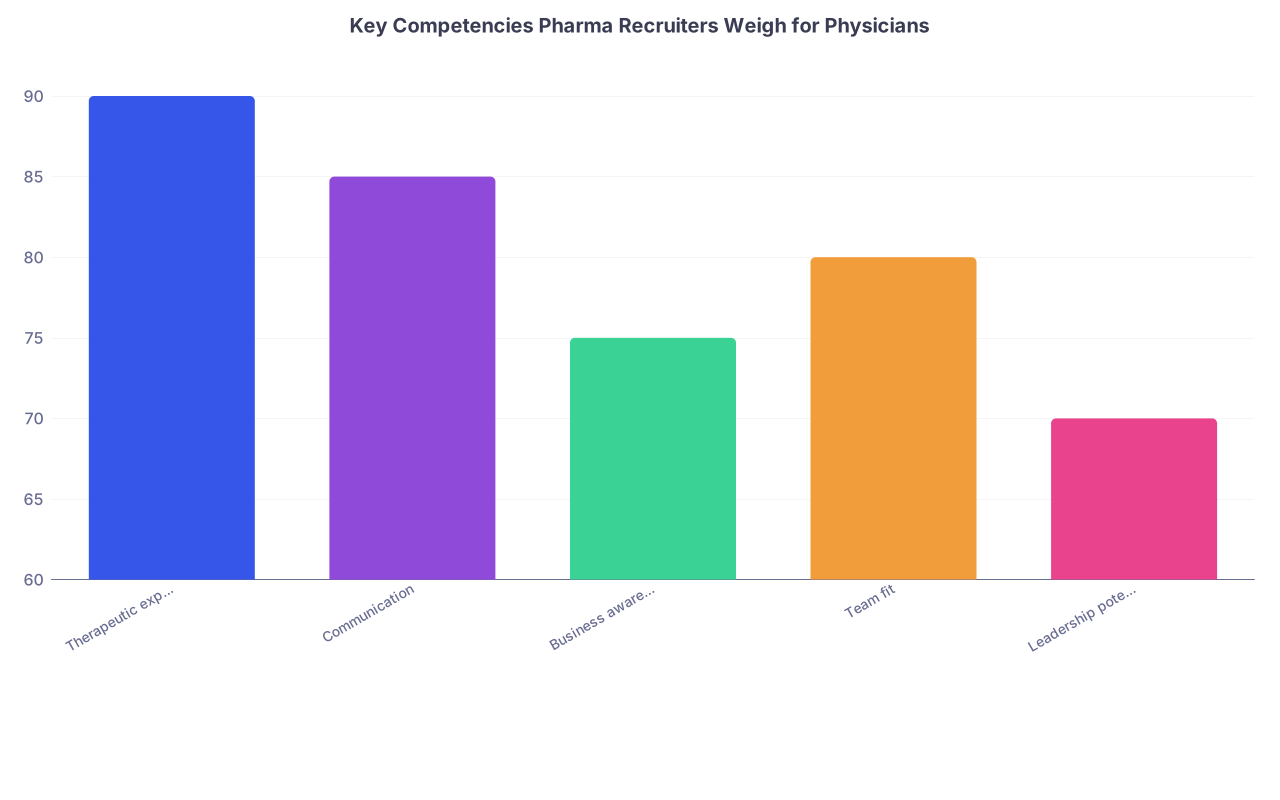
| Category | Value |
|---|---|
| Therapeutic expertise | 90 |
| Communication | 85 |
| Business awareness | 75 |
| Team fit | 80 |
| Leadership potential | 70 |
Roughly, the weighting looks like this for entry-level medical affairs or clinical development roles:
- Therapeutic expertise gets you in the door.
- Communication and team fit decide if you advance.
- Business awareness and leadership potential decide if you get the offer.
Green flags they talk about afterward:
- “He connected the trial design to payer behavior; that was impressive.”
- “She admitted what she didn’t know and asked smart questions.”
- “He framed leaving practice as a strategic move, not an escape.”
- “Very negative about prior employer; might be toxic here.”
- “Still grieving loss of identity as a clinician—too raw.”
- “Doesn’t understand boundaries between medical and commercial; big risk with compliance.”
How AI, Data, and the Future Are Changing What They Want
You’re not just competing with other physicians. You’re competing in a landscape where pharma is trying to look around corners: AI, real-world evidence, value-based care, global regulations.
They’re quietly shifting what they prize in physicians.
Data Literacy Is Becoming Non-Optional
You don’t have to code. But the days of “I just read the abstract and conclusion” are over.
What impresses them now:
- Comfort with RWE, registries, observational data
- Understanding of endpoints beyond survival: PROs, QoL, resource utilization
- Ability to critique trial design beyond “small N”
I’ve seen candidates hired over more “famous” physicians because they could talk comfortably about how an AI-enabled diagnostic might affect trial enrollment or label expansion.
They’re thinking: this person won’t get lost in the buzzwords when the slides say “machine learning–based model” or “synthetic control arm.”
Cross-Functional Fluency
Look at how newer job descriptions are written. You’ll see phrases like:
- “Partner with HEOR and Market Access”
- “Collaborate with Commercial on launch strategy while maintaining medical independence”
- “Work with Digital and Data Science teams”
Translation: they need physicians who can walk into a room with epidemiologists, biostatisticians, marketers, and data scientists and not derail the meeting.
If you already have any experience sitting with non-clinical teams—IT, quality, EMR redesign, operations—highlight that. It’s a great proxy.
Global Mindset
This is subtle but real. Products are global. If your view of medicine stops at your state line, you’re limited.
They notice if you:
- Mention guidelines from outside your own country
- Understand regulatory differences (FDA vs EMA conceptually)
- Have worked with or trained in more than one health system
A candidate who said, “In the NHS, this would never fly due to cost constraints,” earned visible nods around the table. They want that breadth of thinking.
How to Make Yourself Look Like “Already One of Us”
You do not need an MBA. You do not need an extra fellowship. You need to reshape how your existing experience is framed and add a few targeted elements.
Here’s a simple, practical sequence.

| Step | Description |
|---|---|
| Step 1 | Clarify Target Role |
| Step 2 | Map Your Relevant Experience |
| Step 3 | Fill 1 to 2 Gaps - Trials or Committees |
| Step 4 | Rebuild CV and LinkedIn in Industry Language |
| Step 5 | Practice Business Focused Interviewing |
| Step 6 | Network with Insiders for Referrals |
Clarify target role.
Medical affairs vs clinical development vs safety vs HEOR. Each values slightly different flavors of you. Don’t apply blindly to everything with the word “medical” in it.
Map your relevant experience.
Rewrite your background in industry language. You did “quality improvement”? That’s outcomes work. You sat on a protocol committee? That’s governance and evidence implementation.
Fill one or two glaring gaps.
Not twenty. One or two. Get on a committee. Join a trial as site co-investigator. Do a structured course in clinical research or regulatory.
Rebuild your story.
Your LinkedIn summary should read like a bridge from clinic to industry, not a lament about the EMR.
Practice the new conversation.
Every answer you give in interviews should connect three points: patients, data, and business reality. If you leave one of those out consistently, you’ll feel “off” to them without knowing why.
And then, yes, you network. But if you do the above first, your networking will actually work. Insiders will look at your profile and think, “We can put this person in front of my manager without getting burned.”
Years from now, you won’t remember the job postings you never heard back from. You’ll remember the moment you stopped presenting yourself as “a doctor begging to get out” and started showing up as “a physician who already thinks like an industry insider.”
Pharma recruiters are not trying to keep you out. They’re trying not to make an expensive, public mistake. The more you can look like a safe bet—clinically credible, commercially realistic, ego under control—the faster those closed doors start to crack open.