
Leaving clinical medicine isn’t quitting. The data actually suggests it’s a rational, often high‑value career move that the profession is still in denial about.
Let me be blunt: the narrative that “real doctors stay in clinical practice” is outdated, largely emotional, and badly mismatched with what’s happening in workforce trends, compensation, and physician well‑being. You’re not betraying medicine by moving out of direct patient care. You’re exposing how broken parts of the system are.
Let’s walk through what the numbers actually show, not what the loudest voices in the physician lounge like to say.
The Myth: Leaving Clinical = Failure. The Data: It’s Normalizing Fast.
For years, the unofficial rule was: if you leave clinical medicine, you “couldn’t hack it.” Burned out, not resilient, not a “real doctor.” I’ve heard attendings say things like, “He went to pharma… what a waste,” between cases as if that’s still 1995.
Here’s what the data actually looks like:
- The Association of American Medical Colleges (AAMC) has repeatedly projected a physician shortage in the range of 37,000–124,000 physicians by 2034. That’s not because we suddenly lost interest in medicine. A meaningful chunk is early exits and reduced hours.
- Survey after survey shows intent to leave or cut back is no longer marginal:
- A 2022 Physicians Foundation survey found one in four physicians planned to leave their current practice within two years, and nearly half planned to cut back hours.
- Medscape’s burnout reports routinely show a third or more of physicians have seriously considered leaving medicine altogether.
- Non‑clinical roles for physicians are exploding:
- Health tech, digital health, pharma/biotech, payer organizations, consulting, informatics, utilization management, government/regulatory. These sectors are actively recruiting MD/DOs. Not reluctantly. Aggressively.
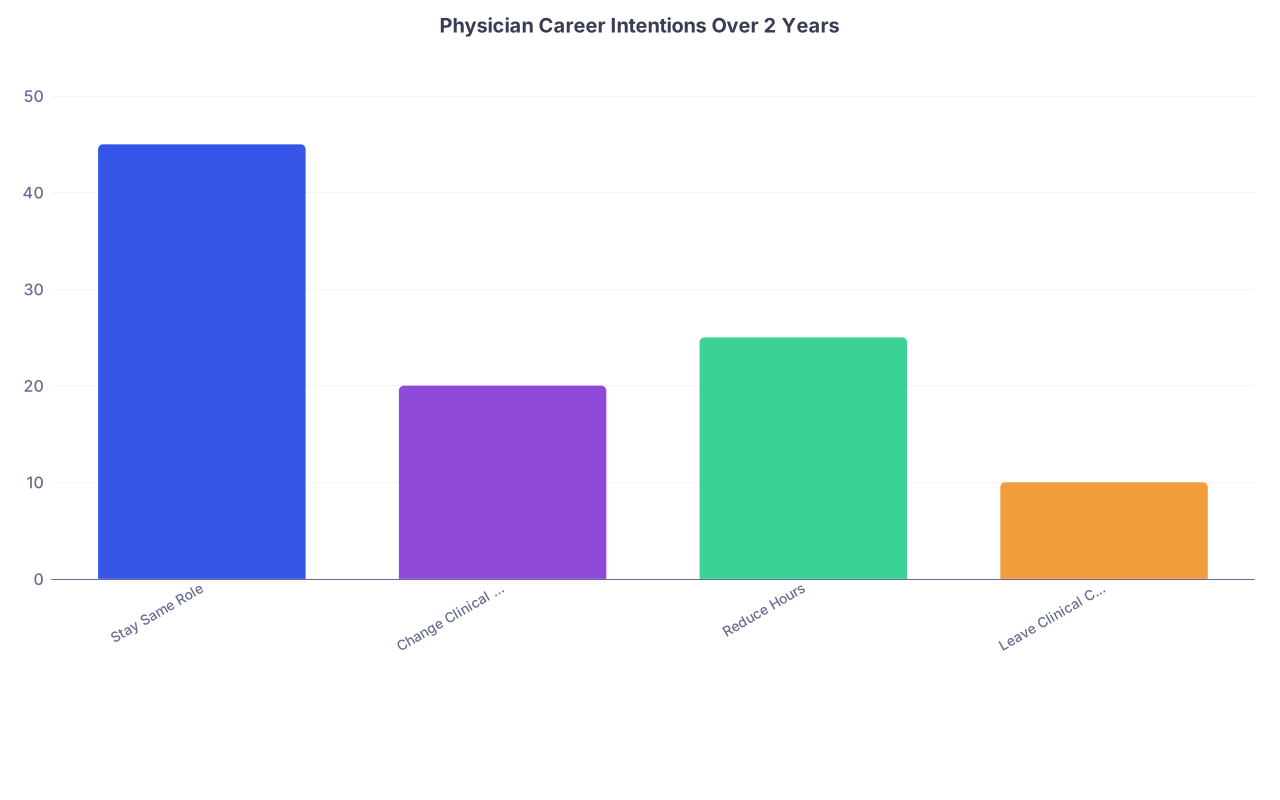
| Category | Value |
|---|---|
| Stay Same Role | 45 |
| Change Clinical Setting | 20 |
| Reduce Hours | 25 |
| Leave Clinical Care | 10 |
Now, look at that last bar. Ten percent planning to leave clinical care in a two‑year window is not fringe. Over a decade, that turns into a substantial portion of the workforce cycling into non‑clinical or hybrid work.
Calling that “quitting” is like calling every engineer who leaves a factory floor for design, management, or policy a “failed engineer.” Other professions have figured this out. Medicine just lags culturally.
Why “Quitting” Is the Wrong Frame: Follow the Incentives
If we’re honest, the “leaving is quitting” story exists mainly to keep the machine running. Not to protect patients. Not to protect you.
Here’s the uncomfortable equation:
- You trained 7–14 years.
- The system needs your labor at the bedside.
- Any path that doesn’t look like full‑time clinical work is framed as selfish or weak.
But incentives tell a different story.

Consider:
- Administrative burden: Multiple studies show physicians now spend 1.5–2 hours on the EHR and deskwork for every 1 hour of direct patient care. Plenty of you feel that’s generous.
- Burnout rates: Consistently around 40–60% in large national studies, higher in certain specialties.
- Loss of autonomy: The rapid consolidation into large health systems and private equity–backed groups means more top‑down decision making, productivity quotas, and RVU pressure.
Then there’s the money. You were probably told clinical is where you’ll make the “real” income. That used to be mostly true. It’s not as clear‑cut now.
Let’s put some rough, realistic numbers next to each other.
| Role Type | Approx. Annual Comp (USD) |
|---|---|
| Outpatient IM (employed) | $230,000–$280,000 |
| Hospitalist (7 on/7 off) | $260,000–$320,000 |
| EM physician (post-cuts) | $250,000–$350,000 |
| Pharma MSL (MD) | $220,000–$280,000 |
| Pharma Medical Director | $260,000–$400,000+ |
| Health Tech Medical Lead | $220,000–$350,000+ |
Yes, clinical can pay more at the high end, especially in procedure‑heavy specialties or rural setups. But a lot of mid‑career non‑clinical roles are:
- Within striking distance of clinical pay.
- Lower hours.
- Far lower malpractice and emotional load.
- More schedule predictability.
So when a pulmonary/critical care doc making $375k in a brutal ICU schedule leaves for a $320k remote or hybrid pharma role with no nights, no holidays, and actual PTO, that isn’t quitting.
It’s doing basic math and choosing a different risk–reward balance.
What Non‑Clinical Physicians Actually Do (And Why It Matters)
Another myth: leave the bedside and you “don’t help patients” anymore. That one’s emotionally loaded and intellectually lazy.
Here’s the reality: patient impact isn’t only delivered at the point of care.
1. Pharma / Biotech / Med Devices
Yes, there’s sleaze in industry. There’s also sleaze in hospital billing departments and RVU schemes. But on the clinical development and medical affairs side, physicians:
- Design and run clinical trials.
- Refine indications and safety monitoring for therapies.
- Translate science into real‑world practice guidance.
- Catch bad study designs or unsafe protocols before they hit humans.
One good medical director can stop a poorly thought‑through trial from enrolling thousands of patients.
2. Health Tech & Digital Health
Most “disruptive” health startups are garbage without serious clinical input. When physicians step in as medical directors, CMOs, or clinical product leads, they can:
- Kill dangerous or clinically naive features.
- Ensure devices and software actually work in a real ward, not just in a pitch deck.
- Implement guardrails around AI, decision support, and remote monitoring.
That’s direct patient protection at scale, just not with a stethoscope in your hand.
3. Payers, UM, and Policy
Utilization management (UM) is everyone’s favorite villain. And yes, a lot of it is awful. But when physicians are involved thoughtfully, they can:
- Push back against blanket denials.
- Build evidence‑based pathways instead of purely financial ones.
- Influence which drugs, devices, and services get covered.
Same for government, NGOs, and policy orgs. You can shape what millions of patients get access to, even if you never see them individually.

| Step | Description |
|---|---|
| Step 1 | Residency/Fellowship |
| Step 2 | Traditional Practice |
| Step 3 | Hybrid Role |
| Step 4 | Industry/Tech/Policy |
| Step 5 | Leadership/Admin |
| Step 6 | Non Clinical Career |
| Step 7 | Stay Clinical Full Time |
This is what the real career map looks like now. Linear “med school → residency → 30 years in clinic → retire” is no longer the only respectable path.
What the Burnout and Satisfaction Data Actually Say
Let’s cut through the romanticism. Surveys comparing clinical vs. non‑clinical physicians are messy and imperfect, but the pattern is remarkably consistent when you talk to people:
- Burned‑out hospitalist moves to UM: “Work is boring sometimes, but I see my kids. My blood pressure is down. I can think again.”
- EM doc who went to health tech: “I miss the team more than the cases. But I don’t miss the 3 am meth psych holds or being assaulted.”
Are they universally happier? No. Some are bored. Some miss direct patient contact deeply. Some return to clinical in some capacity.
But the idea that leaving clinical is uniquely miserable doesn’t hold. Different stressors, different tradeoffs.
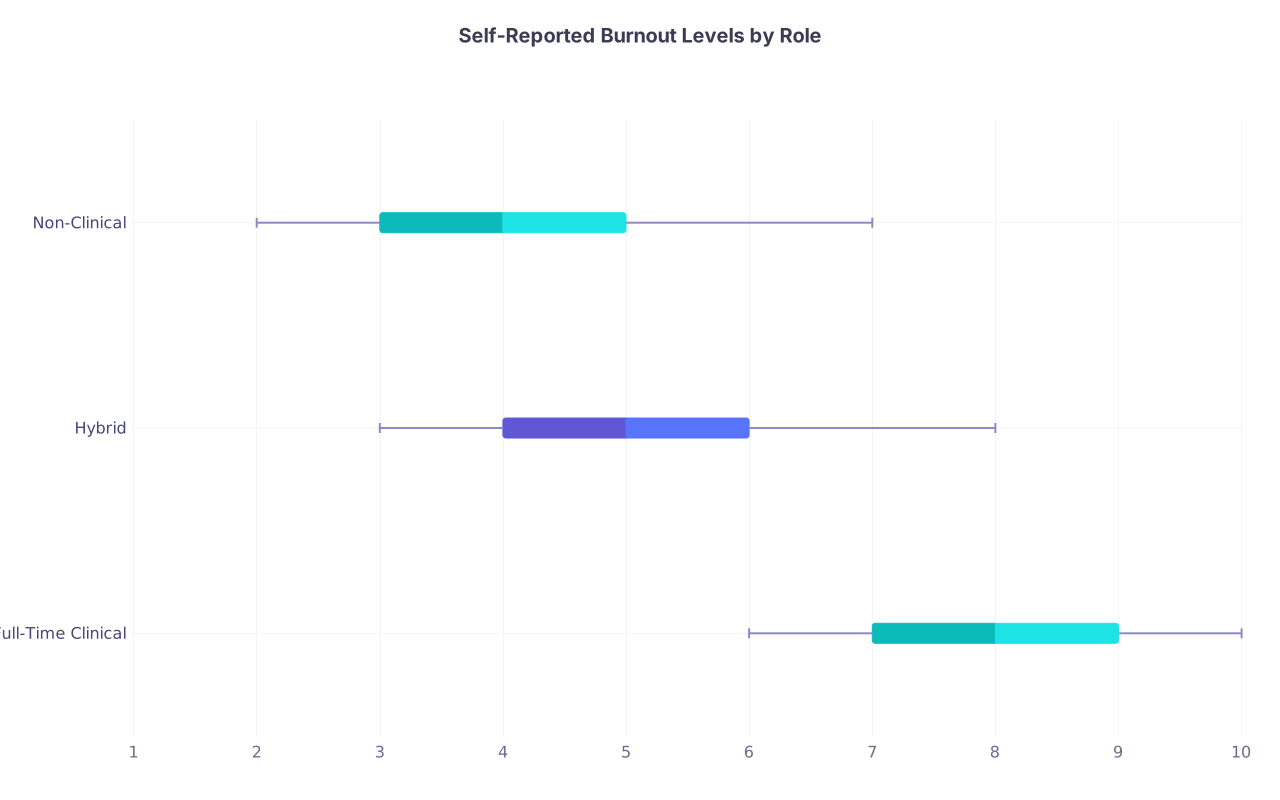
| Category | Min | Q1 | Median | Q3 | Max |
|---|---|---|---|---|---|
| Full-Time Clinical | 6 | 7 | 8 | 9 | 10 |
| Hybrid | 3 | 4 | 5 | 6 | 8 |
| Non-Clinical | 2 | 3 | 4 | 5 | 7 |
Interpret the rough pattern: full‑time clinical tends to report higher burnout scores than hybrid and non‑clinical roles. Not because non‑clinical is magical. Because 28 clinic patients plus an inbox of 150 messages plus EHR after hours is unsustainable.
The Identity Trap: “But I Trained So Long For This”
Here’s the psychological landmine: sunk cost fallacy wrapped in professional identity.
You spent your 20s and early 30s grinding through anatomy labs, 28‑hour calls, and malignant rotations. The story you told yourself (and your family) was: this is who I am. I am a doctor. A clinician.
So when the work starts to feel misaligned—ethically, emotionally, logistically—you don’t just question your job. You question your whole identity. That’s terrifying. And it’s exactly why the “quitting” narrative sticks.
Let me be harsh for a second: staying in a role that’s frying your nervous system, wrecking your relationships, or turning you cynical just so you don’t “waste the training” is not noble. It’s just sunk cost, dressed up as virtue.
Your medical education doesn’t vanish when you leave clinic. It compounds.
- You still think like a diagnostician.
- You still understand pathophysiology and risk.
- You still know how systems fail when real humans are involved.
Those are insanely valuable skills in any serious health‑adjacent sector. Industry doesn’t pay six figures for a decorative MD; it pays for that pattern recognition and clinical judgment.
Risks and Realities: It’s Not All Roses Outside the Hospital
Let’s not swing to the opposite myth: that leaving clinical is a magic escape hatch where everything is flexible, well‑paid, and meaningful. That’s also wrong.
You should know the real tradeoffs.
On‑ramp time and potential pay cut.
First non‑clinical job might pay less than you earned clinically, especially if you were highly compensated (surgical subspecialties, high‑RVU groups, rural contracts).You become “nontraditional” quickly.
Step out of the clinic for a few years and returning full time gets harder. Not impossible—plenty of paths back via locums, part‑time, refresher programs—but you lose the illusion of infinite optionality.Office politics and performance metrics.
Corporations have their own set of nonsense. You trade hospital bureaucracy for corporate bureaucracy. Just a different flavor.Loss of immediate patient feedback.
If your dopamine comes from resuscitations, procedures, or that one patient who says “you saved my life,” you will feel a hole at first. You’ll need to redefine what “impact” looks like.
The adult move is to weigh these tradeoffs against your current reality, not against some idealized version of “being a doctor” that maybe never existed outside marketing brochures and medical dramas.
How to Evaluate Whether Leaving Clinical Makes Sense (Without the Guilt)
If you’re even reading an article like this, you’re probably not “fine.” You’re at least ambivalent.
Ignore the moralizing and ask more concrete questions:
- Do my day‑to‑day tasks match the kind of problems I like solving? (Talking to people, doing procedures, analyzing data, building systems, writing, leading.)
- How sustainable is my current schedule and workload over the next 5–10 years? Not just next month.
- If someone offered me a non‑clinical job at 80% of my current comp but with half the stress and a predictable schedule, would I seriously consider it?
- If my child or closest friend described my current life and health back to me, would I tell them to stay in this job?
If your honest answers skew toward “this is not sustainable,” that’s not a character defect. That’s a signal.
And if your answers are more like “I’m frustrated, but I still get a lot of meaning from patient care,” that’s valuable too. Maybe you aim for a hybrid role: part‑time clinical plus consulting, medical writing, informatics, or industry advisory work.
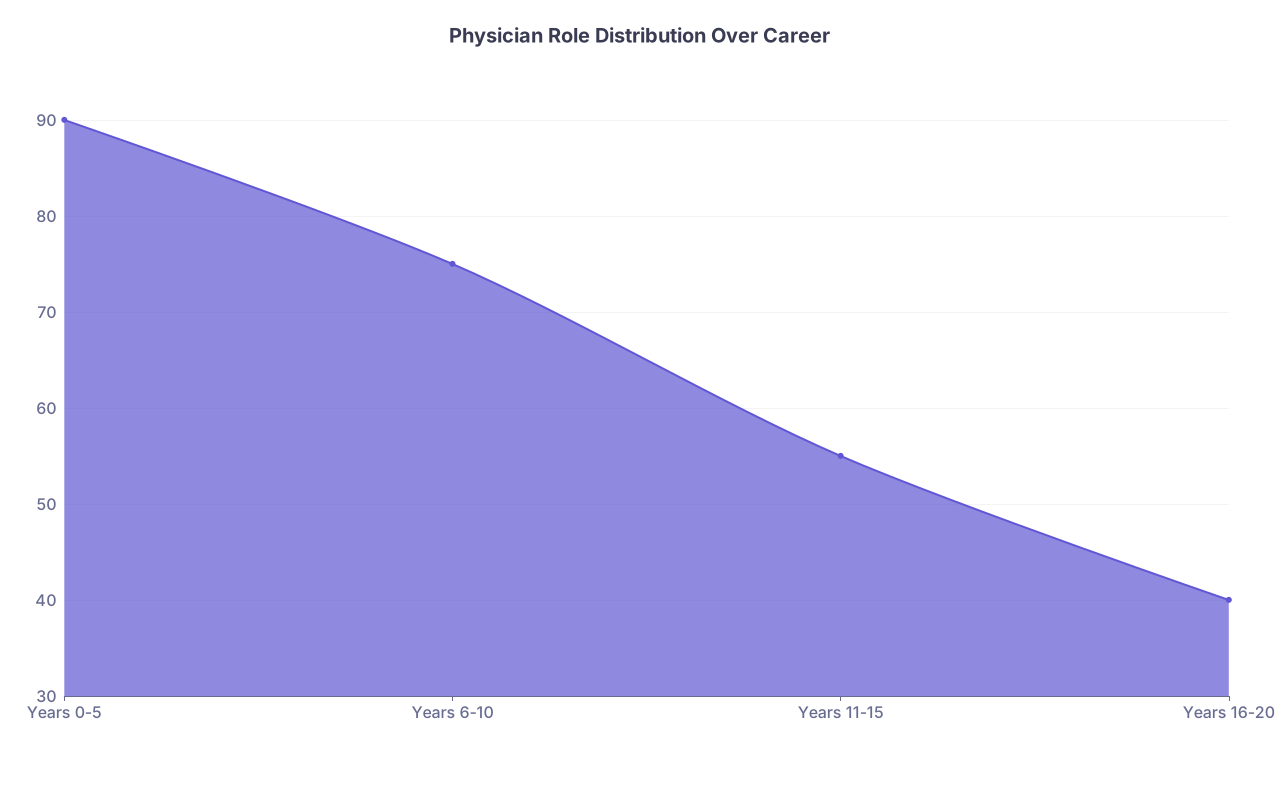
| Category | Value |
|---|---|
| Years 0-5 | 90 |
| Years 6-10 | 75 |
| Years 11-15 | 55 |
| Years 16-20 | 40 |
That rough sketch reflects what’s already happening informally: over time, more physicians shift from pure clinical to mixed or non‑clinical work. The culture just hasn’t caught up to the data.
The Future of Medicine: Portfolio Careers, Not Single Lanes
Here’s where the whole “quitting” frame really collapses: the future of medical careers is portfolio‑based, not monolithic.
I’m seeing more physicians who:
- Start in full‑time clinical.
- Pick up a side consulting gig in digital health or med ed.
- Move into a 60/40 split (clinical/industry, clinical/admin, clinical/tech).
- Eventually tip into primarily non‑clinical while keeping a sliver of practice or volunteering.
None of that looks like “quitting.” It looks like progression.
And as AI, automation, and new care models ramp up, the system will actually need more physicians in:
- Design and oversight of clinical AI.
- Policy and regulation around new therapeutics.
- Large‑scale population health and systems engineering.
- Complex care coordination, not just volume‑based encounters.
The MD/DO is not going away. But the idea that its only legitimate use is 40+ years of full‑time direct care? That’s the myth.

The Bottom Line: You’re Not Quitting. You’re Changing the Job Description.
Strip away the guilt, and what’s left is simple:
- The data shows rising exits from clinical care, surging interest in non‑clinical roles, and burnout rates that make lifelong full‑time clinical practice unrealistic for many.
- Non‑clinical and hybrid roles do not waste your training. They repurpose it. Often with broader system‑level impact and, yes, sometimes with better pay‑to‑sanity ratios.
- Staying in a damaging clinical situation out of fear of being labeled a “quitter” is not loyalty. It’s self‑sabotage.
If clinical medicine still lights you up—great. Stay, and maybe demand better conditions while you’re at it.
But if it does not, and the numbers (on your paycheck, your blood pressure, your calendar, and your burnout scales) all say this is unsustainable, then stepping out isn’t quitting.
It’s just you finally believing the data.