
No, you don’t need an MBA to work in consulting as a physician. In most cases, it’s the least efficient, most expensive way to do it.
Let’s dismantle the mythology first: the shiny narrative that if you want to pivot from clinical medicine into consulting, you must “go back and get an MBA,” ideally at some three-letter shrine like HBS, Wharton, or Booth. That story is pushed hard—by business schools, consultants-turned-coaches, and physicians who retroactively justify their own sunk costs.
The actual hiring patterns, roles physicians get, and the way consulting firms make money tell a very different story.
The Core Myth: “MBA = Consulting Ticket”
The myth sounds plausible: consulting is “business,” MBAs are “business degrees,” therefore you must need an MBA. It’s clean. It’s also wrong.
Top firms hire three main types of profiles for strategy and management consulting:
- Undergrads (often into “generalist” or “business analyst” roles)
- MBAs (often into post-MBA associate roles)
- Advanced degree holders (ADP/PhD/MD/JD tracks)
If you’ve talked to anyone at McKinsey, BCG, or Bain for more than five minutes, you’ve heard the phrase “advanced degree recruiting.” This is their official pipeline for MDs, DOs, PhDs, DPhil, etc. No MBA needed, no apology required.
| Path Type | Degree Profile | Typical Entry Role | MBA Required? |
|---|---|---|---|
| Undergrad | BA/BS | Business Analyst | No |
| MBA | MBA | Associate | Yes (by def.) |
| Advanced Degree | MD/DO/PhD/JD | Associate | No |
| Experienced Hire | MD + Industry | Associate/EM | No |
You as a physician are not treated like “someone missing an MBA.” You’re treated as an advanced degree hire. Different bucket. Different rules.
I’ve seen MDs go straight from residency into McKinsey, BCG, LEK, and IQVIA. No one in those interviews asked, “So when are you planning to go back for your MBA?” They asked about structure, problem solving, and communication. Not diplomas.
What the Data (Quietly) Shows About Physician Consultants
Look at what firms actually do, not what people on LinkedIn say they “recommend.”
At the big strategy shops (MBB + tier-2 like LEK, Strategy&, Oliver Wyman), MDs typically enter through one of three routes:
- Direct advanced degree recruiting (ADP)
- Life sciences / healthcare specialist roles
- Experienced hires from industry, pharma, or health systems
In none of those is an MBA a default prerequisite.
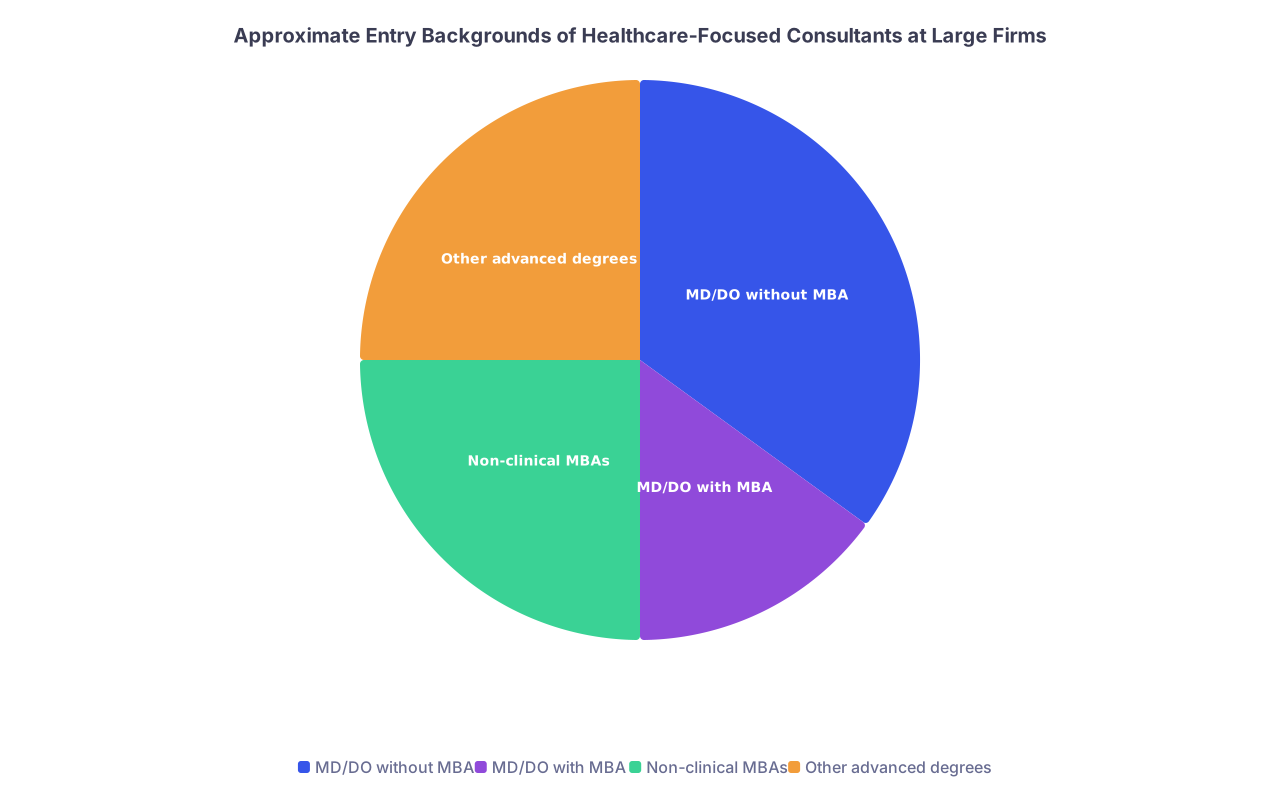
| Category | Value |
|---|---|
| MD/DO without MBA | 35 |
| MD/DO with MBA | 15 |
| Non-clinical MBAs | 25 |
| Other advanced degrees | 25 |
Those numbers aren’t from a formal registry (because there isn’t one), but they’re consistent with what you see if you do something unglamorous but honest: go on LinkedIn, filter for “Consultant” at McKinsey/BCG/Bain/LEK + “MD” and manually scroll through profiles.
You’ll find plenty of:
- MD only
- MD + MPH
- MD + PhD
- MD + MHS/Health Policy
- MD + nothing else at all
And yes, some MD + MBA combos. But not the majority.
The pattern is blunt: being a physician already signals a few things firms care about—stamina, analytical ability, comfort with complexity, and (ideally) some communication skills. They’re willing to train you on “business.”
What they’re not willing to do is subsidize your fantasy that a $200K degree will magically fix weak interviewing, zero networking, or “I don’t know what consulting actually is but it sounds prestigious.”
Why the MBA Myth Persists (Even Among Doctors)
This myth is sticky for a few reasons, none of them especially flattering.
First, the sunk-cost rationalization. Doctors who already spent two years and six figures on an MBA are highly motivated to believe it was necessary. You’ll hear phrases like “it opened so many doors” and “I wouldn’t have this career without it,” which might be true for them but doesn’t mean the door only opens that way.
Second, business schools are marketing machines. They frame MBAs as universal accelerators: leadership, strategy, networks, brand. To physicians stuck in a demoralizing clinical job, those words sound like freedom. The fine print—opportunity cost, debt, the fact that you’ll sit in Corporate Finance next to someone who spent two years doing Excel at Goldman—is glossed over.
Third, most physicians simply don’t understand how consulting hiring works. They’ve never seen a case interview, have no idea what “engagement manager” means, and assume that anything “businessy” needs a business credential.
Let me be blunt: people oversell MBAs to doctors because it’s a clean story that happens to be lucrative—for everyone except you.
What Consulting Firms Actually Screen Physicians For
Strip away the jargon. A partner deciding whether to hire you as an MD into consulting is effectively asking:
- Can this person structure a messy problem logically?
- Can they do math under pressure without melting down?
- Can they communicate clearly with clients and teams?
- Are they coachable, driven, and non-toxic to work with at 11 pm in an airport Marriott?
Notice what’s missing: “Have they taken Managerial Accounting 501?”
The entire case interview format is engineered to test the specific skills firms want. If they believed an MBA guaranteed those skills, they wouldn’t grill MBAs on cases either. But they do. Relentlessly.
For physicians, the bar is similar. You’re not excused from cases because you did an ICU fellowship. You’re just coming in through a different recruiting channel.

| Step | Description |
|---|---|
| Step 1 | Interest in Consulting |
| Step 2 | Learn About ADP Hiring |
| Step 3 | Gain Experience or Consider Other Roles |
| Step 4 | Prepare For Case Interviews |
| Step 5 | Network With Consultants |
| Step 6 | Apply Through Advanced Degree Track |
| Step 7 | Join As Associate |
| Step 8 | Refine Prep and Reapply |
| Step 9 | Has Clinical Experience? |
| Step 10 | Offer? |
The bottleneck is never “no MBA.” It’s “cannot crack the case” or “no one at the firm has heard of you.”
When an MBA Can Make Sense for a Physician
Now, I’m not anti-MBA. I’m anti-reflexive-MBA.
There are cases where an MBA is rational:
- You want to pivot far beyond healthcare: private equity, generalist investing, non-health tech product roles.
- You’re targeting top-tier corporate roles where the HR filter literally demands “MBA preferred/required” and they mean it.
- You want the network of a specific school badly enough to pay the sticker price, and you’ll actively use that network.
- You’ve already hit a ceiling in industry, and internal promotion pipelines in your sector are MBA-biased.
But “I’m a hospitalist who hates nights and heard consulting is cool” is not that scenario.
For healthcare consulting specifically—strategy, payer-provider work, pharma/biotech strategy, medtech—your MD is already a strong calling card. Often stronger than a generic MBA.
You can always do an executive MBA later once you’ve tested whether the non-clinical path actually fits. The opposite sequence—two years and six figures first, then discover you hate PowerPoint—is harder to unwind.
The Real Levers That Get Physicians Hired Into Consulting
If you strip away the fluff, the physicians who successfully break into consulting tend to do three boring but effective things:
1. They learn the game instead of collecting degrees
They figure out:
- What consulting actually is day to day
- Which firms hire MDs for what roles
- How advanced degree recruiting cycles are structured
- What the case interview and “fit” interviews demand
They don’t start by filling out business school applications. They start by talking to real consultants, attending firm events targeted at advanced degrees, and using online resources (Case in Point, Victor Cheng, PrepLounge, etc.) to see if this world even appeals to them.
2. They build signal, not just credentials
Physicians who stand out on paper don’t just say “MD, residency, clinic.” They show things like:
- Leadership in QI projects, system redesign, or clinical ops
- Research in health policy, outcomes, or health economics
- Involvement in hospital committees with budget/strategy exposure
- Work with payers, ACOs, or innovation groups
These are “business-adjacent” experiences that scream: I don’t just know the medicine—I know how care delivery actually runs as a system.
None of that requires an MBA. It requires raising your hand in your current environment and picking projects intelligently.
3. They prep like hell for case and fit
This is where most physicians wash out, then blame “not having an MBA” instead of the real issue.
- They underestimate the math speed expectations
- They struggle to be structured instead of free-associative
- They talk in vague academic language instead of crisp, business-like framing
An MBA doesn’t magically fix this. Go sit in a business school cafeteria during recruiting season and watch MBAs panic over cases just like you.
Serious MD candidates grind 30–50 live practice cases with humans, not just books. They record themselves answering “Why consulting?” until it no longer sounds like a hostage video. They learn how to translate “ICU attending” into language executives care about: capacity, throughput, risk, incentives.
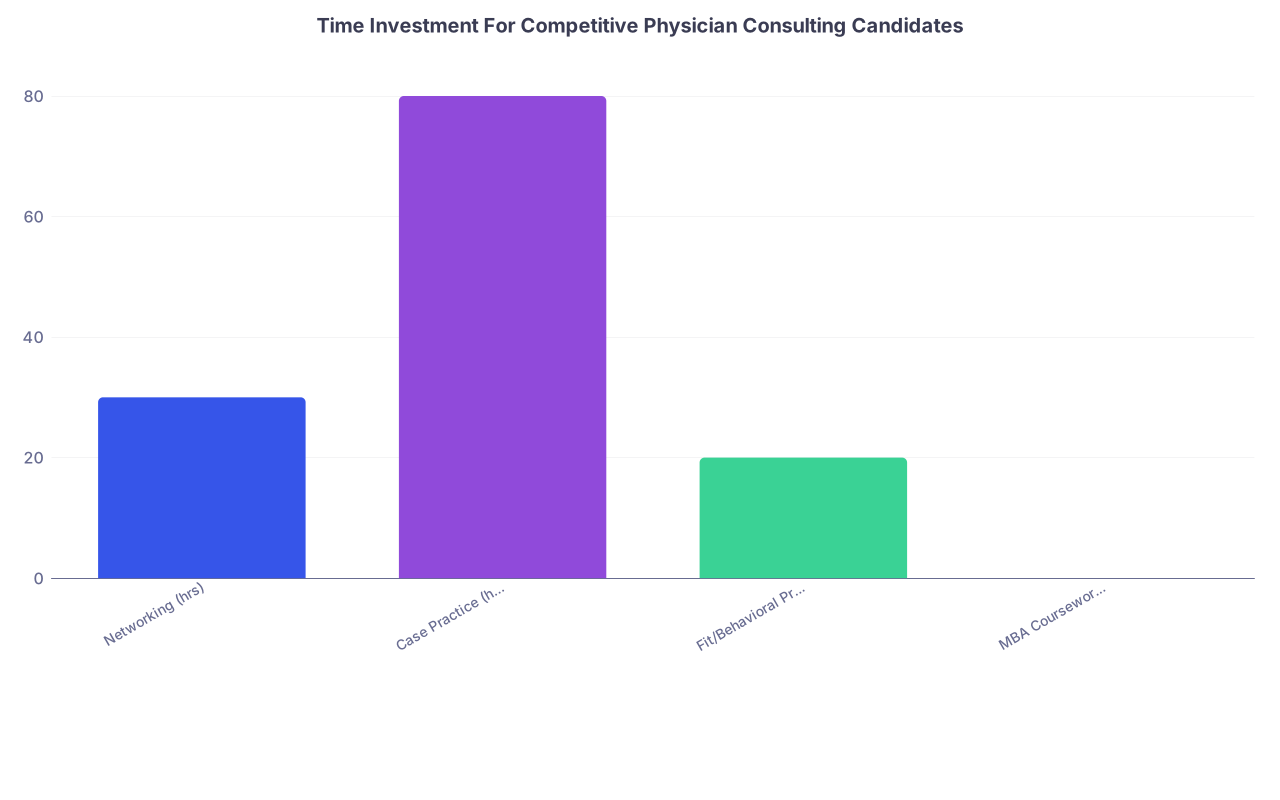
| Category | Value |
|---|---|
| Networking (hrs) | 30 |
| Case Practice (hrs) | 80 |
| Fit/Behavioral Prep (hrs) | 20 |
| MBA Coursework (hrs) | 0 |
Notice the last bar. Not a typo.
The Opportunity Cost You’re Pretending Not To See
Let’s talk numbers, because this is where the “just do an MBA first” story truly falls apart.
Direct path:
You’re a PGY-3 or attending. You recruit into consulting as an MD through ADP and land an Associate role.
- 1st year base at MBB in the US: call it $190K–$220K plus bonus (varies by year and firm)
- You start earning immediately and comp grows quickly
MBA-first path:
You leave clinical work to do a full-time MBA.
- Tuition + fees + living: often $200K+ over two years at a top program
- Lost income: foregone physician salary or consulting salary you could have been earning
- Then you still have to survive consulting recruiting with no guarantee
The total delta in wealth over 3–5 years between these paths is often mid-six figures. If your justification boils down to “I’ll feel more confident” or “I want some business classes,” that’s an expensive therapy session.
If you want the skills, there are targeted, far cheaper ways: short courses in accounting/finance, online strategy classes, on-the-job learning in healthcare administration. The market doesn’t pay you more for knowing CAPM formulas; it pays you for solving real problems for clients.
What If You Eventually Want Leadership, Not Just Consulting?
Here’s the other fear physicians have: “If I don’t get an MBA now, I’ll be stuck later.”
Nonsense.
In consulting and in industry, senior leaders are a mix of:
- People with MBAs
- People with no MBAs but strong track records
- People with other degrees (MPH, MPP, MS Analytics, etc.)
By the time you’re mid-career, what matters is whether you’ve driven results, built teams, managed P&Ls, and delivered for clients. A three-letter degree helps you get into some rooms, but it doesn’t keep you there.
If, 5–7 years in, you decide you truly want an MBA for specific reasons (C-suite roles, switching verticals, executive networks), you can do an EMBA while still working and often get your employer to shoulder some of the bill. That’s rational leverage.

What You Should Actually Do If You’re MD → Consulting Curious
Here’s the path that aligns with how firms really hire:
- Spend 1–2 weeks figuring out what consulting is—read, watch, talk to people.
- Identify advanced degree recruiting contacts at the firms you care about.
- Start structured case prep. Not dabbling. Real practice.
- Build or highlight your “business-adjacent” experiences: QI, operations, policy, analytics.
- Network surgically with physicians already in consulting roles you want.
If, after real exposure and failed interviews, you keep hitting a wall that clearly stems from gaps an MBA would address—then fine, reassess. But make that decision informed by actual friction, not vibes.

| Step | Description |
|---|---|
| Step 1 | MD Interested In Consulting |
| Step 2 | Talk To 5 Consultants |
| Step 3 | Do 10 Practice Cases |
| Step 4 | Drop Consulting Idea |
| Step 5 | Apply Via ADP Track |
| Step 6 | Improve Networking and Resume |
| Step 7 | Interview and Evaluate Fit |
| Step 8 | Join Without MBA |
| Step 9 | Reassess Skills - Not Default MBA |
| Step 10 | Enjoy Cases And Culture? |
| Step 11 | Get Interviews? |
| Step 12 | Offers? |
Notice where “Apply to business school” is. At the bottom. As a last resort, not step one.

Where This Leaves You
So, where does all this land?
First: as a physician, you are already an advanced degree candidate in the consulting world. You are not “missing” an MBA. The key levers are case performance, clear communication, and targeted networking, not extra letters after your name.
Second: an MBA can be useful for specific long-term or non-healthcare goals, but it is almost never the most efficient or necessary way for a doctor to get into consulting. The cost—in time, money, and opportunity—is massive compared to the marginal benefit for healthcare-focused roles.
Third: if you’re serious about this pivot, test reality directly. Talk to firms. Prepare like it matters. See if you can win offers as you are. If you can, you’ve just saved yourself two years and a six-figure bill. If you can’t, then diagnose the real problem before you reflexively prescribe yourself an MBA.

You don’t need an MBA to work in consulting as a physician. You need to understand the game, build real signal, and execute. The degree is optional. The work is not.